Pastiches ‘R’ Us: Conan the Free Lance
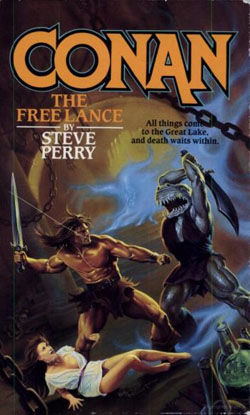 Conan the Free Lance
Steve Perry (Tor, 1990)
Let’s see … I’ve reviewed a Conan pastiche novel each from Leonard Carpenter and John Maddox Roberts. So next up, Steve Perry.
If there’s one word I would used to describe Steve Perry’s Conan novels, it’s goofy. Perry has a reputation among Conan fandom for overkill and general silliness. He apparently loves high fantasy. Perhaps he loves it too much. His Conan books burst at the seams with fantastic monsters, strange races, and weird magic … and not in an ideal way. Although Perry has an enormous imagination, it gets away from him and creates a world that has almost no resemblance to Robert E. Howard’s Hyborian Age. It’s not so much that these elements are silly, but that they seem so when placed in Howard’s setting. They would work fine in the Star Wars universe — and Perry has written some good Star Wars novels to prove it; I’ll admit I enjoyed his Shadows of the Empire, even if LucasFilm tried shoving it down my throat first. But in the grittier, more-historically centered Hyborian Age, where magic is rare and sinister, Perry’s style feels like someone trying to write a Forbidden Realms novel who accidentally wandered into Robert E. Howard-land.
Conan the Free Lance (yes, two words, not one, according to the actual title page — Conan isn’t picking up occasional assignments for the New Yorker) won’t change anyone’s mind about Perry’s style. The story occurs in an overt wonderland akin to high fantasy. Its villain and the instigator of our plot, Dimma the Mist Mage, lives in fortress on a bed of sargasso weeds in a Karpash Mountains lake. He needs a talisman to restore his body to its solid form, and so he sends his shapeshifting servants the selkies to fetch it from the Tree Folk. Conan, while on his way to Shadizar, rescues Cheen, a medicine woman of the Tree Folk, from the draconian hunting beasts of the reptilian-descended Pili. (Okay, we already have far too many demi-human races running around.) Conan helps the Tree Folk repulse the selkie attack, but the selkie leader Kleg escapes with the talisman—the ‘Seed’ which the Tree Folk need to make their tree homes grow. He also kidnaps Cheen’s young brother, Hok. Conan joins the Tree Folk in the quest to save Hok and recapture the Seed.
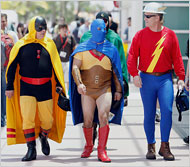 Courtesy of The New York Times comes this report of
 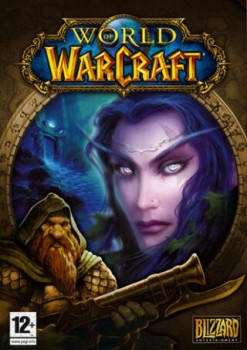 Come with me, if you will, to a magical, improbable land. A land where ideas and craft outweigh brand recognition and marketing potential, where films are the visions of writers and directors rather than of moneyed committees, and where the word ‘remake’ is most commonly associated with smoothing the bedsheets after a midday nap. It’s a place perhaps more fantastic than worlds of warring orcs and elves, since at least the orcs and elves are behaving according to their nature.
 Charles Saunders has posted a terrific short story over at

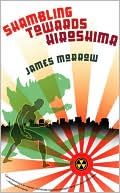
 One good thing about the recession is I have more time to catch up on my reading. And I don’t have to worry about spending money on books during tough times as I already own a ridiculous number of volumes that I never had the time to get around to. One of almost recent vintage is Shambling Towards Hiroshima by James Morrow. It’s a clever premise: a parallel effort to the Manhattan Project is to develop a race of super lizards to level Japanese cities and end World War II. The irony here is that the whole Godzilla mythos of badly made, badly acted 1950s Japanese movies was a metaphorical projection of the atomc bombings. The plot, such as it is , concerns an American horror monster actor who is recruited to provide a realistic demonstration of the lizard’s destructiveness to force the Japanese surrender without having to deploy the monsters (what many critics of the U.S. atomic bombings argue might have sufficed instead of targeting cities). Morrow is one of my favorite authors, though this is a minor work; even at novella length, the premise is stretched a bit thin, and maybe would have worked better at a shorter length in pruning some plotting that doesn’t really advance the theme. Still, worth checking out.
 My first thought upon hearing that Andrzej Sapkowski had won the inaugural