Browsed by
Category: Art

The Waterloo Panorama: An Epic Example of Military Art

The Waterloo Panorama: An Epic Example of Military Art

Marshal Ney leading his troops.

The Napoleonic era has always fascinated me for its visuals — the massive armies, the colorful costumes, and the sweeping scope of some of the battles. These terrible conflicts produced some of the finest military art in European history and I discovered a remarkable example of it when I visited Waterloo, Belgium, last week.

Preserved on the battlefield is a rare example of a panorama. A popular form of entertainment in the nineteenth and early twentieth centuries, these large paintings are now rare. They were usually of epic scenes such as battles or Biblical stories or famous cities, and would be placed on the inside of round buildings to provide a 360 degree viewing experience. Others were set up on stage and unrolled like a scroll in front of the audience, each part relating a sequence of the story.

The Waterloo panorama is set in a round building and is 110 meters long and 14 meters high. It was painted by Louis Dumoulin and his assistants in 1912, just as those newfangled moving pictures were beginning to make panoramas obsolete.

Read More Read More

Art of the Genre: David Trampier, 1954 – 2014

Art of the Genre: David Trampier, 1954 – 2014

1509880_10153982624460584_2120060224_nToday is a day of mourning for those gamers who were brought into the industry during the ‘great launch’ of Advanced Dungeons & Dragons in 1978. That year the AD&D Player’s Handbook hit the market, and nothing in the life of role-playing would ever be the same again. One reason, and certainly one of the most recognizable not named Gygax, was the cover art by David Trampier. On Monday, March 24th, Mr. Trampier passed away in southern Illinois at the age of 59.

That age in itself is a tragedy, but one that can only be further exacerbated by what could have been for a man many gamers considered the great white whale of RPG fantasy artwork.

More words than can easily be counted have been written about Trampier over the years, most hypothesis and some truths, but in the end all we know now is that he is gone.

As an adept in the industry of RPG artwork, I’ve made it my life’s calling to track down bygone artists. But Trampier was never one of them. Sure, I’ve spoken in depth to his relations, and even as late as last August had a lengthy conversation with a group of RPG power brokers on the best course of action to approach him, including old friends on a road trip and private detectives, but in the end Trampier was even too far removed for me, and honestly I can’t say whether that now makes me happy or sad.

What I do know it that in the late 1980s, during his run with the Wormy comic for TSR’s Dragon magazine, Trampier suddenly went off the grid.  At the time, he’d have been only 34 years of age, and smack in the middle of his prime as an artist. Now, 25 years later, he is gone, and not a single shred of artwork was produced by his hand over the course of those intervening years.

Now that brings me profound sadness.

Read More Read More

The Art of Shamanism

The Art of Shamanism

Shaman’s costume and drum, next to a photo of a sacred tree.

The eastern Spanish city of Valencia is rich in museums. Besides the usual archaeology, history, and military museums, there are quirky ones like the Toy Soldier Museum and the one true Holy Grail at Valencia Cathedral. There are also several art museums and galleries. While visiting last year, I came across an exhibition on shamanism at the Valencian Museum of Enlightenment and Modernity.

Titled “Between the Worlds: Shamanism in the Villages of Siberia,” the exhibition brought together more than two-hundred objects on loan from The Russian Museum of Ethnography. Most were collected around the turn of the last century, before the Communist Revolution led to a national effort to stamp out shamanistic practices.

Read More Read More

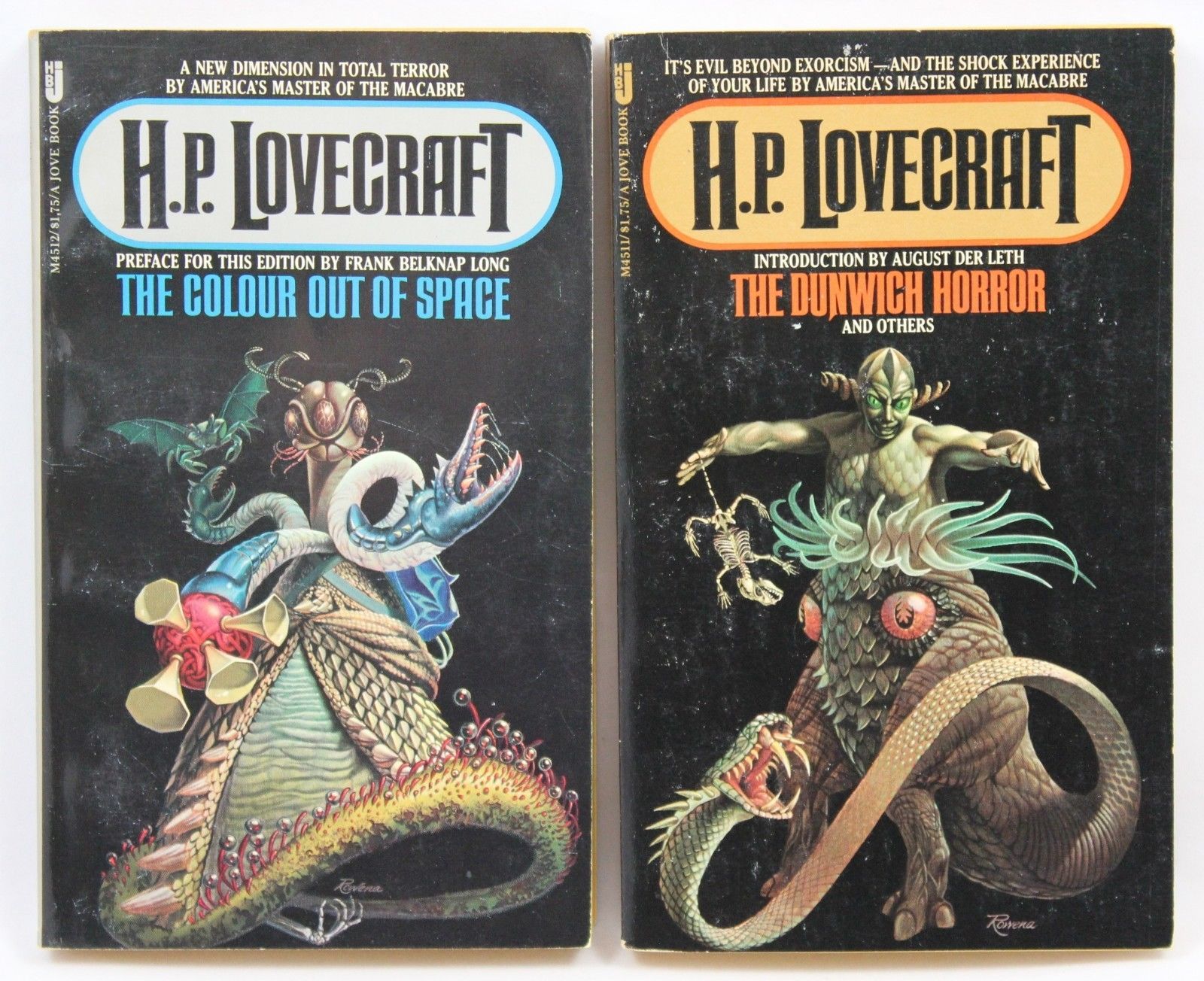
Vintage Treasures: The Dunwich Horror and Others by H.P. Lovecraft

Vintage Treasures: The Dunwich Horror and Others by H.P. Lovecraft

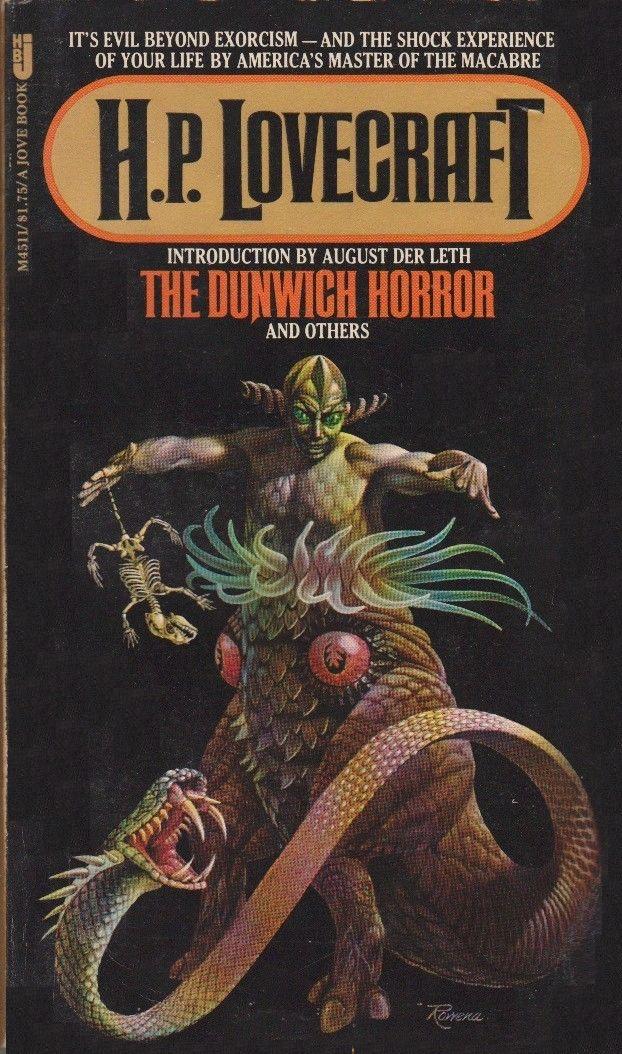
The Dunwich Horror Rowena-smallBack in December, in the comments section of my post on “H.P. Lovecraft, A. Merritt, and Appendix N: Advanced Readings in D&D,” Joe. H. noted:

My first encounter with Lovecraft was the… paperback of Colour Out of Space. I was probably too young and had no idea what I was in for — the title story scared the bejeebers out of me (and to this day still creeps me out)… it was actually the Jove edition; the one with the Rowena painting of a Great Old One from “Shadow Out of Time” on the cover. Needless to say, it was the cover that drew me.

(Hmmm … Rowena also pulled me to Clark Ashton Smith with her City of the Singing Flame cover.)

Naturally, I went searching for evidence of a Jove edition of The Colour Out of Space, and it didn’t take long to find. In the process I also discovered the companion volume, The Dunwich Horror. Both were published by Jove in 1978; see them side-by-side here.

This is why I love collecting paperbacks. I have the Arkham House three-volume set of Lovecraft’s collected fiction in hardcover, but I still find different editions delightful — particularly the compact and inexpensive paperbacks, and especially when they’re as eye-catching as these two. Rowena is a very gifted artist and her interpretations of a Great Old One (on The Colour Out of Space) and Wilbur Whateley (for The Dunwich Horror and Others) are wholly unique and vibrantly real.

Of course, the other reason I love collecting paperbacks is the joy of the hunt, and by late December I was on a hunt for both volumes.

Read More Read More

The Gargoyles of St. Wulfram’s

The Gargoyles of St. Wulfram’s

DSC00165_2Of all the freakish critters in the original hardback Monster Manual, the one that always made the most intuitive sense to me was the gargoyle. Having seen perhaps more than my share of gargoyles by the time I entered the role-playing realms, I already knew them to be fierce, frightening, toothy, amply clawed, and sometimes winged. It stood to reason that they’d be crafty, pernicious opponents.

What made no sense was why the D&D variety weren’t made of stone, as nearly all true (read: real) gargoyles surely are. To this day, I still have no explanation for that decision on the part of the Monster Manual’s creators, Mssrs. Gygax, et al. They certainly had no intrinsic objection to stone beasties: consider the stone golem or that durable tri-form oddity, the xorn.

In order to better address this incongruity, I have abandoned my regular offices deep in Black Gate’s vast Indiana Compound and taken up residence at Harlaxton Manor, an out-of-the-way 1830s edifice set in the rolling hills of England’s Lincolnshire. Is it haunted? Probably. Not only did one of its previous owners conduct regular séances in the cozier of the two libraries, but the manor has been used in several eccentric movies, including The Ruling Class (1972) and the truly execrable remake of The Haunting (1999).

Are there gargoyles? Yes. But only two.

Luckily, just down the road, in the struggling industrial town of Grantham, an astonishment of gargoyles awaits on the walls of St. Wulfram’s, a mid-sized Anglican church that dates back to the 1200s at least.

Read More Read More

Vintage Treasures: Ring Around the Sun by Clifford D. Simak / Cosmic Manhunt by L. Sprague de Camp

Vintage Treasures: Ring Around the Sun by Clifford D. Simak / Cosmic Manhunt by L. Sprague de Camp

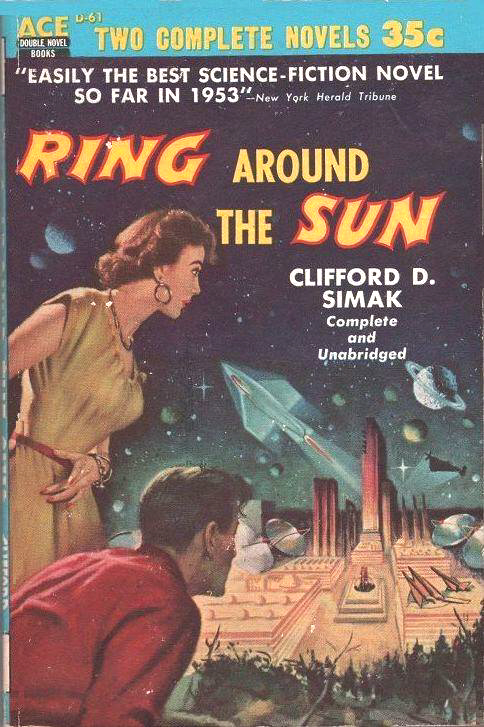
Ring-Around-the-Sun-Clifford-D-Simak-smallClifford D. Simak was one of the first science fiction writers I ever read and, in discovering him, in a very real way I also discovered science fiction.

Simak would probably be marketed as a Young Adult writer today (if any of his work was still in print.) One of his first novels, Ring Around the Sun, also became one of the first Ace Doubles, and it was a significant success.

The New York Herald Tribune called it “Easily the best science-fiction novel so far in 1953,” and in the highly-regarded survey Trillion Year Spree, Brian Aldiss and David Wingrove labeled it his best book, alongside Simak’s better-known classic City.

More recently, Ring Around the Sun featured prominently in Stephen King’s 2001 bestseller Hearts in Atlantis. When eleven-year-old Bobby Garfield gets an adult library card for his birthday, it’s one of the first books he checks out. The mysterious dimensional traveler Ted Brautigan, on the run from the minions of the Crimson King and renting the upstairs apartment, approves of Bobby’s choice.

“I have read this one,” he said. “I had a lot of time to read previous to coming here.”

“Yeah?” Bobby kindled. “Is it good?”

“One of his best…In this book,” he said, “Mr. Simak postulates the idea that there are a number of worlds like ours. Not other planets but other Earths, parallel Earths, in a kind of ring around the sun. A fascinating idea.”

Read More Read More

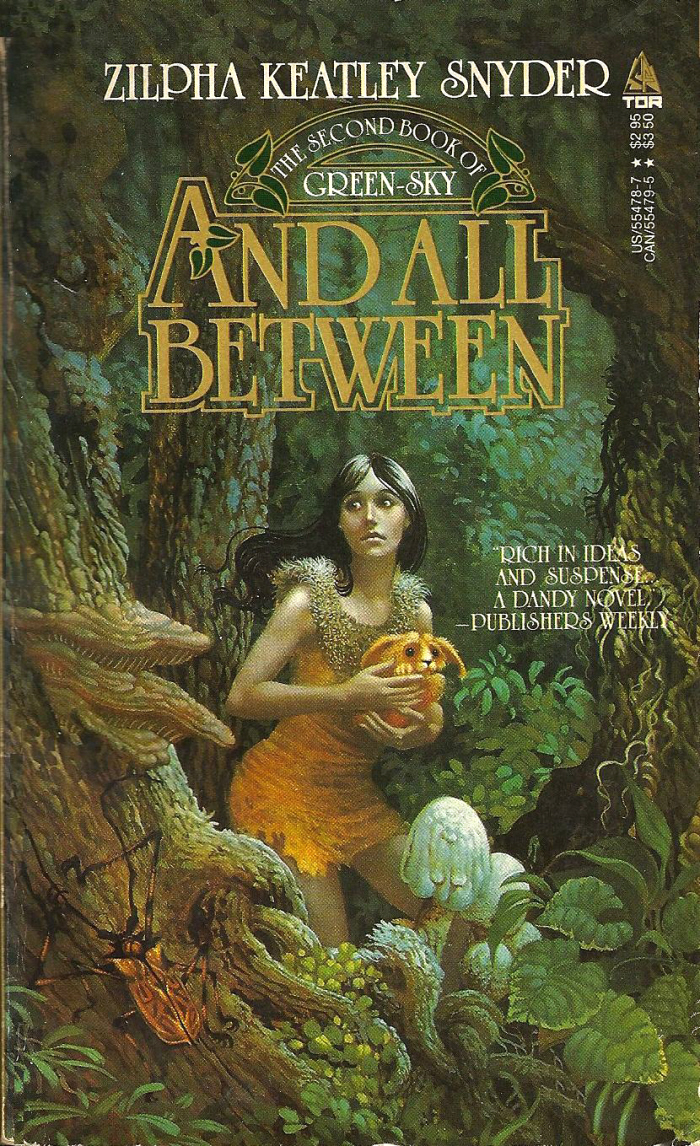
Vintage Treasures: And All Between by Zilpha Keatley Snyder

Vintage Treasures: And All Between by Zilpha Keatley Snyder

Zilpha Keatley Snyder And All Between-smallI love doing these Vintage Treasures articles. I could tell you they’re popular, or they bring some historical weight to the blog, but really, they’re just an excuse to scan some of my favorite old paperbacks and happily yak about them for a few paragraphs. It’s the simple things that keep you happy.

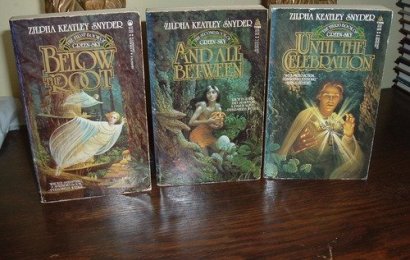
But every once in a while, it’s interesting to feature a book, and an author, that I know absolutely nothing about. And that’s the case with today’s subject, And All Between, a 1985 paperback from Tor and the second volume in the Green-Sky trilogy, by an author I’ve never heard of:  Zilpha Keatley Snyder.

I picked it up in the Dealer’s Room at Capricon 34 two weeks ago. I bought it from Erin and Rich at Starfarer’s Despatch for two bucks, because the cover was so gorgeous that I couldn’t say no. I mean, just look at it.

Yes, it’s the second book in a trilogy. But that just makes it more intriguing to a paperback collector like me. Now I have two more to track down. Sweet! I hope their covers are just as luscious (turns out, they are.)

To be honest, the back cover text kinds of make the novel sound like an episode of The Smurfs, which isn’t really a selling point.

The Erdlings live in the underground world below the magical root — banished there forever by the Ol-zhaan, supreme members of the Kindar, who live in the lofty branches of their forest home in Green-sky.

The Erdlings are starving and escape through the iron-strong root is impossible. Yet, when eight-year-old Teera learns that her pet Lapin must be used for food, she runs away — and climbs through a break in the root to the forest floor above.

Read More Read More

Art of the Genre: The Halflings of Jeff Dee

Art of the Genre: The Halflings of Jeff Dee

Does this Halfling have a cape or a shield on his back? I always wanted it to be a shield.

I was playing Keep on the Borderlands this past week, certainly one of my all-time favorite modules, and as I flipped through it I came across a Jeff Dee illustration that had a Halfling in the background.  As two weeks ago I’d done a piece here on BG called ‘The Top 40 RPG Artists of the Past 40 Years’ AND had left Jeff off that list, I couldn’t help but stare at the image and wonder why I had done so.

Certainly people in the OSR had raised a big fuss about Jeff’s lack of ‘love’ on my part, and for good reason.  He could have arguably made the list, depending on how you viewed the industry as a whole.  Add such a view to the fact that Jeff has been a tireless game designer, player, and advocate for the industry of RPGs since I was in grade school, then he could almost be grandfathered in just for trying so hard.  I guess it would be like a Lifetime Achievement Oscar or something.

Whatever the case, I sat there looking at this great little Halfling and couldn’t shake the feeling that of all the artists to ever do these little guys, Jeff was hands-down the best in my opinion, and here are the reasons why.

One: Jeff is a gamer, and as such, he has an inherent connection to how gamers see themselves, and with that, how gamers see their characters.  Certainly, the thought of a Halfling is appealing because of Tolkien, but not necessarily the thought of Bilbo Baggins.  Sure, we all love Bilbo, but do we love the Rankin/Bass version as a representation of our player characters?  I doubt it.

Two: Jeff drew from a comic book style and therefore his lean lines for humans and elves spilled over directly to Halflings.  Gone were the pot-bellied and cheery pipe-smokers, who were in turn replaced by ‘little men’ with ripped chests, chiseled faces, and weapons and armor that looked incredibly formidable.

Read More Read More

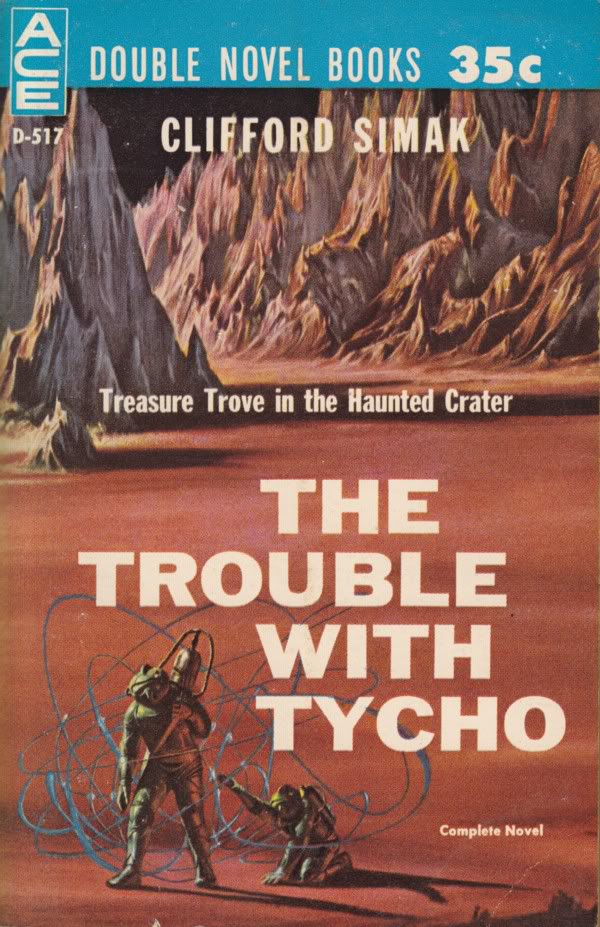
Vintage Treasures: The Trouble With Tycho by Clifford D. Simak / Bring Back Yesterday by A. Bertram Chandler

Vintage Treasures: The Trouble With Tycho by Clifford D. Simak / Bring Back Yesterday by A. Bertram Chandler

The Trouble with Tycho-smallWhile we’re on the topic of my favorite Ace Doubles (trust me, we were), I should say a thing or two about Clifford D. Simak’s The Trouble With Tycho. Simak is not well remembered today. None of his 28 novels are in print (unless you count low-end Kindle or POD editions from specialty publishers), and he had something of a rep as a SF midlister for much of his career. But he remains one of my all-time favorite SF writers. He won three Hugos: for his 1963 novel Way Station, for the short story “Grotto of the Dancing Deer” (1980), and his 1959 masterpiece “The Big Front Yard,” perhaps the most perfect SF story ever written. He also won a Nebula (for “Grotto”).

Simak penned many fine SF adventure-mysteries. One of the first I came across was The Trouble With Tycho, the tale of a haunted crater on the moon and the desperate space miners who try to plumb its secrets. It was part of a 1961 Ace Double, with a cover by John Schoenherr and paired with A. Bertram Chandler’s Bring Back Yesterday. Here’s the blurb from the first page.

No Second Chance on the Moon

Prospecting on the Moon was pretty grim and un-rewarding. With no water, no oxygen, and almost no valuable ores, it was one helluva place to try and get rich quick. Only most of the would-be prospectors didn’t find this out until after they’d gotten there.

And Chris Jackson was no exception. He’d gotten the syndicate back home to put up the money for a moon rig and the passage out, and now he had to make good their faith in him. Had to make it on the Moon, even if it meant going into Tycho!

For Tycho was the one place on Luna where there were positive riches to be found — in salvage. The remains of three expeditions that had disappeared in Tycho would be perfectly preserved in that airless atmosphere, and the man who could get to them — and get out again alive — would have his fortune made.

Read More Read More

Two-Fisted Justice in an Abandoned Cemetery: Will Esiner’s The Spirit

Two-Fisted Justice in an Abandoned Cemetery: Will Esiner’s The Spirit

The Spirit 23-smallWill Eisner is one of the most revered comic creators of the 20th Century, and for good reason. I’m continually astounded at the skill and command of the medium he exhibited, even at an early age.

He was inducted into the Academy of Comic Book Arts Hall of Fame in 1971 and he virtually created the graphic novel with his 1978 masterwork A Contract with God. Comic’s most prestigious awards, the Eisner Awards, were created in his honor in 1988.

So I’m a little disappointed that his most famous creation, the good humored crime-fighter The Spirit, isn’t more well known today.

The Spirit is flat-out one of my favorite early comics. Beginning his career as detective Denny Colt, shot and left for dead in the first three pages of his premiere appearance, the Spirit awakens in the abandoned and overgrown Wildwood Cemetery. From this new base of operations, and with his past virtually obliterated, The Spirit throws himself into life as a crime fighter, disguising his identity with a small domino mask (which he wears even while sleeping), an amazingly resilient business suit, fedora hat, and gloves.

With his sidekick Ebony White, an uneducated but resourceful black orphan (who sleeps in a sock drawer), the Spirit traveled the world, bringing justice to criminals and con men all over the world.

Read More Read More