Comic Con
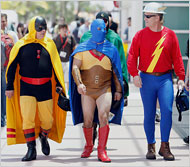 Courtesy of The New York Times comes this report of Comic-Con at the San Diego Convention Center. Here’s a picture of some of the attendees. This is why I’ve never been to a con.
Courtesy of The New York Times comes this report of Comic-Con at the San Diego Convention Center. Here’s a picture of some of the attendees. This is why I’ve never been to a con.
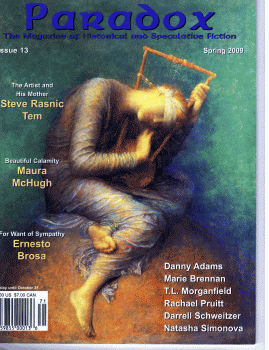 It’s nothing new to hear that yet another print publication has gone the way of the dinosaurs. Still, for those of us who retain affection for inked dead trees, it’s always a cheerless day to learn of yet another comet strike.
The latest victim is Paradox, Editor/Publisher Christopher Cevasco’s biannual magazine of historical speculative fiction, which is now, well, history. After thirteen issues (read into the significance of the number what you will), Cevasco has retired the magazine effective with the Spring 2009 edition. Although he hints that an on-line version may arise from the ashes at some point, or that there may be a future Paradox-themed anthology, it would appear this is not going to be a Lance Armstrong/Bret Favre kind of retirement – Cevasco seems pretty adamant that this is it for the magazine.
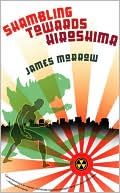
 One good thing about the recession is I have more time to catch up on my reading. And I don’t have to worry about spending money on books during tough times as I already own a ridiculous number of volumes that I never had the time to get around to. One of almost recent vintage is Shambling Towards Hiroshima by James Morrow. It’s a clever premise: a parallel effort to the Manhattan Project is to develop a race of super lizards to level Japanese cities and end World War II. The irony here is that the whole Godzilla mythos of badly made, badly acted 1950s Japanese movies was a metaphorical projection of the atomc bombings. The plot, such as it is , concerns an American horror monster actor who is recruited to provide a realistic demonstration of the lizard’s destructiveness to force the Japanese surrender without having to deploy the monsters (what many critics of the U.S. atomic bombings argue might have sufficed instead of targeting cities). Morrow is one of my favorite authors, though this is a minor work; even at novella length, the premise is stretched a bit thin, and maybe would have worked better at a shorter length in pruning some plotting that doesn’t really advance the theme. Still, worth checking out.
I’m almost finished with Elizabeth Hand’s Mortal Love, which I bought new in hardcover in 2004 and is now available for a penny (before shipping ) on Amazon. I’m also a big fan of Hand’s, despite the fact that plotting isn’t her strong point. The story spans several historical eras and deals primarily with a lost Gaelic princess who down through the ages can’t help but seduce human males, with unfortunate consequences for her paramours. It all seems headed to a resolution which seems to be setting me up for a letdown (but not having finished it in time for this week’s deadline, I don’t know yet). Anyway, who cares? Hand is masterful in creating mood and setting. Besides, we have the same tastes in music, of which there are the usual high quota of references. Even without having finished it, recommended reading for this summer, or any time of year. And at a recession price that can’t be beat.

I guess it’s kind of of odd that I write for a publication that features adventure sword and sorcery type fantasy when that really isn’t my thing. Nothing against it; it’s just that with so much to read, there has to be something to really grab my attention for me to pick up a traditional epic fantasy, particularly if it means a commitment to multiple volumes. Here’s one that has, Robert Redick’s The Red Wolf Conspiracy. To find out why, read more here.
Courtesy of Locus comes this link to, of all places, Penthouse, an article about Geek Love. Don’t get too excited, this is rated PG-13, despite its source.
Who knew being a geek was a way to meet cool chicks? Yet another thing I lived too long past to know existed. Back in my day, geekdom meant girls didn’t want anything to do with you. And, really, scroll down to the picture of the guys dressed up like Ghostbusters…maybe my ideas of sex appeal are just outdated.
Today’s New York Times has a short piece, including an audio clip, on Ray Bradbury. While it is ostensibly about his affection for public libraries and his efforts to keep them open now that funding cutbacks resulting from California’s budget crisis threatens their existence, it also contains two interesting tidbits, one which you probably already know and one which you probably don’t:
1. Bradbury and Bo Derek are buddies.
2. Bradbury hates the Internet.
While the first has nothing to do with libraries, the second does. And, at 89, Bradbury looks very much like the crotchety old man he is in proclaiming the Internet a waste of time.
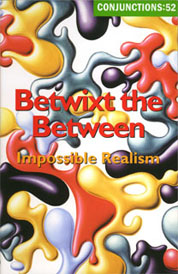 The spring issue of Conjunctions, the literary magazine of Bard College, is called “Between and Betwixt: Impossible Realism,” described as “postfantasy fictions that begin with the premise that the unfamiliar or liminal really constitutes a solid ground on which to walk.” This is a follow-up to its “New Wave Fabulist” issue back in 2003, which I reviewed for Locus.
I like the title of this new edition (makes more sense to me than new wavey fabulous), though I’m not quite sure what “postfantasy” means, other than that because it is published by academia, “post”-things are kind of popular, as are terms like “liminal.” You can see the table of contents here, with links to some stories available on-line by Elizabeth Hand, Ben Marcus, Jonathan Carroll and Jeff VanderMeer.
Something I’m putting on my reading list.
So a lot of people are on the edge of their seats because Apple is introducing a new iPhone model next week, and some people have fuzzy pictures supposedly leaked from China that purportedly show that the new model will have a matte black case. I can hardly contain my excitement. I’m cynical enough to think that Apple itself might be leaking the sneak peeks as a way to generate buzz about what sounds to me as just some feature improvements so people will want to stand in line for two weeks at the wireless store until the new model is available and they can belong to the technical elite for a couple of days or so.
All of which reminds me of a recent short story by Bruce Sterling, “Black Swan” in the March-April 2009 (Issue 221) of Interzone. The protagonist is an Italian blogger-journalist (sounds a little like Sterling himself in some respects) who gets insider tips on new technologies from a mysterious source who is so secretive he can’t be Googled. There’s a lot of techno-speak and the plot hinges on the notion that the 1980s (when, perhaps not coincidentally, Sterling and his fellow cyberpunks first started making names for themselves) was a critical historical point from which multiple realities branched. The story also features Nicholas Sarkozy (yes, the president of France) and his actress-singer wife (yes, that wife).
Fun stuff and much more interesting than the gloss on the iPhone.
 I’m looking forward to China Miéville’s new novel, The City and the City. In the meantime, here’s an interview I did with him just as his star was ascending.
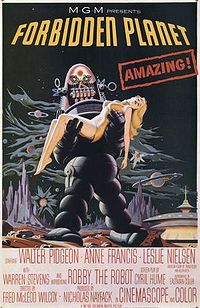 Given all the discussion of late about reboots, I wonder why no one has ever thought to revisit this classic. Forbidden Planet was my Star Wars when I was in fifth grade. In the New York metro area, Channel 9 had a feature called “Million Dollar Movie” that used to play a particular movie ever day throughout the week in the early evening. Forbidden Planet was a regular staple, and whenever it was in rotation, I was there in front of the TV (which, to give you an idea of how old I am, displayed only black and white).
One of the things that was particularly cool about this flick is that it opened up a window to the nomenclature of Freudian repression and Shakespeare, all dressed up in space adventure. My guess is that a reboot would probably ruin it; for every Star Trek or Batman there’s A War of the Worlds starring Tom Cruise…
I’m not saying I want to see a remake, but given the limited imagination of much commercial filmdom, I wonder why no has considered it.