Browsed by
Author: Bob Byrne

Modular: Picking Pathfinder

Modular: Picking Pathfinder

I’m curPatfhinder_Corerently running a Swords & Wizardry (S&W) campaign for a few friends. I wrote here about why I chose S&W instead of my preferred system, Pathfinder. In fact, that post served as the genesis for this Black Gate feature,  Modular. But now, I’m going to look at some of the strengths of Pathfinder and why, when this S&W campaign is done, I’m going to transition the group to a Pathfinder adventure.
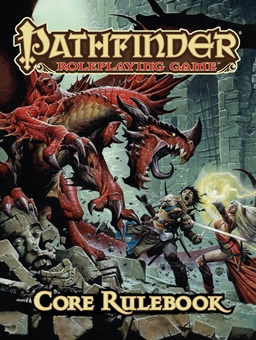
So, though I had both played and run Pathfinder, I chose S&W for reasons I talked about in that prior post. I wanted a more story-driven, less mechanics-based system. Also, because two-thirds of the party was new to pen and paper RPGing, I wanted something lighter in the rules department. And there’s no comparison between the two in that regard. The S&W Core Rules comes in at just over 140 pages. The Pathfinder Core Rulebook is almost 600!

Now, I explained in that first post that while I was still reading RPG products, I had stopped playing during 3rd Edition Dungeons & Dragons (D&D): there simply hadn’t been time for it.

But I wanted to get back into playing, and the choice seemed to be between Pathfinder and the newly released 4th Edition. Now, I had only ever played D&D, going back to 1st Edition. I mean, it was synonymous with role playing games and 4th Edition was the natural choice. But as I researched both systems, Pathfinder clearly seemed to be the way to go.

Read More Read More

Modular: Dungeon Delving Tips – Part II

Modular: Dungeon Delving Tips – Part II

Delve_ESEarlier this year, Modular looked at the first dozen tips for dungeon delving from Creighton Broadhurst of Raging Swan Press. Today, we follow up and tackle thirteen more to get to 25. Good dungeon delving used to be a lot more important than it is today.

While characters seemed to die at a great pace in Gary Gygax’s original campaigns, for most of us who grew up on pen and paper, our characters were not disposable. We tried hard to keep them alive. Necromancer Games (who you surely read about here!) even put out a 3rd Edition D&D supplement, Raise the Dead, containing party quests to bring back that lost character.

In today’s MMO/video game world, death is simply something you undo by reloading the most recent saved game. A character can die dozens of times and we still get to play them over and over again.

But when death is a real threat, that party delving into the dungeons deep needs to employ strategies and tactics to accomplish the goal and get back out alive. Every character mattered (Kinda like, ‘No one left behind’ as a party slogan). So, here are thirteen more tactics to add to the first dozen to help keep your party alive.

Read More Read More

The Public Life of Sherlock Holmes: Solar Pons – The Complete Basil Copper

The Public Life of Sherlock Holmes: Solar Pons – The Complete Basil Copper

I’ve posted a few times about Solar Pons, whom Vincent Starrett called, “The best substitute to Sherlock Holmes known.” Since I created www.SolarPons.com and founded The Solar Pons Gazette, it’s fair to say I’m a big fan of the ˜Sherlock Holmes of Praed Street.’

Erikson-Lees cov copy

August Derleth wrote seventy-something stories about his creation before passing away in 1971. Derleth’s Arkham House publishing company had printed some works by British horror author Basil Copper and Arkham editor James Turner, in response to a Pons-related letter from Copper, suggested that the British writer compile the entire Pons collection into a two-volume Omnibus. Copper did so, making some 2,000 edits to Derleth’s originals to ‘correct errors.’ Copper referred to this Omnibus as “a veritable feast for Pontine enthusiasts.”

Sure. Except that there was a major outcry from said enthusiasts at Copper’s hubris in rewriting the master’s work (reminds me of L. Sprague de Camp ‘revising’ Robert E. Howard’s original Conan writings). It seems to me that the split was never healed. Meanwhile, Turner asked Copper to continue the Pons saga. Copper wrote four collections of stories and one partially completed novel over the next few years (he would go on to release two more collections of originals and complete the novel).

Read More Read More

By Crom: The Tor Conan – Quality May Vary…

By Crom: The Tor Conan – Quality May Vary…

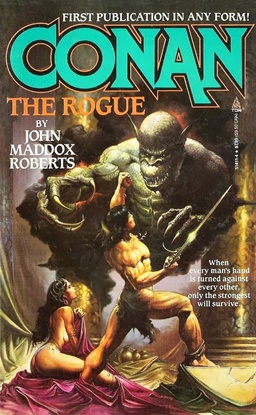
Conan_RogueEvery so often, I get the hankering to read a tale of Conan the Cimmerian (better known as ‘The Barbarian’ thanks to Ah-nuld Schwarzenmuscles).

I usually grab one of the three excellent Del Rey volumes (which Howard Andrew Jones and Bill Ward entertainingly went through – here’s the first installment) and get a quick fix. For a little more reading, I snag one of the Ace/Lancer series edited by L Sprague De Camp (with some help from Lin Carter). And less often, I find one of the Tor paperbacks that I haven’t gotten around to yet and try one of them.

As I mentioned in this post on what qualifies as Conan Canon (say that five times fast!) back in 2015:

‘From 1982 through 2003, eight authors (though primarily four) cranked out 43 new Conan novels for Tor. At two per year, the quality varied wildly, as you can imagine. John M. Roberts’ Conan the Rogue is an homage to Dashiell Hammett’s Red Harvest and one of my favorite Conan books. Steve Perry’s Conan the Indomitable is one of the worst fantasy books I’ve ever read (even though it is a direct sequel to Perry’s Conan the Defiant, which I liked).’

I have maybe two-thirds of the Tor books and have read two-thirds of those (What: I’m channeling Yogi Berra now?). Some of the Tor titles give you at least a bit of an idea what the story is about, such as John M. Roberts’ Conan and the Treasure of the Python and Leonard Carpenter’s Conan of the Red Brotherhood.

But the majority are all titled Conan the (insert vague word here). It’s a litany of titles like Conan the Valorous, Conan the Defiant, Conan the Great, Conan the Formidable: you get the idea. You’ve got to read the back cover to get some clue what the story is about.

The Tor books, pushed out at a punishing pace, are very much a mixed bag. And my experience so far is that more often than not, they fall into the “meh” or worse category.

Read More Read More

Modular: Adventuring in Dangerous Terrain – Frog God Games’ Perilous Vistas

Modular: Adventuring in Dangerous Terrain – Frog God Games’ Perilous Vistas

Fields_CoverBack in 3rd Edition D&D, there were five supplements that fell under the ‘Environmental Series’ category (I’d argue it should only be the first three, but I don’t make that decision):

  1. Sandstorm: Mastering the Perils of Fire & Sand (Bruce R. Cordell)
  2. Frostburn: Mastering the Perils of Ice & Snow (Wolfgang Baur)
  3. Stormwrack: Mastering the Perils of Wind and Wave (Richard Baker)
  4. Dungeonscape: An Essential Guide to Dungeon Adventuring (Jason Buhlman)
  5. Cityscape: A Guidebook to Urban Planning (Ari Marmell & C.A. Suleiman)

It’s not uncommon to hear one of those books cited as a favorite by players from that era. They gave Dungeon Masters lots of material to incorporate into their adventures. Necromancer Games (who you read about here, right?) added to the concept with Glades of Death (a wilderness book) and Dead Man’s Chest (sea adventuring).

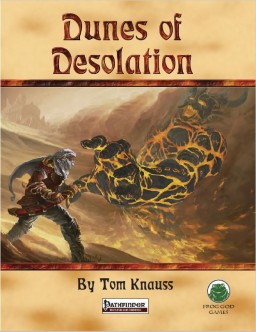
The concept has been continued by Frog God Games (surely you read this post about them!) for Pathfinder, Swords & Wizardry and 5th Edition D&D under the moniker, Perilous Vistas. Along with an updated Dead Man’s Chest, there have been four releases so far, all written by Tom Knauss:

Dunes of Desolation (Deserts)
Fields of Blood (Plains)
Marshes of Malice (Wetlands)
Mountains of Madness (Mountains)

The fifth installment, Icebound (Frozen Wastes), is in the works!

The general idea is that if the Dungeon Master wants to infuse some atmosphere and environment into the adventure, these supplements provide a myriad of options. Sure, they can just have the party get to the abandoned fort in the desert, or have them uneventfully move through the mountains to the deserted abbey or the monster-infested dwarven hall. Some folks like to just get to the dungeon crawl and start hacking away. That’s fine.

Read More Read More

My Favorite Game: Mount and Blade/Warband – Part Two: Playing the Game!

My Favorite Game: Mount and Blade/Warband – Part Two: Playing the Game!

warband_Troops

Okay – hopefully you read Part One of my look at Mount and Blade/Warband. If so, you’ve got an idea of what the game is about and got a taste of the combat portion. Now it’s time to look at the shiny parts of the game: selecting, fighting with and leading your band of warriors to conquer your foes!

 Troop Combat

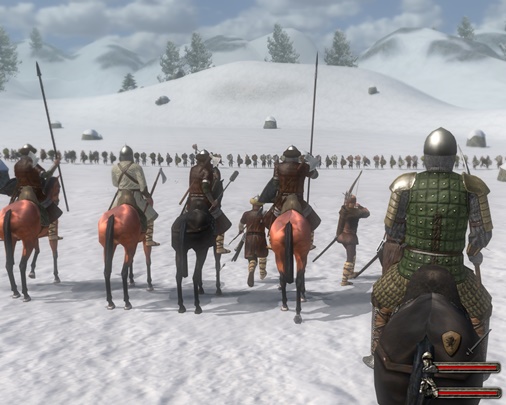
I LOVE troop combat. Throughout the game, you are building up your band with cavalry, infantry and/or archers. You start out solo and begin recruiting with the first quest. I’m not sure what the maximum band size is, but I’m at 249 in one of my current games (it went way up from just over 100 when I started my own Faction). And I have over 300 more soldiers garrisoned in cities and castles I control, some of which I can draw upon to change the makeup of my band.

On the map, you can choose whether to encounter other units or try to avoid them (they may chase you down, though). If they are hostile, you can choose to fight, pay them off or surrender. Usually, you’re looking for trouble and you fight.

At game start, you can choose to allow quitting without saving, or to require saving before quitting. If you decide on the latter, if something bad happens, you’re stuck with it. You can’t just quit and reload: no do-overs. And bad things happen a lot. If you are defeated, you can lose your current band and have to start over. I don’t play hardcore. If you do, pick your fights VERY carefully.

Read More Read More

My Favorite Game: Mount and Blade/Warband – Part One

My Favorite Game: Mount and Blade/Warband – Part One

Mount and Blade banner

I have spent a lot of hours on a lot of different PC/video games over the years – mostly of the fantasy/RPG variety (though Out of the Park Baseball is my favorite simulation game). And from Temple of Apshai to Dungeon Master to Baldur’s Gate to Age of Conan, I’ve quite enjoyed them. But Mount and Blade (and the stand alone expansion, Mount and Blade: Warband) holds a unique spot for me and several years after last playing it, I’m in up to my elbows again.

I spent my first round playing the original, Mount and Blade (M&B). Now, I’m playing Warband. There are some gameplay differences, the most prominent being that the latter includes multiplayer. However, I have never tried that option and don’t plan on doing so. Mount and Blade and Warband are overall, quite similar and I’ll be using the phrases interchangeably, distinguishing between versions when relevant.

The Game

M&B is a combination first person combat and strategy wargame, with some role playing elements. It is a sandbox, without a storyline. The latter is both a strength and a weakness. You create a character, form a band of troops and roam around the land, solving unrelated quests, fighting enemies and either serving a liege or carving out your own kingdom (creating your own Faction was a Warband addition). You won’t survive long if you don’t build a strong war band, and recruiting, commanding and building up your troops is really the heart of the game.

Read More Read More

Black Gate on the List for the 2017 REH Foundation Awards

Black Gate on the List for the 2017 REH Foundation Awards

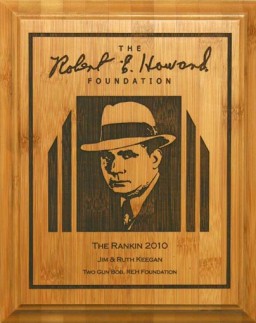
Howard_FoundationPlaqueWell, the Preliminary List. There may well not be a more respected organization in Robert E. Howard circles than that of the REH Foundation. Black Gate and a few of its bloggers were on the final 2016 Awards ballot. Last week, the Foundation released the preliminary list for the 2017 Awards. It will be winnowed down to a final ballot soon.

Typing ‘Robert E. Howard’ or ‘Conan’ in the BG search engine (or just clicking on the Conan Category at left) will definitely establish that we love Howard and his works here at Black Gate. And several Black Gaters, including the site itself, are in the running for the 2017 final ballot. I’ll also point out that many of the nominees contributed to our ‘Discovering Robert E. Howard’ series: some of the best Howard scholars came to Black Gate to share their thoughts. The Black Gate contingent:

The Cimmerian—Outstanding Achievement, Essay (Online)

(Essays must have made their first public published appearance in the previous calendar year and be substantive scholarly essays on the life and/or work of REH. Short blog posts, speeches, reviews, trip reports, and other minor works do not count.)

ADAMS, FRED – “Esau Cairn – A Man Outside His Epoch”Black Gate
BYRNE, BOB – “Steve Harrison: REH’s Private Detective”REH: Two Gun Raconteur Blog
JONES, HOWARD ANDREW – “The Ne’re-do-well Hero of “Gates of Empire”REH: Two Gun Raconteur Blog
MAYNARD, WILLIAM PATRICK – “Steve Harrison Reconsidered”REH: Two Gun Raconteur Blog

Read More Read More

The Public Life of Sherlock Holmes: The Final Post

The Public Life of Sherlock Holmes: The Final Post

Halloween_HolmesBatman
Me and my little superhero

The plan was to put up a linked index of all three years of The Public Life of Sherlock Holmes posts today, but I didn’t get it finished. Hopefully, the powers that be at Black Gate will let me post an irregular PLoSH column now and then and I’ll get that up. As well as the ‘Sherlock Holmes: A to Z’ post that never quite got written.

When I started this column three years ago, the BBC’s immensely popular Sherlock had just finished the divisive season three, from which it never recovered, and CBS’ Elementary was in season two. Sherlock seems to be done after four episodes in the past three years and the fans are still in opposing camps (love/hate). Elementary is finishing up season five with ratings way down and may well not be back for another year, though it will have run for over 100 episodes and made it to syndication.

Robert Downey Jr., who revived the onscreen life of Holmes with his 2009 movie (and a 2011 sequel) is in the early stages of a third Holmes big screen effort. If Sherlock and Elementary truly are done, then the Downey Jr. movie may jumpstart Holmes in the public culture, though many fans don’t like his action hero portrayal.

The Estate of Sir Arthur Conan Doyle sued, and lost, to have Holmes declared under copyright. He and Watson, and the stories before The Casebook of Sherlock Holmes, remain in the public domain.

A Holmes short story, supposedly written by Doyle, was discovered. Its provenance remains doubtful. Quite.

Read More Read More

The Public Life of Sherlock Holmes: Talking About Poirot

The Public Life of Sherlock Holmes: Talking About Poirot

Poirot_OneI mentioned last week (which you know, enlightened reader, because you love this column. You probably bookmarked the link as a memoriam to me. Anyhoo…) that I discovered the Nero Wolfe books through the A&E television series starring Maury Chaykin and Timothy Hutton. I’d just never read any of the books, even though the series had been around for decades. And now it’s my favorite mystery series of them all (sorry Holmes and Pons).

Well, some thirty-ish years ago (maybe a little more), I read a couple of Agatha Christie books. I remember that one was definitely a Poirot. I didn’t care for them and that was that. So, while Christie (alongside The Bard) is reckoned to be the best-selling fiction author of all time, she was absent from my not inconsiderable mystery library.

Then, a few years ago, I began watching the Hercule Poirot television series starring David Suchet (here’s a trailer). And I really, really liked it. From 1989 through 2013, Suchet filmed 70 Poirot stories! So, I decided to give Christie’s writings a chance again. Well, Poirot, anyways: I’m not sure you could pay me to read Miss Marple. Thus, I bought Hercule Poirot: The Complete Short Stories and had at it. As I write this, I’m on story 19 of 51.

First thing I noticed is how short these things are. Yes, I know they’re called ‘short stories,’ but while I haven’t tried counting words, most of them are between 8 and 16 pages long. And that’s on big ol’ 6” x 9” paper. Also, she was really cranking these out. A new Poirot was appearing almost weekly in The Sketch magazine.

Read More Read More