Forgotten Authors: George Griffith
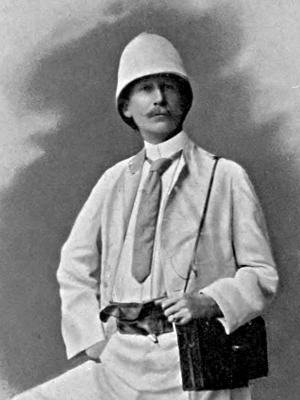
George Griffith was born George Chetwynd Griffith-Jones on August 20, 1857 in Plymouth, England to George Alfred Jones and Jeanette Henry Capinster Jones. The family did not have roots to any specific place as his father’s role as a clergyman kept him moving from parish to parish. By the time George was seven, his father had served in at least six different parishes.
He was home-schooled by his parents and allowed to teach himself from books in his father’s library. Following his father’s death in 1872, Griffith began attending private school , where the limitations of his home schooling became apparent, particularly with regard to mathematics. He left school in 1873 and ran away to sea, deserting in Melbourne, Australia after less than three months. By the age of 19, he had worked in various jobs in Australia and managed to travel, eventually returning to England where he began teaching English, first at Worthing College in Sussex and later at Bolton Grammar School in Manchester. He viewed his time teaching as “penal servitude.”
It was while he was teaching at Bolton that he published his first two books, Poems and The Dying Faith, both were collections of poetry and both published under the pseudonym Lara. Other pseudonyms he used over the course of his career included Levin Carnac and Stanton Morich. He also met Elizabeth Brierly, whom he married in February of 1887. They had a daughter and two sons, including Alan Arnold Griffith, who was a mechanical engineer who helped develop the jet engine.
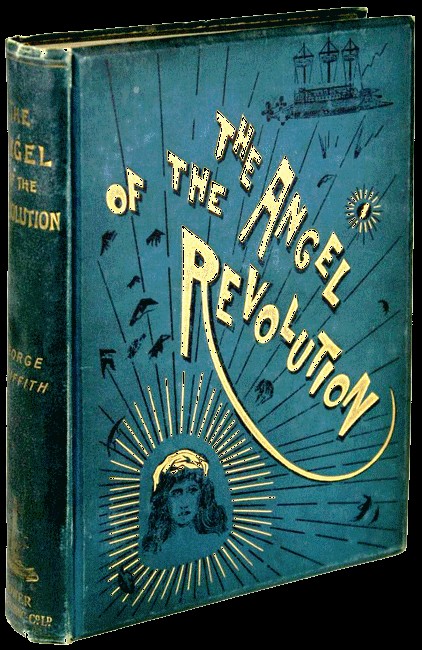
Griffith left the educational field for journalist and moved to London in 1888 to work for, and eventually edit a newspaper. When he chose to defend the newspaper against a libel suit and the newspaper lost, it was forced to close. By 1890, he was working for Pearson’s Weekly and soon earned a column. When the magazine decided to run future war stories, Griffith volunteered and wrote the story The Angel of the Revolution, which ran for 39 installments.
While Pearson’s was running the sequel work, Griffith undertook a circumnavigation of the globe, completing the journey in 65 days and publishing the serial of it, “How I Broke the Record Round the World” in 1894, around the time he changed his name to George Griffith by deed poll.
In the Trillion Year Spree, Brian W. Aldiss notes that Griffith moved from stories of war and revolution, such as his debut novel The Angel of the Revolution and its sequel, Olga Romanoff to more peaceful subjects in A Honeymoon in Space, which offered a tour of the planets.
The success of his circumnavigation led the magazine to send him to South America, where he continued to write fiction and travel articles, claiming to have discovered the source of the Amazon, and another trip to South Africa.
In the late 1890s, he expanded his writing to include historical fiction, but in February 1901, he parted ways from the Pearson magazine family. His writing career began to falter, as did his health. He returned to writing future war stories and exploring technological advancements, but he had lost the audience and the publishers who had help him build his career.
While Griffith’s reputation has not stood up to science fiction historians, Robert Godwin credited him with inventing the countdown to zero for a launch. Brian Stableford notes his importance to the field in creating several tropes, but felt they would have been invented by other authors and called Griffith’s writing “inept.” Everett Bleiler called him the first professional science fiction writer, but also “a bad writer technically.”
Griffith died on June 4, 1906 from cirrhosis of the liver in Port Erin on the Isle of Man and is buried there in Kirk Christ Church Cemetery.
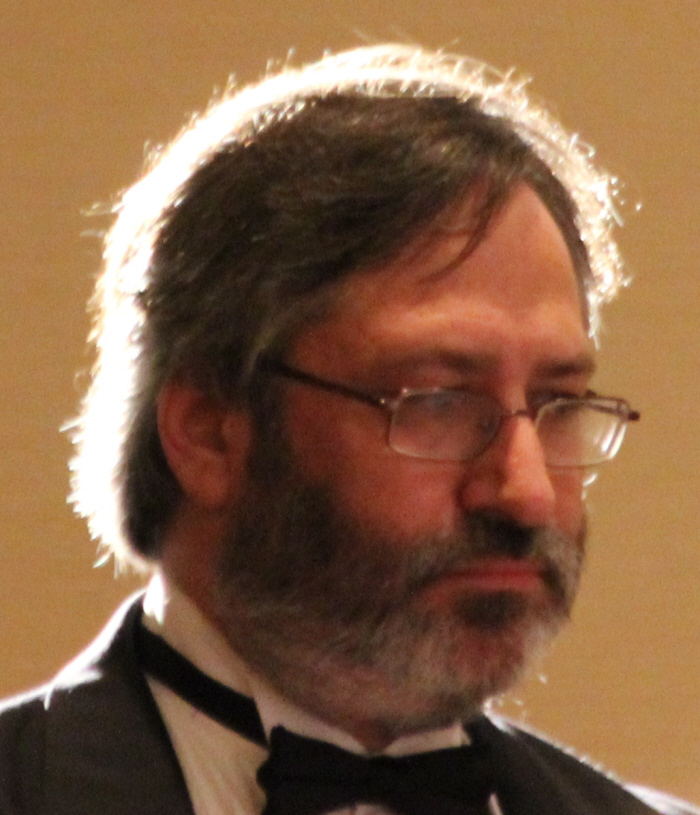 Steven H Silver is a twenty-two-time Hugo Award nominee and was the publisher of the Hugo-nominated fanzine Argentus as well as the editor and publisher of ISFiC Press for eight years. He has also edited books for DAW, NESFA Press, and ZNB. His most recent anthology is Alternate Peace and his novel After Hastings was published in 2020. Steven has chaired the first Midwest Construction, Windycon three times, and the SFWA Nebula Conference numerous times. He was programming chair for Chicon 2000 and Vice Chair of Chicon 7.
This might be the first “Forgotten Author” I didn’t know at all. (Though I must have read his name in the Aldiss book.)
Or another Aldiss book, as I recognized “Honeymoon in Space” by title and tracked it down to an excerpt included in Mr. A’s pulpy treat anthology Space Opera.
He claimed to have found the source of the Amazon? Wow. So he really was part of the Dr. Livingstone/Henry Stanley zeitgeist, and that photograph was not just for show. With all of the libel suits (deserved and undeserved) flying around at that general time, I’m not surprised he lost his paper. Did he try to claim any of the geo society prize money for finding river sources, on offer at the time? The established mode tended to be make expedition->publish journals->give lecture->bicker over claims to prize money->publish cleaned up monograph or travelogue.
How fun that he gave rise to Alan A. Griffith. Didn’t know that guy was connected to an explorer.
Heh. He wrote “Captain Ishmael: A Saga of the South Seas.” He must have been thinking of Typee, Omoo, and The White Whale when he was naming or theming that one.