The Golden Age of Science Fiction: Short Fiction of 1979
|
|
|
|
And finally, after looking at various award winners over the past year and articles about authors’ debuts and the novels published in 1979, it has come time to close out this series of articles with a look at some of the non-award winning short fiction published in 1979.
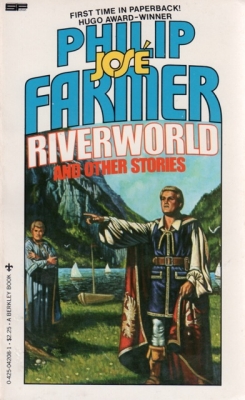
By 1979, Philip José Farmer had published the first three novels in his Riverworld series as well as a novelette set in the same world, entitled “Riverworld.” When he reprinted the novelette in 1979 in his collection Riverworld and Other Stories, Farmer expanded the story from 12,000 to 33,750 words, effectively publishing a new story in the popular series about humanity’s afterlife on an infinite river.
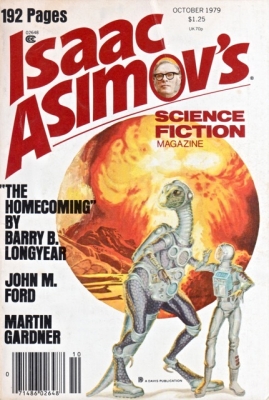
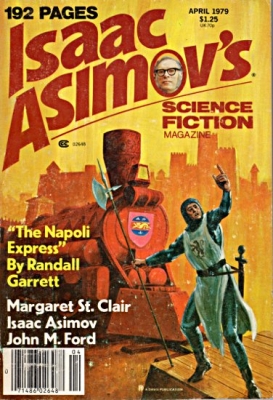
John M. Ford has made the news recently as the rights to reprint his all too few works, plus an unfinished novel, have been disentangled. In 1979 he published six stories in Isaac Asimov’s Science Fiction Magazine (his first sale was in 1976). These stories included “Mandalay,” which kicked off his Alternities, Inc. series of stories, as well as “The Adventure of the Solitary Engineer” and “The Sapphire as Big as the Marsport Hilton.”
Chelsea Quinn Yarbro introduced her vampire, the Count Saint-Germain, in 1978 in the novel Hotel Transylvania. In 1979, she published her first short story about him, “Seat Partner,” detailing his experiences on an airplane, a far cry from the historical settings of the novels he usually inhabits.
|
|
|
|
Roger Zelazny’s most notable story from 1979 was “The Last Defender of Camelot,” which posits an immortal Lancelot living until he can confront Morgana and Merlin in the modern world and eventually succeed in his own quest for the Holy Grail.
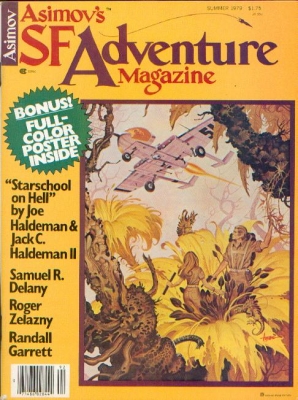
Randall Garrett published his final two Lord Darcy stories in 1979, with “The Napoli Express” appearing in Isaac Asimov’s Science Fiction Magazine and “The Spell of War” a couple months later in Reginald Bretnor’s Thor’s Hammer anthology. The former was a twist on Agatha Christie’s Murder on the Orient Express while the latter, the last of the stories published by Garrett, flashes back to tell the story of Darcy’s first meeting with his assistant, Sean O’Lochlainn.
On the lighter side, Reginald Bretnor, writing as Grendal Briarton, published four installments of his “Through Time and Space with Ferdinand Feghoot” series of joke tales. The series, which he began in 1956, are defined as a short story or vignette that ends with a pun. In essence, many of the adventures of Mr. Peabody from The Adventures of Rocky and Bullwinkle are feghoots.
|
|
|
|
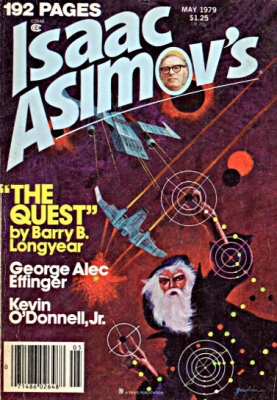
Among the stories Tanith Lee published in 1979 was “The Thaw,” which seems like a straightforward science fictional story about a woman who has been cryogenically frozen and revived in the distant future who is trying to acclimatize herself to the world in which she has found herself. Lee piles on revelations which continually change the readers perception of what is happening as well as the very nature of the story.
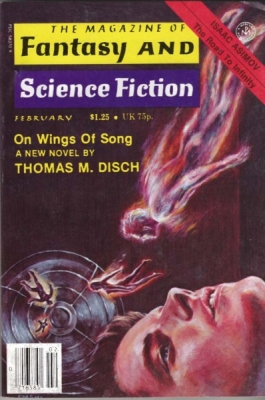
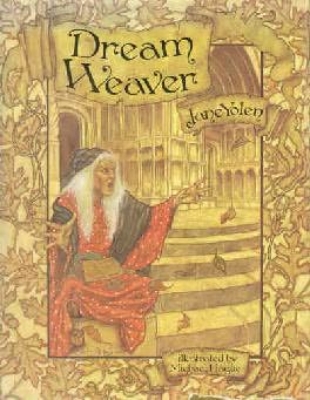
Jane Yolen’s story “The Pot Child” was published twice in 1979, in her collection Dream Weaver and in The Magazine of Fantasy and Science Fiction. The story is a pygmalionesque tale of a potter who creates an urn with a living boy on it, but for all the potter views his creation as perfect, he has failed to provide the boy with either a heart or a soul. Yolen’s story is actually one about the creative impulse, for while the potter only sees perfection in his work, outside observers are aware, although they can’t put it into words, what his creation is lacking.
George Alec Effinger’s contribution to short science fiction was the reflexive tale “Pinch Hitters,” a story of his science fiction author alter ego Sandor Courane. In this story, the second in the series, Courane and several other up-and-coming science fiction authors are attending a convention in Washington when they suddenly wake up in separate cities in 1954 as baseball players for various teams. Their schedules allow them to talk one on one on occasion as they try to figure out what happened and how to get back. The story lacks detail and the solution seems to have come from a late night bull session at the sort of convention that is depicted.
I’ve enjoyed looking back at the stories that were published, the films made, the art created, and the people who were building science fiction in the year when I turned twelve. I certainly hope you enjoyed my retrospective and nostalgia and, perhaps, considered the state of the field during your own “Golden Age.”
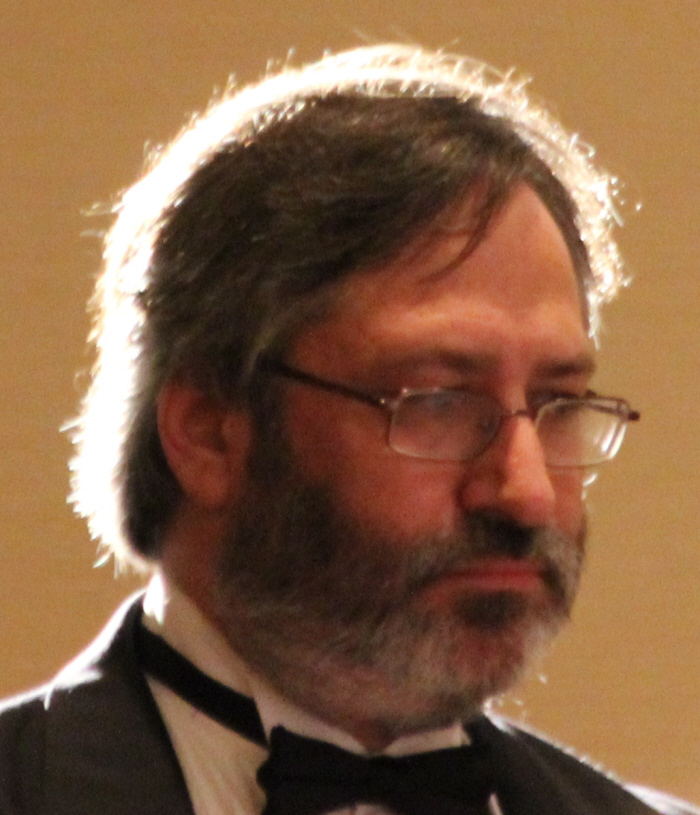 Steven H Silver is a sixteen-time Hugo Award nominee and was the publisher of the Hugo-nominated fanzine Argentus as well as the editor and publisher of ISFiC Press for 8 years. He has also edited books for DAW, NESFA Press, and ZNB. He began publishing short fiction in 2008 and his most recently published story is “Webinar: Web Sites” in The Tangled Web. His most recent anthology, Alternate Peace was published in June. Steven has chaired the first Midwest Construction, Windycon three times, and the SFWA Nebula Conference 6 times, as well as serving as the Event Coordinator for SFWA. He was programming chair for Chicon 2000 and Vice Chair of Chicon 7.
My Golden Age would be 1966. I haven’t looked at it specifically to see what I would have been reading then, but that would be an interesting exercise.
Of the stories you mention, “The Thaw” in particular, is great. I also love “Mandalay”.
Steven,
This has been a really entertaining and delightful series, and I was proud to host it at Black Gate.
This last post is one of my favorites, and a great way to wrap things up. Take a bow, my friend!
1979 was pretty close to my own Golden Age. I think my favorite stories of 1979 were (in order):
“Sandkings” by George R. R. Martin (which I read in OMNI)
“Unaccompanied Sonata” by Orson Scott Card (read in a YEARS BEST anthology, I think)
“Songhouse” by Orson Scott Card (read in a YEARS BEST anthology a few years later)
“Enemy Mine” by Barry B. Longyear (can’t remember)
Story I wish I’d read? “The Moon Goddess and the Son” by Donald Kingsbury, which got a lot of attention at the time.
As usual, John, you ignore the Canadian!
One more 1979 story worth a mention is Connie Willis’ first truly major piece, “Daisy, in the Sun”.
> As usual, John, you ignore the Canadian!
I met Kingsbury in Ottawa in the mid-80s when he was a guest at Maplecon, and was very embarrassed to discover I couldn’t remember reading any of his fiction!