Dropkick Me, Batman: A Meditation on Absolute Batman #1 – 6, by Scott Snyder and Nick Dragotta
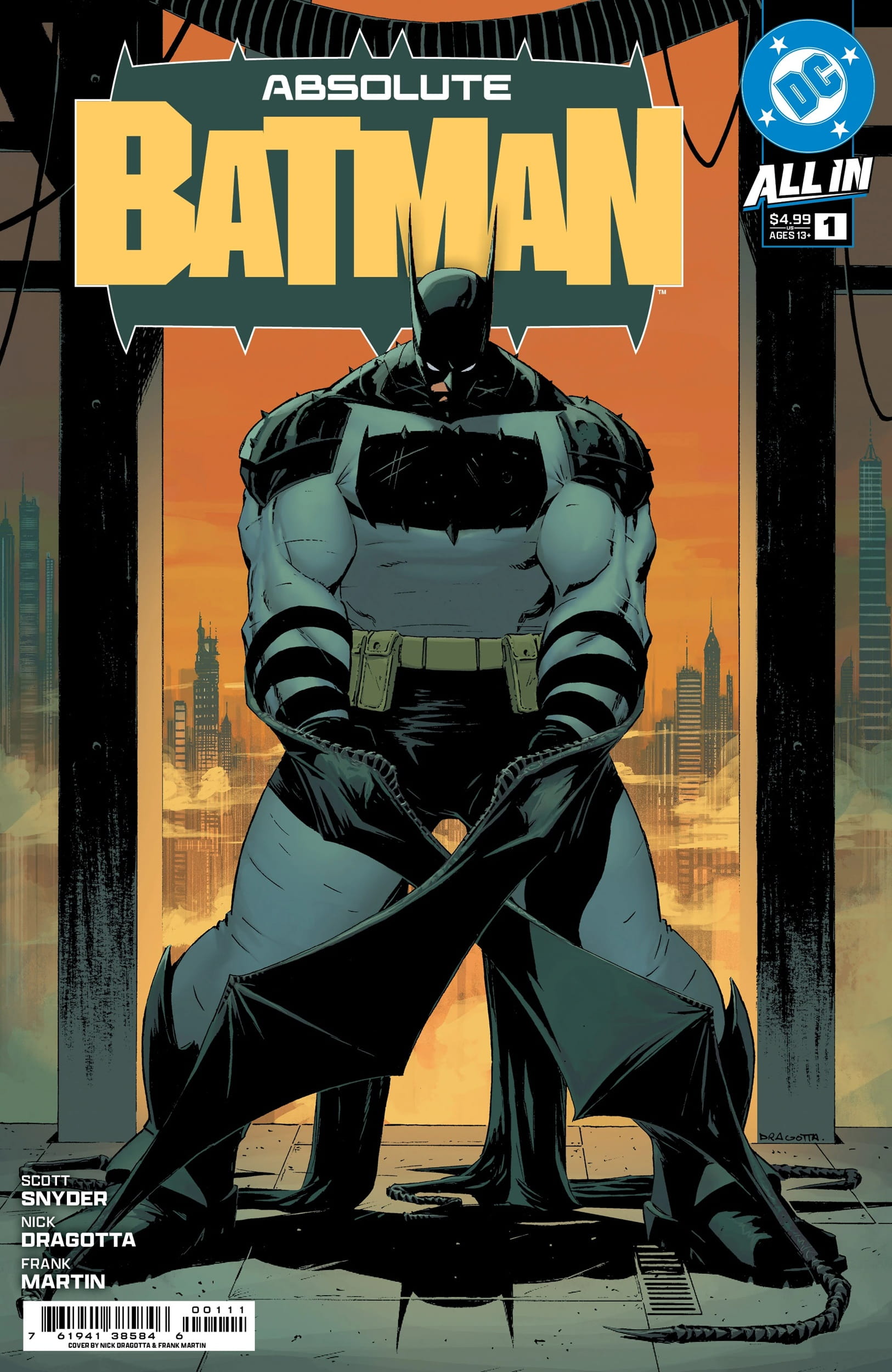
I signed up for the DC Comics Infinite app to access the DC backlist more affordably, but I thought I would try their buzzy new-ish Absolute Batman series. Since Batman is a superhero whose comics I’ve been reading since the early ’70s, and whom I first encountered in the mid-’60s Batman TV show, I’ve been curious about this new re-visioning. So I read “The Zoo” (Absolute Batman issues #1-#6, December 2024-May 2025).
In response, well. Great art (clearly influenced by Frank Miller, particularly his Batman: The Dark Knight Returns, and the late, lamented, and by the sadly underappreciated Darwyn Cooke). Dynamic panels. Snappy storytelling.
But the creators — writer Scott Snyder, artist Nick Dragotta, colorist Frank Martin, and letterer Clayton Cowles — are trying to swim upstream against the powerful current of decades of DC Multiverse history, and not always making the greatest decisions.
[Click the images for Batman-sized versions.]
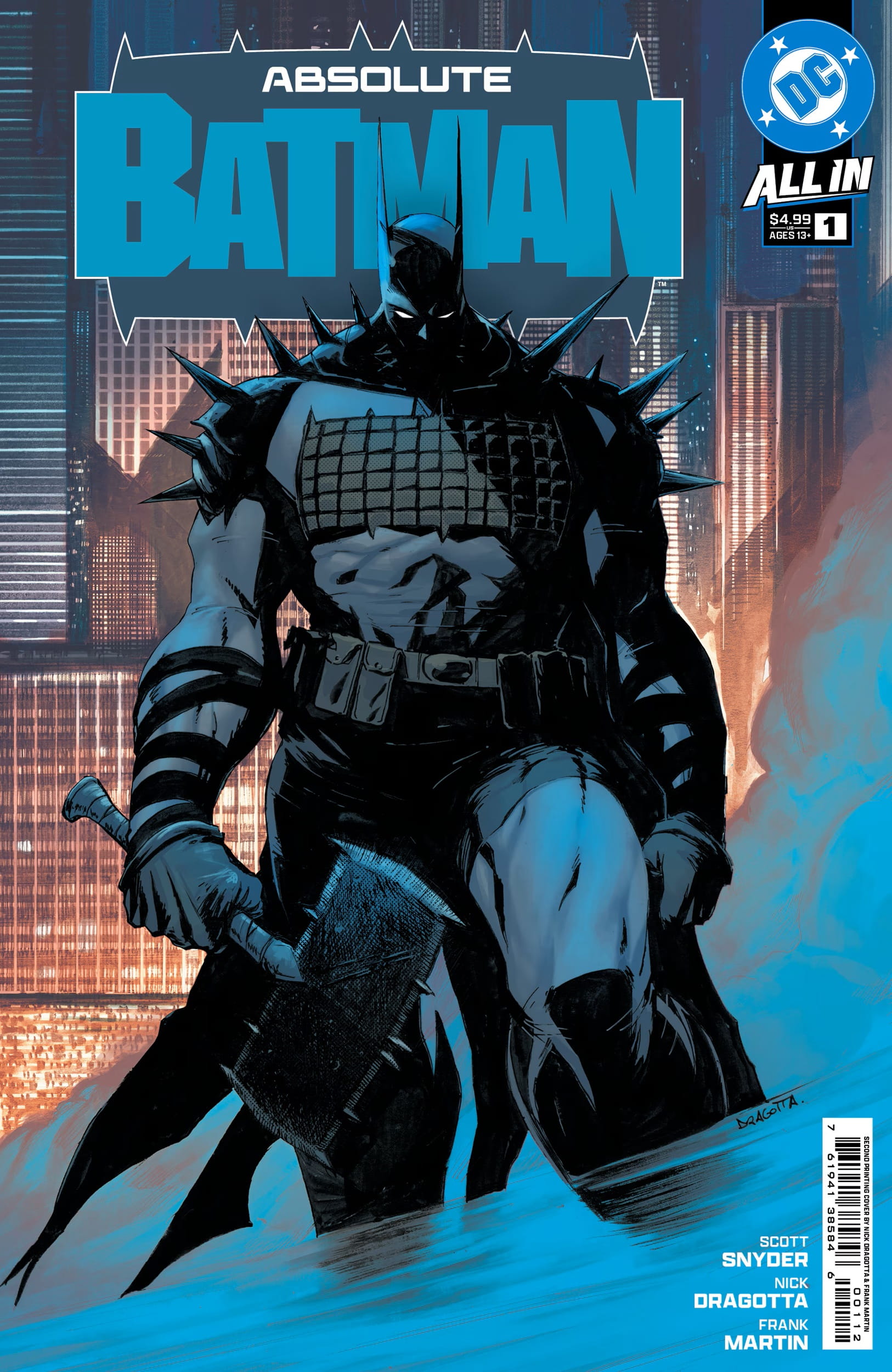
I’ve long thought superhero comics, especially from the Big Two, have been in a decadent period since at least the ’90s. This is a neutral observation. I quite like some decadent art. For example, the early issues of Garth Ennis and Darick Robertson’s The Boys, while pretty problematic, are pretty brilliant (the later issues I have yet to read). However, the first Absolute Batman storyline marks the first time I’ve wondered whether Big Two superheroes are entering their dotage —
— although, to be candid, it might be me, given I’m 65 years old.
Still, I wonder.
In fiction, a protagonist’s greatest strength is often also their greatest weakness and, sometimes, doom. Think of private eye Philip Marlowe, who is so dogged, so determined to solve the case, that he nearly gets himself killed — over and over again. Or think of British secret agent James Bond.
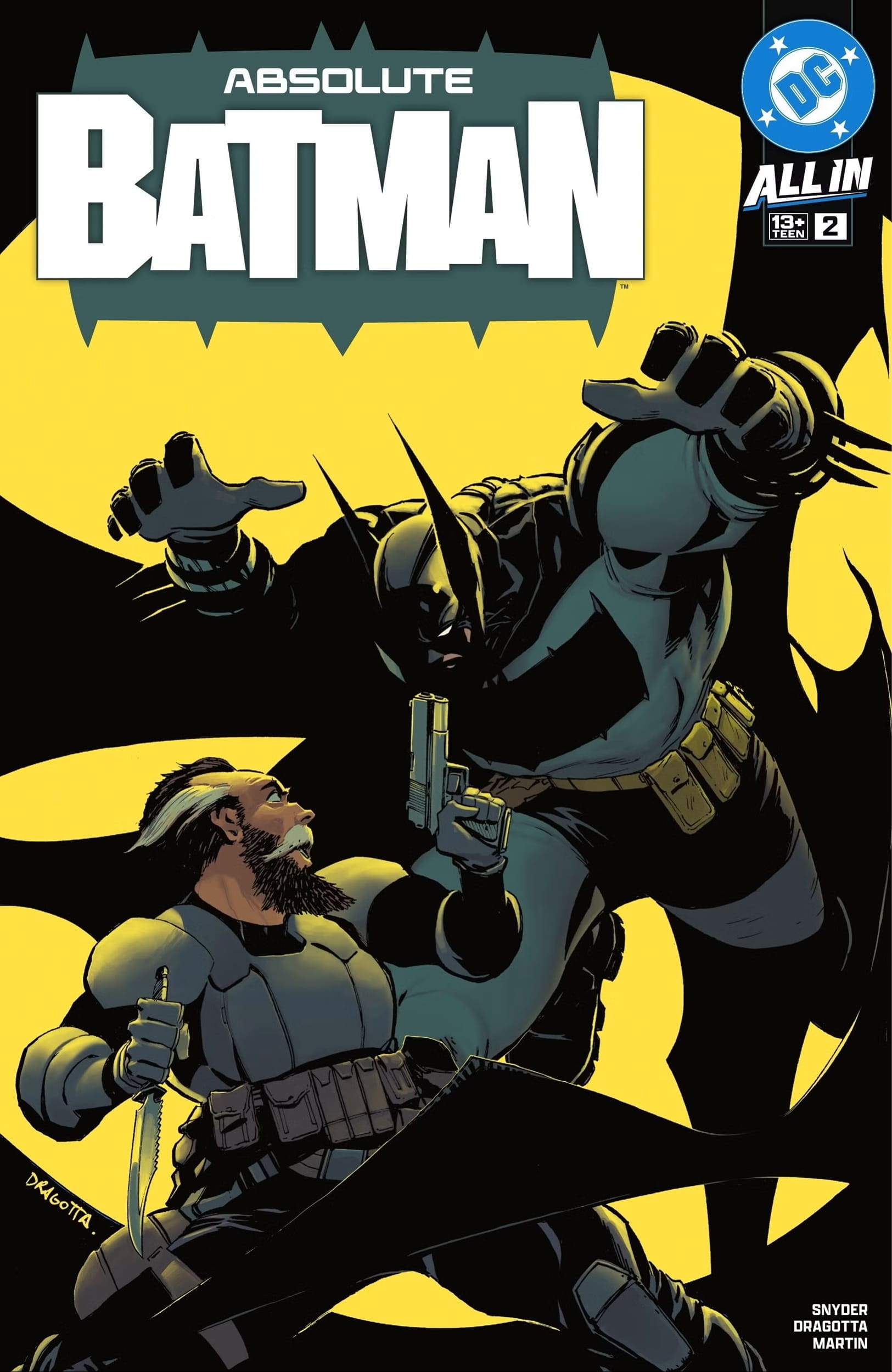
The greatest strength of the recurring superstars in well-established comic-book universes is that these characters are known quantities. They’ve had decades of generally consistent development (or perhaps I should say maintenance). You know who Batman is, and even if you’ve never read a Batman comic or experienced any of the spin-offs across multiple media, you almost certainly know something of alter ego Bruce Wayne’s tragic backstory, something about his crime-riddled home of Gotham City, and a few things about Batman’s most important sidekicks and villains.
But our greatest strength is also our greatest weakness, and the legacy superheroes’ biggest strength has become their biggest liability. It’s a development unlikely to reverse for the nearly-ninety-year-old Batman (or for any other long-running superhero), because he needs to remain recognizable to function as both a character and a viable commercial property in late-stage capitalism, and so do his important allies and antagonists. This bivalent function means that, however much you reboot Bats or the DC Universe, you retain or regain the accessory elements — tragic origin story, famous associates, etc.
DC’s new Absolute Universe is an attempt to strip their most famous superheroes to the bone by removing key elements. What if Wonder Woman loses her mother, the rest of the Amazons, Themyscira Island, and an arm, plus is raised in Hell? What if Superman loses his parents and escapes the destruction of Krypton as a youth, and, after spending barely any “humanizing” time with Jonathan and Martha Kent, may become a dangerous rogue? What if Bruce Wayne is a twentysomething working stiff, instead of a thirtysomething rich man with near-unlimited funds for Batman’s anti-crime crusade?
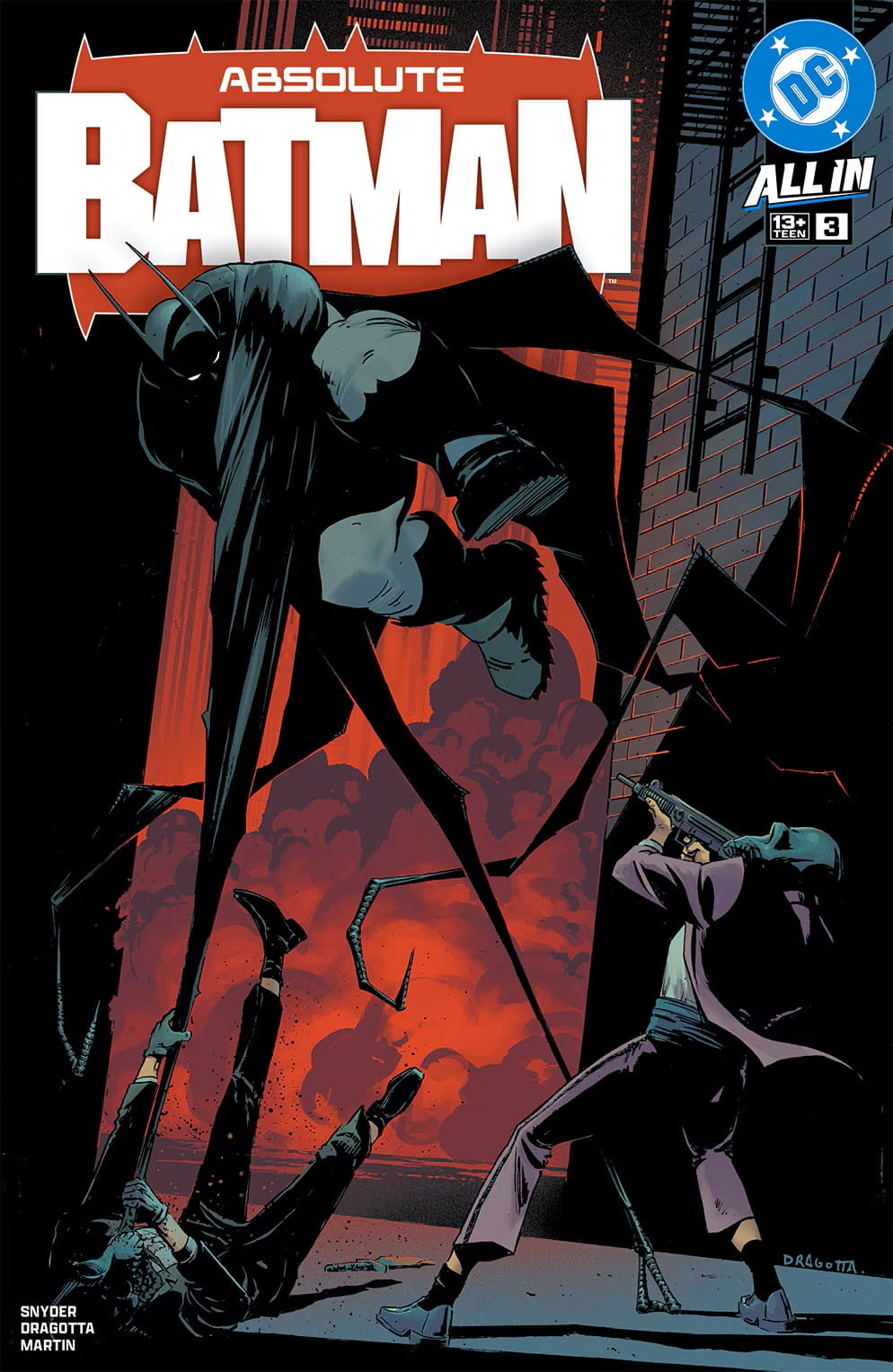
In the case of Absolute Batman, I don’t think they removed enough to overcome the weight-of-history problem — and I’m not exactly won over by everything they did change.
First of all, events in “The Gift” make it increasingly difficult to believe Absolute Batman doesn’t have access to a considerable cash stash, especially once the Absolute Batmobile is unveiled. Yes, he’s a brilliant inventor in this timeline, too, and that’s fine — but, as Malcolm Gladwell has demonstrated in Outliers: The Story of Success, exceptional gifts only get you so far in the absence of other advantages (“The biggest misconception about success is that we do it solely on our smarts, ambition, hustle, and hard work”).
So, given Absolute Bruce Wayne is a young construction worker, I can only wonder, did he steal the baseline vehicle and add-on elements? (The creators do establish that this version of Bats is willing to at least temporarily appropriate and alter someone else’s superduper firearm.)
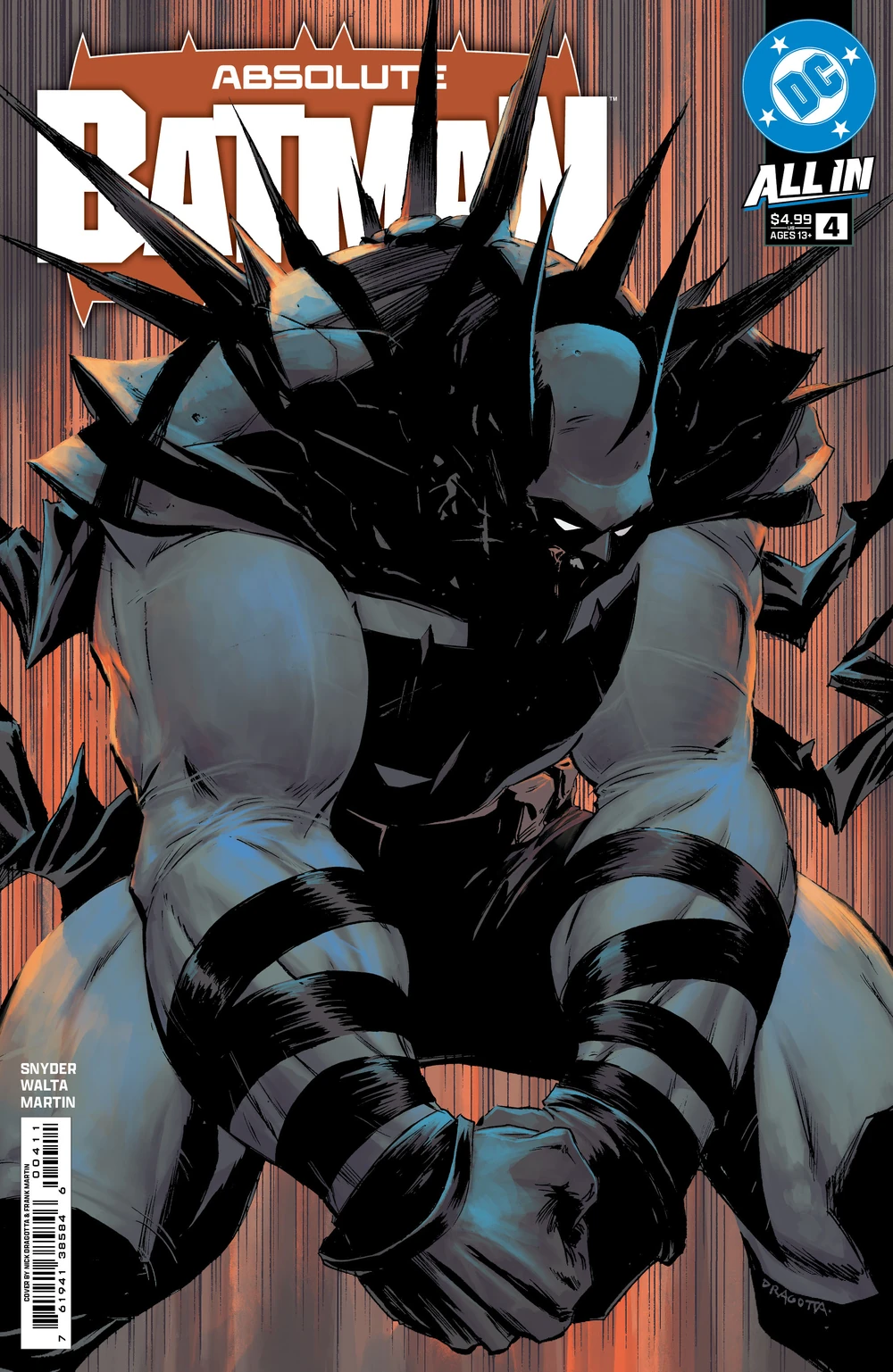
I don’t expect superhero creators to be taking Outlier as their Bible, but the ability to become Batman without the Wayne fortune means Absolute Batman is about Bruce dealing with the disadvantages that so often keep lower-income individuals from the success more readily available to their rich counterparts. So working-class young Batman whipping the Absolute Batmobile metaphorically out of nowhere — in the first story arc, no less — really stretched the suspenders of my disbelief.
But Batman without the Batmobile has become unimaginable, so, however impossible, we get Absolutely Unaffordable Batmobile.
Another element I struggled to accept is Batman’s opposition. They’re a criminal gang known as the Party Animals — a seemingly numberless agglomeration of ruthless criminals who are bankrolled and directed, it turns out, by a brilliant, evil mastermind of functionally unlimited wealth. Thanks to the black web and bitcoin, the mastermind can hire an unlimited number of operatives… although he isn’t paying them in advance, apparently, so why do they tend to dress well and harmoniously, when conditions in Gotham are supposed to be dire?
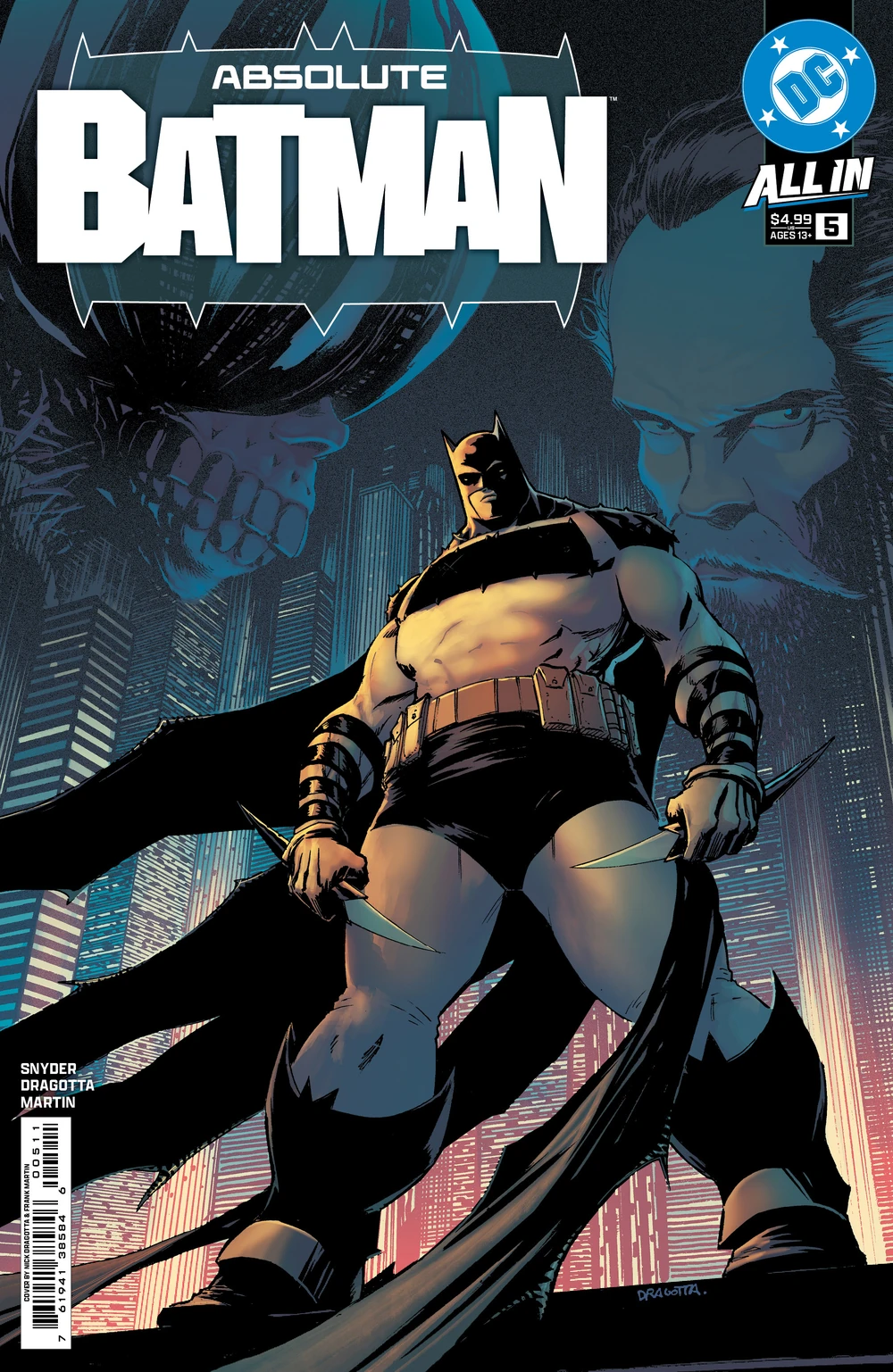
Gotham’s decay is clearly intended as the motivation for the Party Animals’ abysmal behavior, but the link is not well developed. For example, compared to L.A., or even Portland, Maine, Gotham’s homeless population seems small. There is insufficient hardship for so many private citizens taking up not only arms and anarchy, but torture and mass murder, even when offered a lot of money.
Now, maybe I underestimate the number of desperate people cruising for work on the dark web and willing to sign up to commit heinous mayhem at the risk of their own freedom and lives. But flocking to torture random “civilians” is not the typical behavior of any criminal gang I’ve done any research on, never mind the behavior of most anyone else. I get it: the criminal mastermind is basically a terrorist exploiting hard times and anger. But even infuriated residents brutalized by an insane level of income inequity and inured to mayhem by ultraviolent crime dramas and news reports are unlikely to turn a day care center into a multiple-homicide barbeque and celebrate the fiendish butchery.
And then I’m asked to believe a relative novice of a Batman is going to beat this copious and quasi-organized assortment of sadistic monsters?
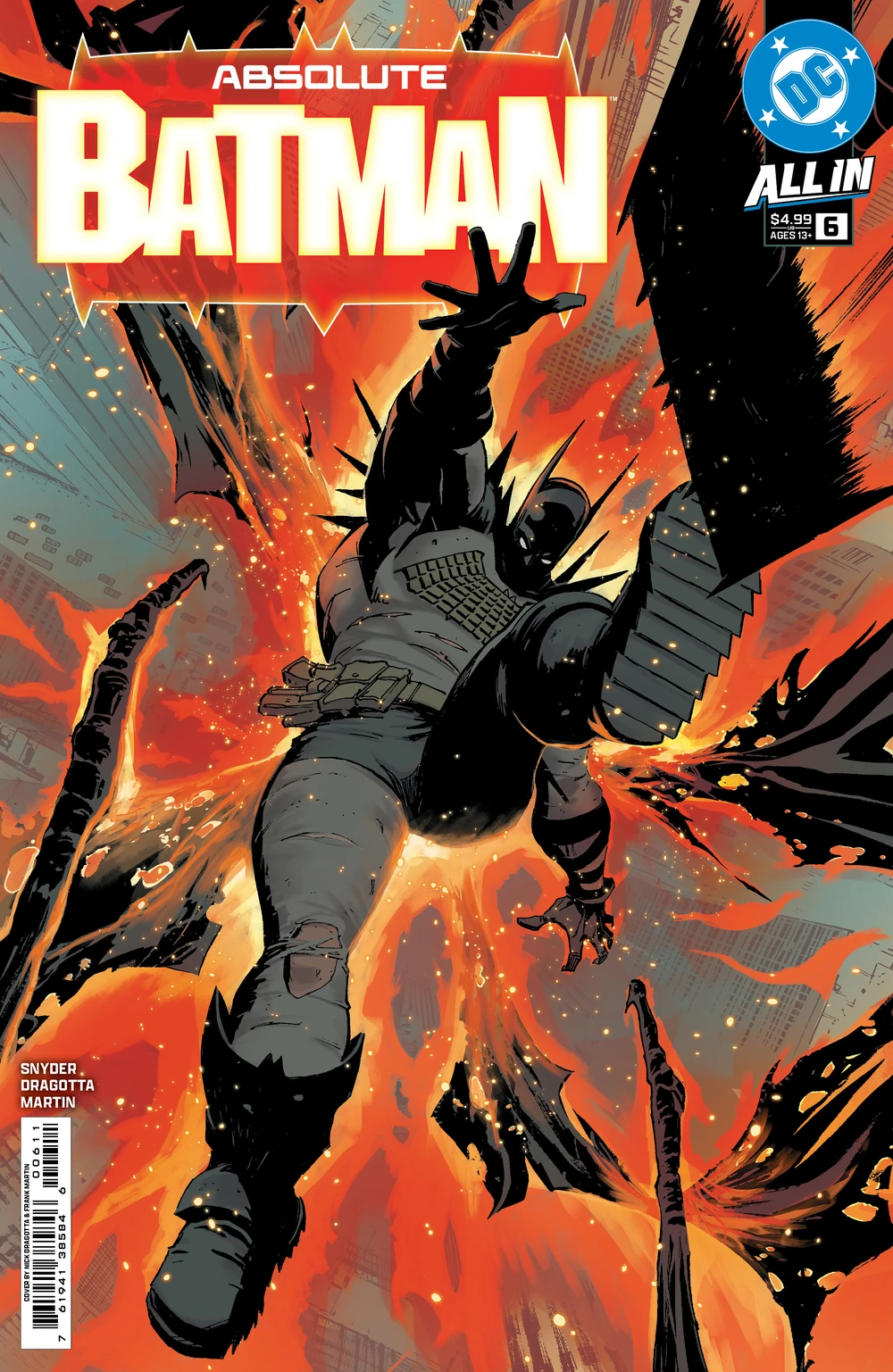
The deteriorating conditions in Gotham — and particularly the cold-blooded murder of child-Bruce’s father, Thomas Wayne, as part of a killing spree — are, of course, the motivation and justification for adult-Bruce taking up crime-fighting as Batman. In this timeline, he evinces the unwillingness to kill which is typically associated with Batman.
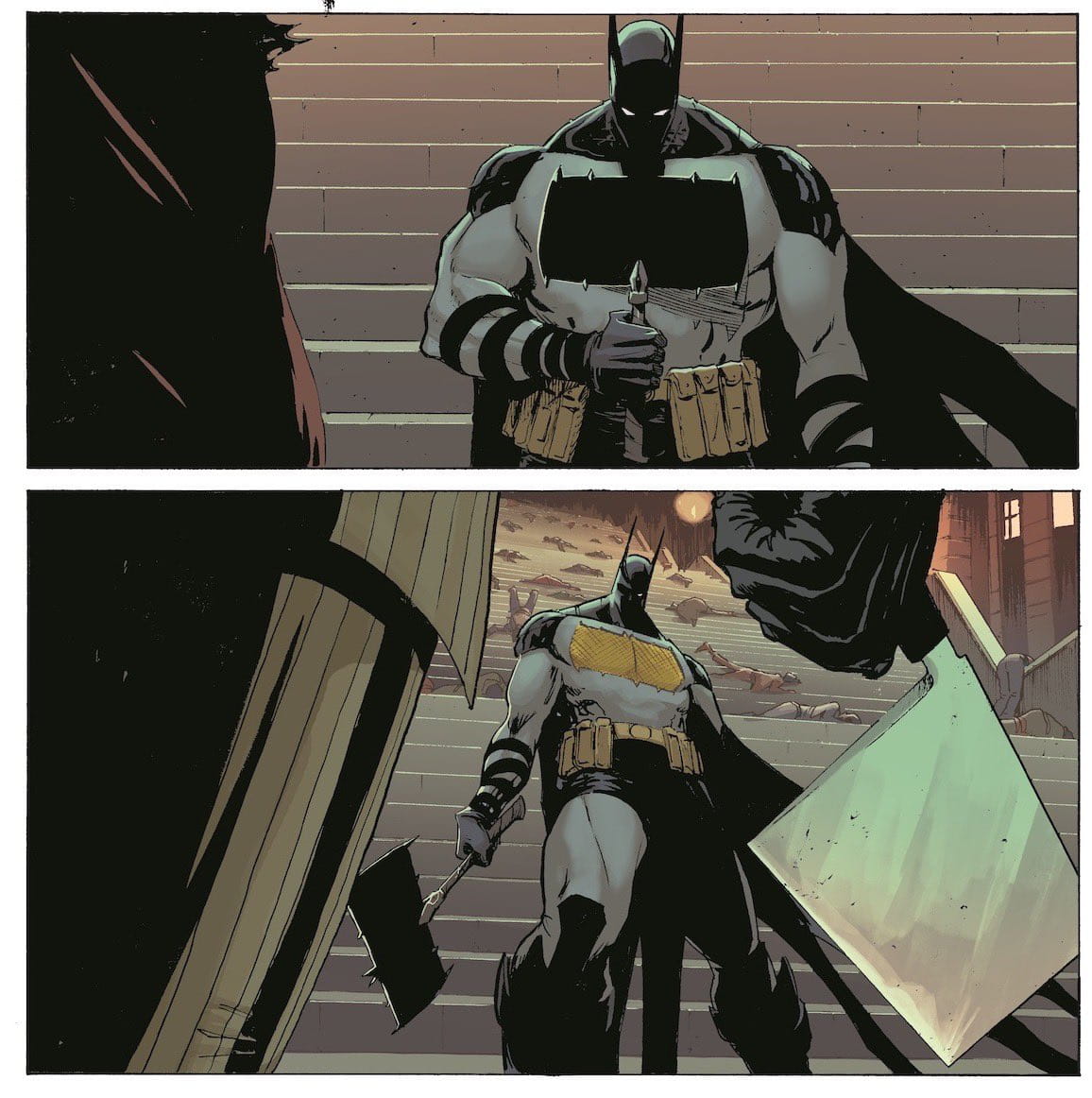
However, his blood-soaked war against crime might be seen as approaching the Party Animals’ sadism. Batman’s unwillingness to kill seems a little (or a lot) like a technicality when he chops off an opponent’s hand and then tells the man there’s a hospital a few blocks in this direction that he’d better run to fast if he wants to survive… unless it’s a few blocks in another direction.
Now, to be sure, personal trauma damages you. Also, to be sure, Batman embodies the dark side of the superhero, as Superman represents the side of light. But don’t expect me to think I’m simply reading about a deeply flawed and damaged hero when Batman drop-kicks a child.
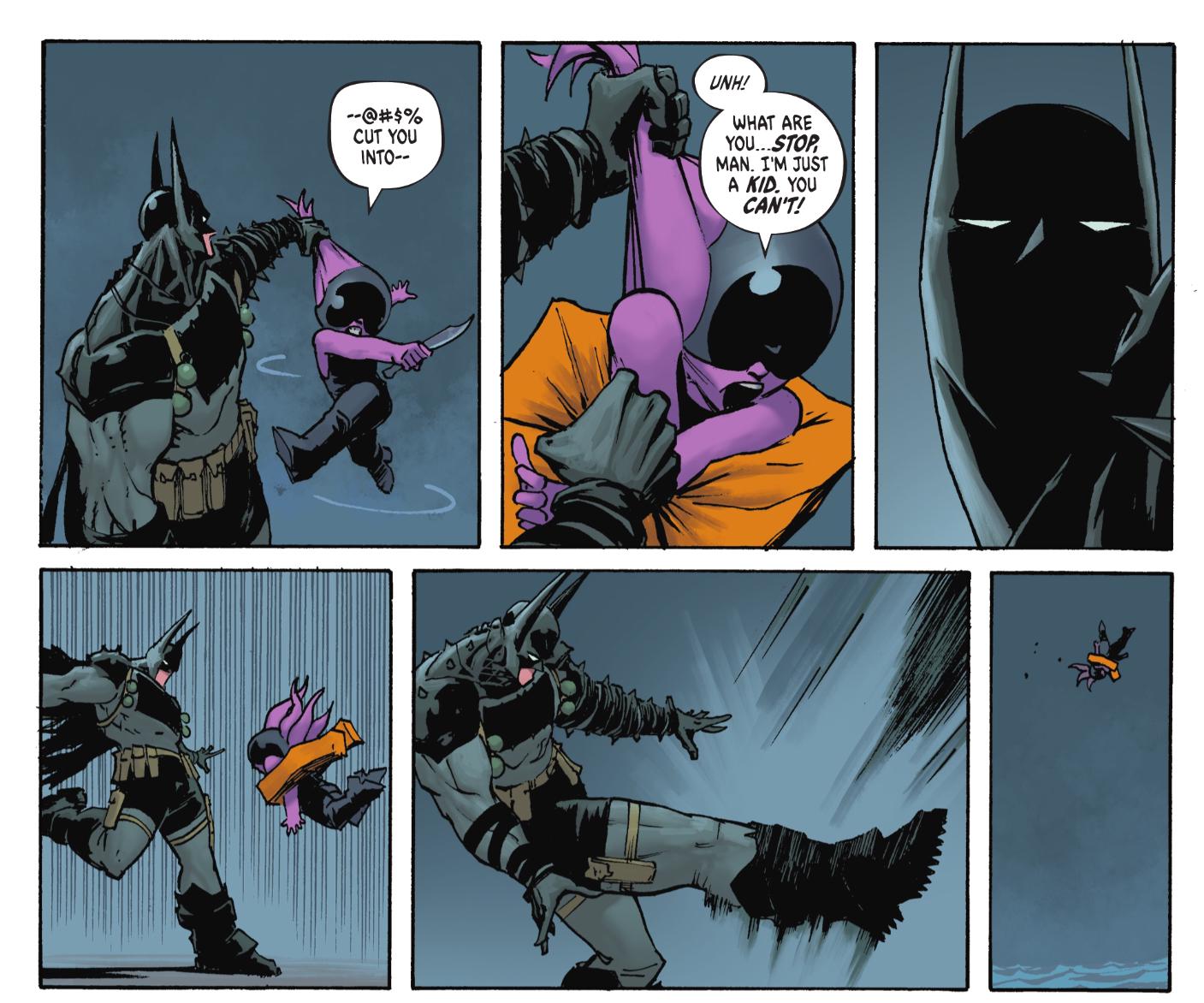
(This situation, by the way, represents a real lost opportunity. Yes, the boy attacks Batman with a knife and, as the child of villains, probably hasn’t been instilled with stellar values. And Batman defending himself from a knife attack is reasonable. But the child attacks Batman because he sees this complete stranger — someone with massive muscles and bizarre costuming, who literally drops out of the sky — attacking his family. Are we supposed to think child-Bruce, if he had knife and opportunity, would not have gone after the man seeking to kill Bruce’s father? Maybe this mirror situation is intended to be addressed in a sequel to “The Gift.” But currently it reinforces the idea that Absolute Batman is such an absolute asshole, he can’t even empathize with a small child in the same traumatizing situation he once survived.)
As “K. Leslie Steiner” (Samuel R. Delany) suggests in the foreword to Delany’s sword and sorcery collection, Tales of Nevèrÿon, a work of fiction — whatever and whenever its setting — is an exploration of the now of its time, not of the fictional setting’s time. Our now is going downhill at an accelerating rate in the United States, so Western comics are reflecting that. But maybe, when the popular new Batman is a humorless, obsessive, homicidal sociopath, it’s time to think about places the present might go that aren’t worse?
Sadly, I suspect the weight of some nine decades of Batman will just keep pushing things toward what many call “the edge” but which is starting to look more like “the bottom.”
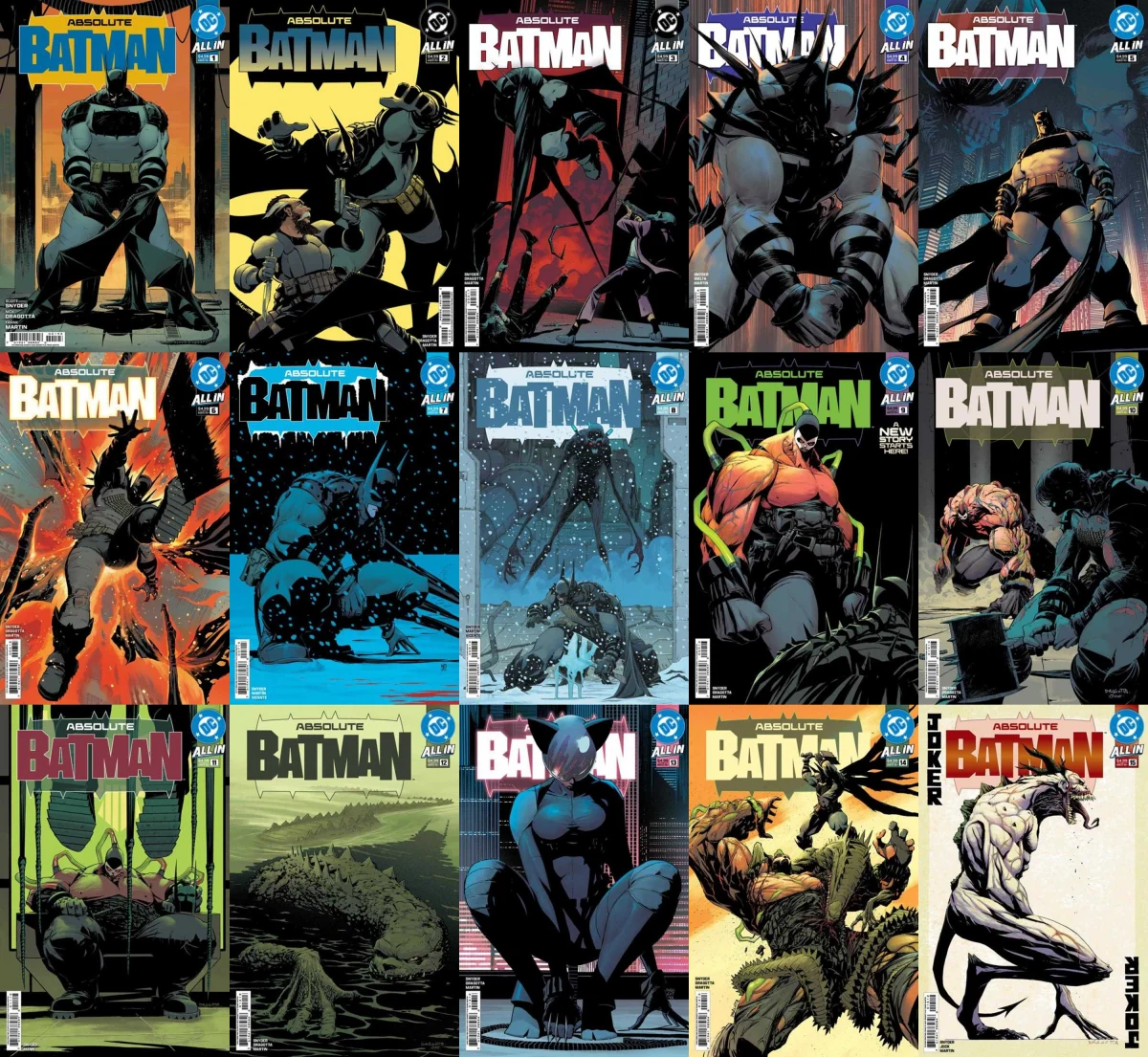
To be fair, Snyder and Dragotta are doing a lot of interesting change-ups. The Party Animals seem to be new villains (although their mastermind, Black Mask, has appeared previously in another DC timeline, if not several). Bruce Wayne’s mother, Martha Wayne, is alive, and the Deputy Mayor of Gotham City. Police Commissioner James Gordon is now Mayor Jim Gordon, who appears poised to get his butt stomped in his reelection bid, because he doesn’t seem to make good policy decisions about things like minimally adequate security in a terrorized city. His daughter, Barbara Gordon, is a uniformed cop, apparently as young as Bruce is here (early/mid 20s), and Black and/or biracial — though, disappointingly, she doesn’t do much of anything in this story arc.
Presumed-rookie Gordon is a symptom of a larger narrative choice which doesn’t work for me, which is that so many of the most significant players of the Batverse (excluding — I think — the Robins) are known to Bruce from early on. The supervillain biggies of other timelines (Joker, Catwoman, etc.) are, herein, Bruce’s childhood and early adulthood friends. There’s a suggestion they may remain good guys and become Batman’s sidekicks in the Absolute Universe, which is a promising alteration. Yet, ultimately, it feels like there’s no escape. It feels like Batman is doomed to repeat his history, no matter how many histories he gets. I feel claustrophobic.
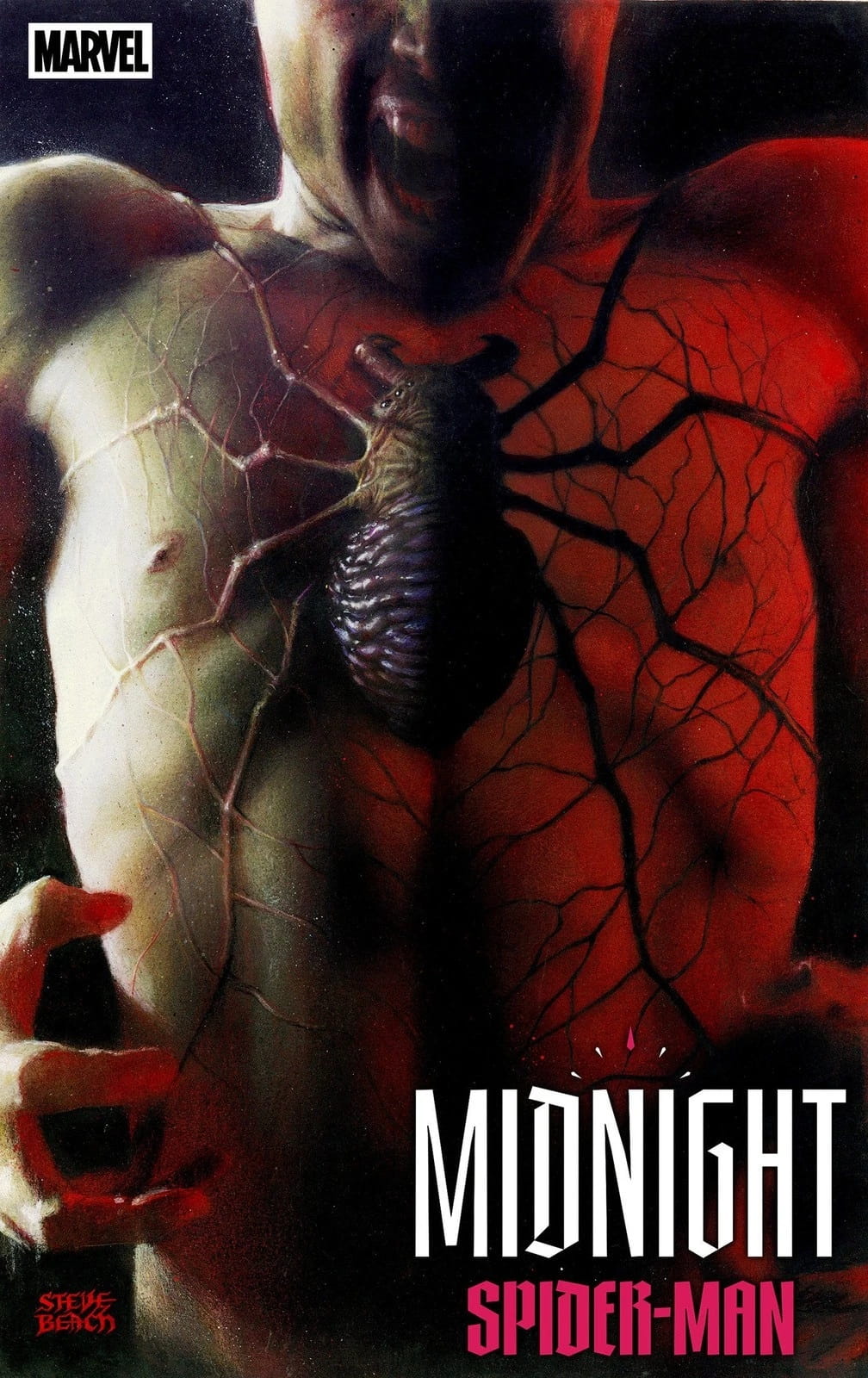
Claustrophobia is clearly not most people’s reaction, given Absolute Batman is the best-selling Bat-title of our time. Which is fine — we don’t all have to like the same things. But the tightly circumscribed situation is another symptom of legacy superheroes suffocating under their own history. However much or however often the relevant fictional universe may be rebooted or spun off, the oppressive significance of the superheroes’ continuity, success, and longevity continues to increase. Probably Sociopathic Batman was inevitable. And probably the launch of Midnight Marvel, a reboot of the other long-time legacy imprint’s best-known superheroes in “a terrifying new universe,” was inevitable.
While reading these early issues of Absolute Batman, I thought a lot about Miles Morales. Early on in the Ultimate Marvel timeline, he was a refreshing Spider-Man, not only because he wasn’t Peter Parker and was socioculturally pretty different from Peter Parker, but also because he inherently didn’t have so much of the original Spider-Man’s accumulated baggage.
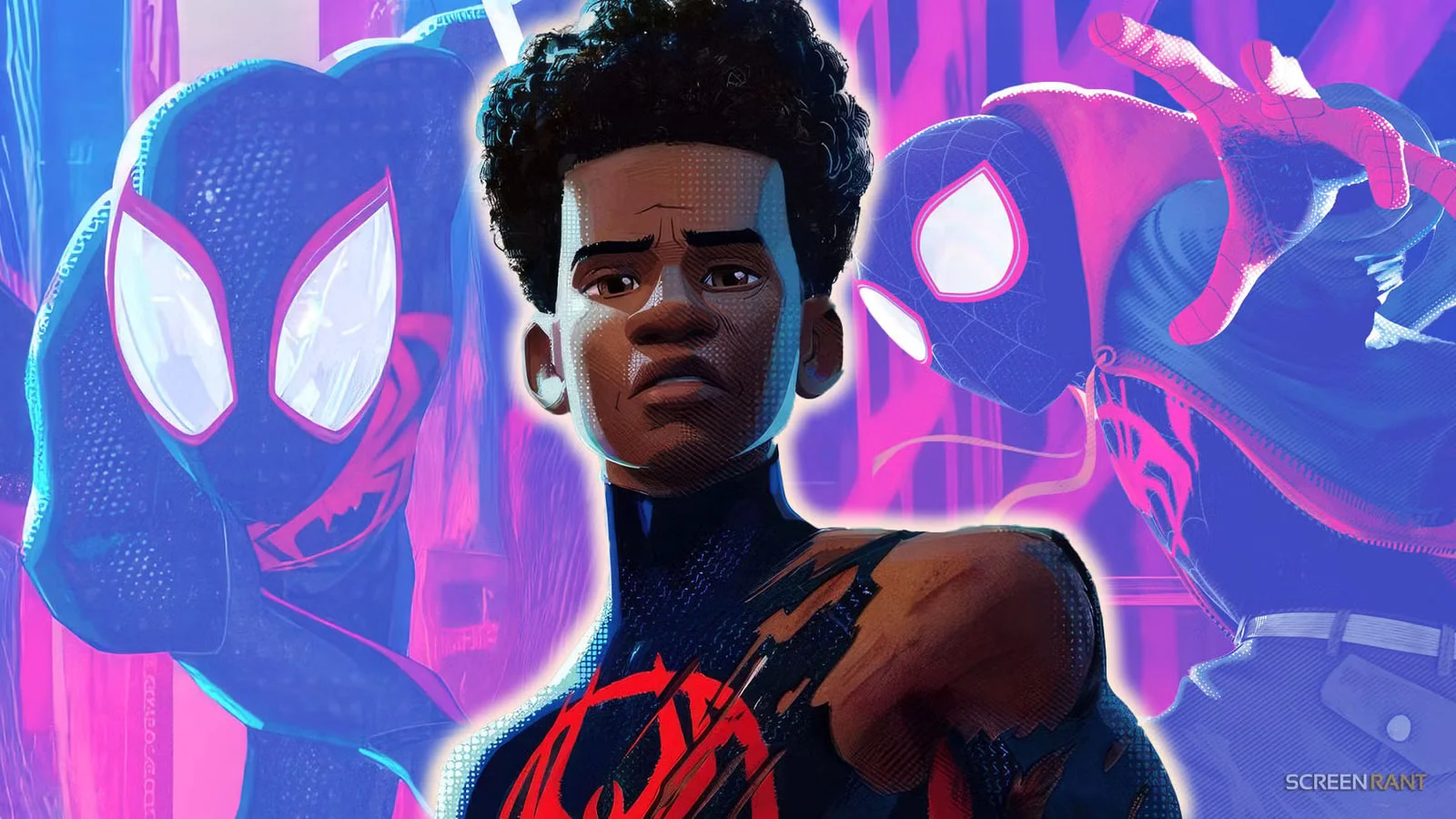
Of course, that baggage increasingly weighed in, to increasingly tiresome effect. Still, I wonder about spinning off Batmans (Spider-Mans, Wonder Women, Supermans, etc.) who are truly different, regardless of the discomfort to bean-counters and status-quo absolutists.
For example:
A gay Black Superman whose complicated role and double life are significantly recomplicated by not automatically blending into the most privileged group in the U.S.A.
A cross-dressing Chinese immigrant woman Batman during the California Gold Rush, whose motivation isn’t the death of her parents, but her partner’s slaughter by claim-jumpers.
A trans Wonder Woman who embodies in an unexpected body on Themyscira Island and faces increasingly dangerous marginalization in the United States.
Or just a different set of villains entirely.
I know. Not likely. There’s more gold in them thar old hills, however overworked, than in new territory. Or at least that seems to be the view of upper management.
But then again, there’s no particular reason to think we won’t have legacy superheroes a century from now, laboring under more than twice the current weight of history and expectation. Then, all else might fail. Then, we might end up with some genuinely fresh and radical rethinking of legacy superheroes.
Although I wouldn’t object if it happened now.
Cynthia Ward is the author of The Adventure of the Incognita Countess (Aqueduct Press, January 2017), Writing the Other: A Practical Approach (with Nisi Shawl), and more than 70 short stories and chapbooks. Her last article for Black Gate was a look at DC’s Lords of the Ultra-Realm by Doug Moench and Pat Broderick.