Nine Years Later – Revisiting Castlevania and Tragic Villains and Heroes
Goodafterevenmorn, Readers!
Being chronically online has revealed some pretty awesome things (as well as absolute nonsense (covered previously)). For example, I discovered an entirely new to me Transformers show – Transformers Prime, which is a lot of fun. Also, fully available on YouTube, if you’re interested. Perhaps one day I’ll go through the show and point out its very funny rebuke of the Bayverse Optimus Prime. It’s probably very basic of me, but Optimus was always my favourite Cybertronian. But we’re not here to talk about that.
What I wanted to talk about was Castlevania. Let’s dive in!
The YouTube algorithm has been popping off with new reactions to Castlevania in my feed — a now nearly ten-year old Netflix original animation adapted from a series of video games bearing the same name. It is far and away the single best video game adaptation, I think, or at least on par with The Last of Us (which I also loved). So of course, I’ve had to rewatch it. Nothing has changed from the first time I watched it. Castlevania is phenomenal; a masterclass in writing and voice acting, as well as stylish animation.
But what struck me most was how it is a beautiful example of writing tragedy. In fact, Vlad Dracula Tepes in this series is one of the best sympathetic villains I’ve seen in pretty much any media. His son is one of the best tragic heroes. I’ve written about Vlad specifically before on this very site, I realise (as a search for images to use revealed my own damned article… that’s a weird experience), so I’m going to focus a little more on Alucard this time… Though I remain absolutely fascinated with Vlad as a character in this show. I’m also limiting it to the first two seasons, because there is a lot that this poor boy goes through, and I’d be writing forever if I went through it all.
The first two seasons make for a nice contained story within themselves, though the rest of the series is well worth the watch.
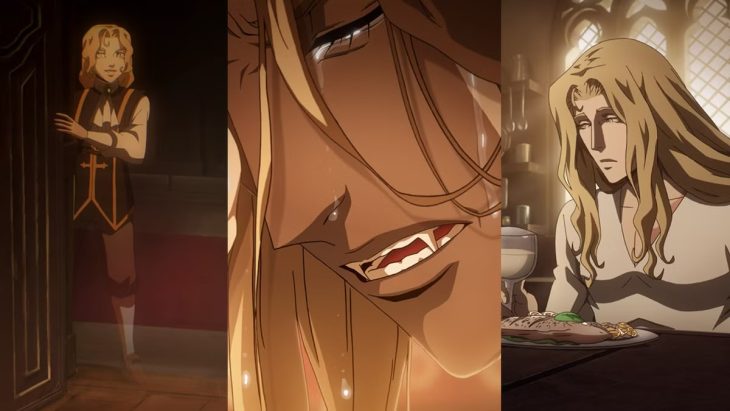
If you’ve not seen the series, stop reading right now, go watch it (four short seasons; very binge-able), and come back and tell me your heart didn’t break for both Vlad and Adrian (Alucard). Also, do it now, because this will be full of (probably mild) spoilers.
Right, so, from my last article, we know that Vlad’s quest for genocide was the direct result of his human wife being murdered — accused of witchcraft and burnt at the stake for the crime of effectively practicing medicine. We all know that women in possession of medical knowledge must have acquired it from association with the devil (that was sarcasm, in case that needed explaining). Which… in this story, is not really all that far from the truth. Lisa did make her way to Vlad’s castle and demand he teach her the sciences necessary to help her become a physician and help the people of Wallachia. So, I mean, she did learn it from a creature we might consider the embodiment of evil, I guess. There’s that.
In the first episode, we’re introduced to a mysterious blond man who tells Vlad that he also grieves Lisa’s death, and those responsible should be punished, but that he would not let Vlad commit genocide. Enraged, Vlad slashes this mysterious blond man. In that scene we don’t really see what this stranger looks like, save that he is blonde. If you are watching without the captions, you don’t even know it’s Alucard.

I’m not going to recap everything here. What you really need to know is that while Dracula was intent on making the world suffer for murdering his wife, Adrian was intent on saving the innocent from his father’s wrath. Both of them were, in their ways, acting out of love. Lisa would not want genocide in her name. Indeed, she even attempted to appeal to her husband as she died. Not that he could hear. He was off travelling.
So we have love for the same woman as the central fulcrum balancing two opposing ends. Vlad would kill his son to see his vision of a human-free world. Adrian would kill his father to prevent that. In his own words, he chooses to honour his mother by killing his father. What a terrible choice to have to make. But in Alcuard’s mind, his father cannot be stopped otherwise. Indeed, the man who was his father had died with his mother, and only a madman remained, lashing out in “the world’s longest suicide.”
Alucard had failed to stop his father before (right at the beginning of season one). We watch his journey as he teams up with a Belmont, the hilariously sardonic last son of House Belmont, and a speaker magician. So this time, when he confronts his father again at the end of season two, he has friends. Together, the three of them fight Dracula. And here we have the terrifying power of Vlad Dracula Tepes on display. He hasn’t been feeding. He is in a weakened state, and still, the three of them cannot overcome him.
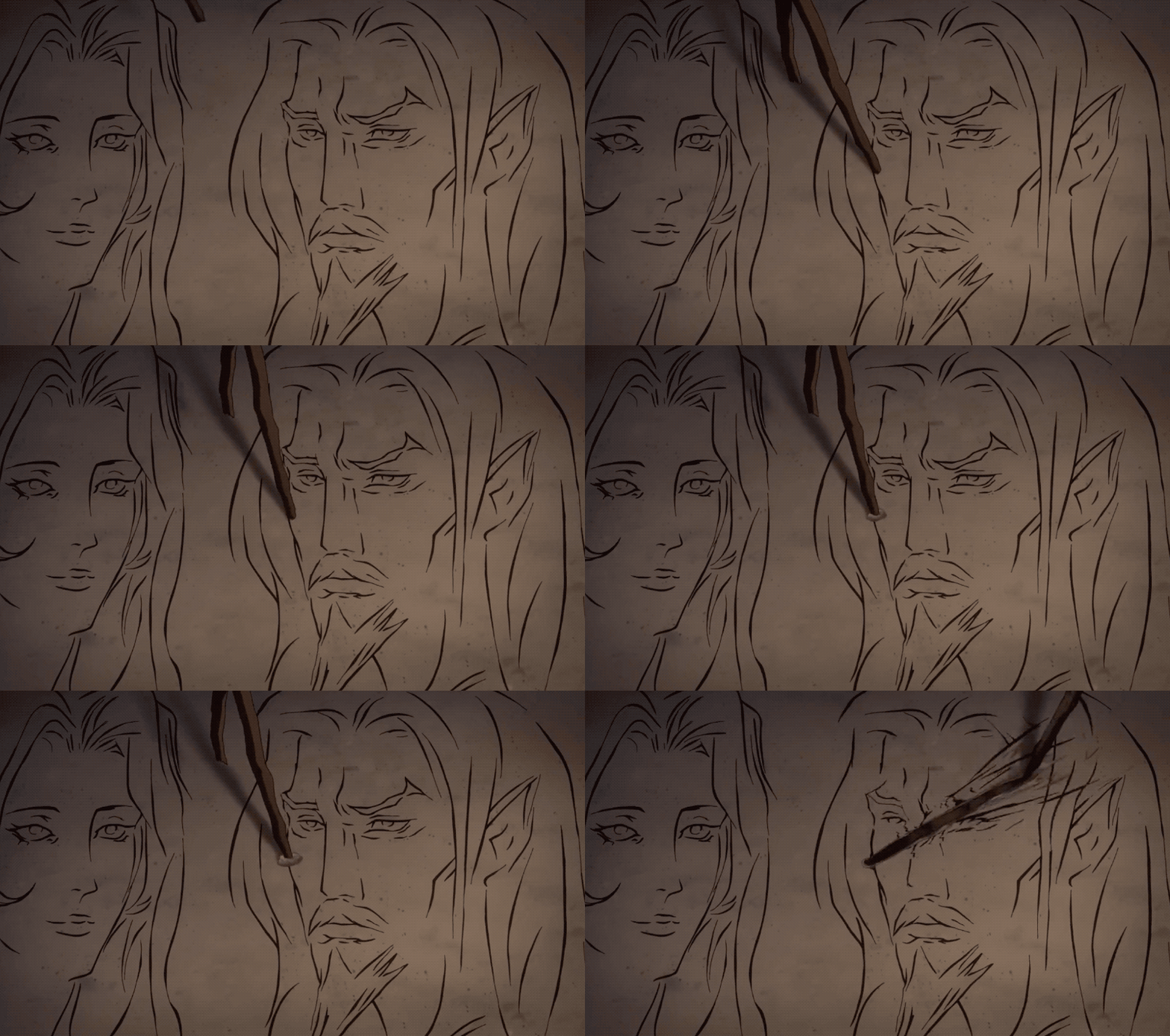
The only reason Alucard is able to land the final blow that kills his father is because Vlad ultimately lets him. Their ferocious battle through Dracula’s castle ends in Adrian’s childhood bedroom. It is there that Vlad realises that it is his son he’s very nearly killed. And he mourns it. He mourns nearly obliterating the gift his wife had given him. Only in that grief, only when his lovingly reaches for his son, does Alucard find the opening he needs to drive an improvised stake through his father’s heart, killing him.
That scene is as beautiful as it is brutal. The looks of grief and horror on Alucard’s face as he watches his father crumble to dust before his eyes is beautifully done. This isn’t a triumph. Sure, the genocidal maniac is killed. The heroes achieved their goal. But that victory is costly, and it is heartbreaking. At least for one of the heroes.
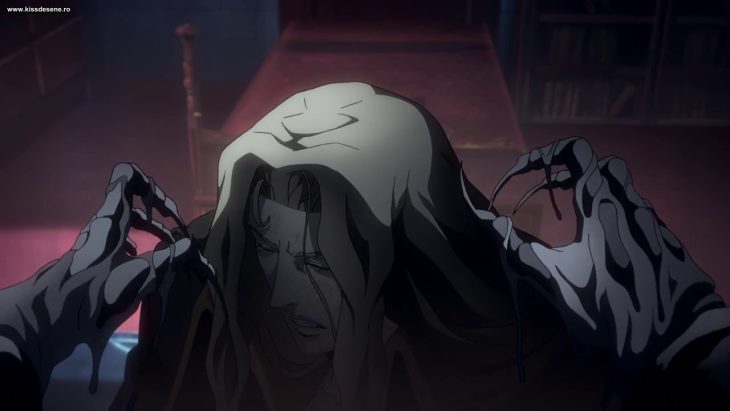
This heaviness is not lifted in the final episode of the second season. The aftermath. We see the other two heroes, Trevor and Sypha, head off together, clearly in love and happy. They won the day. Dracula is dead. The genocide is averted. Yay! They experience what many heroes written get to experience. Alucard is left alone in a guarding a ruined house, in a ruined castle full of mostly happy memories. There isn’t some grand celebration for Alucard. He isn’t satisfied or happy.
In fact the very last shot of the season is this:
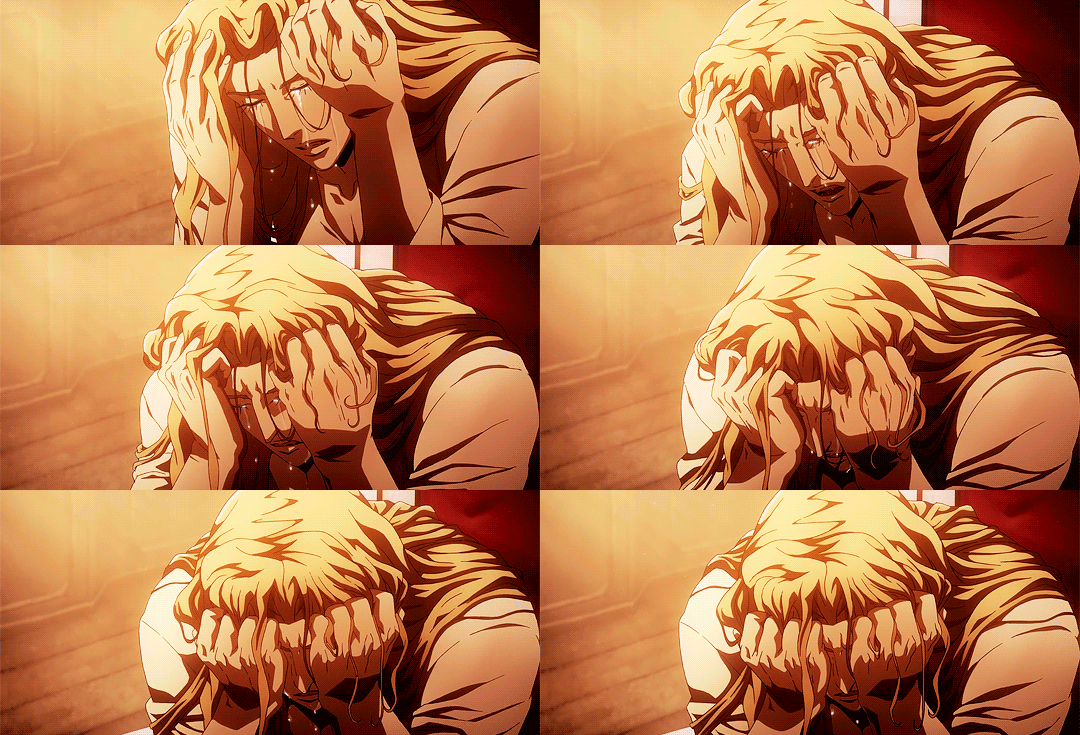
If the last episode broke hearts, this one shattered them. I have never wanted to hug a fictional character more. Poor baby.
It is also the perfect way to end the first two seasons. It’s also one of the best representations of the cost of heroism I think I’ve seen in visual media.
We are inundated with stories of heroes doing the deed and then being celebrated. It’s rare that we see heroes being affected by the things they’ve had to do to save the world in this way. It’s not usual for us to see heroes struggle after victory, to feel guilt or grief over the lives they’ve had to take. Personal cost for far too many heroes in media stops at physical harm. Not this series.
Like Frodo in The Lord of the Rings, the quest to save the world cost far more than a few scars or broken bones.
I adore the writers of this series for this. Creating this tragic character that is a hero, who achieves his goal, and who grieves because of it was a most excellent choice.
Because here’s the truth about heroism. It’s hard. Doing the right thing, the good thing is really, ridiculously hard. So hard, in fact, that few people do. The cost is judged too high for most people to do the right thing, even about much, much, much smaller evils than Dracula (or Sauron). Showing the deep, personal cost of Alucard’s act of heroism, of him protecting humanity, making himself an orphan in doing so, was brilliant. I would love to see more stories like this.
Of course, the writing throughout the first two seasons (and the entire series, to be honest), made this ending so damned emotional (at least for me. I sobbed — sobbed — the first time I saw this). And I really do also enjoy the more campy representations of heroes and heroism, when they win the day and are perfectly fine with all the things they had to do to get there. But there is a special place in my dark little heart for the tragic hero.
Anyway, I’ve already said it here, but I’ll say it again, Castlevania is masterful, and I’m so glad that the algorithm has put it back into my feed. I think this will become a yearly Hallowe’en-time watch for me. I love it.
When S.M. Carrière isn’t brutally killing your favorite characters, she spends her time teaching martial arts, live streaming video games, and sometimes painting. In other words, she spends her time teaching others to kill, streaming her digital kills… and sometimes relaxing. Her most recent titles include Skylark, Human and The Timbercreek Incident.