Peter Pan by JM Barrie
Hitherto he had thought it was some fiend fighting him, but darker suspicions assailed him now.
‘Pan, who and what art thou?’ he cried huskily.
‘I’m youth, I’m joy,’ Peter answered at a venture, ‘I’m a little bird that has broken out of the egg.’
This, of course, was nonsense; but it was proof to the unhappy Hook that Peter did not know in the least who or what he was, which is the very pinnacle of good form.
‘To ‘t again,’ he cried despairingly.from CHAPTER XV ‘HOOK OR ME THIS TIME’
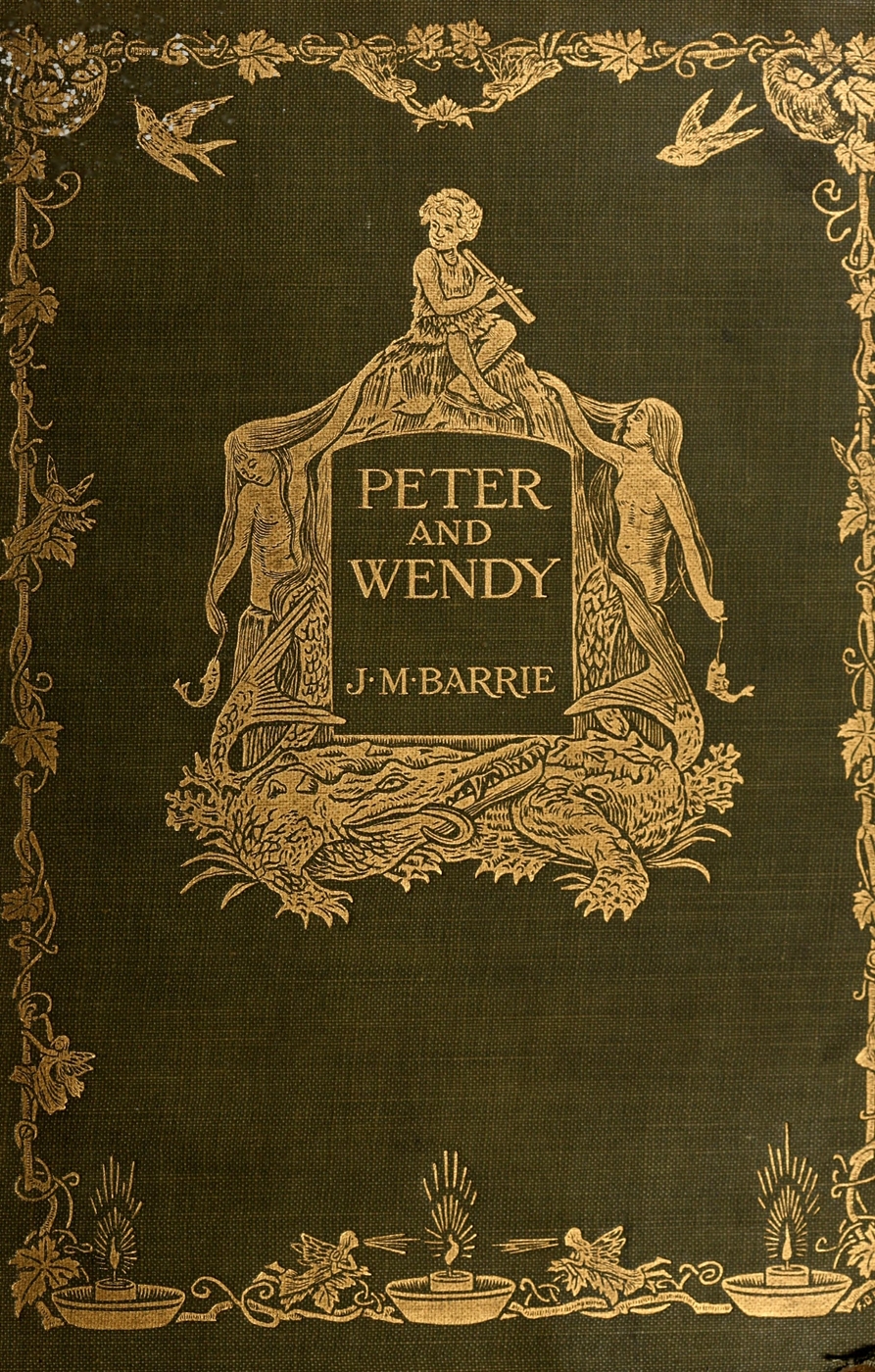
Leaving work yesterday, a friend expressed surprise when he saw my copy of JM Barrie’s 1911 novel, Peter Pan, in my hand. “You’re reading Peter Pan, the kids’ book?” he asked. To which I answered, “Yes. But it’s not a kids’ book, because it’s about a sociopathic twelve-year-old.” An exaggeration, perhaps, but not much of one.
I think most people, if they think of Peter Pan at all, it’s either because of the 1953 Disney movie or the long-running stage productions with first Sandy Duncan and later Cathy Rigby. For them he’s merely the boy who never grows up and spends his time fighting the Captain Hook and his crew of blackguards. Now, those are important elements of the book, but they barely hint at the depths contained between its covers. It is a much weirder, darker book than the Disney version.
J.M. Barrie, aka Sir James Matthew Barrie, 1st Baronet, born in Scotland in 1860 seems to have been a man unable to ever grow up fully himself. The ninth of ten children, his older brother David died in a skating accident at 13 and his mother consoled herself that he would never grow old, remaining forever young.
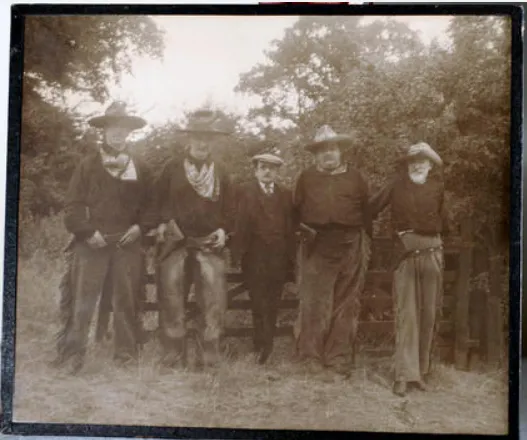
He was a member of literary world, being friends with John Galsworthy and H. G. Wells, a correspondent with Robert Louis Stevenson, and founded a cricket team that included Wells, Rudyard Kipling, A.A. Milne, and many others over the years. He even scripted and filmed a now lost Western starring G.K. Chesterton and George Bernard Shaw.
Barrie seemingly would fall in love with people regularly, though as a child does. He was married for fifteen years in a possibly unconsummated marriage to the actress Mary Ansell. He became attached to the Llewellyn Davies family in 1897 when he met George, Jack, and Peter, three of the five sons and their nanny in Kensington Gardens. He would meet them in the park while walking his St. Bernard and entertain them with stories.
He met their mother Sylvia at a dinner party, herself part of the literary world. Her father was the novelist George du Maurier and Daphne du Maurier was her niece. She and Barrie became friends, and soon, he became a fixture at her home. When her first her she died, not long after her husband, Barrie helped raise the boys. Sylvia had included him in her will as a trustee of the boys. He would remain close to them for the rest of his life.
The boys’ lives would remain touched by tragedy. First, George was killed by a sniper near Ypres in 1915. In 1921, Michael, with whom Barrie was closest, died, drowning, possibly in a suicide pact. Much later, in 1960, Peter, died when he threw himself in front of a train.
He invented the character of Peter Pan, inspired in part by all five boys, and told them stories of the wild boy’s adventures. In 1904, he wrote the play Peter Pan; or, The Boy Who Wouldn’t Grow Up. The play was successful in London and on Broadway. Shaw described the play as “ostensibly a holiday entertainment for children, but really a play for grown-up people.”
As children weren’t allowed on the stage at the time, the fashion at the time was to have young women play their roles, something as mentioned above, has continued through today when the play’s revived.
In 1911, Barrie turned the play into the novel Peter and Wendy, now more commonly known simply as Peter Pan. It is a story of the costs of growing up and the costs of not, and is wreathed in melancholy and wistfulness. It is also very funny and exciting.
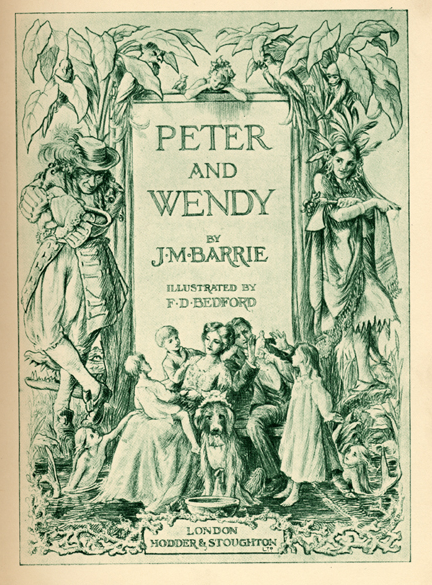
George Darling is a clerk in the City and Mary Darling keeps house. With the aid of a Newfoundland dog called Nana, hired as a nanny, she cares for her three children, Wendy, John, and Michael. One night, after her children were asleep, Mrs. Darling became curious about the name Peter
Mrs. Darling first heard of Peter when she was tidying up her children’s minds. It is the nightly custom of every good mother after her children are asleep to rummage in their minds and put things straight for next morning, repacking into their proper places the many articles that have wandered during the day. If you could keep awake (but of course you can’t) you would see your own mother doing this, and you would find it very interesting to watch her. It is quite like tidying up drawers. You would see her on her knees, I expect, lingering humorously over some of your contents, wondering where on earth you had picked this thing up, making discoveries sweet and not so sweet, pressing this to her cheek as if it were as nice as a kitten, and hurriedly stowing that out of sight. When you wake in the morning, the naughtinesses and evil passions with which you went to bed have been folded up small and placed at the bottom of your mind; and on the top, beautifully aired, are spread out your prettier thoughts, ready for you to put on.
When Wendy tells her mother Peter is in fact Peter Pan, a long-forgotten memory surfaces.
At first Mrs. Darling did not know, but after thinking back into her childhood she just remembered a Peter Pan who was said to live with the fairies. There were odd stories about him; as that when children died he went part of the way with them, so that they should not be frightened. She had believed in him at the time, but now that she was married and full of sense she quite doubted whether there was any such person.
‘Besides,’ she said to Wendy, ‘he would be grown up by this time.’
‘Oh no, he isn’t grown up,’ Wendy assured her confidently, ‘and he is just my size.’ She meant that he was her size in both mind and body; she didn’t know how she knew it, she just knew it.
When dead leaves appear from seemingly nowhere, Wendy tells her mother that Peter must have left them. The next night, on Nana’s night off, Mrs. Darling puts the children to sleep. Woken from a dream of distant place called Neverland, she lets out a scream when she sees Peter Pan is indeed real and in the room with her.
Responding to the scream, a returning Nana dashes up the stairs and lunges for Peter. He dashes out the window, but not quickly enough to keep his shadow from being severed when she slams the window closed. She resolves to tell her husband about it later, and rolls it up and puts it in a drawer. A few nights later, Peter, with the fairy Tinker Bell in tow, returns for his shadow.
When he can’t reattach the shadow to himself, Peter begins to sob, which wakes Wendy. As much smitten by him, she takes a maternal attitude toward him, too, and offers to sews it on. She becomes a little disappointed when she learns he has been coming to the Darling house, not to see her as she’s hoped, but to hear the stories her mother tells. When she tells him she knows stories, he tries to take her with him back to Neverland. He wants her to tell stories to him and the lost boys, his band of adventurers. They are boys who have fallen out of their prams as babies and were never recovered. There are no lost girls as they don’t fall from their prams.
Eventually, he convinces her to come with him and be a mother to the lost boys, darning their clothes, telling them stories, and tucking them in at night. It’s not that difficult as he possesses “a voice that no woman has ever yet been able to resist.” Once he blows fairy dust on the Darling children, he teaches them to fly and then they’re off to Neverland.
Neverland itself is the wild realm of children’s imaginations. The Indians are stealthy and speak like old movie Indians, the wild animals are all maneaters, and the pirates of the Jolly Roger and
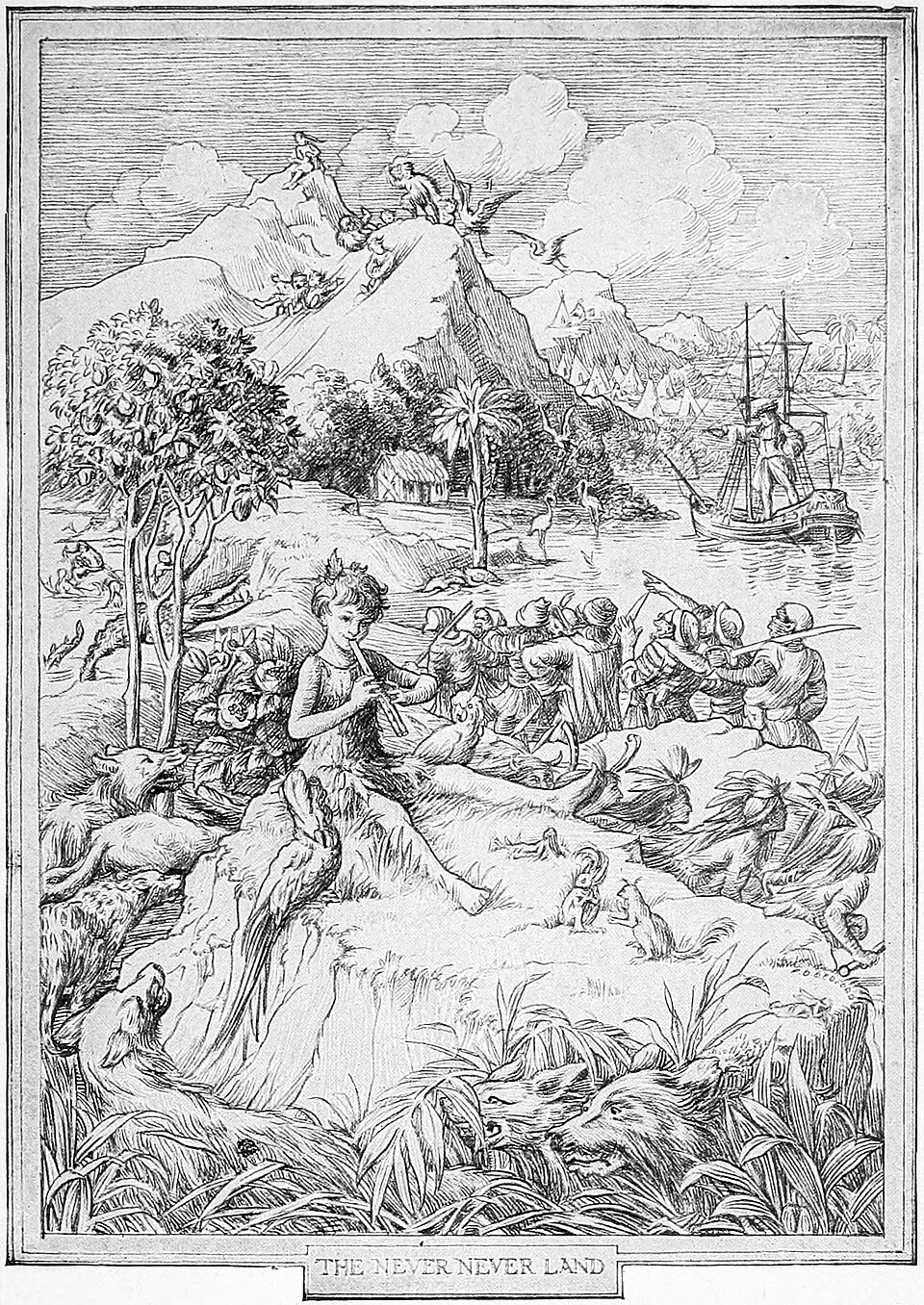
their captain, James Hook, are dastardly beyond all measure. As if on a schedule, the lost boys, pirates, Indians, and beasts follow each other in a great circle around Neverland in endless pursuit of each other. It is not uncommon for things to end in bloodshed and death, and it is mentioned that one of the Indian warriors carries scalps on his belt of pirates and boys alike.
It is the pirates, though, who are the great villains of the tale. Hook lost his hand to Peter in a previous duel. The hand was then eaten by a crocodile (who also ate a clock which can be heard ticking whenever the creature nears). Now, Hook pursues Peter and the crocodile pursued Hook, hoping to get the rest of him.
In the midst of them, the blackest and largest jewel in that dark setting, reclined James Hook, or as he wrote himself, Jas. Hook, of whom it is said he was the only man that the Sea-Cook feared. He lay at his ease in a rough chariot drawn and propelled by his men, and instead of a right hand he had the iron hook with which ever and anon he encouraged them to increase their pace. As dogs this terrible man treated and addressed them, and as dogs they obeyed him. In person he was cadaverous and blackavized, and his hair was dressed in long curls, which at a little distance looked like black candles, and gave a singularly threatening expression to his handsome countenance. His eyes were of the blue of the forget-me-not, and of a profound melancholy, save when he was plunging his hook into you, at which time two red spots appeared in them and lit them up horribly. In manner, something of the grand seigneur still clung to him, so that he even ripped you up with an air, and I have been told that he was a raconteur of repute. He was never more sinister than when he was most polite, which is probably the truest test of breeding; and the elegance of his diction, even when he was swearing, no less than the distinction of his demeanour, showed him one of a different caste from his crew. A man of indomitable courage, it was said of him that the only thing he shied at was the sight of his own blood, which was thick and of an unusual colour. In dress he somewhat aped the attire associated with the name of Charles II., having heard it said in some earlier period of his career that he bore a strange resemblance to the ill-fated Stuarts; and in his mouth he had a holder of his own contrivance which enabled him to smoke two cigars at once. But undoubtedly the grimmest part of him was his iron claw.
Peter is wild, carefree, and heartless. Once an adventure’s passed or a foe’s defeated, he forgets them as if they never existed. If he remembered his adventures and learned anything from them, it seems he would lose his endless youth would end. When he’s about to die, drowned by a rising tide, he faces it with almost gladly in the end.
Peter was not quite like other boys; but he was afraid at last. A tremor ran through him, like a shudder passing over the sea; but on the sea one shudder follows another till there are hundreds of them, and Peter felt just the one. Next moment he was standing erect on the rock again, with that smile on his face and a drum beating within him. It was saying, ‘To die will be an awfully big adventure.’
On the flight to Neverland, when the Darling boys almost fall into the sea, he rescues them at the last moment. Not because he can’t do it sooner, but because it’s more fun and dangerous. Dressed in a suit of leaves and playing the pan pipes, he is like a demigod. He named all of Neverland’s birds, and the place moves to his rhythm and presence.
Feeling that Peter was on his way back, the Neverland had again woke into life. We ought to use the pluperfect and say wakened, but woke is better and was always used by Peter.
In his absence things are usually quiet on the island. The fairies take an hour longer in the morning, the beasts attend to their young, the redskins feed heavily for six days and nights, and when pirates and lost boys meet they merely bite their thumbs at each other. But with the coming of Peter, who hates lethargy, they are all under way again: if you put your ear to the ground now, you would hear the whole island seething with life.
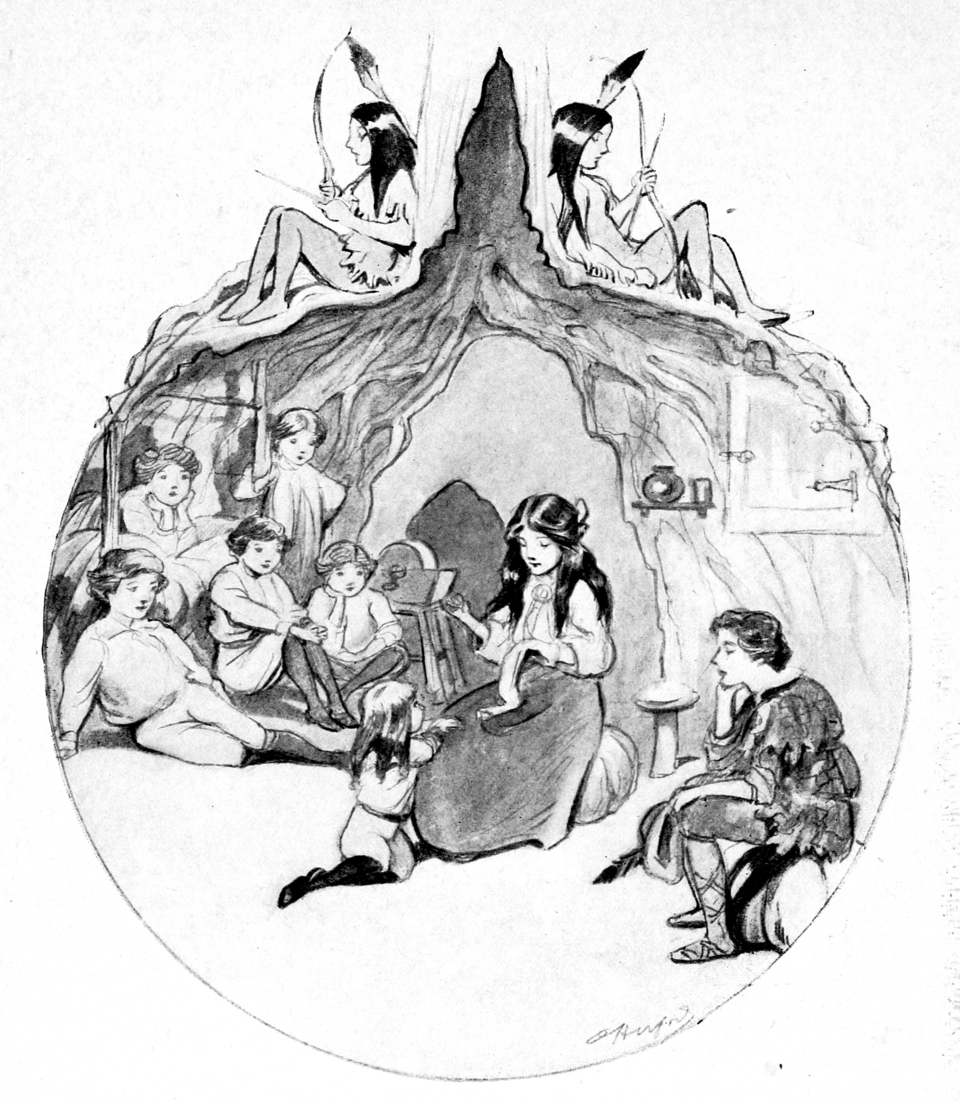
Peter is a bold leader, but also a jealous and demanding one. The lost boys wear the skins of the wolves and bears they’ve killed, because no is allowed to dress like Peter. They can only talk about mothers when he’s away as he considers it a silly subject. When they start to grow, something that’s expressly forbidden, he “thins them out.” He is Cocteau’s sacred monster. For all his selfish and heartless ways, the lost boys will follow him to the very end.
He’s also fickle in his ways. During one battle with the Indians, he decides he wants to be an Indian. At once the lost boys all choose to be Indians, too, and the Indians are forced to act as lost boys. Peter and Neverland are painted in the mercurial colors of childhood.
Most striking of all is his inability to actually love or recognize it when directed at him. Tinker Bell clearly loves him. So much, that she tries to have Wendy killed because she’s jealous of her. Tiger Lily loves him too, after he rescues her from the pirates. Wendy does too, but Peter is oblivious to all this.
‘Peter,’ she asked, trying to speak firmly, ‘what are your exact feelings for me?’
‘Those of a devoted son, Wendy.’
‘I thought so,’ she said, and went and sat by herself at the extreme end of the room.
‘You are so queer,’ he said, frankly puzzled, ‘and Tiger Lily is just the same. There is something she wants to be to me, but she says it is not my mother.’
‘No, indeed, it is not,’ Wendy replied with frightful emphasis. Now we know why she was prejudiced against the redskins.
‘Then what is it?’
‘It isn’t for a lady to tell.’
‘Oh, very well,’ Peter said, a little nettled. ‘Perhaps Tinker Bell will tell me.’
‘Oh yes, Tinker Bell will tell you,’ Wendy retorted scornfully. ‘She is an abandoned little creature.’
Here Tink, who was in her boudoir, eavesdropping, squeaked out something impudent.
‘She says she glories in being abandoned,’ Peter interpreted.
He had a sudden idea. ‘Perhaps Tink wants to be my mother?’
‘You silly ass!’ cried Tinker Bell in a passion.
She had said it so often that Wendy needed no translation.
‘I almost agree with her,’ Wendy snapped.
Once set up as the lost boys’ mother, Wendy takes to her task with love and care. In turn, at Peter’s direction, they build a little house for her to use when they are all sleeping in their secret, underground lair.
When she sees that John and Michael are starting to forget their parents and home, Wendy begins introducing new games of make-believe. They include school lessons gear to prompt their memories and mimic their everyday lives back home. Peter even joins in on the latter, finding it amusing to have to sit on a chair, motionless and quiet.
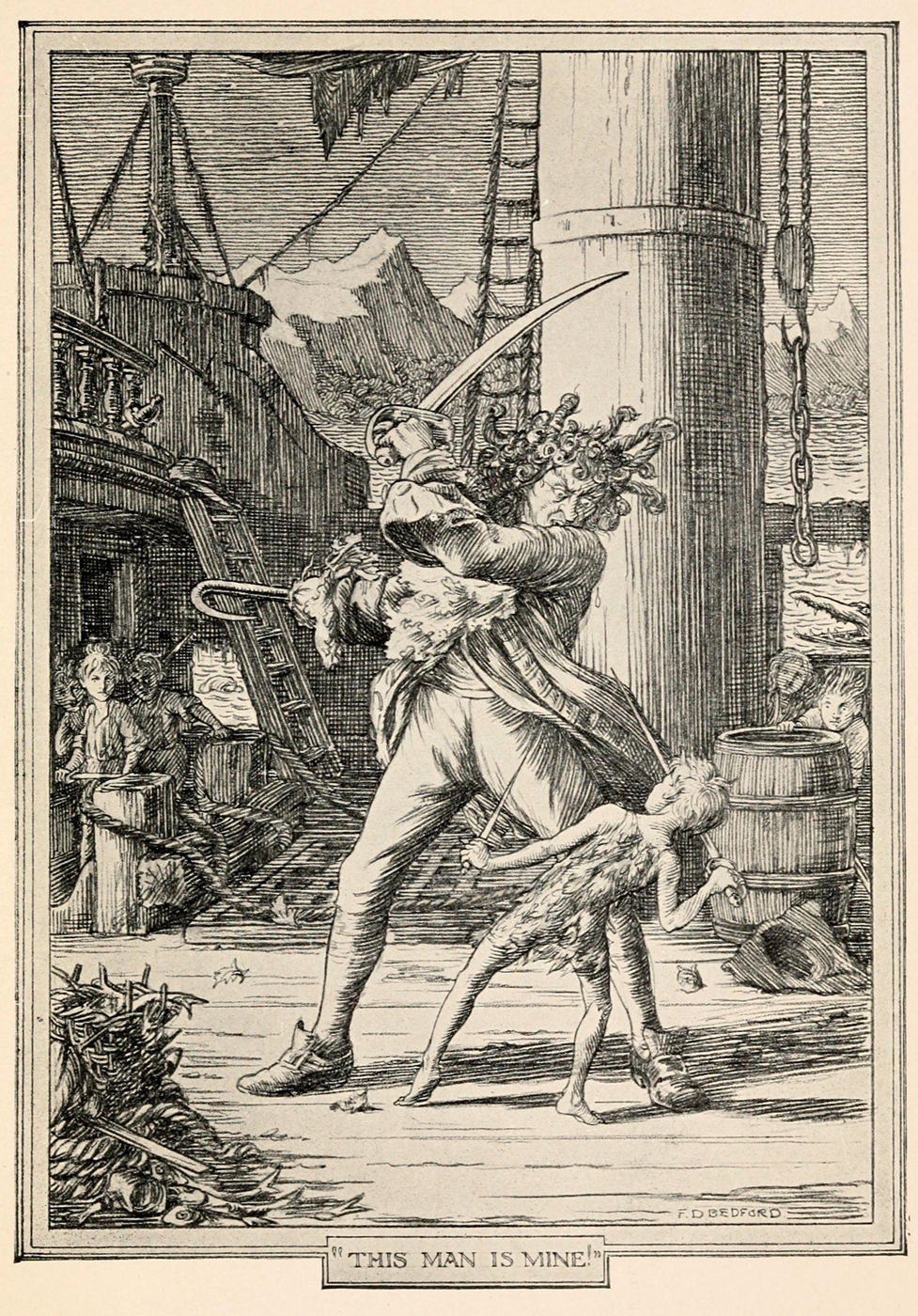
In the end, all adventures must end, and the Darlings’ sojourn to Neverland ends in grand style. As they are preparing to leave Neverland together, the Darlings and the lost boys are captured by the pirates and prepared to walk the plank. At the last moment, as befits such dire circumstances, Peter makes a theatrical entrance and brings his longstanding rivalry with Captain Hook to its inevitable conclusion.
Finally, Wendy, John, and Michael, with the lost boys, return to London. There, they grow up, become respectable people with families and children of their own. For a while, Peter returns each year for Wendy to do his spring cleaning, with her mother’s permission. Eventually, though, he forgets, and doesn’t return for many years, only to find Wendy grown and with a young daughter of her own. In the end, he takes the new girl, and years later, he takes Wendy’s granddaughter.
As you look at Wendy you may see her hair becoming white, and her figure little again, for all this happened long ago. Jane is now a common grown-up, with a daughter called Margaret; and every spring-cleaning time, except when he forgets, Peter comes for Margaret and takes her to the Neverland, where she tells him stories about himself, to which he listens eagerly. When Margaret grows up she will have a daughter, who is to be Peter’s mother in turn; and thus it will go on, so long as children are gay and innocent and heartless.
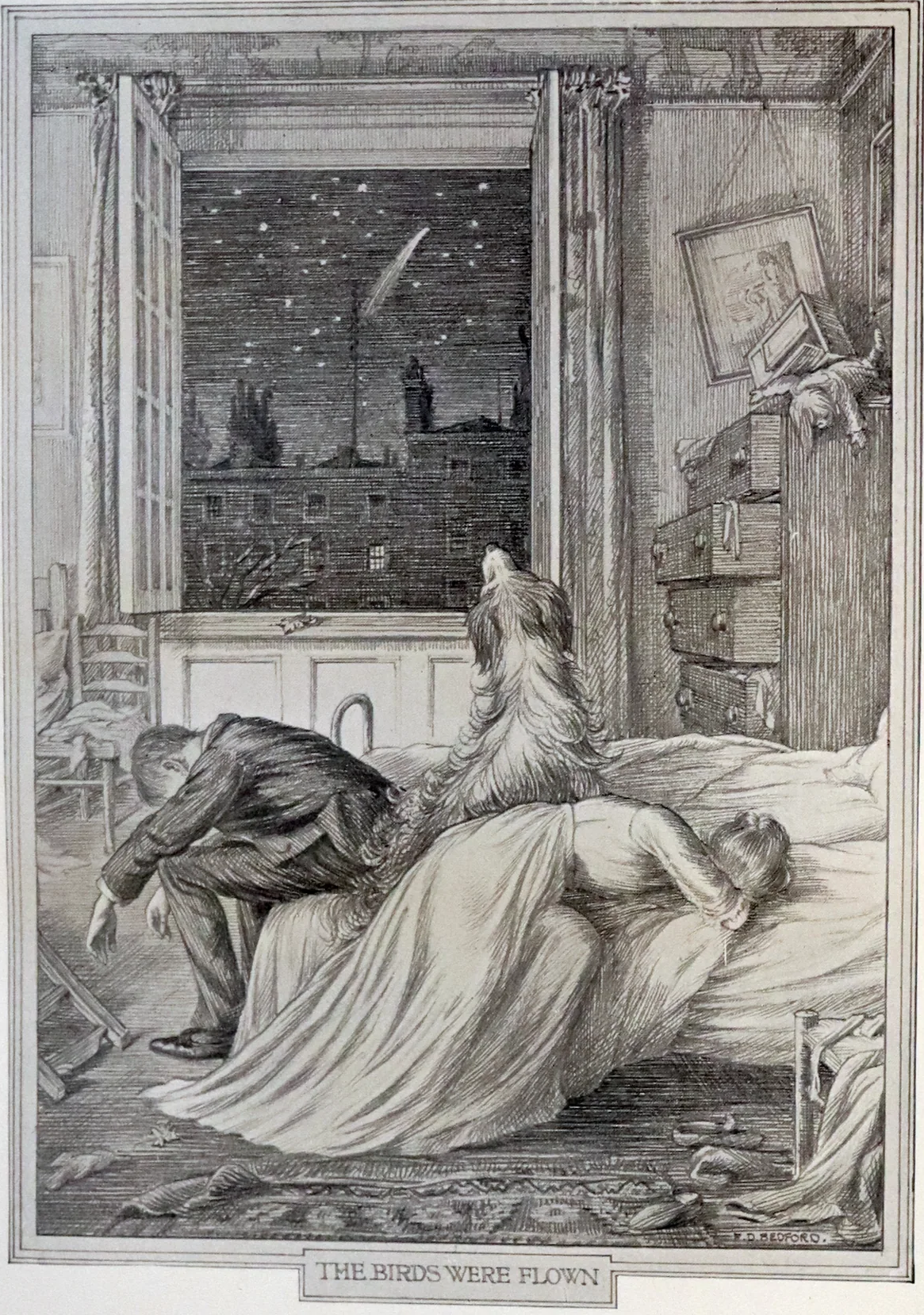
Peter Pan is the book’s titular character, but the story is Wendy’s. Peter won’t grow up, by inclination as much inability. He’s sees only pain and duty in maturity. The one time he speaks of his own mother, he claims he always thought she’d leave the window open for him should he return. When he did go back, he found the window barred and a new boy in his bed. For Wendy, there is never a moment that she doubts her parents have left the window open for her and that they aren’t anxiously waiting for her return. Her desire first to travel with Peter and growing realization that she must return home is real heart of the book.
With that return, she also knows it means she will grow up. And she longs for that, even if she doesn’t say it aloud. She takes her responsibility to the lost boys seriously. It’s also clear, she imagines a future with love, marriage, and children of her own. Her recognition of that is plain when she asks Peter what he feels for her. Early in the story, when she first met Peter, she recognized she was “in the presence of a tragedy.” She knows she must grow up, she wants to grow up, and that is something Peter can never do or allow her to do if she remains in Neverland. She returns home to adulthood, but also to set her daughter and granddaughter off on the same voyage she once took.
I don’t think I’ve ever included this much text from a book I’m writing about. I’ve done it this time, because Peter Pan is by turns laugh-out-loud funny, exciting, and poignant. There’s a tossed-off line at the end of the book that had tears welling up in my eyes. Barrie’s narrative voice is funny and propulsive, and every sentence feels perfect. The chapter where he’s going back and forth with himself about which of Peter’s adventures to recount is brilliant. I’ve never read anything else by him or seen any of his other plays, and now I know I must.
I’ve left out practically everything about Mr. and Mrs. Darling; her with a kiss on the corner of her mouth that no one, even her husband cannot get, and he living in and going to work in the doghouse he’s exiled himself because he believes it’s his fault the children are gone. They only take up the first and last few chapters, but the narrator admits that he like Mrs. Darling better than Peter and Wendy. Nana, the dog-nanny, is herself a marvelous creation, as is the Neverbird and a dozen other throwaway bits and pieces. I simply had to give some sense of just how good Barrie’s writing and this book is.
Peter Pan is an exquisitely wrought and touching book. Yes, the Indians are stereotypes, but then so are the pirates and Peter Pan is a narcissistic kidnapper. While I’m not quite sure this is really a children’s book (if you read it to your kids you’ll have to define orgy), I think it’s a book about youth, and memory, and maturity, and it deserves to be read.
PS: I made the mistake of rewatching the Disney movie right after I finished the book. I didn’t have many strong memories of it, but vaguely remembered liking it well enough. Sadly, like with Mary Poppins, Disney shaved off all the rough edges and sharp corners. Hook’s a laughable coward, not the Old Etonian, who if we knew his real name it would “set the country in a blaze.” They did sort of get Tinker Bell right, but the rest is only a pale imitation of Barrie’s book.
Fletcher Vredenburgh writes a column each first Friday of the month at Black Gate, mostly about older books he hasn’t read before. He also posts at his own site, Stuff I Like when his muse hits him.
Peter Pan struck me as a very dark book, with Peter’s eternal youth being depicted as a kind of imprisonment; if there is no past and no future, even memory itself cannot exist (eventually Peter doesn’t even remember Hook) and without memory there can be no moral growth (and nothing concerned the Victorians more than that), only a sort of flat, horizonless amorality (re Barrie’s famous description of children as “heartless.”)
My favorite Barrie quote – and I think it gives some insight into his distinctive view of childhood and children – is: “Children have the strangest adventures without being troubled by them. For instance, they may remember to mention, a week after the event happened, that when they were in the wood they met their dead father and had a game with him.”
I’ve been intending to reread Peter Pan for a while (I guess I read it twenty years ago) and I think the book is an interesting contrast with Richard Hughes’ A High Wind in Jamacia, another book (and I think a very great one) that has “innocent” children falling in with “depraved” pirates, with unexpected and ironic results.