Wood for Sheep: Catan by Klaus Teuber
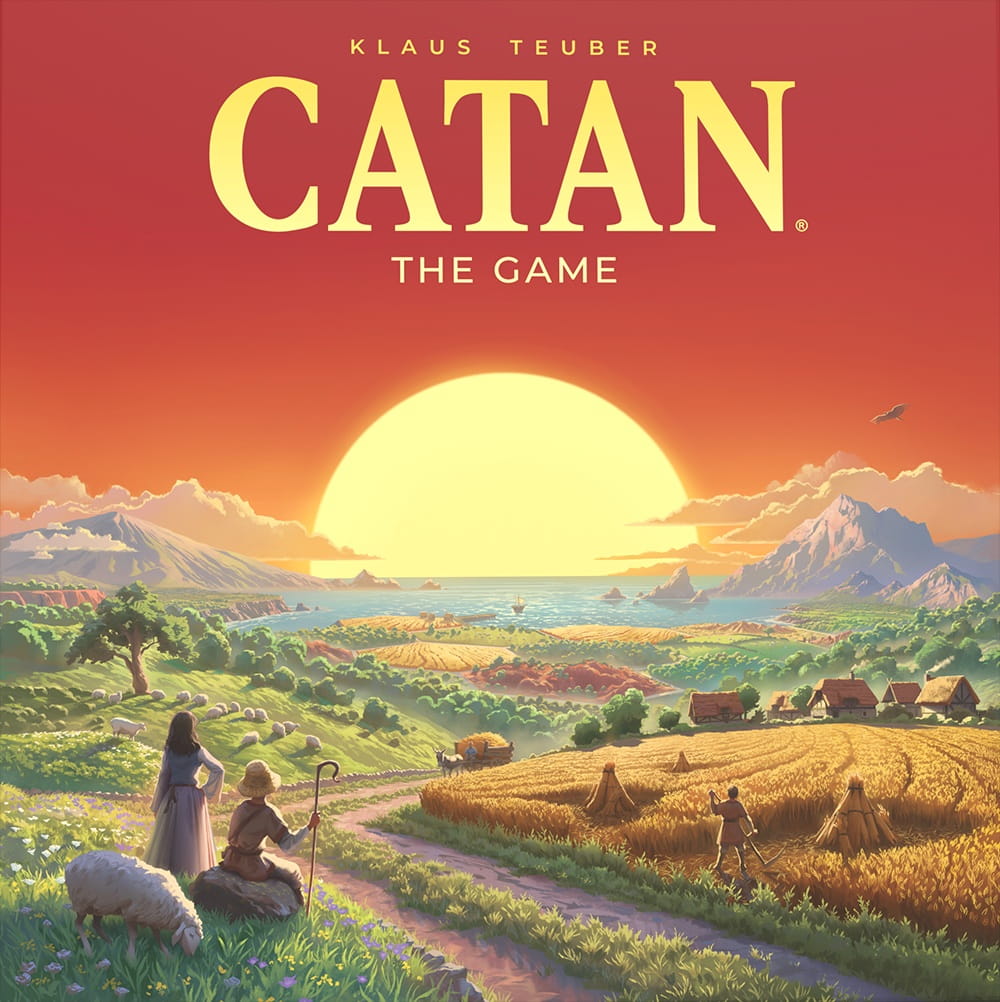
I’ve played a lot of Catan over the years, since friends in San Diego introduced me to it (back when it was called Settlers of Catan). I think it’s my favorite board game. It seems to be a widely liked one, so it may not be new to a lot of people reading this review. But if I’m going to talk about games, I think it certainly deserves inclusion.
Catan is mainly a game of economic development. The primary thing players do is to establish villages, roads, and cities on a fictitious large island or small continent. Their scores are primarily based on how many settlements they have on the board, though there are other ways to pick up points. There’s a small nod to violence in the form of the “robber,” an object that looks like a stylized pawn in chess and moves about the board from time to time, and in the ability of players to acquire “knights” that can compel the robber to go somewhere else; but at most this is a model of border raids or irregular war — no one ever takes over another player’s land or cities.
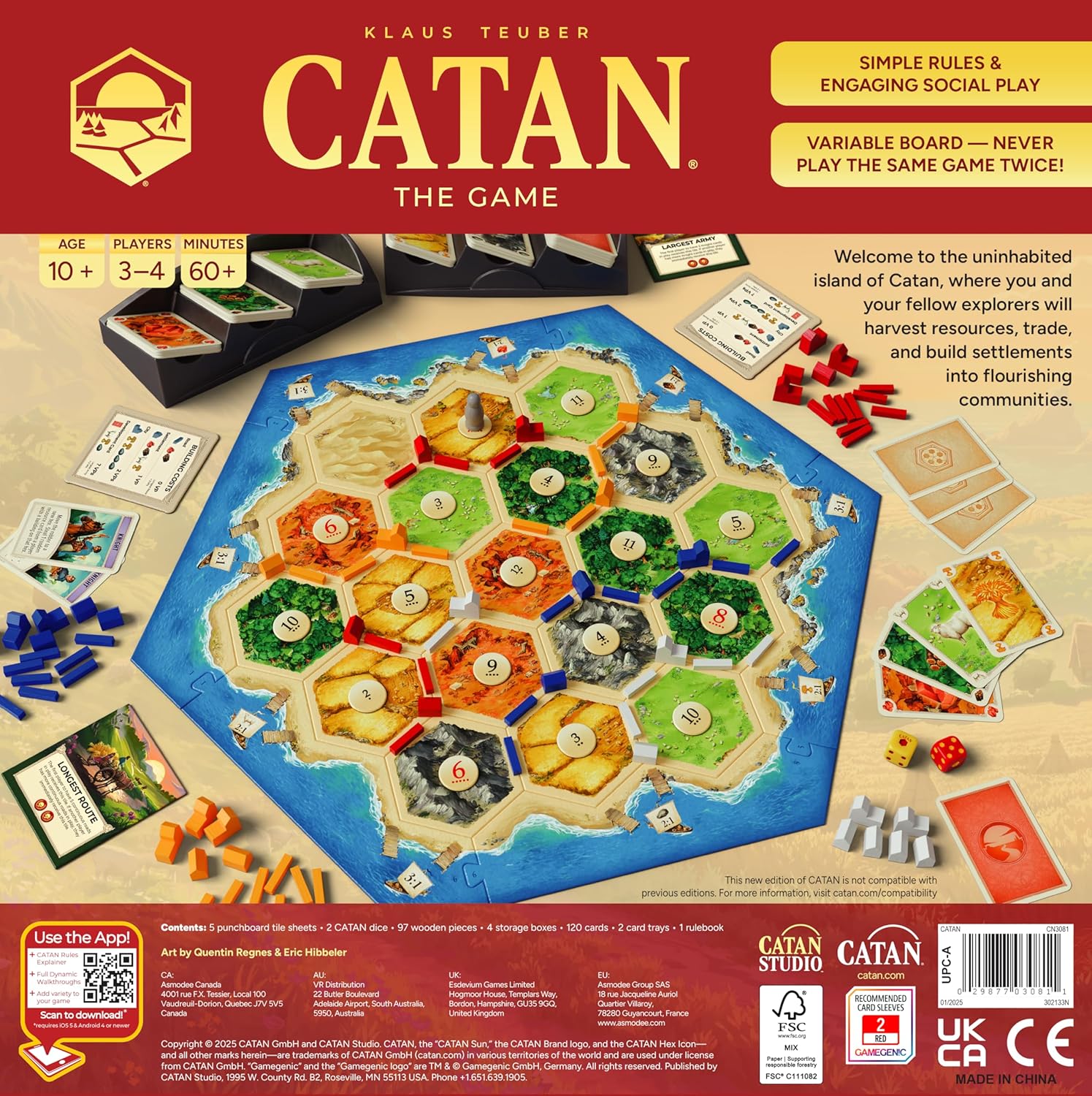
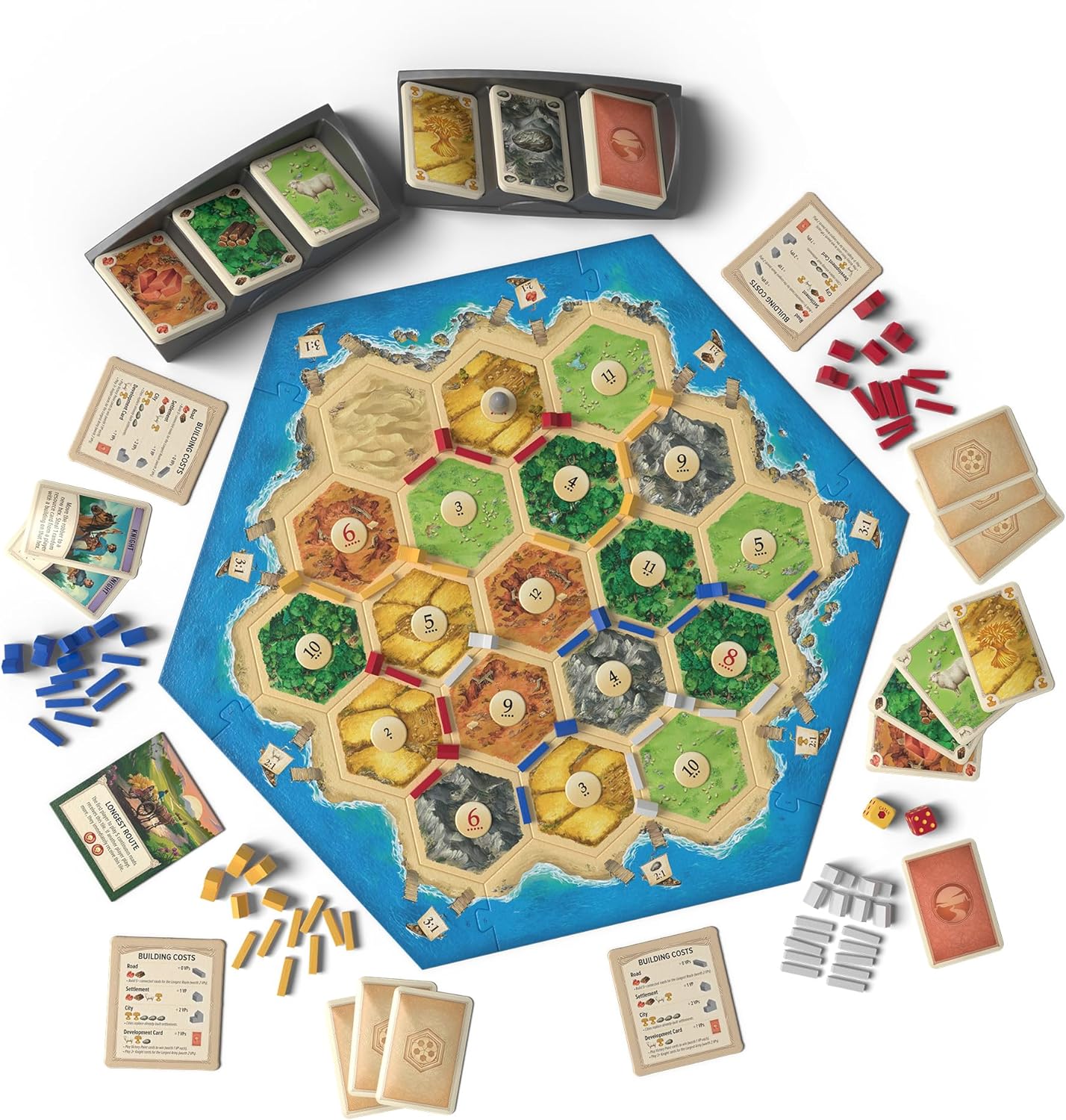
The game board is usually assembled randomly from hexagonal tiles, most of which show one of five types of resources: sheep, grain, wood, clay, or stone. These tiles are randomly assigned numerical values from 2 to 6 and from 8 to 12. At the start of a player’s turn, they roll dice to determine which tiles produce their specific resource. This means that tiles with a 2 or 12 hardly ever produce anything, and tiles with a 6 or 8 are highly productive. Players then use their accumulated resource cards to build roads or settlements, or to purchase development cards that give them special advantages (which include “knight” cards).
Settlements don’t occupy the interiors of hexes, but points on their edges; a typical settlement is in between three hexes and can benefit from what any of them produces. A common problem for players is not having the right mix of cards to build what they need; to get around this, players can trade cards, either with the “bank” or, on much more favorable terms (often one for one), with other players. This practice of trading and bidding for trades has inspired a lot of jokes about “wood for sheep!” — at least among English-speaking players.
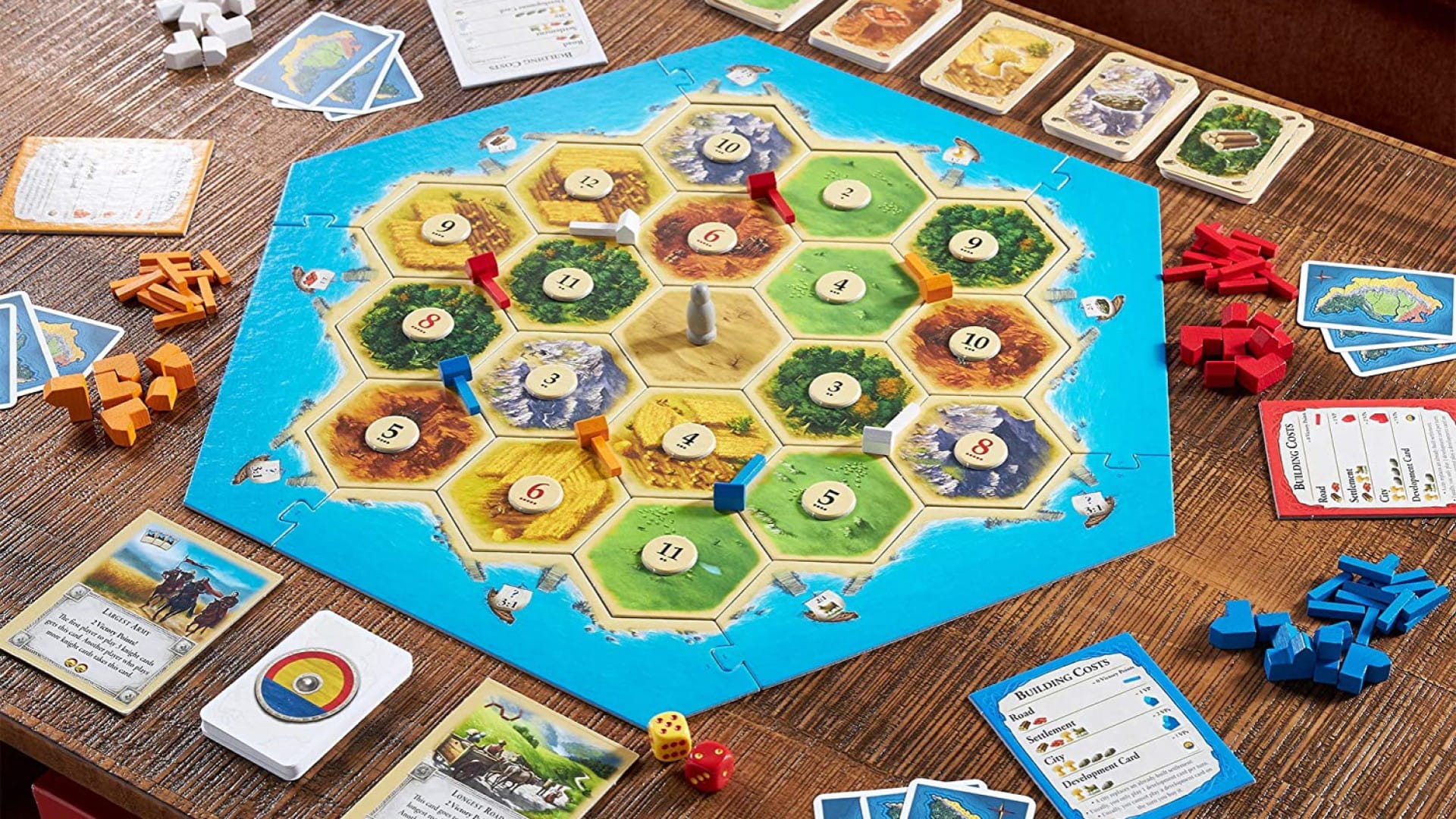
Recent editions of Catan recommend a specific board layout for new players, and even prescribe where their starting villages and roads should be placed. I’ve read that some editions don’t even have separate tiles, but have game boards in a standard configuration, which is supposed to be fair and balanced. I don’t think I’d like that as much; analyzing a newly created board and figuring out the best sites for initial villages and roads is part of the fun for me. But that may be because I enjoy combinatoric thinking and play (as in games such as Azul) and a requirement for it may put me at an advantage.
One map hex offers no productivity at all: the desert. It also has no numerical value. However, when the dice come up 7 (the most common result, happening in one-sixth of turns), two things happen: First, the robber, who is initially placed in the desert, has to move to a different hex; his presence in that hex suppresses its production when its number is rolled. Second, any player whose hand contains more than 7 resource cards is required to discard half of them (rounded down). Both of these moves seem to reflect an underlying idea that violence is economically destructive and wasteful!
I’ve played in some groups that try to move the robber to the least damaging map hex; others embrace the use of the robber to hinder rival players, especially the ones who have higher scores. I’ve also seen an element of the classic game theoretic “tit for tat” approach, where players who’ve used the robber aggressively are likely to be targets for other players.
Purchasing development cards adds a variety of extra options to the game. Knight cards give a player control of the robber’s movements. Some cards represent special achievements that are worth extra points, and can be revealed by surprise at the end to reach the score of 10 points that allows a player to proclaim victory. Some cards provide a way to gain extra resources on one’s turn, either from other players or through increased productivity.
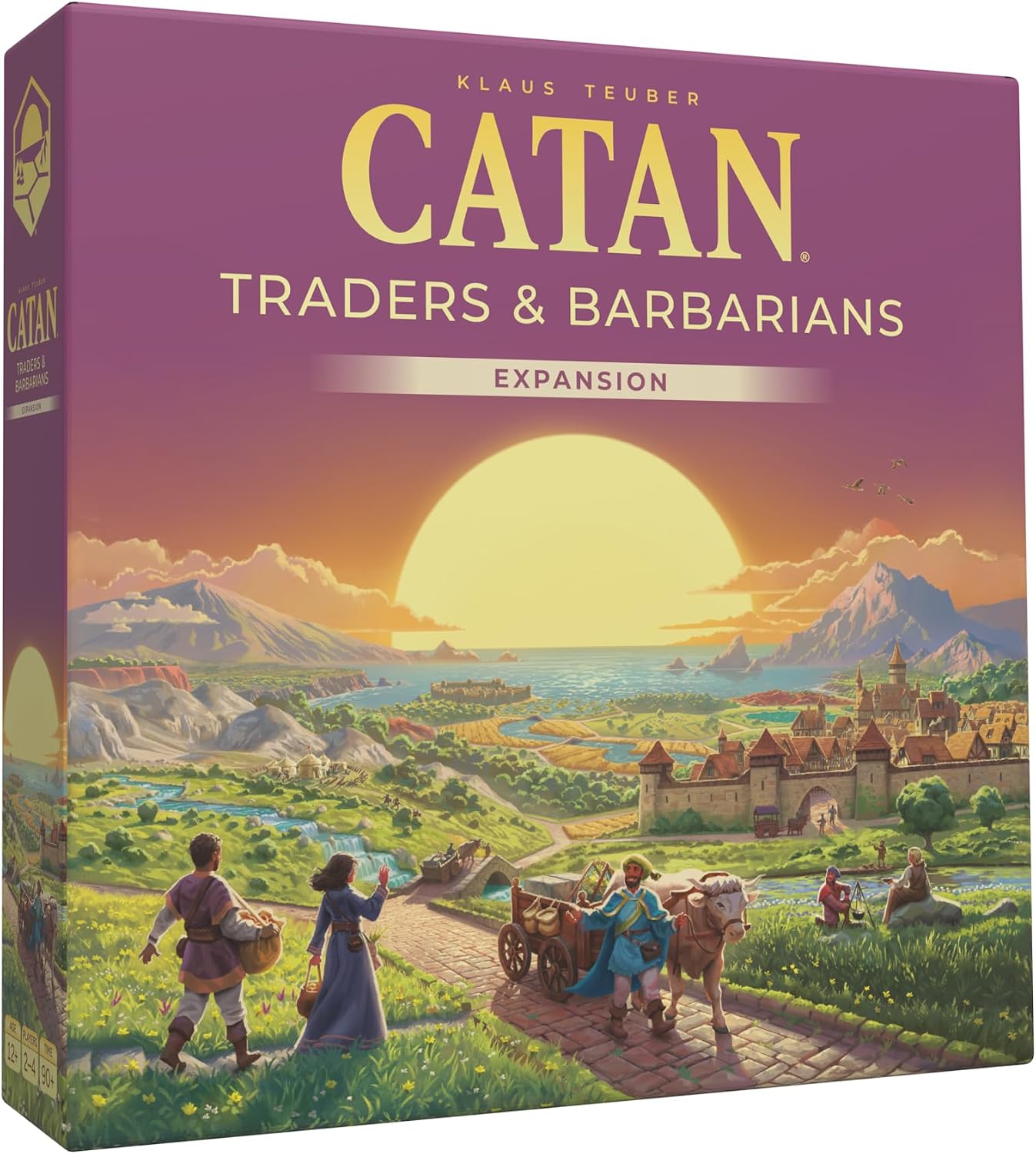
I’m personally cautious about this sort of element in a game design; there are some games that have more special options than I like, or that even rely entirely on such options, and I prefer not to play that sort of game at all. But Catan seems to have hit a sweet spot where development cards offer enough options to be interesting without being a big distraction from the combinatorial tactics that I get a charge from.
European games such as Catan have been played in North America for decades now — huge numbers of them, too many for a casual player to keep track of. But Catan seems to be one that’s widely recognized and that a lot of people are ready to play; it’s probably in the running for “most popular.”
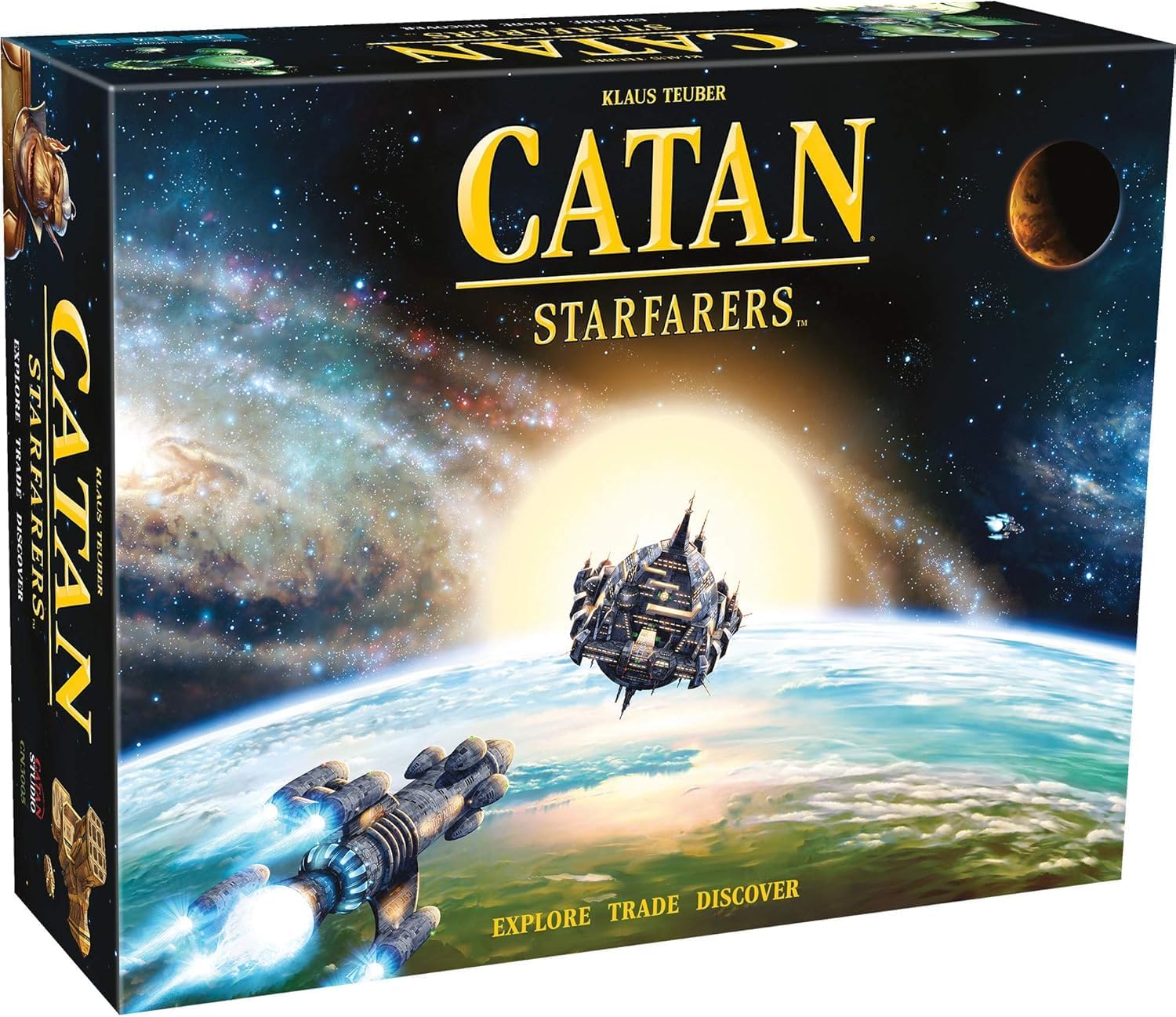
These games commonly have a narrative premise of some kind, rather than being just an abstract exercise in strategy, like go, chess, or bridge, and Catan’s premise of settling a new continent is easily understood and readily suggests a set of game mechanics. (I would have loved it in my teens, when I came up with my own game that involved hand-drawn maps and a combination of economic development and land warfare.)
But also, that game mechanics itself is elegant; on nearly every dimension of game design it seems to hit the sweet spot. Three decades after its original publication, I think we can safely say that it’s not a temporary craze but a lasting classic.
William H. Stoddard is a professional copy editor specializing in scholarly and scientific publications. As a secondary career, he has written more than two dozen books for Steve Jackson Games, starting in 2000 with GURPS Steampunk. He lives in Lawrence, Kansas with his wife, their cat (a ginger tabby), and a hundred shelf feet of books, including large amounts of science fiction, fantasy, and graphic novels.