Thoughts on Designers & Dragons: Origins
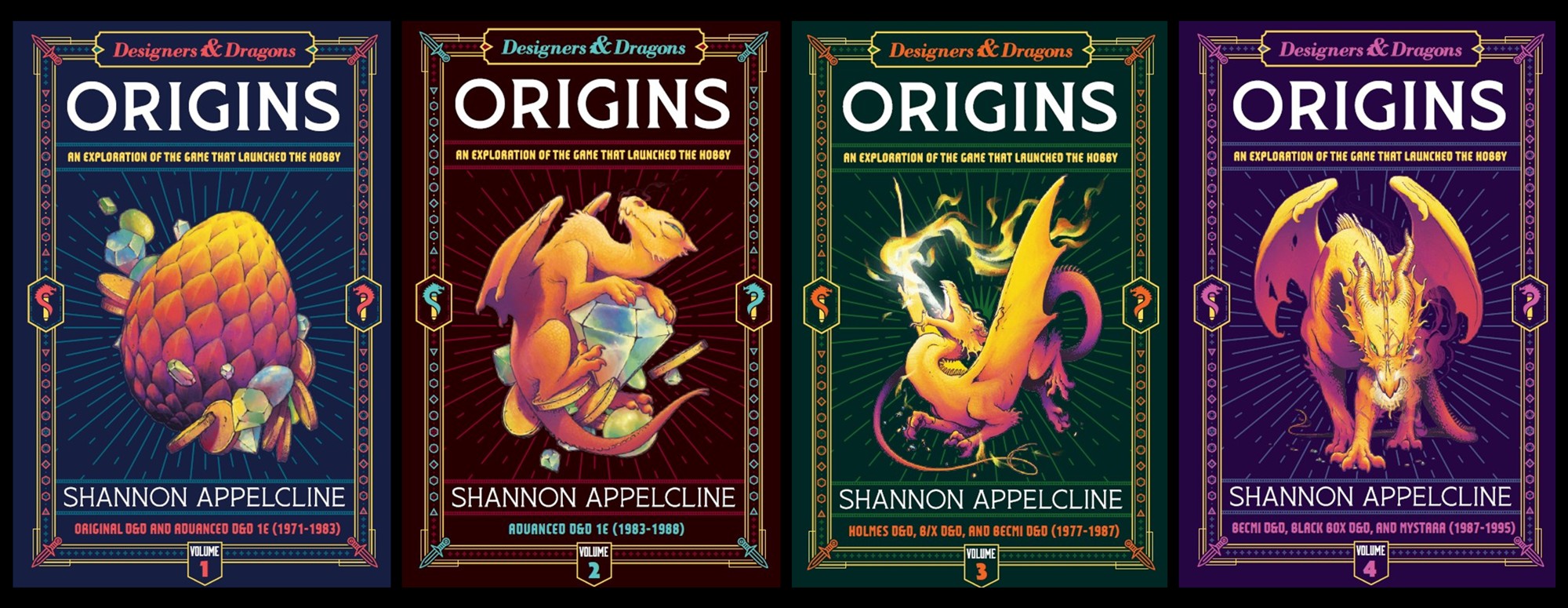
This is emphatically not a review of Shannon Appelcline’s Designers & Dragons: Origins, although if you have an interest in 1970s and 1980s OD&D, D&D, or AD&D, you should grab a copy. Rather it is a collection of personal reflections having read the first two volumes and part of the third for reasons that will be made clear later.
I started playing D&D in 1980 with the Holmes box and the included module In Search of the Unknown. Someone else in the group wound up with a copy of The Keep on the Borderlands. My group quickly moved on to Advanced Dungeons and Dragons, leaving the box set behind. When we began, one of us bought the Monster Manual, one bought the Player’s Handbook, and I bought the Dungeon Master’s Guide (I remember riding my bike home from Klipper’s hobby shop with the book in my backpack). Eventually we all filled out our collections. We made our way through our own worlds, but also through Greyhawk, once it was released and I had the folio version of Darlene’s map attached to a wooden board.
Reading these books made me understand why we were never going to see details of Greyhawk the way we eventually did of the Forgotten Realms, and why it would be impossible for Gary Gygax’s “real” Castle Greyhawk to be published.
The series looks at each product produced by TSR for the OD&D, AD&D, and D&D line through the launch of 2nd edition and the release of the black box. Occasionally, there are short biographical sketches of the writers involved in creating the game. For me, the most interesting chapters are the products that I either owned or the modules my characters played through. Reading the first two volumes was a wave of nostalgia, especially when people I knew, or know, like Jody Lynn Nye or Bob Blake, were mentioned.
The mentions of the 1982 AD&D Open at Gen Con and the fact that is has never been released, not only raised a sense of nostalgia, but also regret, since it was the last Open I played in and my team took third place. Subsequent to that, I spend a few years DMing rounds of the open through the early years at MECCA. Of course, that year’s tournament appears to be the only tournament that was never published.
Reading the section on the original three rules books and the Holmes box set reminded me of how difficult it was to figure out the rules back then. The Holmes books gave us the basics, the descriptions of a game in both the Holmes book at the DMG shows us what gameplay looked like. In Search of the Unknown taught us to populate a dungeon, and the rest was a matter of flipping through the books to find the tables we needed, not always in the logical places.
And until I read the section on the Monster Manual, I never even realized that it didn’t include LN, CN, NG, or NE creatures.
I read the first two books straight through, which means the repetition was very obvious. Clearly, Appelcline intended for readers to dip in here and there to read about their favorite modules or accessories. Although the books contain great reproductions of the cover art, the text also talks about back cover art, interior art and maps, which do not appear. Appelcline also talks about the various purges and downsizing, but since the history of TSR isn’t the focus of the books, those are more tantalizing hints than explanatory.
It reminded me of how much I enjoyed running my friends through the A series and the U series, and waiting for the next module in the series to come out. I also realized that I think of the primary period of my role playing life as being from 1980-1986, but based on the release dates and what was in my collection, I really played until the end of the decade.
My older daughter and her husband play D&D now and last year I joined them for one (online) game to see what 5e was like. My niece also plays and a couple months ago I asked if they would be interested in having me run all three of them through a dungeon. Originally, I was going to do a 5e game, but realized I don’t have the time (or inclination) to learn the new version, so instead, a few weeks ago I ran them through the first half a homebrew AD&D adventure. They (along with my wife, who has never played) enjoyed it and we’ll continue the game the next time everyone is in town. Amazingly, there was not a single combat role in the session (and my wife commented, “There was a lot more role-playing than I expected.”)
 Steven H Silver is a twenty-two-time Hugo Award nominee and was the publisher of the Hugo-nominated fanzine Argentus as well as the editor and publisher of ISFiC Press for eight years. He has also edited books for DAW, NESFA Press, and ZNB. His most recent anthology is Alternate Peace and his novel After Hastings was published in 2020. Steven has chaired the first Midwest Construction, Windycon three times, and the SFWA Nebula Conference numerous times. He was programming chair for Chicon 2000 and Vice Chair of Chicon 7.