Mary Poppins by PL Travers
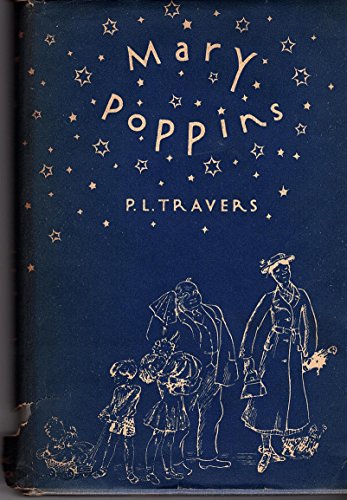
Mary Poppins gave a superior sniff.
“Don’t you know,” she said pitingly, “that everybody’s got a Fairyland of their own?”
Ultimately, I have Baird Searles (or you have to blame) to thank for pointing to P.L. Travers‘ original Mary Poppins books. To quote the entry in his A Reader’s Guide to Fantasy (1982),
Those who know P.L. TRAVER’s acerbic creation, Mary Poppins, only through the persona of Julie Andrews, do not really know Mary Poppins, despite the best efforts of that charming actress. Mary Poppins seldom has a kind word for anyone, almost never smiles except at heir own prim reflections, and can get four children washed and in bed with No Nonsense Whatsoever.
I didn’t rush out and buy the books, but his words always lingered in my memory, and when I saw the books for sale in the old Borders in the World Trade Center, I bought the first one, Mary Poppins (1934), and promptly devoured it. Strains of the book and its sequels can be heard in the Julie Andrews’ movie, but there are deeper, more mythic moments that I imagine Walt Disney wanted no part of.
Travers was born Helen Lyndon Goff in Australia in 1899. She took to the stage as a teenager, creating for herself the stage name Pamela Lyndon Travers. For several years she traveled in Australia and New Zealand as part of a Shakespearean company. In New Zealand, she became a published poet and later a primary writer for the women’s sections in a Christchurch newspaper.
In 1924, she left the Antipodes for England. Their, she continued writing poetry and found a regular spot in the Irish Statesman. It was edited by George William Russell, a theosophist who wrote poetry under the name Æ. He introduced her to fellow poet, William Butler Yeats and other Irish poets who fostered her interest in Celtic mythology. Later, she would become a disciple of the mystic George Gurdjieff and a student of Carl Jung. She continued to write, becoming well-known with the success of Mary Poppins and its sequels. She would later spend several years in America, even serving as a writer-in-residence at Radcliffe and Smith colleges.
Her deep interest in myth and archetypes seems to have culminated in a collection of essays she wrote in her seventies and eighties titled What The Bee Knows: Reflections on Myth, Symbol, and Story (1989), largely for the recently shuttered magazine, Parabola: The Magazine of Myth and Tradition. In it, she ranges on topics ranging from the importance of fairytales in all their bloodiness to Zen Buddhism, along with several interviews and memories of the poet, Æ. For the genre-interested, she seems to have like some of Tolkien and LeGuin, and is totally dismissive of Watership Down, wondering where Mrs. MacGregor was when she was needed. It was this woman who created Mary Poppins, not the more popularly inclined Walt Disney.
The character of Mary Poppins first appeared in 1926 in the story “Mary Poppins and the Match Man.” In it, a seventeen year old Mary Poppins and Bert the Match Man jump into a sidewalk chalk drawing and have a wonderful day out. Somewhat rewritten, and dropping references to her age, it would reappear as the second chapter of the book, Mary Poppins, retitled, “The Day Out.” As to the origin of her character, as quoted in her obituary in the New York Times, she wrote
Nothing I had written before Mary Poppins had anything to do with children, and I have always assumed, when I thought about it at all, that she had come out of the same wall of nothingness as the poetry, myth and legend that had absorbed me all my writing life.
At its most straightforward, Mary Poppins is the story of the first encounter between the titular character and the Banks family, in particular, the children Jane and Michael and their infant twin siblings, John and Barbara. It isn’t a novel, but instead, a collection of stories, some involving the above characters, some as observed by them, and others as told by them. As the books progresses, the stories become more complex and mysterious. The earliest chapters are fun reads, the later ones are wondrous.
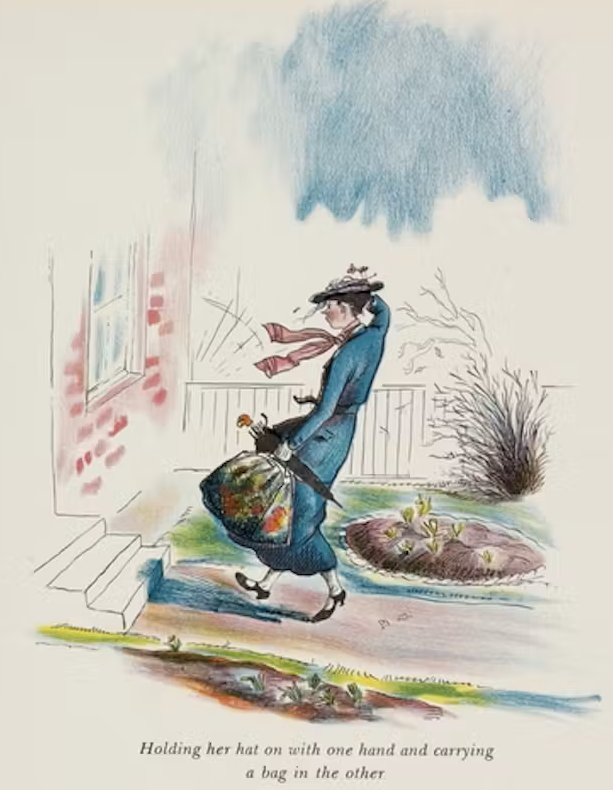
The first chapter, “East Wind”, opens with the Banks’ nanny having left without notice, and they are at loss at what to do. The same day Mrs. Banks writes to the papers to “send some Nannies to her at once,” Jane and Michael see something strange out in the street in front of their house. At first they think it’s their father home from work.
“That’s not Daddy,” she said. “It’s somebody else.”
Then the shape, tossed and bent under the wind, lifted the latch of the gate, and they could see that it belonged to a woman, who was holding her hat on with one hand and carrying a bag in the other. As they watched, Jane and Michael saw a curious thing happen. As soon as the shape was inside the gate the wind seemed to catch her up into the air and fling her at the house. It was as though it had flung her first at the gate, waited for her to open it, and then had lifted and thrown her, bag and all, at the front door. The watching children heard a terrific bang, and as she landed the whole house shook.
Instead of providing references, which, she tells Mrs. Banks she never provides as they are an old-fashioned and outdated idea, she says she will decide if the situation is to her liking. Which, of course, she does.
Right away, she gives a hint of the strangeness her arrival will introduce to Jane’s and Michael’s lives. From her clearly empty carpet bag, she draws forth a starched apron, a folding chair, hair pins, and other sundries. The medicine she gives the children before bedtime tastes delicious, Michael’s like a strawberry ice and Jane’s like lime-juice cordial. Mary’s own spoonful tastes like rum punch. The children are immediately smitten with her, despite her threat to call the a Policeman when they keep talking, and ask her not to leave. Somewhat ruefully, it seems, she tells them she’ll stay until the wind changes.
The second chapter, “Day Out,” begins with Mary informing Mrs. Banks of when her scheduled days off will fall. It then leads into her previously described day out with Bert the Match Man. It’s a perfectly charming piece, but the Mary of this part is as amazed by journey into the chalk drawing than the Mary of any of the later chapters would be. Still, it’s fun to see Mary on her own, released a bit from her strict nanny persona.
“Laughing Gas” with it the characters floating to the ceiling of Mary’s uncle, Mr. Wiggs’ room, is a scene taking for the Disney movie. Throughout the book, Mary is given to spending long moments admiring herself in mirrors and shop windows, and my favorite moment in the this chapter is one of the most memorable examples of this.
Mary Poppins put her hat straight at the Tobacconist’s Shop at the corner. It had one of those curious windows where there seem to be three of you instead of one, so that if you look long enough at them you begin to feel you are not yourself but a whole crowd of somebody else. Mary Poppins sighed with pleasure, however, when she saw three of herself, each wearing a blue coat with silver buttons and a blue hat to match. She thought it was such a lovely sight that she wished there had been a dozen of her or even thirty. The more Mary Poppins the better.
In the following chapter, “Mrs. Lark’s Andrew,” we discover Mary Poppins can talk to animals. She uses her ability to free dog, “one of those small, silky, fluffy dogs that look like a fur necklet,” from the smothering and pampering of his owner.
In “The Dancing Cow,”, Michael sees a red cow wandering down the street and says it’s a funny thing. Mary promptly tells him it’s not funny at all, and that she’s known the cow for a long time, that she was a great friend of her mother’s, and she’ll thank him to speak politely of her. Mary then proceeds to the story of the cow, how she came to dance, meet the king, and jump over the moon. Again, quoting from the Times obituary, Travers once wrote “sorrow lies like a heartbeat behind everything I have written.” The story introduces a real element of deep regret. The red cow experiences a period of uncontrollable, but never before experienced, abandon, and can’t wait to escape it. Once she’s recovered, though, she quickly understands what she’s given up and spends the rest of her days trying to retrieve those lost times.
“Bad Tuesday” is the chapter that caused the book in its original form and an initial revision to be banned. Michael wakes up on the wrong side of the bed and begins a furious assault on anyone and everyone in the household. He makes his sibling cry, he kicks the maid, and carries out all sorts of vicious little acts. To help work the nastiness out of his system, with the help of a magical compass, Mary Poppins takes Michael and Jane to the four cardinal points where they meet friends of the nanny.
 As written in 1934, at each destination they met people; an Eskimo in the North, Africans in the South, Chinese in the East, and American Indians in the West. Each was presented in the most stereotyped manner, and the Africans spoke in a terrible southern American dialect, among other things. The first revision in 1971 kept people at each location, but changed the descriptions and dialogue. However, it an illustration of ethnic stereotyped people at each compass point. This meant the book was banned in several school systems. So, in 1981, Travers changed it again, this time replacing people with animals. Now, there’s polar bear in the North, a hyacinth macaw in the South, a panda in the East, and dolphins in the West. Travers said she didn’t do it as an apology, but for a much simpler reason, “I do not wish to see Mary Poppins tucked away in a closet.”
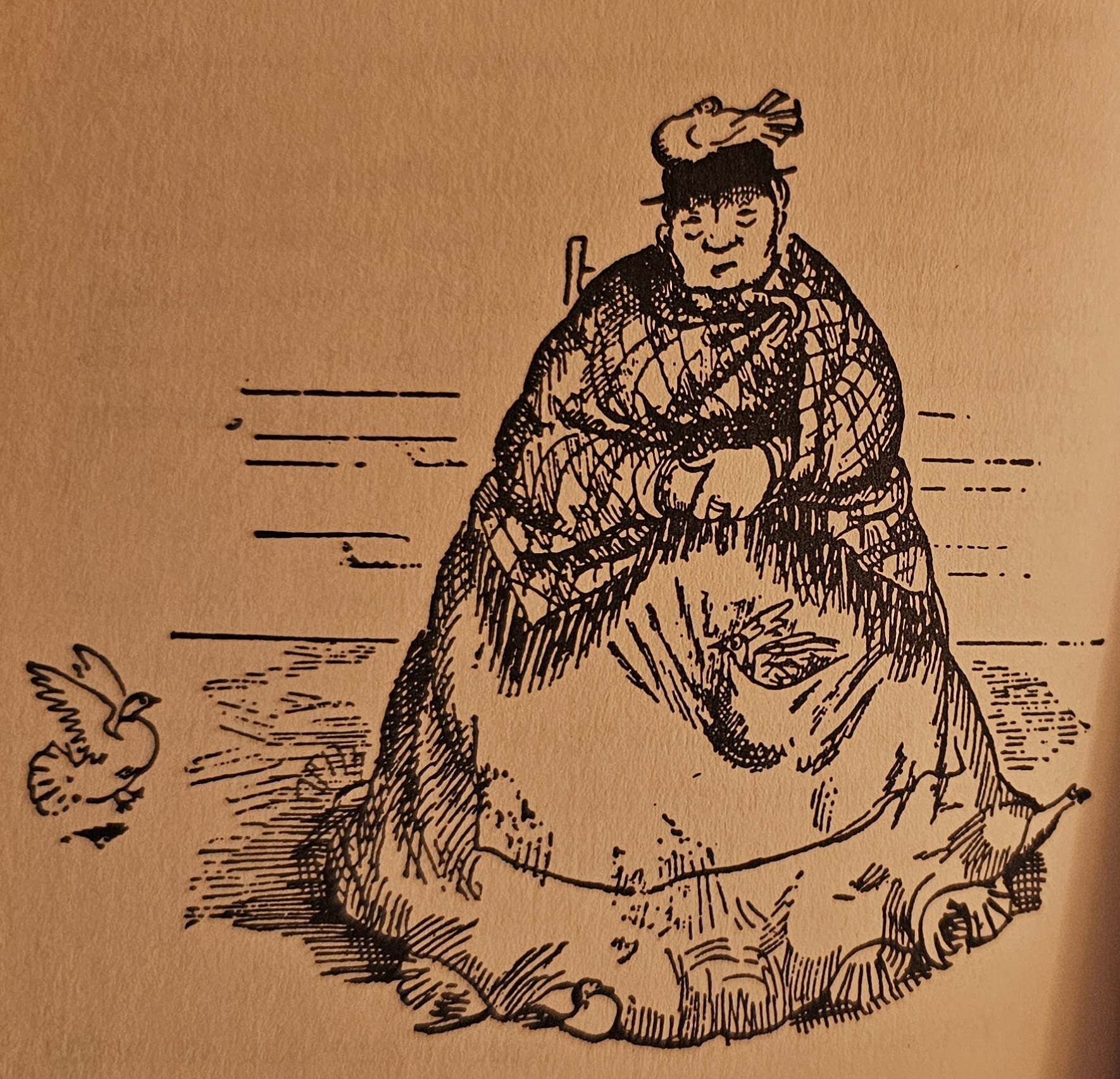
“The Bird Woman” is like a dream. In front of St Paul’s Cathedral is a old woman who sells breadcrumbs, tuppence a bag, to feed the pigeons. The only words she ever says, even in response to direct questions, are “feed the birds” and “tuppence a bag.” The children buy a bag of crumbs from and Janes offers a theory of what happens after everyone except the Bird Woman and the birds have left for the day and it’s beautiful.
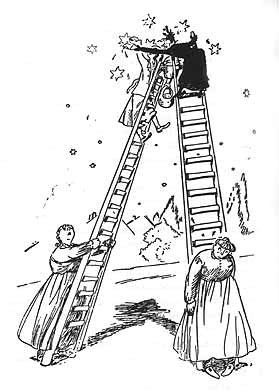
I almost don’t want to describe anything in “Mrs. Corry,” it’s that extraordinary. What starts as a shopping trip, takes a turn into the magical when Mary Poppins and the children visit Mrs. Corry’s store to buy gingerbread. Suffice it to say, it involves an old woman who remembers when the world was put together, her gigantic daughters, and stars.
“John and Barbara’s Story” is another story of loss. In it we learn that babies cannot only speak with each other, but animals, the sun, as well as all the other elements. When they learn they’ll lose the ability once they’ve turned one, they ask the Starling why can Mary Poppins still understand them.
“A-a-a-h! She’s different. She’s the Great Exception. Can’t go by her,” said the Starling, grinning at them both.
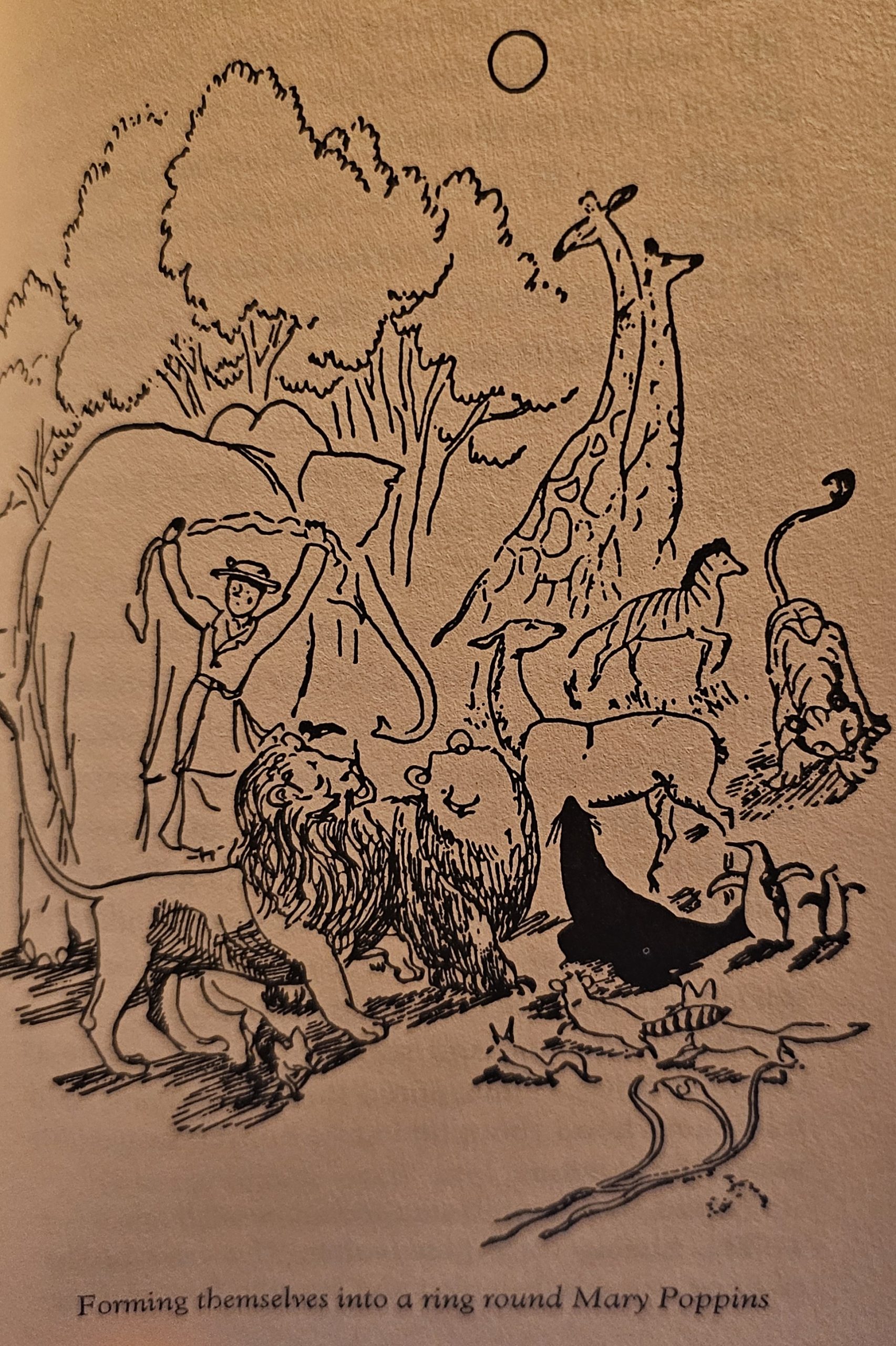
“Full Moon” seems to come about when Michael wonders aloud what happens at the Zoo after it closes. That very night, he and Jane wake up and find themselves drawn to the Zoo by some mystical force. Once there, they are greeted a uniformed bear at the entrance gate who gives them tickets to enter. Inside, they see all the animals wandering freely and some of the cages occupied by humans. These they later learn were the people left behind when the Zoo closed for the night. What makes the night extra special, they learn, is that it is Mary Poppins’ birthday and when it falls on a full moon, all the animals gather to celebrate it.
Jane and Michael meet Mary in the Snake House where she admonishes them for not being dressed warmly. They also meet the King of the Animals, a golden Hamadryad (King Cobra). Later, when Jane asks him how all the different animals be together he answers her in a way I’d didn’t expect to encounter in children’s book.
“I thought, Sir–” she began and stopped, feeling confused, and not sure whether she ought to say it or not.
“Speak, my child!” said the Hamadryad. “You though?”
“Well–that lions and birds, and tigers and little animals –”
The Hamadryad helped here. “You thought that they were natural enemies, that the lion could not meet a bird without eating it, nor the tiger the hare — eh?”
Jane blushed and nodded.
“Ah — but you may be right. It is possible. But not on the Birthday,” said the Hamadryad. “Tonight the small are free from the great and the great protect the small. Even I–” he paused and seemed to be thinking deeply, “even I can meet a Barnacle Goose without any thought of dinner–on this occasion. And after all,” he went on, flicking his terrible little forked tongue in and out as he spoke, “it may be that to eat and be eaten are the same thing in the end. My wisdom tells me that is probably so. We are all made of the same stuff, remember, we of the Jungle, you of the City. The same substance composes us –the tree overhead, the stone beneath us, the bird, the beast, the star — we are all one, all moving to the same end. Remember that when you no longer remember me, my child.”
“But how can a tree be stone? A bird is not me. Jane is not a tiger,” said Michael stoutly.
“You think not?” said the Hamadryad’s hissing voice. “Look!” and he nodded his head towards the moving mass of creatures before them. Birds and animals were now swaying together, closely encircling Mary Poppins, who was rocking lightly from side to side. Backwards and forwards went the swaying crowd, keeping time together, swinging like the pendulum of a clock. Even the trees were bending and lifting gently, and the moon seemed to be rocking in the sky as a ship rocks on the sea.
“Bird and beast and stone and star — we are all one, all one –” murmured the Hamadryad, softly folding his hood about him as he himself swayed between the children.
“Child and serpent, star and stone — all one.”
The penultimate tale, “Christmas Shopping,” tells of what happens when one of the Pleiades visits London to buy presents for her sisters. Nothing much happens, though the scantily dressed star does disrupt the street in front of the department store.
Finally, the wind changes, and in “West Wind,” Mary Poppins takes her leave without a word to anyone. She does leave a note though, strongly implying she will be back one day. Fortunately, for Jane and Michael, as well as readers, she did return for several more volumes.
In recounting the narratives of the book’s chapters, I’ve neglected much. Travers’ writing, suffused ink drawn from fairyland and suffused with myth, is also often very funny. The opening chapter with Mr. and Mrs. Banks and the humans caged in the Zoo are hilarious, as is poor Mrs. Lark and her dealings with Andrew. Mary Poppins’ vanity and sharp tongue make her a very different character than Julie Andrews’ version.
In my monthly Black Gate column, I’ve written about another children’s book, Kenneth Grahame’s The Wind in the Willows. Mary Poppins belongs alongside it on every child’s bookshelf as well as discerning adult’s. Books like these capture the whimsy of childhood, as well as the weirdness and, the best of them, some of the danger. Fairytales and the like flow up from our oldest and deepest roots. Mary Poppins, like Wind in the Willows, feel like they’ve found some lost or forgotten source to draw new tales from.
When I first wrote about Tolkien last year, I described how my earliest fantasy reading was fairytales. I still have a solid collection of fairytales from around the world and dip into them every now and then. But there were also all sorts of children’s books, many of which I have no real memory of them any more, save Wind in the Willows. I really wish I’d read Mary Poppins all the years ago as well.
Finally, there are Mary Shepard‘s illustrations. Travers had asked her father, E.H. Shepard, the illustrator of Winnie the Pooh is he was available. Though he turned her down, she saw a Christmas card drawn by Mary and engaged her. Apparently, it was a sometimes prickly relationship, but she illustrated all the Poppins books, from 1934 through 1988. They are absolutely perfect and important at helping create Travers’ world.
NOTE: I’m planning on visiting at least one, if not two, more children’s books in the next few months.
Fletcher Vredenburgh writes a column each first Friday of the month at Black Gate, mostly about older books he hasn’t read before. He also posts at his own site, Stuff I Like when his muse hits him.
Thanks, Fletcher, this sounds like a missed opportunity for most readers of BG who had/have children (and, like me, knew only the Disney movie while growing up) to encourage their sense of wonder! Re other fantasy-themed children’s books that deserve a wider audience, I highly recommend “Mischief In Fez”, by Eleanor Hoffman. Published in 1943, it’s a Morocco-based story reminiscent of the children’s version of the Arabian Nights, about a precocious boy who gets caught up in a battle between djinn. It’s smart, charming and a great find for those of us who appreciate imaginative literature.
Thank you. I’ll have to look up the Hoffman book.
So again Uncle Walt watered things down for his own sappy artistic vision.
Eh, he pretty much always did. The Queen in Snow White isn’t made to dance to death in red hot iron shoes, and I could go on forever about The Jungle Book.
I have never dared to watch The Jungle Book. I love the books too much, and what Disney did to the Alice books was horrible enough.
It’s got some good songs and Phil Harris, Louie Prima, and George Sanders are a joy, but, yeah, it’s not Kipling’s story.
Thanks for this. I saw the movie in the 60s when it was released and had paperback tie in with Julie Andrews on the cover. I wasn’t really taken with the book perhaps because of the film. Disney’s saccharine view of the world now revolts me, although I do think that you could claim the film to be an acid head movie. Travers sounds a lot more interesting than I ever realised and I will take another look. I regularly read children’s fiction and fairy stories.
Fairy stories and children’s books are a staple around here. My wife just read the Chronicles of Prydain for the first time (she loved them).
I’m pretty sure I read at least the first Mary Poppins book back in the day and yeah, Walt definitely sanded off some of her harder edges, much as he did with Peter Pan and Pinocchio. Having said which, I do still love all of the movies.
And the Shari Bobbins episode of The Simpsons.
It was his way, and that’s fine. Classic Disney movies are generally fantastic. I remember liking the movie, but Dick Van Dykes atrocious Cockney accent keeps me from researching it.
Am a bit vague on whether I ever read any of the Mary Poppins books, or not, so thank you for this overview of the first and the general backgrounding for each of the stories within it. The character traits of Mary Poppins align much better with what was depicted in “Saving Mr. Banks” than in the second Mary Poppins movie… though it sounds like they sort of aligned with the first Mary Poppins movie somewhat. She’s always been a sort of contrary character, strict AND fanciful, as if there were deliberate through-lines drawn between her and “Mary, Mary, quite contrary.”
I very much dislike the idea of “John and Barbara’s Story.” It sounds like it contains every one of the elements that I hate with a passion from the song “Toyland.” But you’ve piqued significant curiosity about “Mrs. Corry.” I don’t remember that one at all.
Thank you. As to “John and Barbara”, they’re not so happy in their infancy once they learn their fate, so it might not be as irritating as you think. “Mrs Corry” really was something surprising.
It’s difficult to figure out what Travers ultimately thought about the movie. While she’s supposed to have suggested moving it back to the Edwardian Age and was happy with that, she loather the animation and the sweetened nature of the character when she first saw it. At later viewings she seems to have expressed some admiration for it.