Into the Weird: Weird Tales, May 1923 (Volume 1, Number 3) Part 1
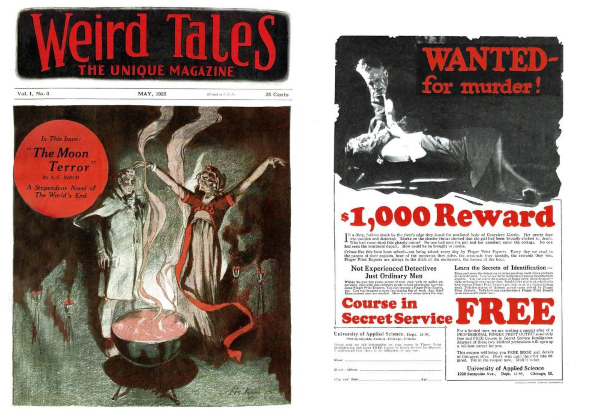
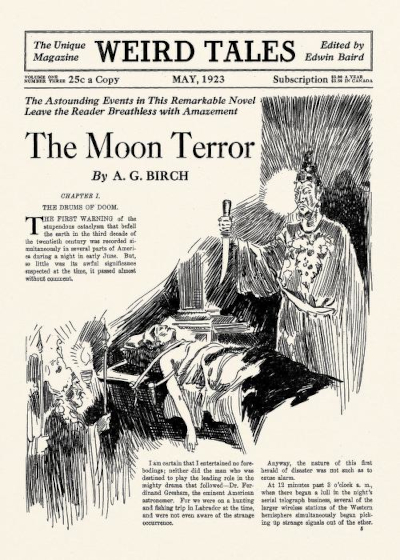
The layout’s gone to three columns of text instead of two. There are two reprints in the issue, one of them printed at a reduced type size, presumably to fit the space available. And the magazine boasts interior artwork for the first time, with nine stories getting uncredited illustrations; black-and-white line drawings, usually with heavy hatching and cross-hatching.
The artist was presumably this issue’s cover artist, William Heitman, who seems to have done all the interior artwork in Weird Tales’ first year. Heitman’s two-colour cover image is simple, bordering on crude, but conveys a mood. The blurb on the cover is for A. G. Birch’s “The Moon Terror,” though there’s nothing in the story like the picture, for reasons which we’ll come to later on in this post. The colour scheme of the cover’s similar to the last issue, with solid red and black, but the logo’s the third in three issues — though the magazine’s subhead, “The Unique Magazine,” has remained consistent.
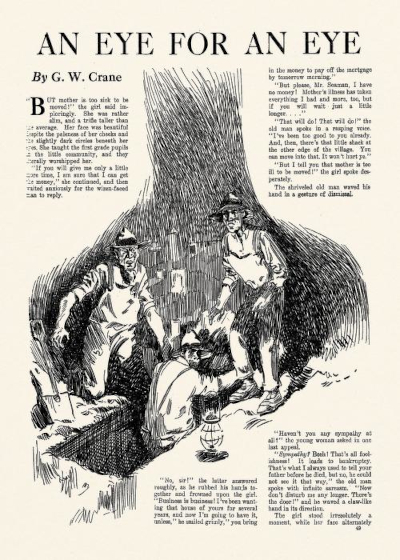
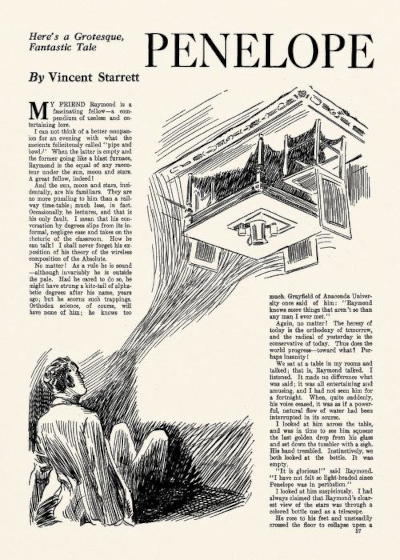
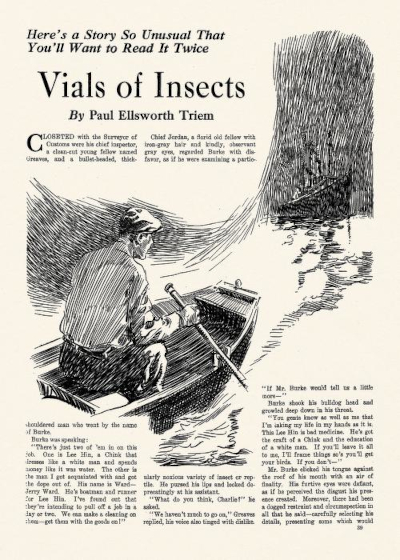
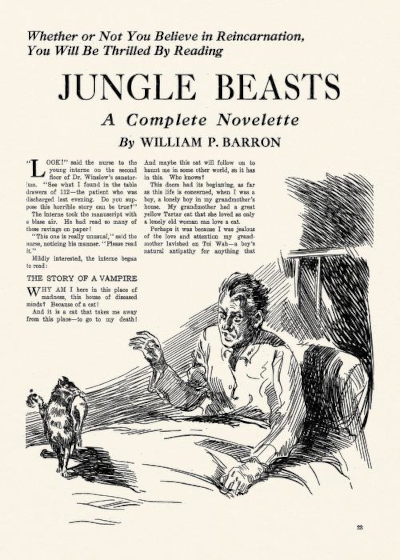
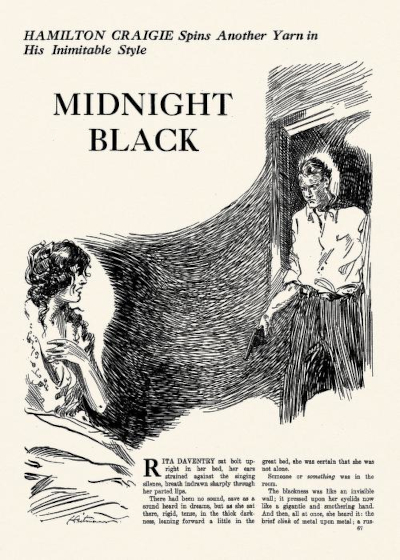
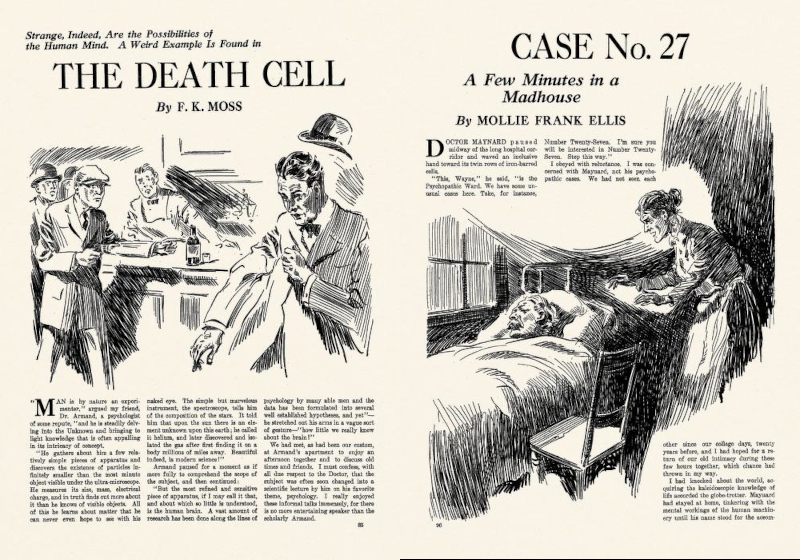
And then there are those illustrations, on the first or occasionally second page of a story. Heitman’s art is frequently criticised, and with justice. The selection of scenes to illustrate are sometimes strong (notably some men digging up a grave in “Eye For An Eye”) but sometimes uninteresting (a man rowing a boat in “Vials of Insects”). Overall the images rarely do a good job of capturing what’s striking in the story, or even in the moment they illustrate. For better or worse they always focus on human characters, usually one showing fear or tension in body language and facial expression; the acting of Heitman’s characters isn’t subtle. I find the images are often undercut by the background hatching, which tends to overwhelm the foreground scenes. The hatching’s often the solution to a compositional problem in making the image work with the layout of the print, but is usually overdone — as in the illustration to “Penelope,” where it does tie together two separate sub-images separated by blocks of text, but too strongly, implying a motion absent from the situation described in the story.
Let’s take a look at the ads in the issue. The back cover ad is for a fingerprinting course, with a splashy true-crime pitch. Inside cover ads are missing from the Internet Archive .pdf of the issue, but the full-page ad on the first interior page is also for a fingerprinting course, from a rival school. After the table of contents there’s a full-page ad for a draftsmanship course, then a full-page ad for “The Cleanest, Yet Most Outspoken, Book Published,” which turns out to be Sex Conduct In Marriage, by one Bernard Bernard. You can see the book for yourself here, complete with picture of Mr. B. Bernard, who bills himself as “Editor, Author, Philosopher, Scientist, Idealist, and Champion Wrestler.” The book’s about sexual morality, and provides basic (by 2026 standards) sexual education.

Following The Eyrie, the letters and editorial section, is a full-page mostly-text ad for a “wonder restorative” called Korex. H. M. Stunz, who claims the “compound” originated in “famous European laboratories,” promises that Korex will prevent “the loss of youthful animation and a waning of the vital forces. These difficulties have caused untold unhappiness—failures, shattered romances, mysterious divorces.” The promise of “youthful vigor” appears aimed specifically at men, and indeed within a few years Stunz, his wife, his father, and two brothers would all be indicted and convicted of mail fraud for selling Korex and other patent medicines that they claimed “would within a short time restore to a man of 60, 70, or 80 years of age the sexual vigor that he possessed at the age of 30.” (The phrasing comes from the judgement of the Appeals Court that confirmed the original verdict.)
The main thing I take away from the ads in this issue is that there are relatively few of them. And while some advertisers return from previous issues, others don’t turn up in this one. That doesn’t look like a good sign for the health of the magazine.
Let’s move on to the nonfiction snippets at the ends of some of the stories. The first two turn up well into the magazine, on page 38, after a story called “The Golden Caverns.” Of these, the first is headlined “Woman Receives Poems from Spirit World,” and briefly describes the case of Pearl Curran, who by 1923 had for several years been publishing poems that had allegedly been dictated to her through a Ouija board by a spirit named Patience Worth. Patience claimed to be an early Puritan settler of America, but no person by that name has been found in the historical record; by 1923 there had already been much ink spilled over whether Patience was a real supernatural visitor, a fraud, or a delusion. The second piece is headlined “Man Captures Lion, Barehanded;” the single paragraph tells us of a man who managed to capture a mountain lion in a “Mexican desert” by wrapping his coat around its head and “chok[ing] it into insensibility.”
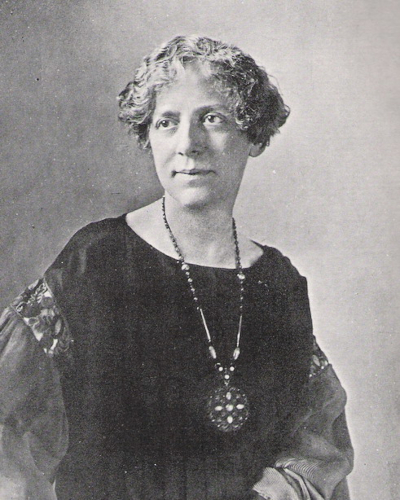
On page 56, after “The Floor Above,” is a piece that runs across all three columns on the page. Titled “Reads Story of Mankind on Egyptian Coffins,” it simply quotes a paragraph of a letter from Egyptologist James Henry Breasted to a colleague, describing the beginning of Breasted’s work photographing sarcophagi; the Weird Tales write-up describes this as “solving some of the mysteries of the beginning of the human race.” One web site I found about Breasted notes that “aware of the popular interest in his work, Breasted was not averse to turning the lure of buried tombs and lost cities to his advantage,” and his appearance in Weird Tales may be an outgrowth of that.
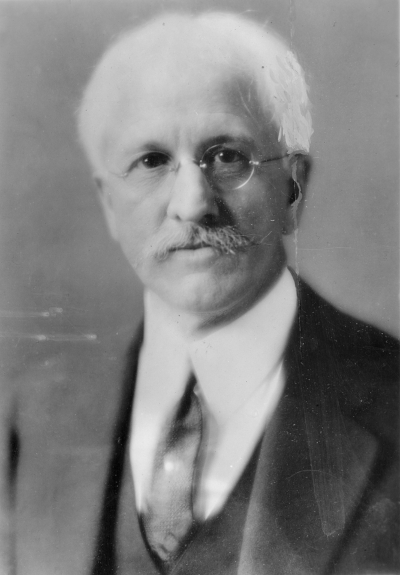
Three pages on, another page-width story tells us “Chicagoans to Live in the Air Fifty Years Hence.” The piece quotes “Mrs. William J. Chalmers, who has been closely identified with the city’s progress” as predicting that humans would “overstep” the bounds between earth and air just as in the distant past our evolutionary ancestors moved from water to earth. More immediately: “in fifty years this will come to pass—that we will all own small aeroplanes, so perfected that it will be possible for us to alight on the window ledges of our apartments, whether they be ten or twenty stories high. Chicago will, fifty years hence, have become a seaport. Steamships will be run [by] electricity and will attain tremendous speed. But steamers will be used for heavy loads and passenger travel will be by aeroplane.” These predictions become more accurate as they go along; for example, since the construction of the Saint Lawrence Seaway, Chicago is indeed a seaport. Note that if the William Chalmers mentioned was the philanthropist and mining machinery manufacturer who died in 1938, then his wife Joan was the daughter of detective agency founder Allan Pinkerton, which one might have thought worth a mention.
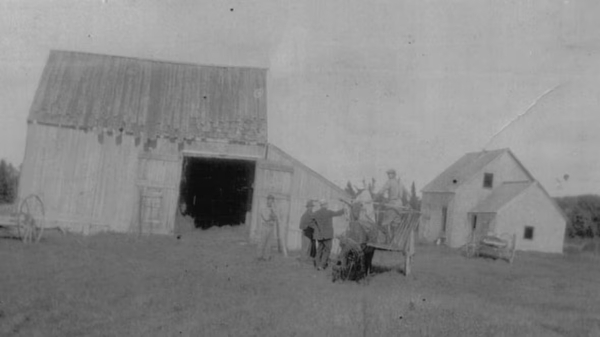
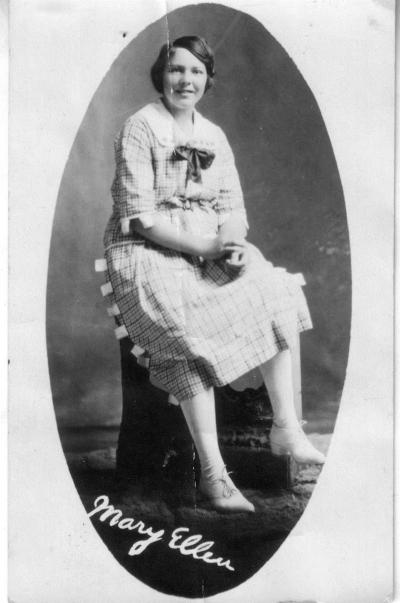
Instead, the piece gives a long description of the alleged haunting of the MacDonald farm in Caledonia Mills, Nova Scotia. In that case a series of mysterious fires and allegedly supernatural events led a family to flee their farm; an investigator from the Society For Psychical Research blamed the family’s teenage daughter Mary, claiming a deliberate fraud. Weird Tales accepts that verdict, widely doubted today — not solely by believers in the supernatural, but by researchers who suspect a malicious neighbour.
The next piece, “Woman’s Spirit is Photographed,” is three columns wide but laid out in three columns, another new format. A New York Times article from March 24, 1923, gives a slightly different and more detailed version of what is recognisably the same event: a pastor of the Central Spiritualist Church died and left a will specifying that her corpse be photographed, at which point she would manifest her spirit on the photo. This was duly done, and members of the church claimed to spot three different faces on the pictures.
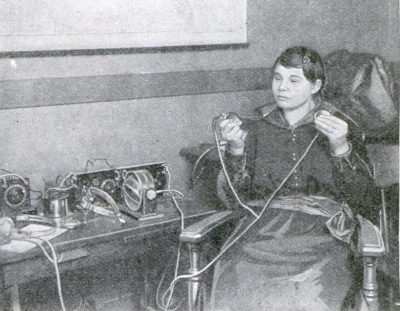
Finally, on page 118, which holds the lest few paragraphs of several stories continued from earlier in the issue, are the last two nonfiction articles of the month. First: “Neighbours See ‘Sacred Heart’ In Girl’s Death Room” tells us that after the death of a devout girl named Lillian Daly at 6724 Justine Street, a heart appeared on the wall of the room where she died, and the image of the heart had the power to heal people who touched it. I can find no record of Lillian Daley online, so choose to think this is an early and extreme example of the influence of the Daley family in Chicago.
That’s a dozen pieces of nonfiction, compared to six in the first issue, and seven plus a single-page bylined nonfiction article in the second. They’re on the whole well-chosen for the magazine, mostly recounting genuine oddities. They’re credulous, but then sometimes that’s what makes for a good story. I note that three stories have to do with Chicago undertakers. This may speak to the amount of deaths in Chicago during Prohibition, but Seabury Quinn, who would shortly become one of Weird Tales’ most prolific writers, was at this time using his legal training to build a career in mortuary law; his work wouldn’t start appearing in the magazine for another five months, but as he lived in Chicago he might have started to make connections with the magazine by using his knowledge of the field to give Weird Tales some interesting anecdotes. (Or perhaps it went the other way; perhaps somebody at Weird Tales chatted or went out drinking with some Chicago undertakers and gathered material, one of the undertakers mentioned the magazine to Quinn, and Quinn submitted work that took a few months to get into print.)
The table of contents boasts “Nineteen Thrilling Short Stories … Two Complete Novelettes / Two Two-Part Stories.” There are only twenty pieces of fiction listed, but the boast is correct; for whatever reason, William Sanford’s short-short story “Hooch” isn’t in the table of contents. Two of the other stories are reprints, and I want to look at some of the editorial choices involved.
The story’s quite long. It follows Evie, an 18-year-old upper-class Englishwoman as she goes one October to visit her cousins the Mervyns on their estate, which legend says has a haunted chamber with a mysterious locked cabinet that nobody knows how to open. The Mervyns are supposedly plagued by misfortune due to a curse laid upon one of their dissolute ancestors. Still, Evie has fond memories of spending time with the Mervyn boys when young, particularly the now-twenty-five-year-old Alan. Alan’s become strangely moody and nervous, as Evie finds when she rides out with him late one afternoon to a ruined tower where they’d played as children, finding there an old board on which was written a mysterious riddling couplet.
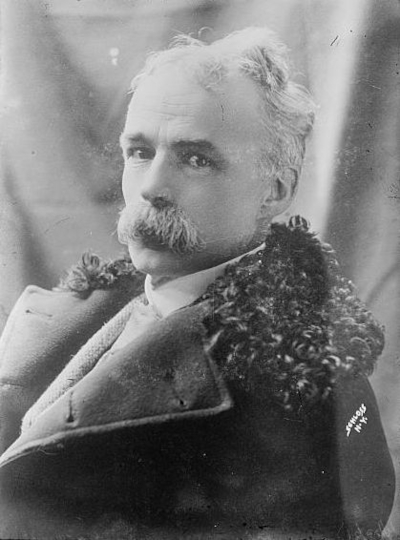
It’s a solid enough wholly unironic mix of love story and Victorian ghost story. The ending’s anticlimactic, and a bit baffling (and there’s a bit of gratuitous racism when Evie makes an offhand and somewhat odd comment about the “modern, Chinese-American school” of novels). And the story never becomes very frightening, though there is the one suspenseful passage of the time-slip vision. But it’s atmospheric, and well-written in a very 19th-century manner. The baffling structural choice of letting the story wind on well after the key supernatural incident may make more sense if you see the piece more as a love story than a ghost story. It struck me at one point that there’s probably a reading in which Alan is himself symbolically a closed cabinet; he holds secrets about his family and the reason for his moodiness, and Evie’s time-slip and victory over the curse is, functionally, her getting Alan to open up to her about the way he really feels about things.
It’s not the weirdest or most challenging of ghost stories, but as we’ll see this was not a particularly strong issue, and so the well-crafted prose is a pleasure in context. Since the story hadn’t been reprinted very often, it’s a reasonable choice for republication in Weird Tales. If it had physically fit into the issue. It doesn’t, quite, so a smaller typeface had to be used to print the story. Given the chaotic sense of the rest of the issue, my suspicion is that the format change to a physically larger magazine with fewer pages caused some real confusion, and the layout of “The Closed Cabinet” suffered as a result.
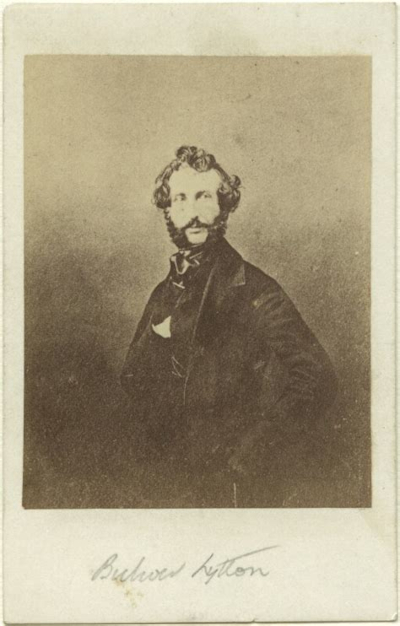
Bulwer-Lytton published “The Haunted and the Haunters; or, the House and the Brain” the next year in Blackwood’s Edinburgh Magazine. When it was reprinted a few years later, he made some significant edits, removing the last third or so of the story. (He made some minor ones as well, tweaking dialogue here and there. For the record, besides the version in Weird Tales I’m using the Project Gutenberg version of the edited text, and the Internet Archive clipping from Blackwood’s for the full text.) The edited text became an extremely popular and frequently-reprinted story; one disgruntled letter-writer to Weird Tales (‘H.M.’ of New York City, in the fifth issue, volume 2 number 1, July-August 1923) in fact chastised the magazine for reprinting “old ‘Pappy’ Bulwer’s ridiculous ghost bunk over which our ancestors laughed, the fathers guffawing, the mothers giggling, at his frantic and most amusing attempts to be awfully terrorizing! Never was spook story so overdone.”
The second half of the story, as it appears here, is an extended anticlimax in which the narrator goes to the landlord, discusses the nature of human willpower, and the two men then go to the house in broad daylight and find various paraphernalia that seem to explain why supernatural events were occurring. In the original final third of the story the narrator stumbles into a meeting with the magician who caused the strange happenings in the house, is hypnotised by him, and prophesies a cosmic vision of the magician in the far future. I have what is perhaps the unusual view that the longer version of the story’s better; the construction of the plot has a much better shape, while the edited version ends on that extended anticlimax. Either version’s effect likely depends on how much atmosphere you can read into Bulwer Lytton’s philosophical arguments about the nature of will and magic.
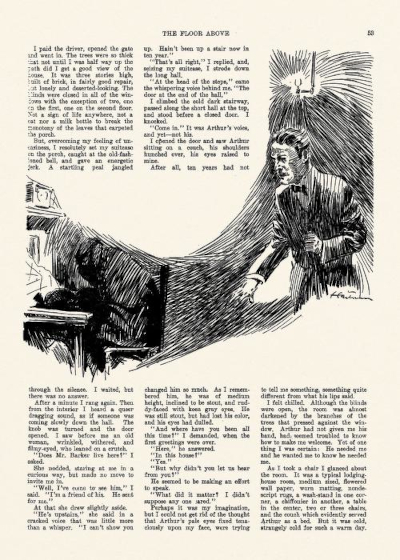
I’ll also note that the version that appeared in Weird Tales was further edited, possibly for space. More specifically, there’s an extensive cut after the narrator reaches the house; in the original the narrator’s servant cheerfully tells him he heard some inexplicable footfalls and whispers during the day, then the two of them explore the house and they see mysterious footprints appear in the backyard, after which, inside, a chair flies through the air, the narrator sees an indistinct blue figure sitting in said chair, and the servant feels a tap on his shoulder. One might reasonably characterise this section as significant to the flow of events in the story overall. If nothing else, the long paragraph where the two leads explore the house sets up the geography of the place, and deleting it means that a later reference to “the little back yard I have before described” becomes nonsense because the description’s been cut. This is especially odd as there’s some space on the last printed page of the story, where the nonfiction snippet about the woman appearing as a spirit photograph appears.
Consider also the covers of last issue and this issue. The cover of issue 2 has two giant eyes in darkness, and a ray beaming out from below them to strike a standing man in a suit. It doesn’t particularly fit any story in that second issue. You can sort of stretch it to cover a moment in the story advertised on the cover, “The Whispering Thing:”
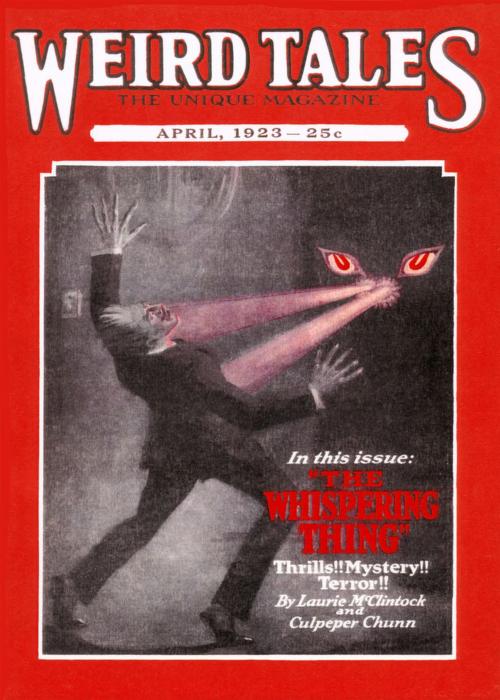
I could see nothing, but I felt my throat caught in a viselike grip and my chest crushed between two opposing forces. I cried out once, and then my breath was shut off. I threw out my hands to grapple with the unseen Thing, but there appeared to be nothing to grapple with.
But it’s not a particularly good match. No beam of light, and no burning eyes in the darkness. On the other hand, the cover nicely illustrates one of the tensest moments in “The Haunted and the Haunters:”
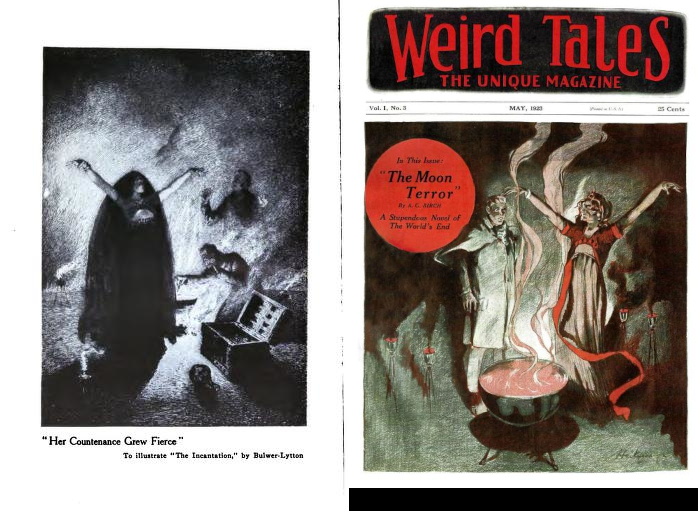
It was a Darkness shaping itself forth from the air in very undefined outline. I cannot say it was of a human form, and yet it had more resemblance to a human form, or rather shadow, than to anything else. As it stood, wholly apart and distinct from the air and the light around it, its dimensions seemed gigantic, the summit nearly touching the ceiling. While I gazed, a feeling of intense cold seized me. An iceberg before me could not more have chilled me; nor could the cold of an iceberg have been more purely physical. I feel convinced that it was not the cold caused by fear. As I continued to gaze, I thought—but this I cannot say with precision—that I distinguished two eyes looking down on me from the height. One moment I fancied that I distinguished them clearly, the next they seemed gone; but still two rays of a pale-blue light frequently shot through the darkness, as from the height on which I half believed, half doubted, that I had encountered the eyes.
Did the cover meant for the third issue get put on the second? Had something gone wrong with the cover for the second issue, and the cover for the third was pressed into service? Or was “The Haunted and the Haunters” originally slated to go in the second issue, and at the last minute pushed back to the third? Consider that the cover art for the third issue again doesn’t particularly match a story in the issue, especially not the cover-blurbed “The Moon Terror.” A few paragraphs above, I mentioned that the Weird Tales editors probably took “The Closed Cabinet” from the 1909 anthology reprint; that book also had “The Haunted and the Haunters” in it. Here (as observed by the Tellers of Weird Tales blog) is the frontispiece of the book, side-by side with the cover of Weird Tales 3:
You expect teething pains with a new magazine. And if you step back to consider that Weird Tales was part of a two-magazine stable, you can appreciate that there were a lot of moving parts involved in how a given issue was put together. There’s certainly a tension for a publisher between trying new format ideas to draw readers versus creating a coherent package within a fixed timeline and budget. I think the interior art’s a step forward for the magazine, the bits of nonfiction are mostly more interesting than in previous issues, and the attempt to bring in reprints to insist on the existence of forerunners for the magazine — a pre-existing set of weird masterpieces — is intriguing. Overall, before getting into the fiction, the issue is doing some exciting and promising things. But it’s still a bit of a mess visually.
Find all my posts about Weird Tales here!
Matthew David Surridge is the author of “The Word of Azrael,” from Black Gate 14. You can buy collections of his essays on fantasy novels here and here. His Patreon, hosting a short fiction project based around the lore within a Victorian Book of Days, is here. You can find him on Facebook, or follow his Bluesky account, @bookofdays.
It’s difficult not to feel for Mr. Heitman. It’s not uncommon for someone to decide on a particular arrangement of page content, and then shove the page at the next person along the line with a “This is your available space for graphs/specs/illustrations. Make sure they tie together well.” The hatching was a good attempt to actually tie some things together. Poor guy.
Enjoyed the discussion of the potential cover swap-outs on issues two and three. And thank you for the does-the-dog-die warning on “The Haunted and the Haunters.”
You’re welcome for the warning! And I agree with you about feeling for the artist trying to work around the parameters of a job. As far as I can tell, staff at Weird Tales was always pretty minimal; a business manager, the editor (Edwin Baird), and then probably somewhere around this point Otis Adelbert Kline and Farnsworth Wright were hired to read submissions, and possibly also for other minor editorial tasks. So I suspect there was just generally a lot of work to be done in not much time, and in this case Heitman may well have suffered for it.
I kind of liked the illustrations! Jespersen – very accurately – calls this hatching. So no cross-hatching. Instead there are a lot of parallel lines, either further apart or closer together to get the required degree of shade. It was popular style of illustration back in the day and had been around for a while – e.g. ’The Gibson Girl’ – but is rarely used now.
SOME crosshatching? (Albeit kept to the minimum). Heitman was 45 when he produced this work and only twelve years younger than Gibson, so I guess it’s reasonable to assume Gibson influenced him, along with a whole generation of illustrators. And Gibson’s innovations as an illustrator were largely due to technological advances in reproduction. Originally a drawing had to be reproduced by an engraver before going to print.* Photographic processes in the 1880’s eliminated this process, allowing for more fluid linework.
* Think there were exceptions – e.g. Cruikshank had trained as an engraver.
*Nods.* It does look like there was a little bit of cross-hatching, mostly confined to where Mr. Heitman needed to differentiate between background and deep shadow, or where a very small area of deep shadow became necessary. Agreed, though, that we don’t tend to use this technique as much, today; stylized shading more favors stippling and pointilism (I’d put that down to our digital, pixilated lives, if the preference hadn’t shown up long before) or cel-shading. Neither current technique would do half as well in connecting the contorted spaces Mr. Heitman had to work with as the hatching does.
I’m sorry I’m late in responding to this thread, but this is a good discussion! (And I’ve updated the cross-hatching reference to be more precise.) I should probably state up front that I like the style of the art just fine; but while I have a passing familiarity with pulp illustrations, I tend to look at this era of commercial art through the lens of comics (I’m planning one of the 1920s background articles to focus on comics and visual art of the time). Gibson was actually still working in 1923, though the popularity of the Gibson Girl was fading; but he certainly would have been one of the elders of the field of illustration that Heitman would have looked up to. I will say that part of the reason I’m not wild about Heitman’s art is that I think the magazine gets better work within a couple of years, but that’s for the future …
Mentioning how your primary focus is on comics etc, suddenly reminded me of Bernie Wrightson who also wasn’t a big fan of crosshatching! Frazetta’s line drawings are similar in this respect. On the other hand – in traditional book illustrations from the 1970’s et al – you get artists like Edward Ardizzone, whose work is almost defined by its crosshatching. Hard to see a pattern, really – other than that line illustration is nowhere near as common as it used to be.
I didn’t know that about Wrightson and crosshatching! He may not have liked it, but boy was he ever a master of it. I hadn’t thought about Frazetta in this context; I haven’t seen many of his line drawings, I guess.