Weird Times 4: Demography and Race
This post is the fourth in a series reflecting on the world of 1923, and the 1920s generally, as a background to early issues of Weird Tales. Imagine that you’re an American in 1923, and you’re taking a walk to the newsstand to buy the first issue of a new pulp fiction magazine. What sort of things will you see?
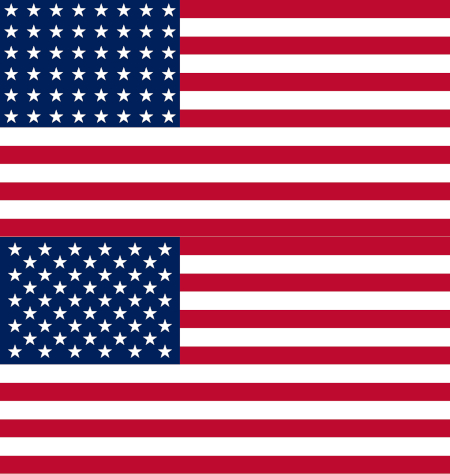
You might, for example, see a flagpole with an American flag on it. It is a flag with a regular grid of stars in the corner, six rows of eight stars apiece, representing the 48 states of the Union. The United States in 1923 is a different place from what it will become a hundred years later, with a population that is distributed differently, different territories, a different self-image and different ideas about the nature of its peoples.
(Some disclaimers before we go further: I am neither American nor a historian, though I’ve written pop history in the past. These posts are reflections on things I’ve read about the 1920s, and things I’ve come to think about the time; things I find interesting, and things I think underlie the fiction in Weird Tales. If I repeat here things that are common knowledge among Americans, my apologies; I can only say they seemed relevant to me as a foreigner. This particular post will discuss aspects of the demographics of the time, which means discussing race, which means discussing racism in the 1920s. Fair warning: there was a lot of it.)
The 1920 American census revealed that for the first time the majority of the population of the United States lives in cities with more than 2500 people. It wasn’t by much, 51.2 percent to 48.8, but had psychological significance in an America that still had an image of itself as a nation of ‘yeoman farmers.’ Canada’s not quite as urbanised, but at about this time is reaching or just past the point where most Canadians live in a population centre above 1000 people. Then again, the proportion of people in the two North American countries is a little different than it will be a hundred years on — about 112 million in the United States to just above 9 million in Canada (as opposed to 2026’s over 340 million to just above 40 million); this in a world swiftly approaching a global population of 2 billion people.
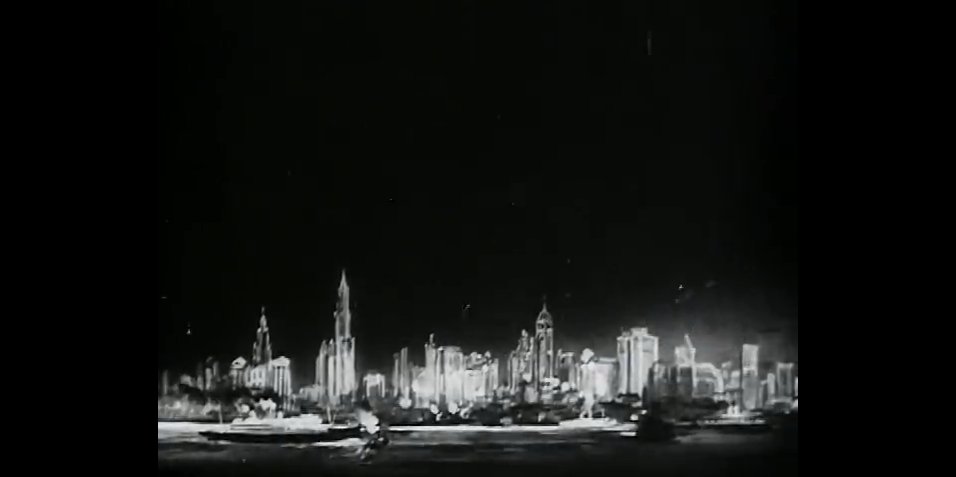
Still from the 1921 experimental short film Manhatta, showing the New York skyline
About one in twenty Americans live in New York City, with five and a half million people almost ten times the size of Los Angeles (there were only three and a half million people in the entire state of California in 1920). Chicago’s the second-biggest city in the United States, about half the size of New York. Philadelphia, coming up to two million people, was the only other American city in the 1920 census with a population over a million, though Detroit’s passed that mark by 1923; Cleveland, St. Louis, Boston, and Baltimore had all recorded populations from seven to eight hundred thousand. Montreal’s the largest city in Canada, with above 600,000 people, and Toronto’s the only other Canadian city above a half-million.
It has been said that in the nineteenth century the United States had a metropolitan centre in the northeast, and hinterlands to the south and west. You can still see evidence of that in 1923. New York State has about a tenth of the population of the US in 1923; Texas (fifth place in the 1920 census and second in 2020) about a twentieth, compared to a tenth in 2022. So: the continent is in some ways still tilted to the east. With air conditioning not widespread, places like Florida (with roughly a million people) have not yet seen their population explode. One analysis has the Midwest and South basically identical in population in 1923, each with about 34 million, while the Northeast is close with 30 million and the West far behind with only 10. By comparison, 2022 figures show the South’s population up to 128 million, the West at nearly 79, and the Midwest just shy of 69, while the Northeast trails along at 57 million. Meanwhile, in 1923 personal income per capita in the Northeast is at 132% of the figure for the United States as a whole, while the South is at 62%.
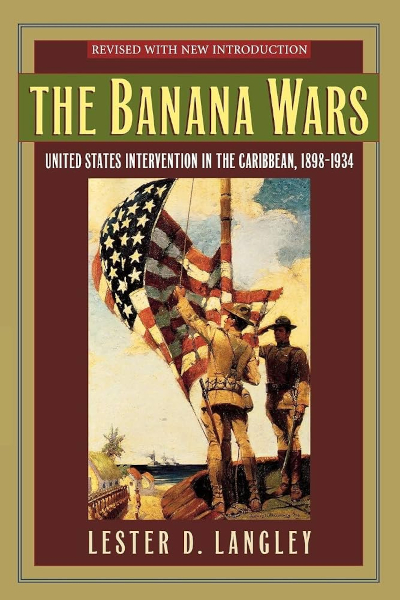
Beyond the 48 contiguous states, in 1923 Alaska and Hawai’i are officially organised incorporated territories. Puerto Rico, Guam, and the Philippines, ceded to the United States by Spain following the Spanish-American War in 1898, are unincorporated territories. Following a campaign in Puerto Rico in 1917, the Puerto Rican people are citizens of the United States, though they can’t vote for President. The people of the Philippines — over 10 million people — and Guam, along with the people of American Samoa (acquired in 1899) and the United States Virgin Islands (acquired in 1917), are officially non-citizen U.S. nationals. Note that at this time the United States is occupying Haiti and the Dominican Republic under separate military regimes, and maintains protectorates (or what are functionally protectorates) in Nicaragua, Cuba, and Panama. While the Monroe Doctrine of 1823 had stated that the United States would oppose intervention by foreign powers in the Americas, in 1904 Theodore Roosevelt expanded the Doctrine with the ‘Roosevelt Corollary,’ claiming that the United States had the right to intervene in the internal affairs of Caribbean and Latin American countries in the event of “chronic wrongdoing, or an impotence which results in a general loosening of the ties of civilized society.” This effectively means that the United States claims the right to intervene in these countries whenever it wishes; and so 1923 sees the United States in midst of the so-called ‘Banana Wars,’ a series of American military operations in Latin America.
According to the 1920 United States Census, in the 48 continental states there were 95 million whites, 10 and a half million Blacks (9.9 percent of the US population, compared to 12.4 in 2020), about a quarter million Indigenous Americans (.3 percent, in 2020 1.1), and less than 200,000 Asians and Pacific Islanders (.2 percent to 6.2); there is no category in the census for ‘Hispanic.’ 13.9 percent of the population of the United States was foreign-born in 1920, roughly in line with the figure ever since 1860. Ten million people had immigrated to the United States between 1905 (when the population of the country was 83 million) and 1914, most from southern and eastern Europe. It is worth noting that between 1870 and 1914 an estimated one hundred million people, one in 14 people around the world, had moved from one continent to another — sometimes to the Americas and sometimes elsewhere, and sometimes back, but this was a mobile age.

In fact, anti-immigrant sentiment has already led to a law, passed in 1921, that for the first time limited immigration by imposing numerical quotas. It’ll be followed by a similar but more restrictive law in 1924. Immigration laws of other kinds have been around for some time. State laws involving ‘head taxes’ in the late nineteenth century paved the way for the 1882 Chinese Exclusion Act, which stopped the immigration of Chinese “skilled and unskilled laborers” (this after an 1878 Supreme Court decision barred Chinese people from naturalised American citizenship); in 1923, this law is still in effect, and won’t be overturned for another two decades. It had been followed later in 1882 and in 1891 with laws formalising federal control of immigration and forbidding the entry of criminals, the insane, and “persons suffering from a loathsome disease.” The 1917 Immigration Act forbade various other categories of people (including “political radicals”), imposed a literacy test on migrants, and outright prohibited all immigration from Asia outside of Japan (and the American-ruled Philippines) excepting for students and a few categories of professional.
Both the 1921 and 1924 laws would establish hard limits on the total number of immigrants, roughly 350,000 in 1921 and 165,000 in 1924, by establishing quotas for individual countries based on the number of foreign-born people from each country already in the United States (according to the 1910 census for the 1921 law and the 1890 census for the 1924 law). There were a number of exceptions and loopholes — the 1924 act, which founded the border patrol, would exempt Mexicans from its quotas so that workers could come to the US. Note also that before 1922 women (not men) lost their citizenship if they married a non-citizen; the Cable Act of 1922 has partially changed that, but with some qualifications and limitations, and still tying a woman’s citizenship status to her husband’s. The immediate, and intended, effect of these immigration laws has been to forcibly scale down the admission of most ethnicities while increasing the percentage of immigration from north and western Europe.
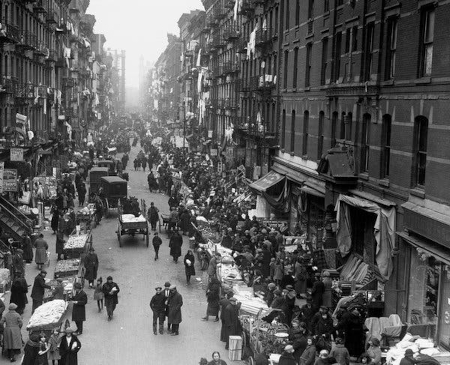
Some of the anti-immigrant sentiment is driven by antisemitism. Jews made up a relatively high percentage of the immigration from Eastern Europe in the years before the Great War; almost half a million had come to America between 1904 and 1907 alone. By the outbreak of the War, there were 3.5 million Jews in America, the largest Jewish population of any country in the world. New York’s 1.6-million strong Jewish population was the largest Jewish community of any city in the world, with five times the number of Warsaw’s Jews. Though the War significantly decreased Jewish immigration to America, 1920 saw 190,000 Jews come to the country. But after the 1921 and 1924 Immigration acts, the fiscal year 1924-5 will see only 10,000 Jews immigrate, and the year after that only 7000.
Racist fears are being stoked not only by immigration into the United States, but also by a significant population movement within the country. In the 1920s African-Americans are moving northward in large numbers. This is the time of the Great Migration, which began in the nineteen-teens and will last for decades. The Black urban population in the north more than doubles between 1910 and 1930, despite the fact that the sharecropping system common in the South, effectively a system of indentured servitude, binds poor farmers to the land. White authorities actively try to prevent Black migration; there are records of police (in Savannah, Georgia) arresting all the Black people in a train station or (in Summit, Mississippi) closing ticket offices and not allowing northbound trains to stop to take on passengers. Recruiters from northern manufacturers who travelled south to hire Black workers often went in disguise as insurance salesmen to avoid being arrested by local sheriffs.
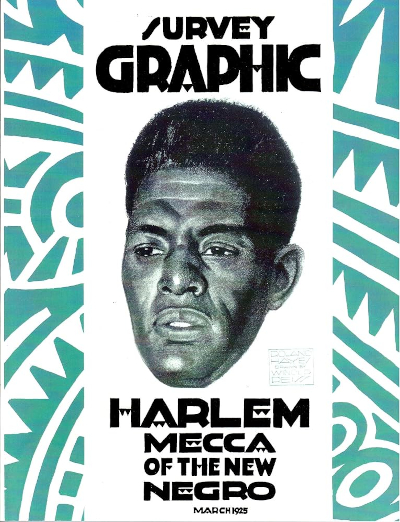
In the North, governments and real estate companies try to prevent the integration of the new African-American residents despite a 1917 Supreme Court case that found it was unconstitutional for a law to bar real estate sales on the basis of race. In the New York neighbourhood of Harlem, for example, white-owned real estate companies fought desperately for years against the successful efforts of Philip A. Payton, Jr., and his Afro-American Realty Corporation to rent apartments to African-Americans. In 1910 the population of Harlem was 90 percent white; in 1920, a bit more than two-thirds white; in 1930, 70 percent of a population of slightly more than 200,000 will be Black, among them poets, novelists, musicians, and artists of startling power. In 1922 James Weldon Johnson had published an anthology called The Book of American Negro Poetry with an introduction that has been called a manifesto for the flourishing artistic and cultural movement centred in Harlem that would come to be known as the Harlem Renaissance. The movement will be further publicised by a 1925 issue of a magazine called Survey Graphic guest-edited by Alain Locke, the first Black man to receive a PhD in Philosophy from Harvard; Locke will expand the issue into a book, The New Negro, that will be an extensive anthology of the Harlem Renaissance.
Why are so many African-Americans moving northward? In part, industrial labour shortages in the north are providing work. But legal discrimination and extralegal violence has worsened in the South over the previous decades. Following the 1896 Plessy v. Ferguson Supreme Court case, the doctrine of ‘separate but equal’ legalised racial segregation, which was then mandated by Jim Crow laws, starting with trains and transit systems and extending to (in one writer’s listing) “hotels, restaurants, restrooms, drinking fountains, parks, schools, libraries, saloons, telephone booths, theaters, doorways, stairways, prisons, cemeteries, and brothels. … Florida required separate storage facilities for school textbooks. In Georgia, courtrooms had two Bibles for swearing in witnesses.” African-Americans are often politically disenfranchised, through a variety of mechanisms including poll taxes and literacy requirements. So-called ‘white primaries’ for the Democratic Party are open only to whites — and as the Democrats are the dominant political party in the ‘Solid South,’ the Democratic primary effectively determines who’ll win the following election.
Extralegal racist violence is notorious; there’s been a series of race riots and massacres since the end of the Great War, with some whites irrationally afraid of African-American veterans. 1919 alone saw at least 30 riots in the season dubbed the ‘Red Summer.’ The violence has lessened slightly since then, but the Tulsa Race Massacre of 1921 saw over 1000 homes burned and probably from one to to three hundred people killed. 1923 has already seen another massacre, in Rosewood, Florida, in the first week of January. Beyond these mass outbreaks of violence there are still individual lynchings, though at least these are decreasing. One count in later years will record 33 lynchings in 1923, down from 57 the year before and 64 the year before that, and 16 lynchings in 1924. Lynchings, usually racially motivated and usually directed against Black men, aren’t merely murders but public and often communal acts which might involve atrocities such as mutilation and torture, not infrequently attended by whole families.
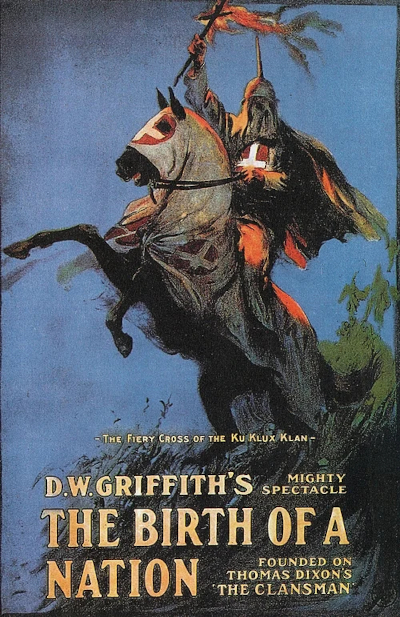
Sadly common at this time is the myth of the Lost Cause of the Confederacy, a warped version of American history often taught in schools, in which the obscenity of Confederate slavery is downplayed and the Civil War is described as provoked by northern oppressors aiming to enforce an unjust racial equality. Among the proponents of this big lie is a novelist named Thomas Dixon, Junior, who wrote popular novels in the first decade of the century glorifying the Ku Klux Klan, a white supremacist terrorist organisation active in the years after the Civil War; one of those novels was adapted into the heavily-publicised 1915 film The Birth of a Nation, which in turn led directly to a revival of the Klan. The twentieth-century Klan hates more widely than the original, attacking not only Blacks but also Catholics and Jews and flappers and criminals and immigrants and anyone having sex outside of marriage — among their activities, they’ve burned down dance halls and flogged alleged prostitutes.
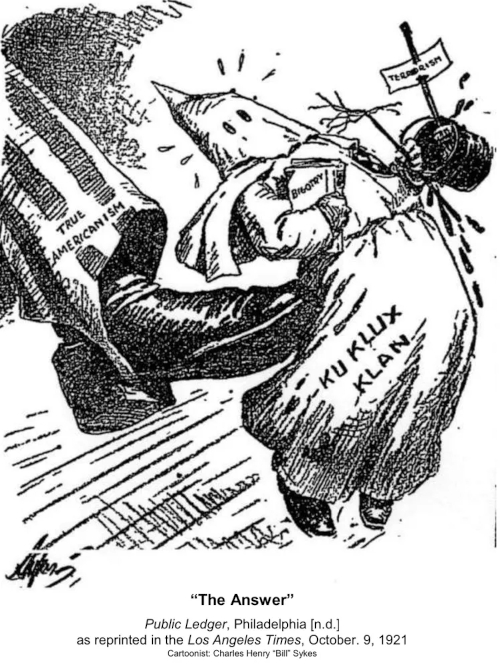
The Klan will grow to a membership of somewhere between five and eight million at its peak, all across the country and mostly in cities, with 75 members of Congress associated with it. Most surprisingly, perhaps, it has even held discussions with Black nationalist Marcus Garvey, At its height, the 1920s Klan is a kind of Masonic organisation; there are people who join it to get ahead in society. One scholar, Kathleen Blee, has observed that: “The true story of the 1920s Klan is the ease with which racism and intolerance appealed to ordinary people in ordinary places.” Still, there are people who see clearly the nature of the Klan; and in 1925 it will begin a rapid decline after one of its leaders is convicted of an especially vicious rape and murder.
In the 1920s anti-Black imagery is common in popular culture, in comic strips and advertising and postcards; in 1908 the Postmaster General had to outlaw sending lynching postcards through the mail, and scholars have noted even that had little effect. Various organisations have been formed by Blacks and whites to try to reform society, notably (in 1909) the National Association for the Advancement of Colored People. One of its white founders noted that part of the aim of the association was “to make race prejudice if we can as unfashionable as it is now fashionable.” A few years later, in 1914, Marcus Garvey founded the Universal Negro Improvement Association, calling for Black pride and urging “up you mighty race;” at the peak of UNIA’s popularity Garvey will claim 6 million members, though he’s likely overstating things by an order of magnitude. After 1923, his links to the Klan and financial irregularities will undermine his influence.
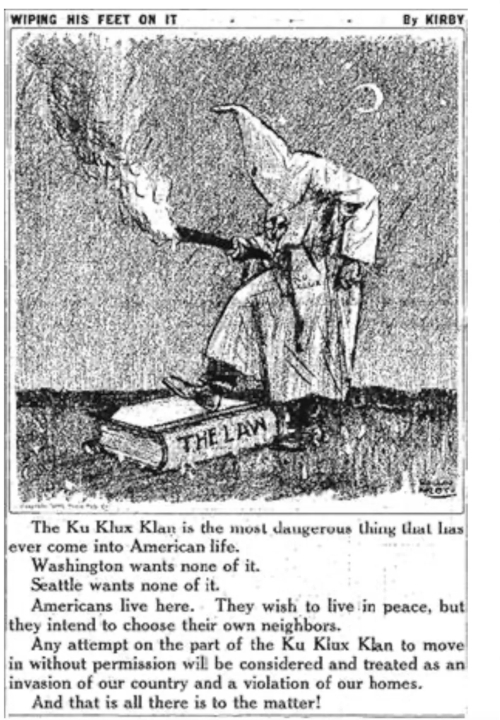
Hatred and discrimination are widespread. Writer Bill Bryson has observed: “There may never have been another time in the nation’s history when more people disliked more other people from more directions and for less reason.” So, for example, in addition to finding frequent antisemitism in the fiction and letters of the period, you can find it in the controversy around the appointment of the Jewish Louis Brandeis to the Supreme Court in 1916, in the dubious conviction and later lynching of a Jewish man named Leo Frank, in the decision by Ivy League universities to impose quotas on the number of Jewish students they accepted (starting with Harvard later in 1923), and especially in the most famous and wealthy automaker of the day publishing antisemitic writing in a media outlet he’d bought — when, starting in 1920, Henry Ford published the antisemitic tract The Protocols of the Elders of Zion in a newspaper he owned named The Dearborn Independent.
Or, as another example, at this time the policy of the United States government to Native Americans is one of forced assimilation to white society, a cultural genocide aimed at eliminating Native identity. As in Canada, boarding schools compel Natives to adopt white values and beliefs, forcing them to speak only English and to worship Christ. Native Americans born within the borders of the United States are not citizens by birth, though many have gained citizenship; in 1924 Calvin Coolidge will pass the Indian Citizenship Act, though even after that several states will continue to refuse to allow Native Americans to vote.
Or one might consider the situation of recent Mexican immigration in the American Southwest. Between 1890 and 1920 one and a half million Mexicans came to the United States, many of them fleeing the dictatorship of President Porfirio Díaz (before 1910) or the violence of the Revolution that followed his reign. American agricultural businesses were expanding dramatically in the Southwest during this time, and they found immigrant labour useful; but anti-Latino, and specifically anti-Mexican, sentiment was strong among the general Anglophone population. There were recorded incidents of lynching and mob violence, though the total number of fatalities is unknown. Estimates suggest that thousands of Latinos died between 1910 and 1920 in Texas alone; in only one example, in January of 1918 near the village of Porvenir a vigilante mob that included several Texas Rangers shot 15 men and boys to death.
Popular prejudice against Mexicans took many forms, including a persistent belief that immigrants spread disease. Starting in 1916 Mexicans crossing into the United States were forcibly deloused by being made to strip and bathe in gasoline; at one border crossing in El Paso, Texas, after finding that women were surreptitiously photographed while nude, and the photos shared in a local cantina, a 17-year-old named Carmelita Torres refused the procedure and sparked a multi-day riot that was suppressed by soldiers from both Mexico and the United States.
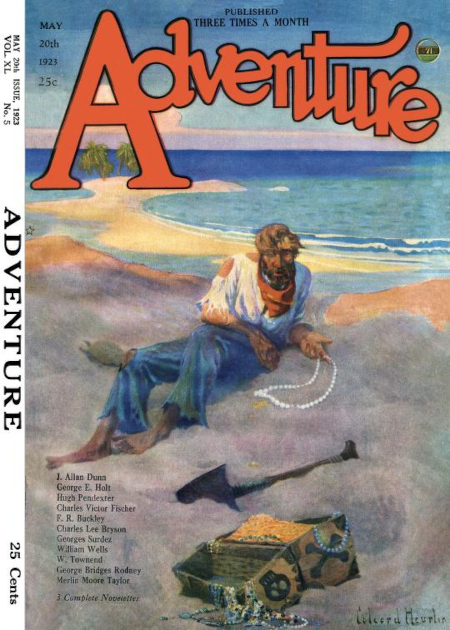
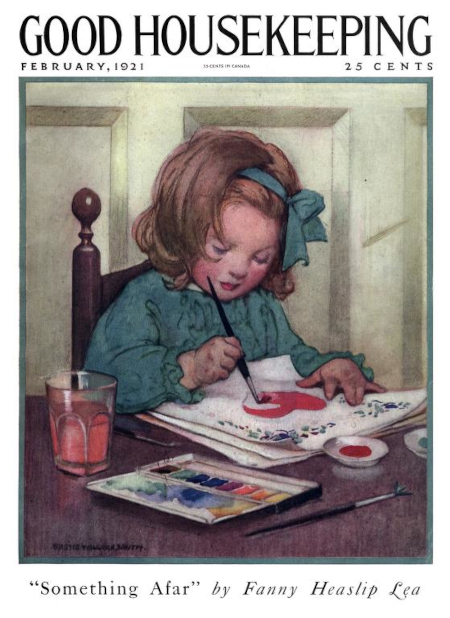
To read the fiction of this era, particularly the popular fiction, is frequently to find open intolerance and racism. Browsing through an issue of the pulp magazine Adventure for May 20, 1923, I found an item in its editorial section “The Camp Fire” stating “Only a little over 55 per cent. of the population of the United States is of white American parentage. It’s more than time to stop immigration altogether.” In 1924, one survey will find that 91 percent of Midwestern high school students are comfortable with the statement “Christianity is the one true religion and all peoples should be converted to it.” In 1921, Vice-President Calvin Coolidge published an article in Good Housekeeping called “Whose Country is This?” in which he wrote that “Biological laws tell us that certain divergent people will not mix or blend. The Nordics propagate themselves successfully. With other races, the outcome shows deterioration on both sides.”
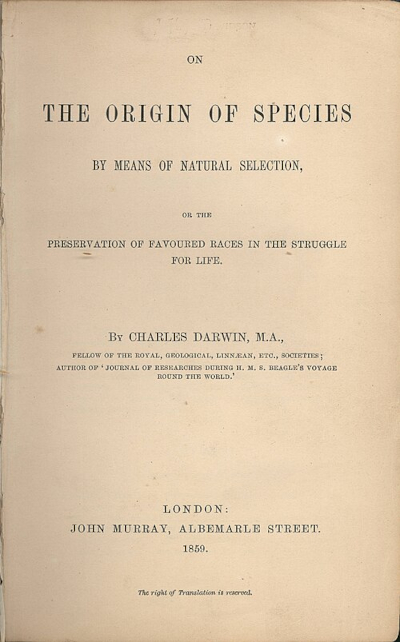
Coolidge’s argument was based in eugenics, a mainstream scientific position in the 1920s. Eugenicists believe that human society can be made better by selective reproduction, ‘breeding out’ undesirable characteristics as though human beings were farm animals. After Darwin published On the Origin of Species in 1859, writer Herbert Spencer coined the term ‘survival of the fittest’ in 1864; a so-called ‘social Darwinism’ (the phrase first appeared in 1944) then tried to apply a version of evolutionary thought to human affairs. People were to be characterised as ‘superior’ and ‘inferior,’ the superior encouraged to breed with each other, and the inferior prevented. In 1883 Francis Galton called this field of study ‘eugenics,’ from the Greek eugenes, ‘good in stock.’
Eugenics was a pseudoscientific justification for racism, white supremacy, and more broadly the idea of a racial hierarchy, as in Coolidge’s article, but so-called ‘scientific racism’ long predated Darwin; broadly, as science developed, scientific language, thought, and discoveries were used to justify pre-existing beliefs about race. In 1923, eugenics, and so-called scientific racism more generally, assumes that humans can be divided into ‘stocks’ and that race is a biological reality. More precisely: beyond heritable phenotypal characteristics (skin colour, for example), eugenicists believe that ‘race’ represents an essential inherited characteristic that also defines intelligence, personality, and other characteristics, and necessarily trumps education and other developmental factors.
But these beliefs were not held by dedicated eugenicists or race-theorists alone. In the 1920s race as biological reality is something close to conventional wisdom, at least among white Americans. Some of the unselfconscious racism so common in fiction of this period, especially popular fiction, is derived from this widespread belief in racial essentialism. Eugenics claims to articulate human nature, and eugenicists like Grant or zoologist Charles Davenport use cranial measurements, the shapes of noses and lips, and various other anatomical measurements to try to give scientific rigour to various racial stereotypes. In 1905 French psychologists Alfred Binet and Théodore Simon developed an intelligence test that, rejecting the idea intelligence was innate, was intended only to compare children of similar backgrounds as a way to determine which of them needed help to do better in school; revised in 1908 and 1911, it was translated into English as a general-purpose intelligence test (the word ‘moron’ was invented to describe a category of testees who scored low on this test), and seized on by racists and eugenicists as an objective measure of intelligence.
Note that the belief in identifying ‘superior’ and ‘inferior’ people does not only take the form of ranking ethnic groups, but is also thought to apply within a given ethnicity. Late in the nineteenth century social theorists and psychiatrists were haunted by the notion of ‘degeneracy,’ the idea (or fear) of a society declining over time as madness, illness, and criminality expand over the course of generations. Eugenics therefore singles out the disabled, the mentally ill, and the poor — whose poverty eugenicists interpret as proof of their inferiority. Starting in 1907 that led to the legalisation of forced sterilisations in various states, inflicted on groups including the insane, criminals, epileptics, and anyone deemed feebleminded (which might include, for example, any woman with a high sex drive). This varied by state; Iowa, for example, allowed the sterilization of “drunkards” and “drug-fiends.” In 1927 the legality of these laws will be upheld by the Supreme Court, leading to an estimated 70,000 forced sterilisations in the 20th century.
Eugenics has been popularised by several bestselling books. Madison Grant was an anthropologist and white supremacist whose 1916 book The Passing of the Great Race claimed that the Nordic subrace of whites was superior to all others, but despite that superiority was endangered by the abandonment of their culture and an increase of intermarriage. Skeptical of American democracy into the bargain, Grant was nevertheless tremendously influential. Three-quarters of American universities founded courses on eugenics, many of them using his book; it went through four editions and 13 printings by 1936. Similarly, Lothrop Stoddard’s 1920 book The Rising Tide of Color: The Threat Against White World-Supremacy claimed that white supremacy was collapsing as other races grew more numerous and more politically powerful, and feared “a ‘Pan-Colored’ alliance for the overthrow of white hegemony at a single stroke.” He called for an end to marriage between races, and to immigration to the United States. The book was positively reviewed by The New York Times, and praised by President Warren Harding. This is the context in which, for example, the architectural style of buildings constructed at Princeton University at around this time, in the ‘collegiate gothic’ style, were described by the supervising architect as answering “the call of inextinguishable race memory” and showing “ethnic continuity,” while Princeton’s then-president Woodrow Wilson said the buildings “declared and acknowledged our derivation and lineage.”
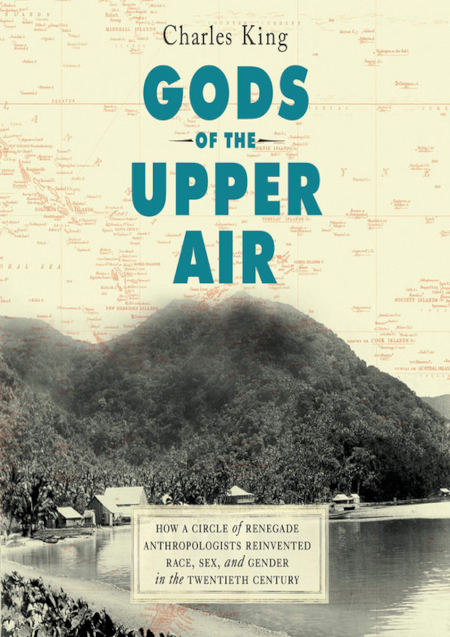
In the 1920s, then, eugencists’ neurotic fear of civilizational decline is feeding into white Americans’ fear of immigration. Note that in 1902 the term ‘race suicide’ was popularised by then-President Theodore Roosevelt, speaking to a perceived difference in birthrates between immigrants and native-born white Americans. In 1908 the first ‘better babies contest’ was held at the Louisiana State Fair, ranking babies by their healthiness; in 1913 the Women’s Home Companion co-sponsored a Better Babies Bureau that evaluated over 150,000 babies during the agricultural fair season, and would continue to hold contests into the 1920s. As Charles King put it in his 2019 book Gods of the Upper Air,
The idea of a natural ranking of human types shaped everything: school and university curricula, court decisions and policing strategies, health policy and popular culture, the work of the Bureau of Indian Affairs and U.S. colonial administrators in the Philippines… Differences in physical appearance, customs, and language were reflections of a deeper, innate otherness.
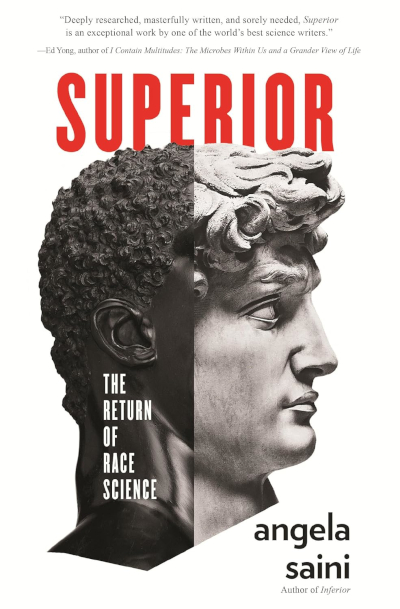
(Nor was eugenics restricted to white people. Black activist W.E.B. DuBois argued that Blacks should “train and breed for brains, for efficiency, for beauty,” using eugenicist ideas and terminology. Booker T. Washington invited noted eugenicist Charles Davenport to speak at the Tuskegee Institute. At least one Rabbi, Max Reichler, wrote in favour of “Jewish eugenics.” Science journalist Angela Saini, in her 2019 book Superior, notes Darwin being invoked in Meiji Japan, Chinese politicians in the early 20th century discussing sterilization and intermarriage, and India adapting European racial ideas to the caste system; she observes: “Each nation used the idea of race in its own ways, marrying it with science if it could be of use. Eugenics, then, became just another tool in what were longstanding power dynamics.”)
Court cases at around this time establish who counts as ‘white.’ A 1922 decision held that Japanese people were not white, and incidentally that whiteness was not a function of mere skin colour, “as that differs greatly among people of the same race, even among Anglo-Saxons, ranging by imperceptible gradations from the fair blond to the swarthy brunette.” At about the time you are walking down the street in February of 1923, the Supreme Court is preparing a decision (handed down on February 19) stating that most South Asians are not white, even though they’re Aryans and Caucasian, and therefore not eligible for American citizenship. That overturned a 1910 decision that held that Parsis, being Caucasian, do count as white. A 1909 decision held that Armenians are Caucasian, which is at least geographically accurate. And a court case in 1908 stated definitively that Finns are white as far as American law was concerned, even though they may have Mongol ancestors (and even though some of them are socialists).
But while eugenics is so common as to be part of the worldview and mental furniture of many people in the United States and beyond, it is being challenged. The New Republic has already run a series of articles attacking intelligence testing which labelled a large percentage of the American population as mentally deficient. In 1926 renowned lawyer Clarence Darrow will write an influential article attacking “the eugenics cult.” Some former eugenicists (including Henry Goddard, who had rewritten the Binet-Simon intelligence test for American use) will recant their views. In years to come other scientists will point out shortcomings in the methodology and field research of the eugenicists, and attack the idea of character traits like laziness being embodied in the genes.
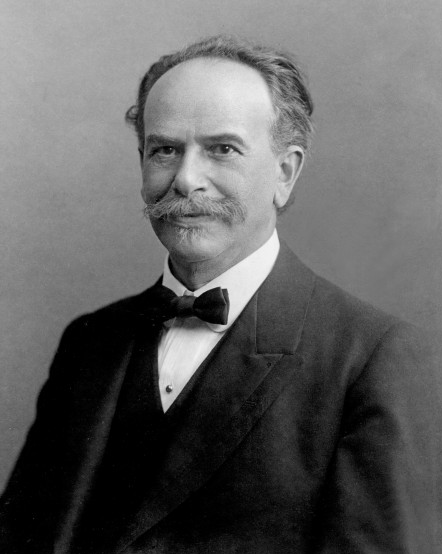
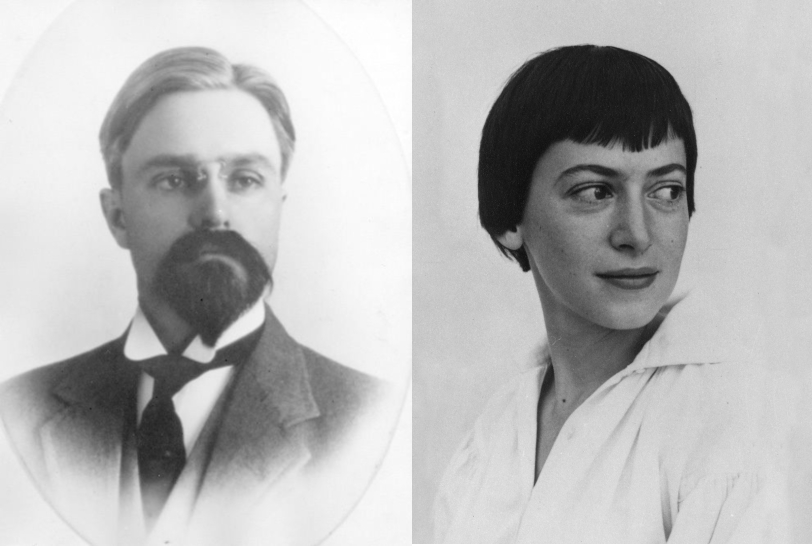
Perhaps most notably, in 1923 a professor at Columbia University named Franz Boas, who has clashed with Grant and other eugenicists, has already written and argued forcefully that race is not biological reality but culturally constructed. Brought up in the old tradition of biological essentialism, he analyzed data he collected about femur lengths and the relative roundness of skulls and various other anatomical features; and he realised there was no scientific correlation between these things and common ‘racial’ categories. He attacked biological essentialism as early as 1894, will continue to promote the idea of culture as the primary driver of differences between population groups until his death in 1942, and today is known as the “father of American Anthropology.” Not only will his own work and writing be influential in undoing the eugenicist consensus of the early 20th century, he’ll also teach a number of influential anthropologists, including Margaret Mead, Zora Neale Hurston, and Alfred Louis Kroeber — whose anthropological work would be reflected in the fiction of his daughter, Ursula Kroeber Le Guin.
I have written this much about race in 20s America because I am writing about popular fiction from 1920s America. And what I mean by that is that if someone had told me before I started reading Weird Tales (and The Thrill Book, and other 1920s pulps) that I was going to find a lot of 1920s attitudes about, say, sex and gender, I’d have thanked them for the warning and not been at all surprised by the various femmes fatales and damsels in distress and square-jawed heroes I found. As indeed I was not really surprised, and have from time to time been intrigued by things that seem fascinating exceptions. But if somebody had warned me that I was going to find a lot of 1920s attitudes about race, I’d have thanked them and then been surprised anyway; no brief warning could have prepared me. And this despite having already read a fair amount of popular fiction from around this time.
What is surprising is partly the quantity and openness of the racism in Weird Tales, but mostly the strangeness of it. The magazine comes from a time when race was conceptualised differently, by and large, than it is now. This post has very directly come from trying to understand what I am seeing in the stories, and what attitudes they’re reflecting. I hope it’s some help for others; it has been a very useful exercise for me.
Find all my posts about Weird Tales here!
Matthew David Surridge is the author of “The Word of Azrael,” from Black Gate 14. You can buy collections of his essays on fantasy novels here and here. His Patreon, hosting a short fiction project based around the lore within a Victorian Book of Days, is here. You can find him on Facebook, or follow his Bluesky account, @bookofdays.
Thanks for putting this together. It is shocking just how blatant the racism was and how so many of those threads are still sticking to us to this day.
Thank you for commenting, Adrian! To be honest, there’ve been moments while working on these posts. and this one in particular, when something terrible would come up in the news that was exceptionally depressing because I could see how directly it traced back a hundred years or more, and how willful the refusal was to move on. Well; better to remember the past, and have a hope of not repeating it, I suppose.
Interesting that segregation was a comparatively late development (although in fairness, emancipation would have only been thirty years earlier). Also the whole notion of racial degeneration – a concept that seems laughable on reflection but is very much a feature of both Lovecraft and Howard’s work (just like you imply).
I am in no way an expert on segregation, but I gather that it was something that was building in the years before the Plessy v Ferguson decision. But I also gather that the years after the Civil War saw some progress in racial equality before a backlash. I suppose there’s a tendency to expect history to progress in a straight line, but it so often is a series of curves.
Interesting note about the population of my city, St. Louis. You cite a population of 700,000-800,000 in 1920. The peak was about 875,000 in 1950, if memory serves. The current population? Around 230,000! Now, part of this is due to a curious feature of St. Louis’ political geography — in the 19th Century a dispute (I’ve forgotten the details) led to the formal separation of St. Louis County and St. Louis City — in essence, the city is a county of its own. But that meant that its borders were constrained — as people moved to then open areas outside city limits, they perforce moved to new cities (or unincorporated land in the County) — whereas in other cities the central city would typically incorporate more and more of the “suburbs”.
As for the Ku Klux Klan and their hatred of groups besides black people — in my birth city, Naperville, IL, when the Klan showed up they didn’t notice any black people, and probably not very many Jews. So they went after Catholics, and burned down the church that my parents would later attend, Sts. Peter and Paul. (Obviously this was a rebuilt church.) When did this happen? In 1922. (I suppose I should add that while it is proudly cited as part of Naperville history, especially local Catholic history — that we were victims of the Klan — it was never definitely proved that the Klan was responsible.)
The population of American cities is a little fascinating to me; growing up, I knew about New York (thanks to Marvel Comics), and knew that Los Angeles was the second-largest city in the US; but then there were a lot of other places that were basically just names, until, eventually, I pieced together enough American history to grasp the background of different cities and why they thrived. Still, I was well into adulthood before I learned, say, that Chicago was the traditional second city of the US. And so seeing the population figures is a little eye-opening to me; I knew that Cleveland, for example, was a more prominent place then than now, but hadn’t grasped how much so. (And then, as you say, there’s the question of what territory you count as a ‘city’ for the purposes of determining population.)
It’s disturbingly familiar how the Klan weaponised hatred in different ways in different areas. I remember being baffled back in college when I heard the Klan had a branch in Quebec — one of the traditionally most Catholic areas of North America. But it seems hate is an effective means of manipulating people.
Actually, St. Louis was a bigger and more prominent city than Chicago until somewhat late in the 19th Century. (The importance of river traffic was a big reason.) In fact, St. Louis manipulated the census numbers one decade, 1870 or 1880 I think, when it appeared that Chicago would go ahead of St. Louis in population. And apparently it had by then — but that particular decade the “official” census still showed St. Louis in the lead — because of exaggerated figures that St. Louis reported.