Neverwhens: World Building in a Shared Universe– Cormac Mac Art and The Isle of Swords
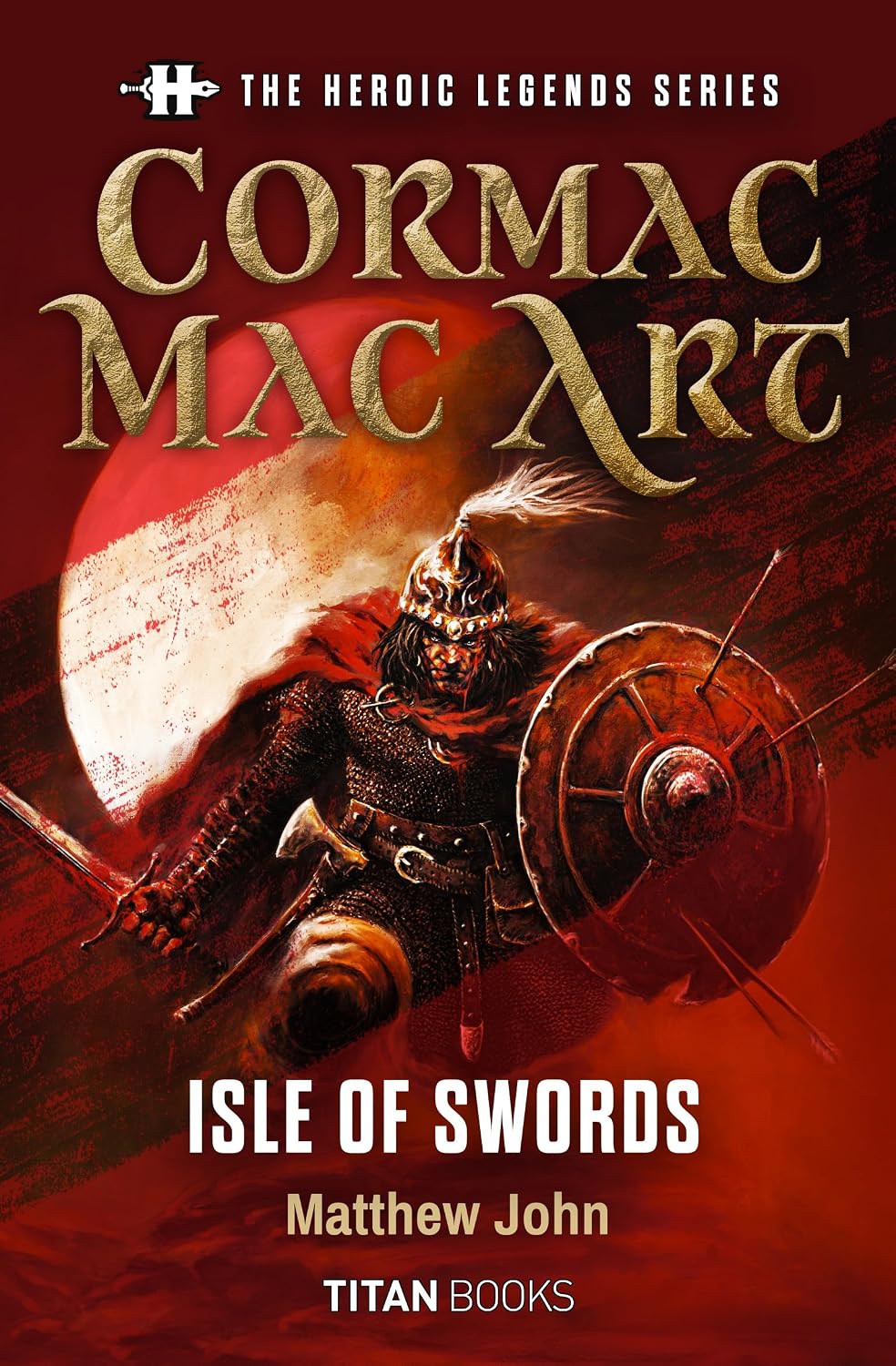
When Titan and Heroic Signatures announced they were bringing back Robert E. Howard pastiche, not just of Conan, but of many others of his rich panoply of heroes, I sacrificed many a reading night to take a deep-dive into the first year’s worth of stories, and chronicled the results at Black Gate. You can read about that descent into Cosmic Pastiche Horror here.
The truth was that, like most pastiche — assuming one excepts the value of pastiche at all — the results were mixed. Most was admirable attempts by authors who clearly had fond memories of REH, but didn’t really remember what made HIS fiction (not their memories of it, not their memories of it via Marvel comics, film, or even other pastiche) work. A few, namely the work by Scott Oden, John C. Hocking and James Lovegrove, “got” the characters they were writing (Oden can even sound like Howard), while an equal number could only be called… well… not worth the paper they weren’t printed on.
[Click the images for Cormac-sized versions.]
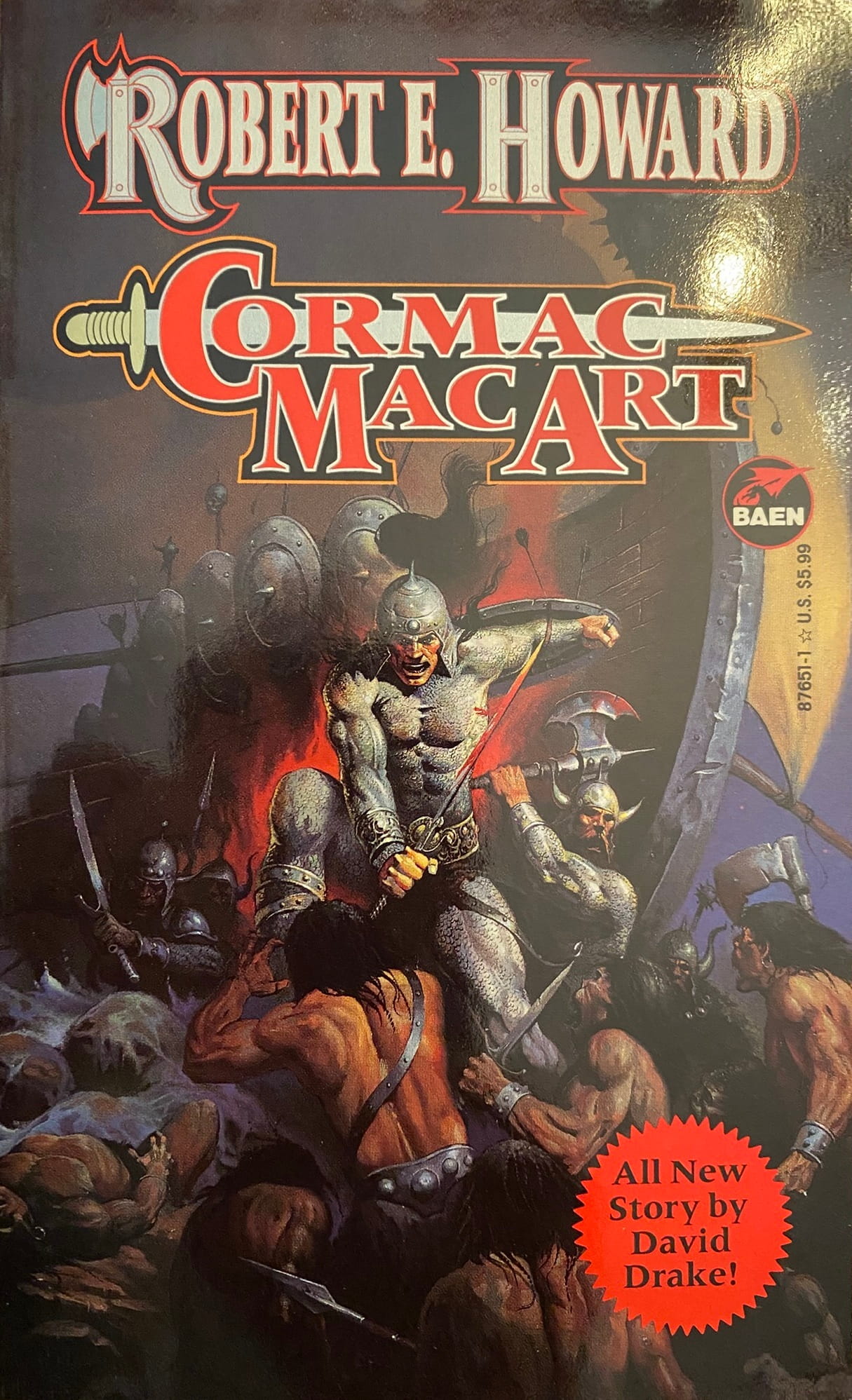
This go around, I’ve most skipped the new Titan pastiche, largely because I still think the stories are generally written too short (about half the length of the usual Howard yarn) and often miss the mark (I DID read a Kull story and almost didn’t make it through…5,000 words.). But when I heard that Matt John of Rogues in the House, author of the new Conan RPG and periodic Savage Sword scribe had penned a story on Cormac mac Art, I was going to make time.

Not THAT Cormac
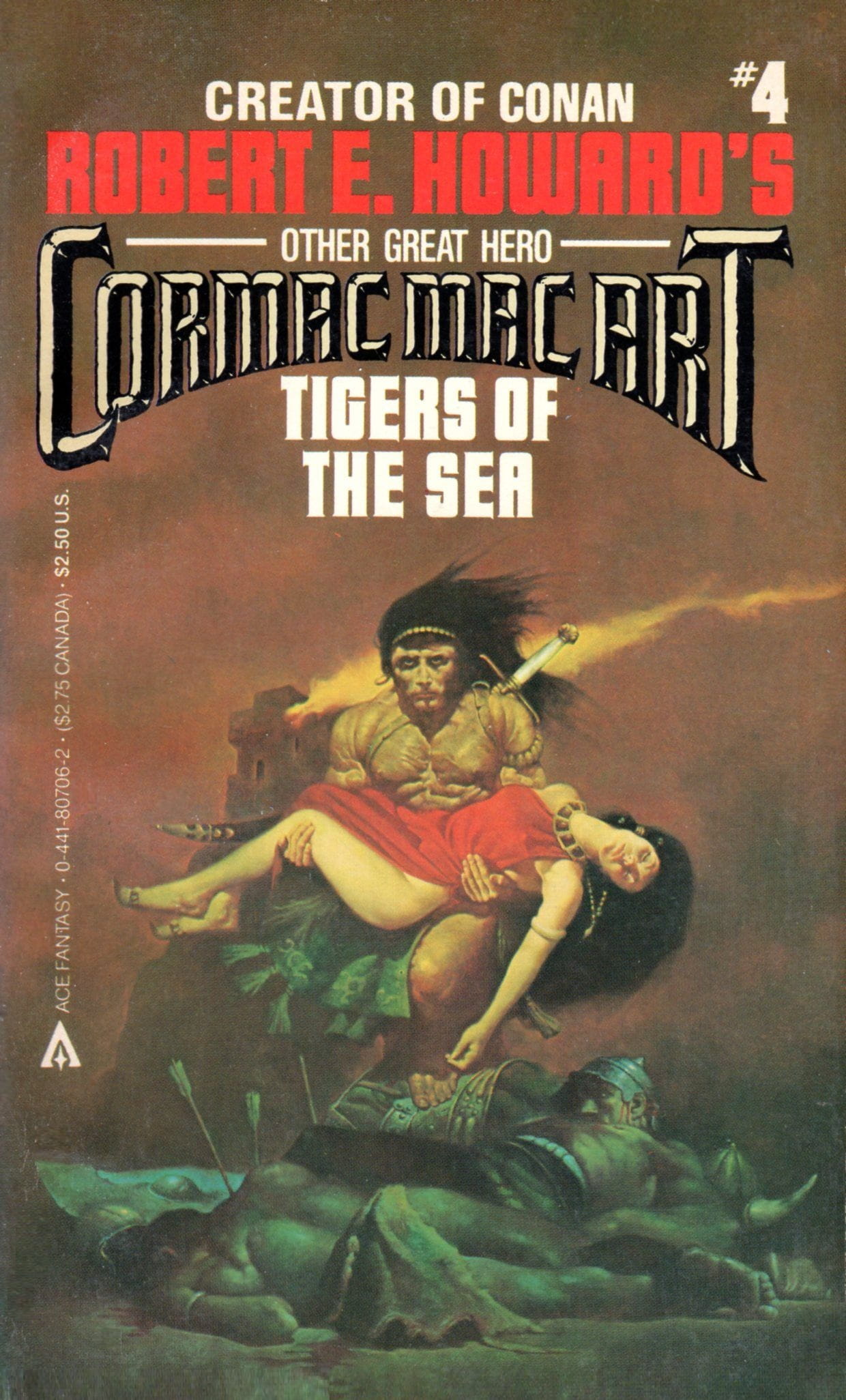
Cormac mac Art is one of REH’s minor characters, and yet one of my favorite characters in his entire canon, ironically because of pastiche. I discovered the character, and his companion, the hulking Dane Wulfhere, as a teen, in a series of six pastiche novels by Andrew Offutt and Keith Taylor. (These are also, IMO, the best pastiche novels of Robert E. Howard out there, although the two Bran Mak Morn novels and Dave Smith’s Black Vulema novel come close). I fell in love with this 4th century Irish reaver and his hulking, impetuous side-kick (and yet captain — in an interesting twist, Cormac is number 2 to Wulfhere aboard their ship, The Raven).
Cormac mac Art (nicknamed an Cluiun — “The Wolf”) is an Irish Reivers — bold pirates who range far among the ruins of the Roman Empire, reaching Spain and on occasion even Egypt, though their ships are less sound than those of the Scandinavian Vikings. (Entirely anachronistic for the time period, as this is the Vendel era, not the Viking Age).
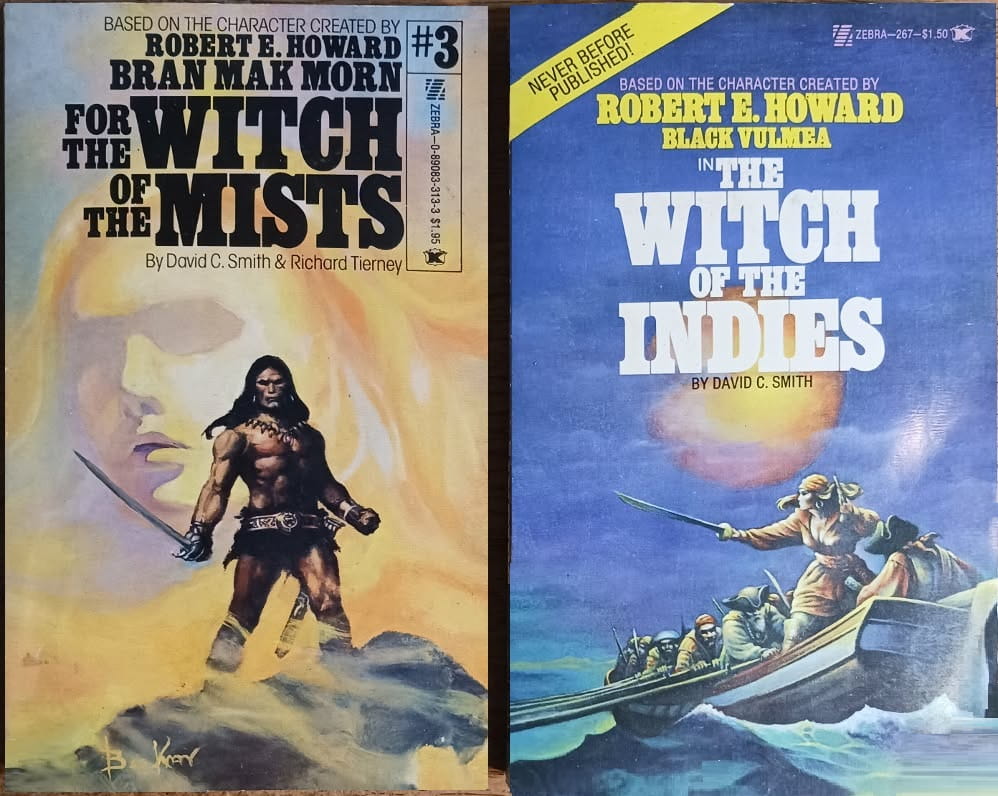
Two fine pastiche novels: For the Witch of the Mists by David C. Smith & Richard Tierney (Zebra, January 1978) and The Witch of the Indies by David C. Smith (Zebra, June 1977). Covers by Doug Beekman and Stephen Fabian
Cormac is an outlaw for unspecified reasons (although Offutt would write an entire origin story and lost love for this exile, it is entirely his fabrication) and had to flee Ireland. He finds refuge among a ship of Danish Vikings led by Wulfhere the Skull-Splitter. Wulfhere is a giant of a man, armed with a Dane axe, a broad humor and a short temper, and is apparently on bad terms with most of the other Viking leaders. Cormac is a more subtle man: well-informed on the affairs of the numerous kingdoms, tribes, and factions inhabiting the turbulent British Isles, a fluent speaker of many languages, a competent spy able to infiltrate enemy strongholds, and the originator of complicated or intricate plots.
As a Howard character, Cormac is named for a famed Irish High King who lived a century before his time, but also shares the name with Cormac Fitzgeoffrey, REH’s Crusader hero, and the most obvious prototype for Conan. Cormac mac Art is more morose and brooding than Conan, and his many enemies and reliance on wit to see through makes him something of an Odysseus, applying his cunning and trickery to problems as much as the sword. Although Conan-esque in appearance, he is leaner in build, even more scarred, and with stormy grey eyes that fit his disposition. Both swear by Crom (Crom Cruach being, indeed, one of the last Irish gods venerated), both seem to have little other use for him.
In the three published stories, one unpublished and two unfinished, Cormac’s exploits in the north bring him afoul of (anachronistic) Vikings and the last remnants of Howard’s “lost race” of Picts (not to be confused with the historical people). Offutt took these stories, only one of which has any sword & sorcery elements and made them more thoroughly in the canon of Howard’s S&S characters, linking him by racial memory (a Howard trick!) to Conan and Kull.
At the same time, over the years, both Richard Tierney and David Drake have plied their hands at finishing those unfinished tales — Drake completing “Tigers of the Sea” and Tierney “Tower of Abomination.” Tierney wrote his own (and far better) completion of “Tigers of the Sea” for the Donald M. Grant 1974 edition by the same name, while Drake had created a treatment for the Offutt series that was not picked up and simply renamed Cormac and Wulfhere in the stand-alone novel The Dragon Lord, while writing one final Cormac short story “The Land Toward Sunset” for the 1994 collection Cormac Mac Art published by Baen (see above).
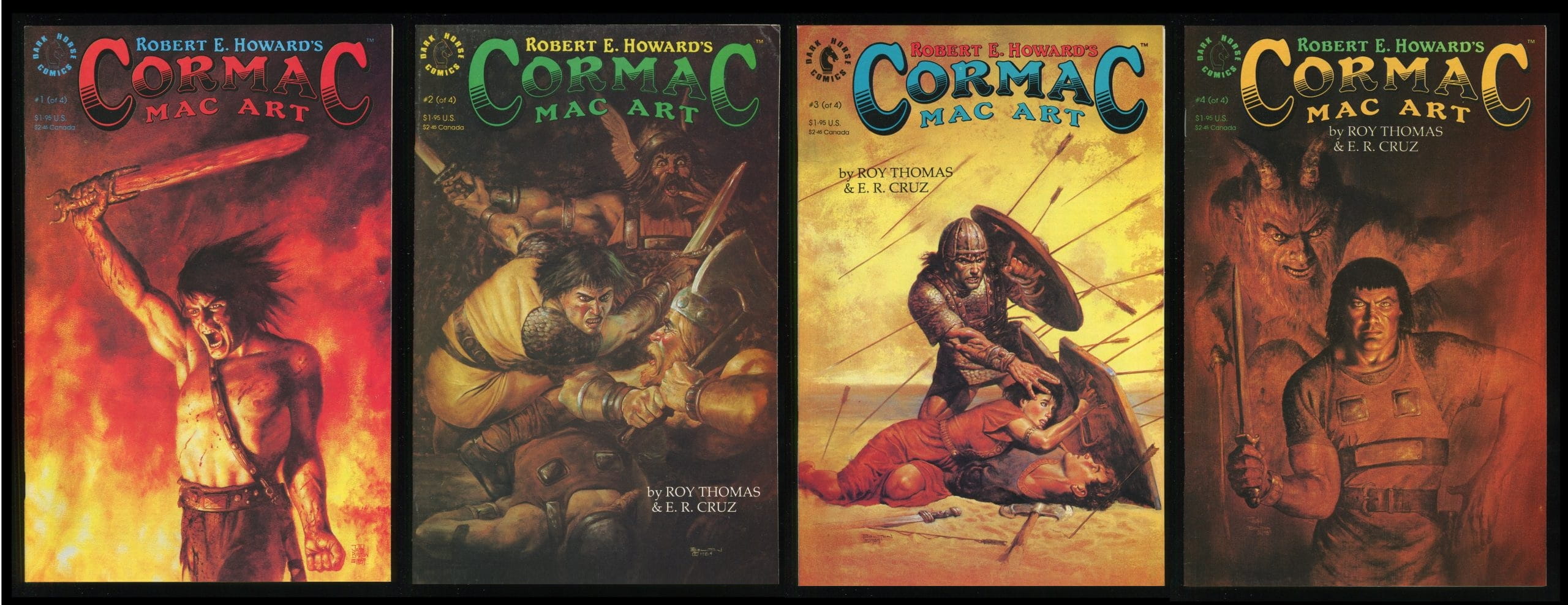
Finally, the collection of REH stories, unpublished and unfinished, would further be adapted by Roy Thomas as a four volume comic series that creates the thinnest of linkages for the stories.
All of which is to say that, for a character with so little canon, Cormac has had a surprising run of reprints, adaptations and expansions. In truth, the character exists far more in pastiche than in canon, already.
Sailing to the Isle of Swords
Which brings us to the latest entry into Cormac’s career, a short novelette by Matt John. John is faced with an interesting choice: try to reconcile all of this other material, which provides far more detail about mac Art than Howard himself, stick strictly to Howard’s think sketches, or just write a stand-alone story and ignore the rest. It’s an interesting world-building challenge — a very similar one that Jim Zub has attempted (to, IMO, varying degrees of success) in the new Conan comic, trying to reconcile iconic elements of the Conan films and other media to REH’s work as part of a Robert E. Howard multiverse.
John’s decision shows his Robert E. Howard chops as he takes Howard’s characters, the Offutt pastiche and not only Howard’s own crumbs of possible ideas where he might have taken the characters, but his other major British Isles heroes and then pulls it all together in a fast-paced tale that requires no previous knowledge but will delight those who have it.
The story Easter Egg is that it is first and foremost a prequel (by 500 or so years) to the “The Dark Man.” That story reveals the fate of Howard’s 2nd century AD character, the Pictish king Bran Mak Morn, and features another brooding Irishman — Turlough Dubh. Black Turlough is a minor character in one of Howard’s best historical fantasies, “The Grey God Passes,” about the famed Battle of Clontarf (1014), but later finds himself departed from Ireland — again for vague reasons.
In the “Dark Man,” Turlough meets a towering Saxon, Aethelstan, who becomes his companion in the lost-race adventure, “Gods of Bal-Sagoth” and the unfinished “Shadow of the Hun.” Other than timeline and his wielding an axe, Turlough is a near twin to mac Art, so it seems Howard was basically reinventing Cormac and Wulfhere as proper Viking Age characters, this time with overt magical elements and ties to his other sword & sorcery stories — even reusing several plot lines from the Cormac stories.
If “The Dark Man” neatly ties Black Turlough and Bran mak Morn, by revisiting that story’s setting in “The Isle of Swords,” John skillfully uses this story to tie together Howard’s 2nd century, 4th century and 11th century characters without short-changing or retconning anything. Whereas in the comic, Zub introduces the iconic sword from the movies — and Thulsa Doom — but has to give entirely different ways to introduce Conan to the tale — all John needs is Howard’s own canon. (And if we recall that Howard himself linked Kull and Bran, we now actually have an overt linkage to four different REH swordsmen.) Brilliant work for a pastiche writer and the subtlest form of added world-building to the creator’s universe.
But Matt John is also his own man — and he adds touches to this story that REH himself (who sadly committed suicide at 30) would not. We meet Cormac and Wulfhere later in their careers — they are not old, but they are middle aged, and they are feeling it. Legs fatigue, sword arms are less quick, reactions just a bit slower. As someone in his 50s, I could relate! And yet, fate hasn’t brought them to any easier or more secure a life than when we met Cormac in his 20s.
This is a nice commentary on series characters, whose lives never seem to much change, no matter how many adventures they have, and yet seem oblivious to it. (My favorite conceit in this nature is with Nero Wolfe, for whom the year is ALWAYS the same, despite having been written across a 40-year period.) John’s choice about fading youth and ability fits well in a story of the Dark Man, a magical “entity” which is itself created over concerns over the waning of an entire people, and Bran Mak Morn’s sacrifice to continue serving his people, after his body failed. It’s a nice, subtle touch of characterization and growth.
Isle of Swords is pastiche that knows the assignment: knows your source material, understand the original author’s characters, and tell a good story, while respecting what came before. I’d love to see Matt John return to these two rogues, in a longer format.
Thanks for the nice overview. I will add that Patrice Louinet believes that Turlough predates Cormac. REH had written about Turlough in The Ballad of King Geraint, and then in Spears of Clontarf, which became The Grey God Passes. He then wrote The Dark Man and The Gods of Bal-Saggoth for Strange Tales, but that magazine folded. REH therefore submitted them to Weird Tales, where they were accepted (and published out of order).
If REH had a story published, or even just accepted, it sometimes spurred him to write more about that character (as happened with Kull). The success of Turlough/Athelstane led him to create a similar pairing of Cormac/Wulfhere, for sale to one of the adventure pulps. When The Night of the Wolf was rejected, he tried to add supernatural elements to the series, via The Temple of Abomination, but abandoned the effort. Note that the Temple of Abomination involves Atlantean sorcery, which ties it in with the world of Kull, and even of Solomon Kane, who meets an Atlantean in The Moon of Skulls. (While discussing tie-ins, I’ve seen criticism of the ending of The Road of the Eagles. But that ending ties in the Cossacks with the world of Solomon Kane)
It’s been fascinating over the years to see Howard aficionados realize that most of REH’s heroic writing all took place in the same world, over the course of a hundred millenia.
” John skillfully uses this story to tie together Howard’s 2nd century, 4th century and 11th century characters without short-changing or retconning anything. ” and “Isle of Swords is pastiche that knows the assignment: knows your source material, understand the original author’s characters, and tell a good story, while respecting what came before. ” are fantastic review quotes. Kudos to you and Matthew John
Thanks for the article, Greg. I came across “The Tower of Death” back in high school in the 80’s and it didn’t take long for Cormac and Wulfhere Skullsplitter to become some of my favorite reads. Although I must admit at the time I thought I was reading Howard with his name plastered boldly across the tops of the books. I absolutely loved the cover illustration and the title of “When Death Birds Fly” Thanks for recommending a couple of the other titles. Something to look for to become reacquainted with old friends.
I liked the first two pastiches by Offutt, more than I did REH’s original. I thought they were terrific books.
I plan on reading the remainder at some point.
So little time, to much to read.