A Science Fiction Film Noir: Lord of Light by Roger Zelazny
 |
 |
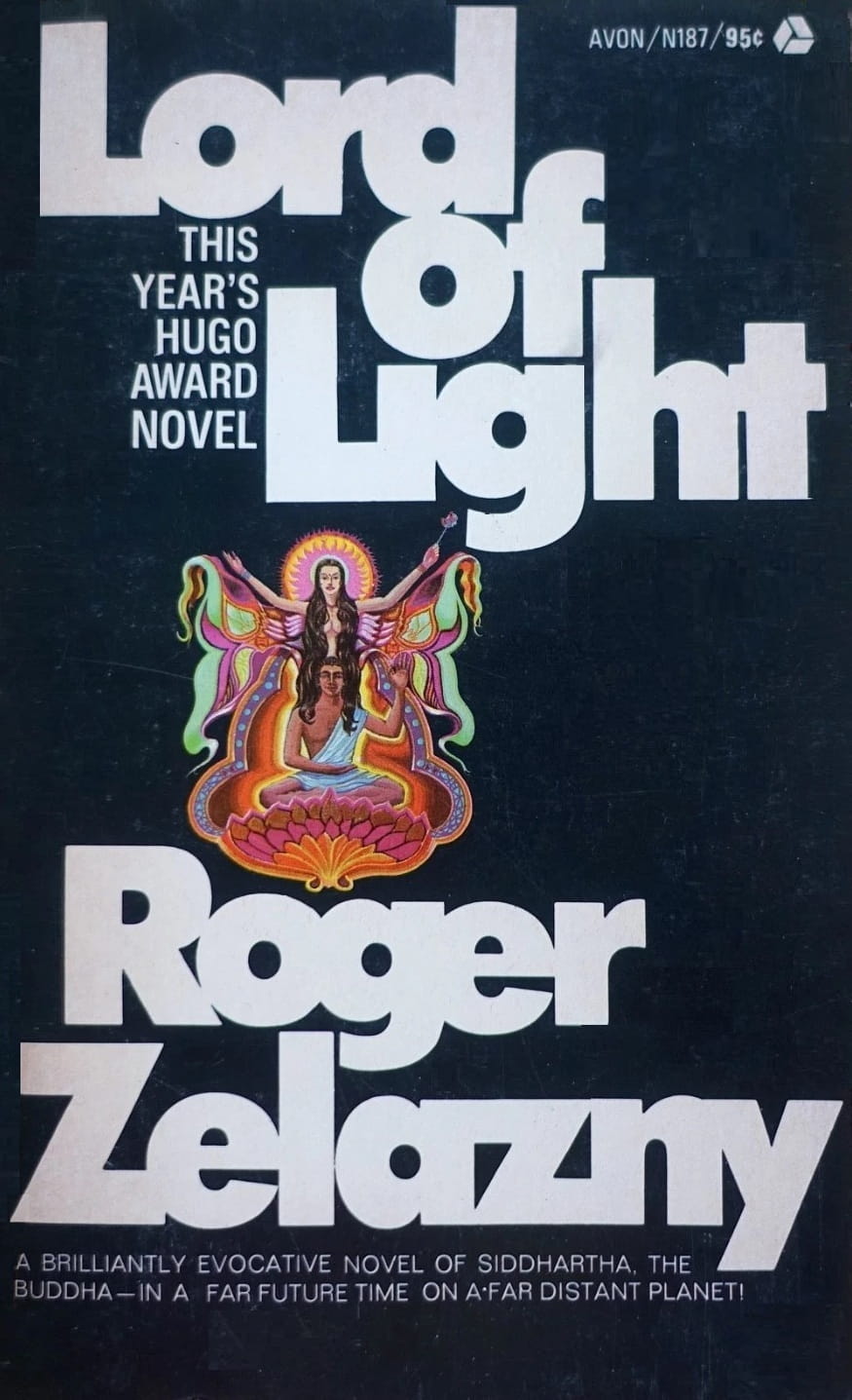
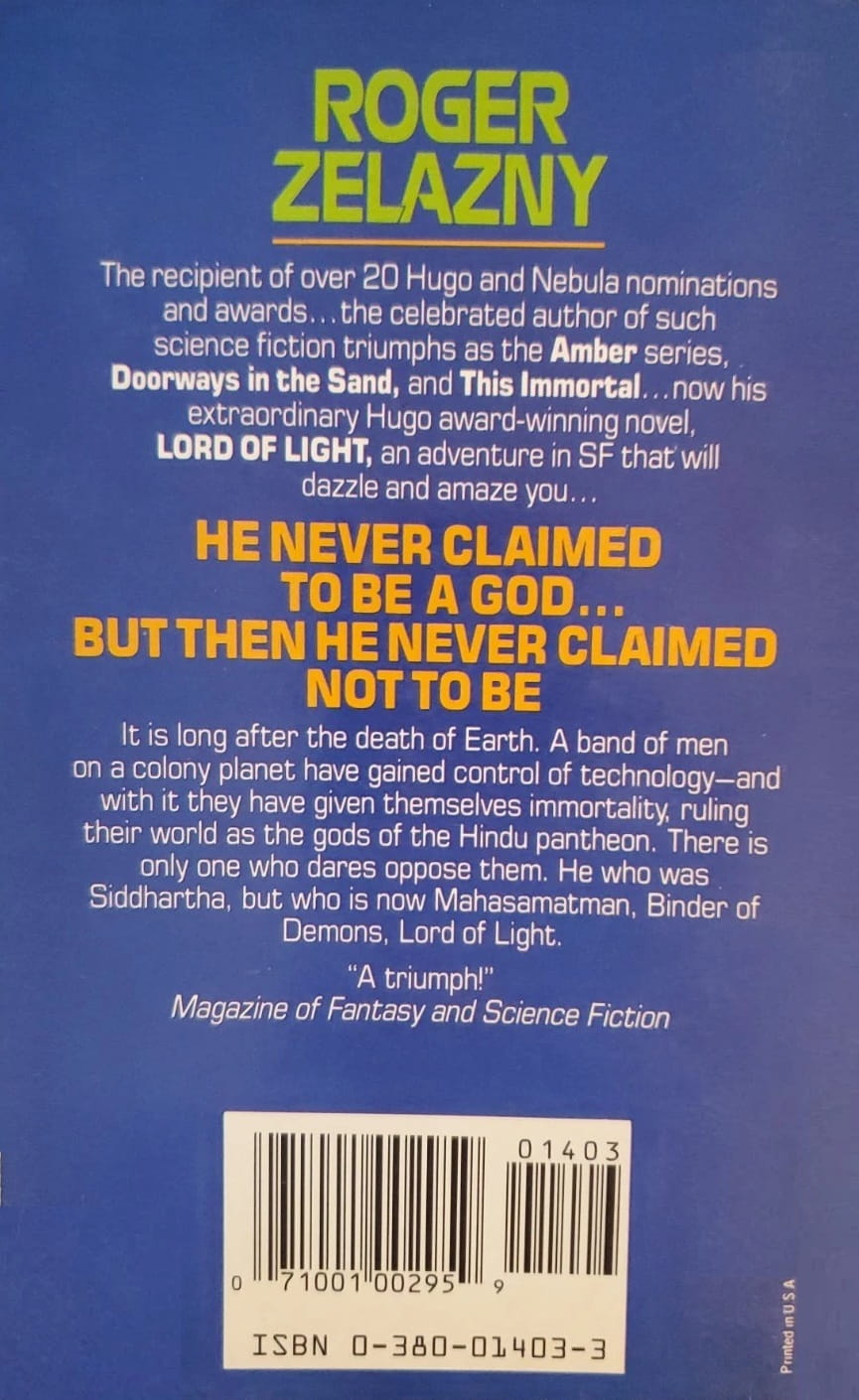
Lord of Light (Avon Books, January 1969). Cover by Ronald Walotsky
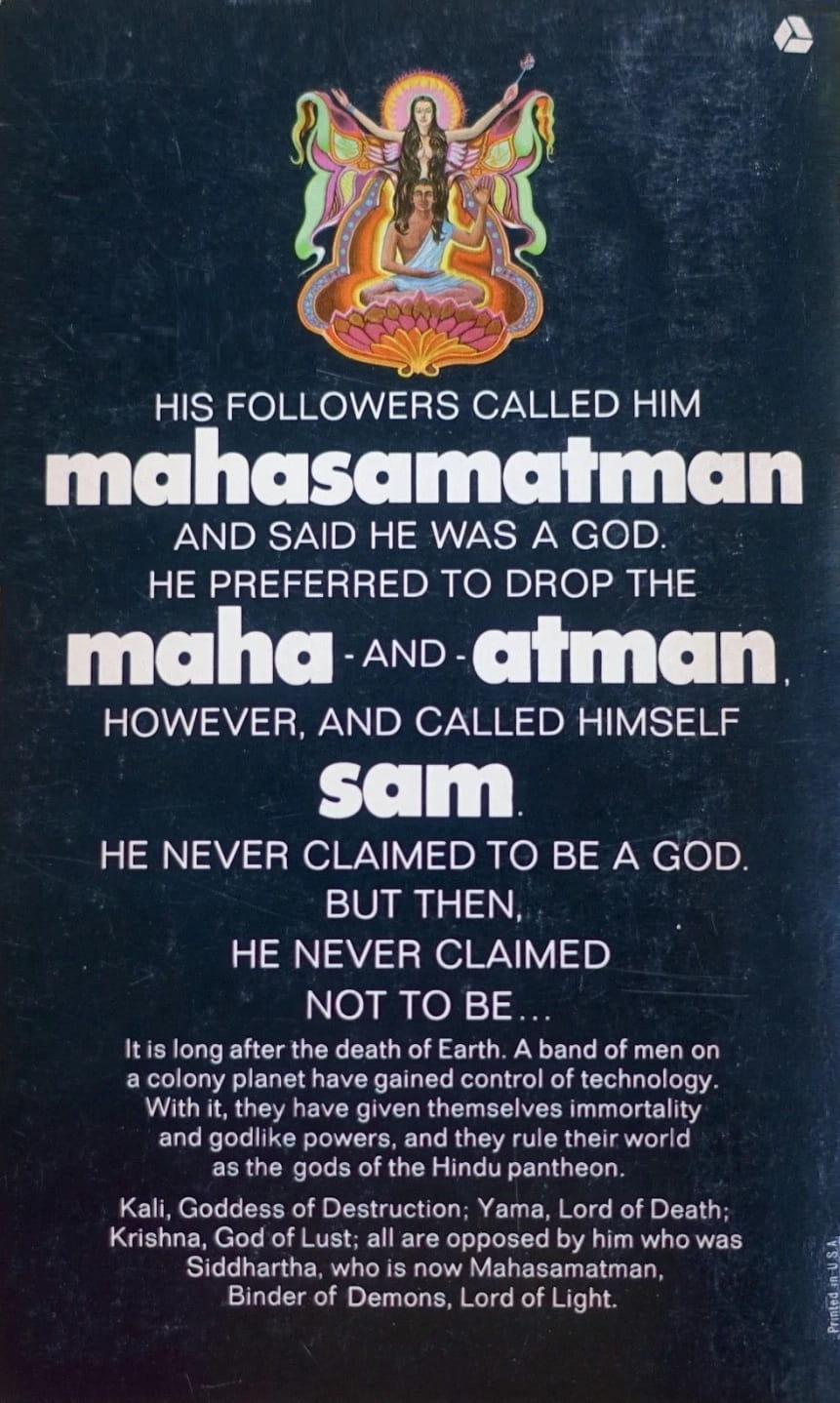
His followers called him Mahasamatman and said he was a god. He preferred to drop the Maha- and the -atman, however, and called himself Sam. He never claimed to be a god. But then, he never claimed not to be a god.
Roger Zelazny was considered to be one of the major New Wave writers of the 1960s. But where many of those writers found inspiration in naturalism, modernism, or even surrealism, much of Zelazny’s work was inspired by mythology, somewhat in the style of poets such as Yeats or Eliot.
Early novels in this mode included The Dream Master (expanded from the novella “He Who Shapes”), This Immortal (originally titled And Call Me Conrad, which I think is a much better choice), and Lord of Light, which I’ve long considered his single greatest literary achievement.
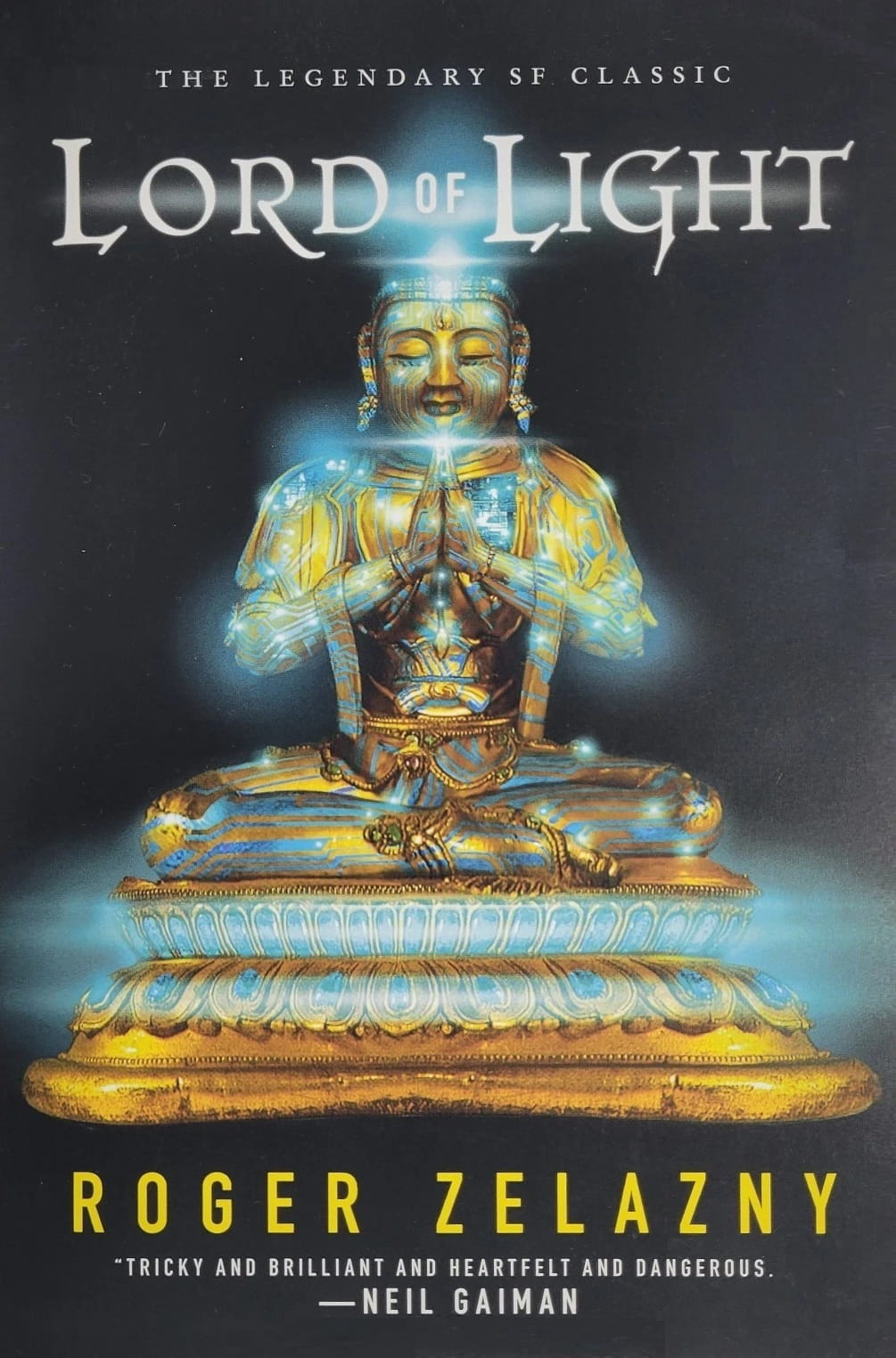
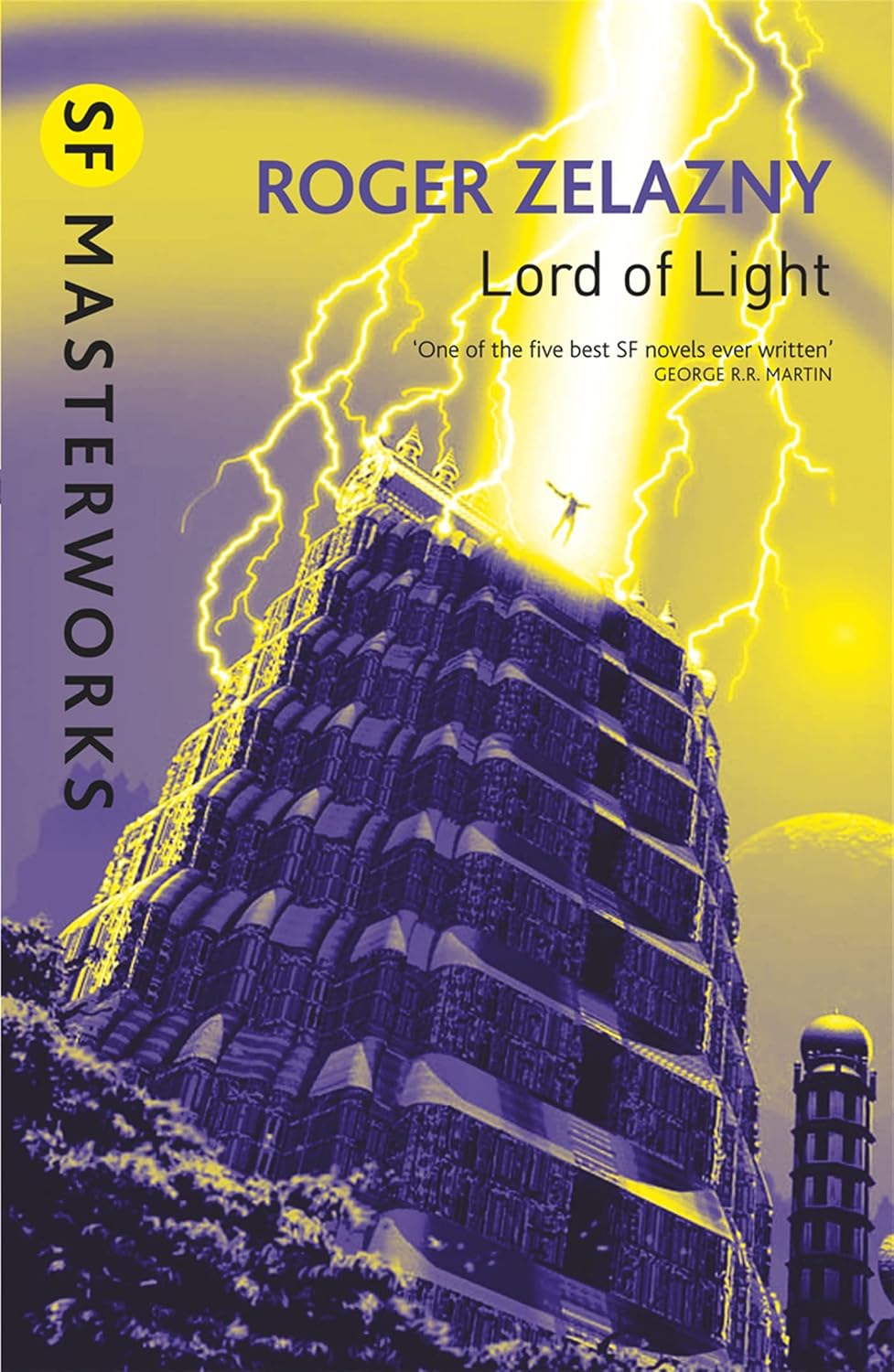
[Click the images for lordly versions.]
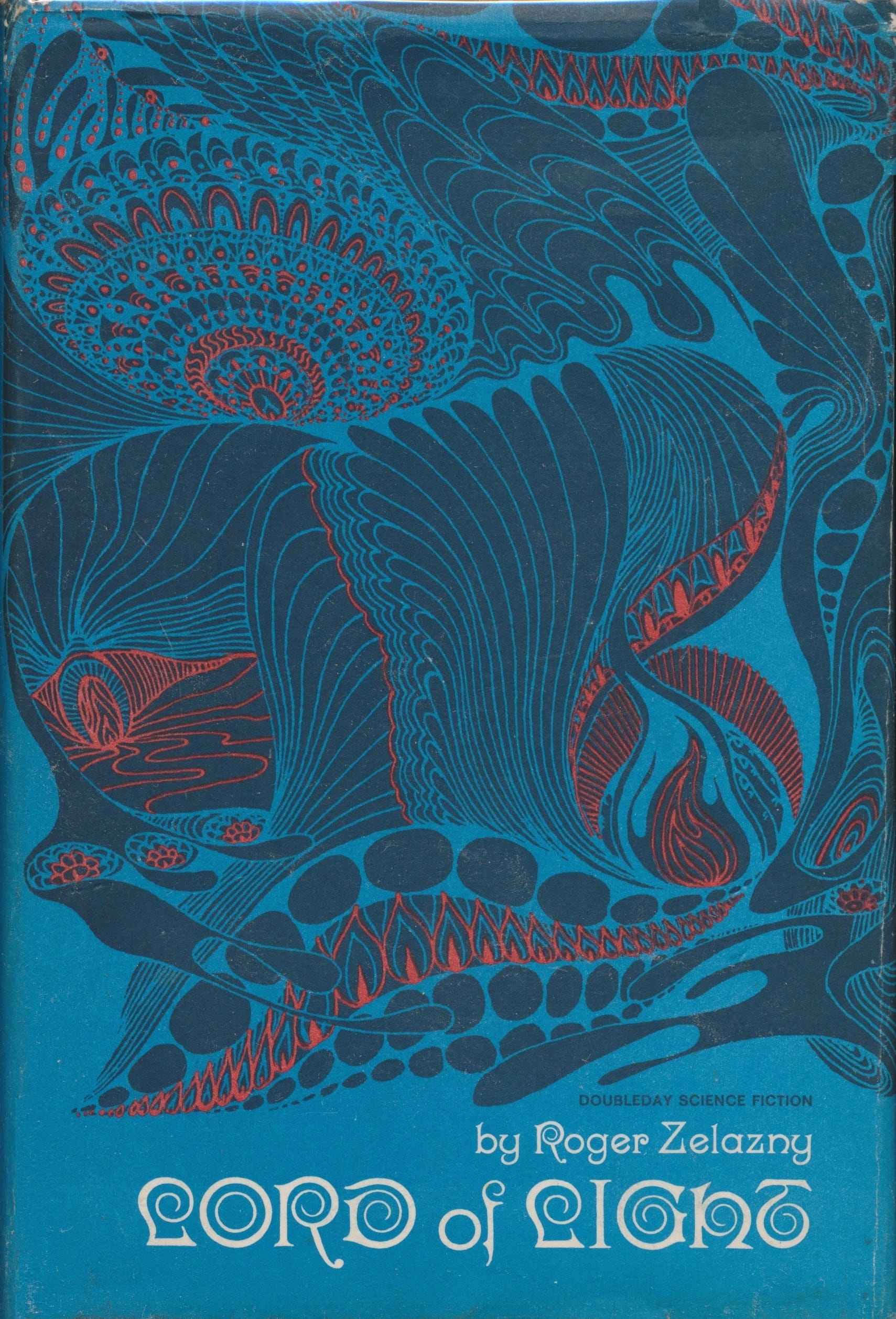
Lord of Light draws on India for its mythological elements. Most obviously, most of its major characters bear the names of Hindu gods and goddesses. But its protagonist takes the role of Buddha, a critic of Hinduism and the founder of a religion that sought to displace it. And it also is filled with quotations from both Hindu and Buddhist texts, both as head quotations for chapters and woven into the narrative — as when, notably, in Chapter III, Yama faces one of the protagonist’s disciples in single combat, and the two quote a dialogue from the Katha Upanishad to each other, beginning with.
“There is doubt concerning a man when he is dead. Some say he still exists. Others say he does not. This thing I should like to know, taught by you.”
“On this subject, even the gods have their doubts. It is not easy to understand, for the nature of the atman is a subtle thing. Ask me another question. Release me from this boon!”
In what sense is this mythological narrative “science fiction”?
 |
 |
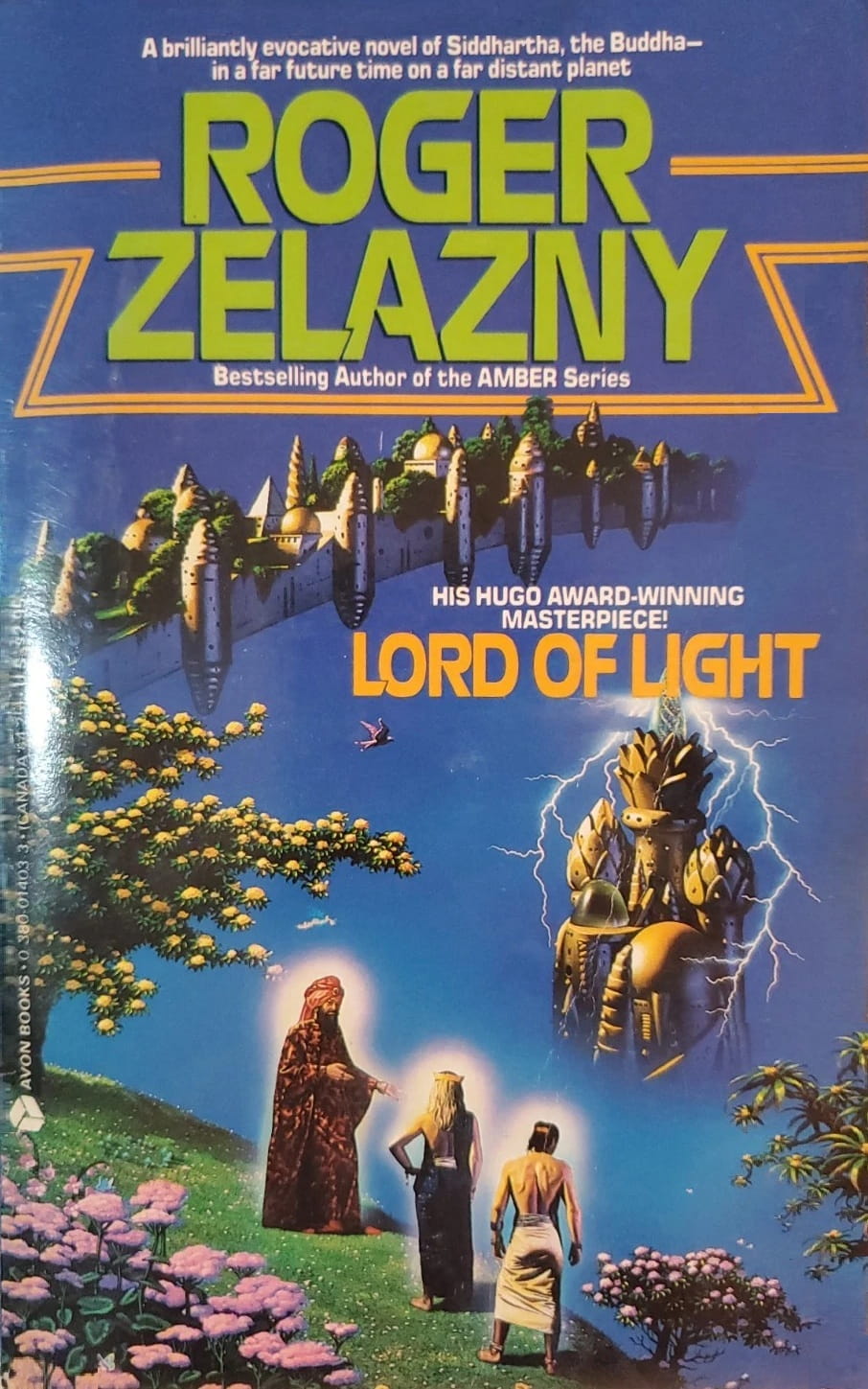
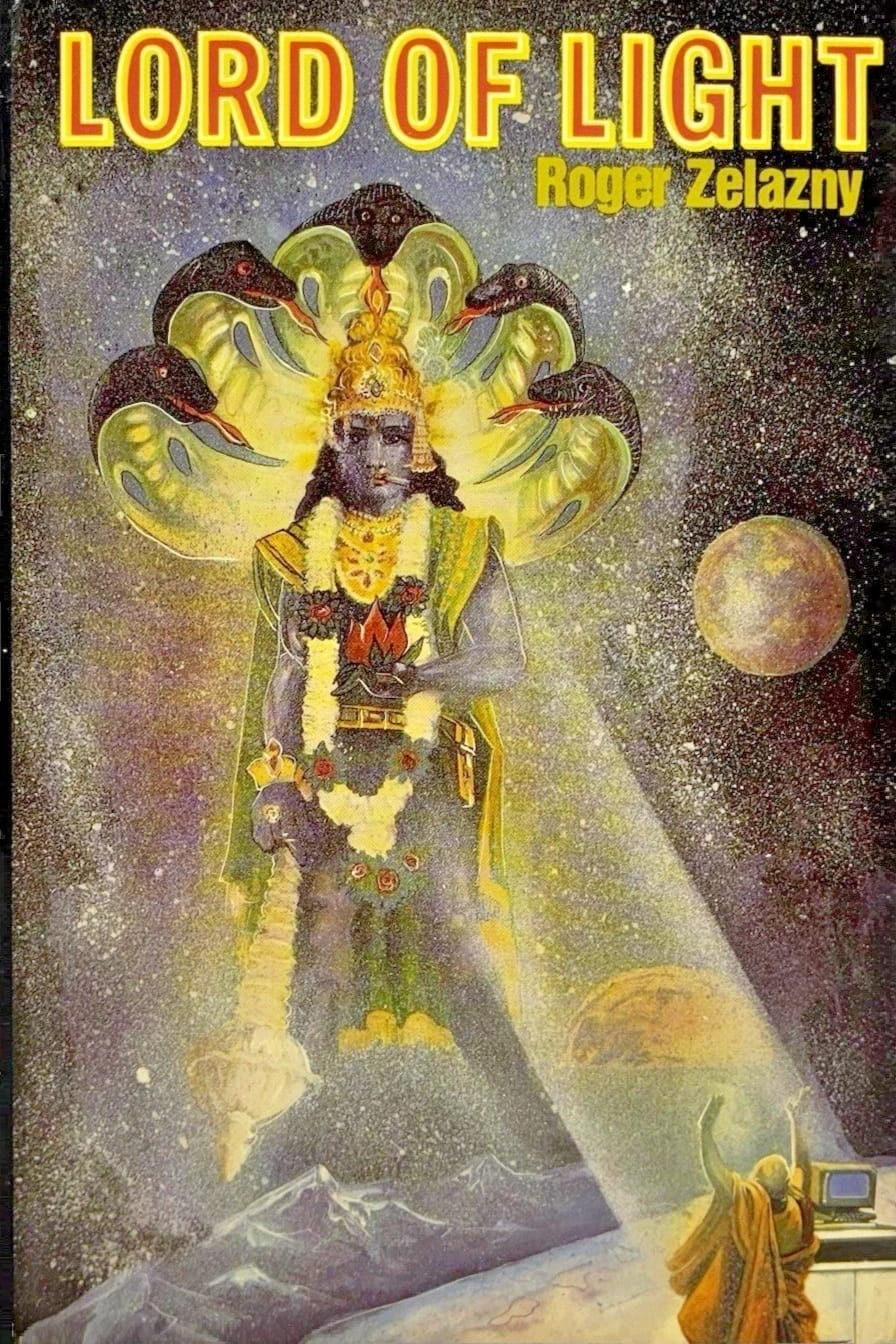
Lord of Light (Avon Books, February 1987). Cover by Tim White
In the first place, its setting is an Earthlike planet of another star, established in the opening chapter as a red sun. It has its own sapient beings, ranging from the apparently invertebrate Mothers of the Terrible Glow to the immaterial Rakasha — a diversity that makes me think of Barsoom. There are references to “vanished Uratha,” a plausible Indic pronunciation of “Earth,” which suggests that humanity’s original home has been destroyed; the final chapter mentions that there are other worlds, but no one from them shows up. We learn that the one spacecraft that brought humanity to this world was named the Star of India, which may hint at largely Indian passengers.
In the second place, there’s a crucial technological advance: a process for amplifying the electromagnetic pattern of a human mind and transmitted it into a new body (which we might now called “cloned”). This provides a way to extend human life — one that’s customarily sought at sixty; those who die without access to it, or choose not to use it, are said to die the “true death.” The technicians who run the process acquire a monopoly, and use it as a source of political power, preserving conformists and letting dissidents perish. This whole process is surrounded by the language of karma and reincarnation, which literalizes Hindu (and in some degree Buddhist) religious doctrines.
Also fitting this theme, the rulers of the planet have declared themselves to be gods. And this claim is backed up with superhuman powers — in fact, powers much like those of comic book heroes and villains. They seem to have initially acquired them during their voyage from Earth; there is a reference to their “struggling to discipline their mutant powers with drugs, hypnosis, medication, neurosurgery.”
Now, the greatest of them have both an Attribute, a paranormal capability, and an Aspect, an outward appearance that reflects that capability, as when Ratri, the goddess of night, can surround herself with darkness. Apparently other people, either their children or passengers who didn’t mutate, still lack these powers, and live in societies modeled on early India.
The primary conflict in this world’s history is a political one, between the Accelerationists and the Deicrats. The goal of the Accelerationists was to ensure that the entire human population had access to advanced technology. The goal of the Deicrats was to identify themselves as gods — the gods of the Hindu pantheon, whose names they took.
The gods aren’t uniformly hostile to technology: they live in the Celestial City, a virtual paradise designed and constructed by Vishnu; they have access to a variety of advanced weapons, constructed for them individually by a technological genius, Yama (this equipment is another way in which they resemble comic book heroes); and they have allowed the general population access to selected devices that sustain religious faith, including the mind transfer system and a kind of slot machine called a “pray-o-mat.”
But the technology they favor consistently is that which gives them a monopoly of power. The whole system is explained to the protagonist, Sam, in an early chapter by his friend Jan Olvegg, former captain of the Star of India, a few years after the temples began probing the minds of applicants for reincarnation and giving undesirable bodies to anyone who favored Accelerationism — which would include Sam himself. That sets up his personal conflict with his society and his world.
A secondary conflict involves Nirriti the Black, one of the few Christians on the original ship, who was allowed to leave the Celestial City with modest equipment that he used better than anyone anticipated. His adopted name shows how immersed Zelazny was in Indian thought when he wrote this novel: Originally an abstract noun, a negation of Rita or natural and moral order, it came to mean “decay,” and then became the name of a goddess and later of a god. (The opposition is similar to that between Amber and the Courts of Chaos in Zelazny’s best known fantasy series.) This Nirriti is a long-time foe of the Celestial City, served by an army of cloned zombie soldiers — “zombie” in the now common philosophical sense, a seemingly human being who has no consciousness and, in this novel, none of the electromagnetic patterns that embody consciousness.
The protagonist, Mahasamatman, “great-souled Sam,” is one of the original ship’s crew, who developed his own mutant power, which Zelazny calls “electrodirection,” the mental control of electromagnetic energy, which made him a potent foe of the Rakasha, self-sustaining patterns of such energy. He finds himself the only “god” who still believes in Accelerationism, and undertakes a prolonged struggle to overthrow the Deicrats.
During this struggle, he repeatedly encounters Yama, who not only is a brilliant inventor, but has a power of his own, deathgaze, the ability to kill by looking at a foe. The third central character is Kali, the goddess of destruction, whom Sam loved in the early days of the human colony and whom Yama loves in the present — but whose ability to love anyone in dubious. Lord of Light is as much a story of their personal conflicts as it is of the political and cultural struggle they’re engaged in.
As one of his strategies, Sam undertakes to revive Buddhism, remembering it as a religion that challenged the power of Hinduism in its native India, and plays the role of the Buddha — only to acquire a disciple, Rild, who genuinely is enlightened. This leads to Rild’s duel with Yama, a moving and enigmatic scene: Did Rild set aside his own enlightenment, like Purun Bhagat in one of Kipling’s best stories, to fight in his teacher’s defense? Or was that struggle itself a proof of enlightenment?
 |
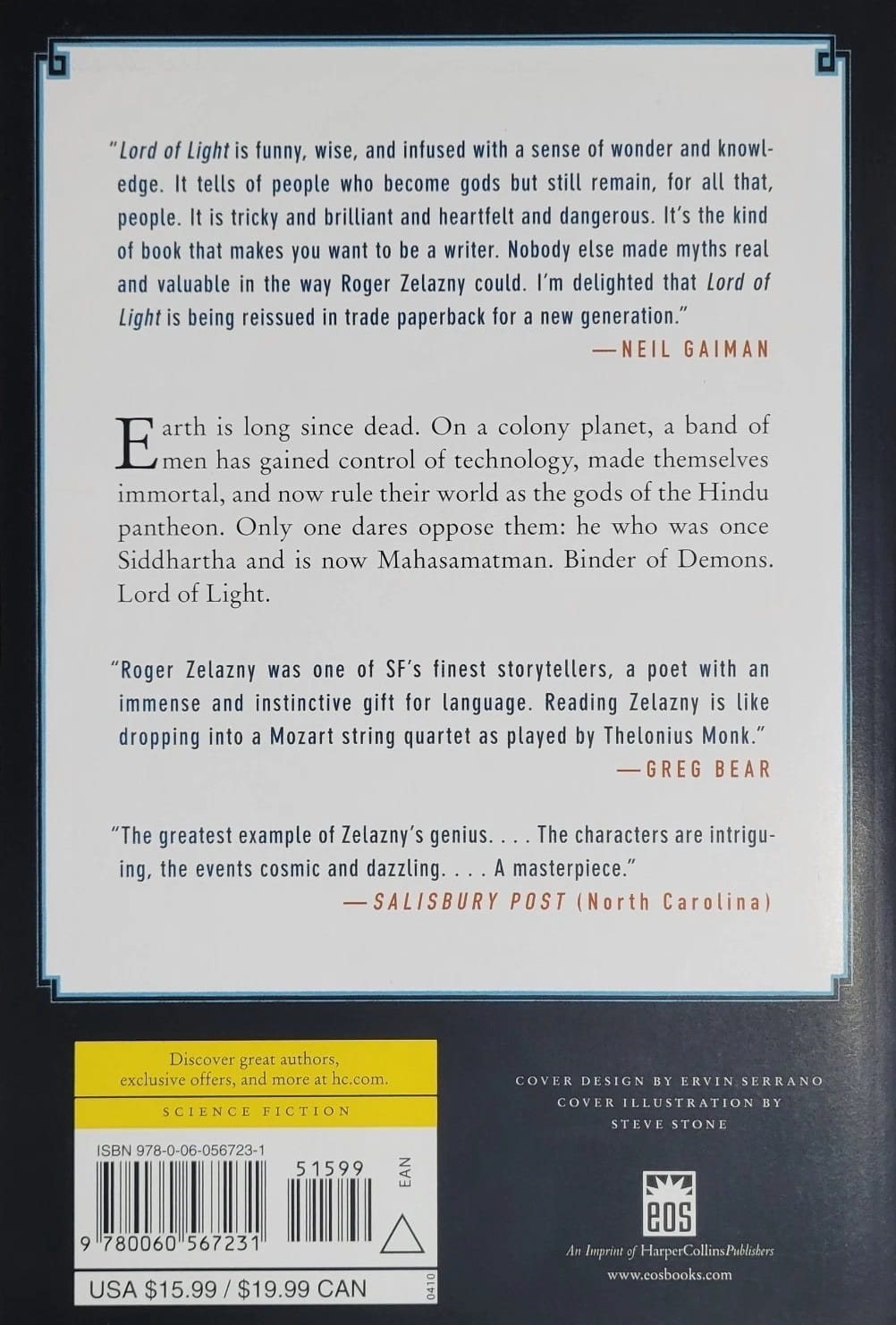 |
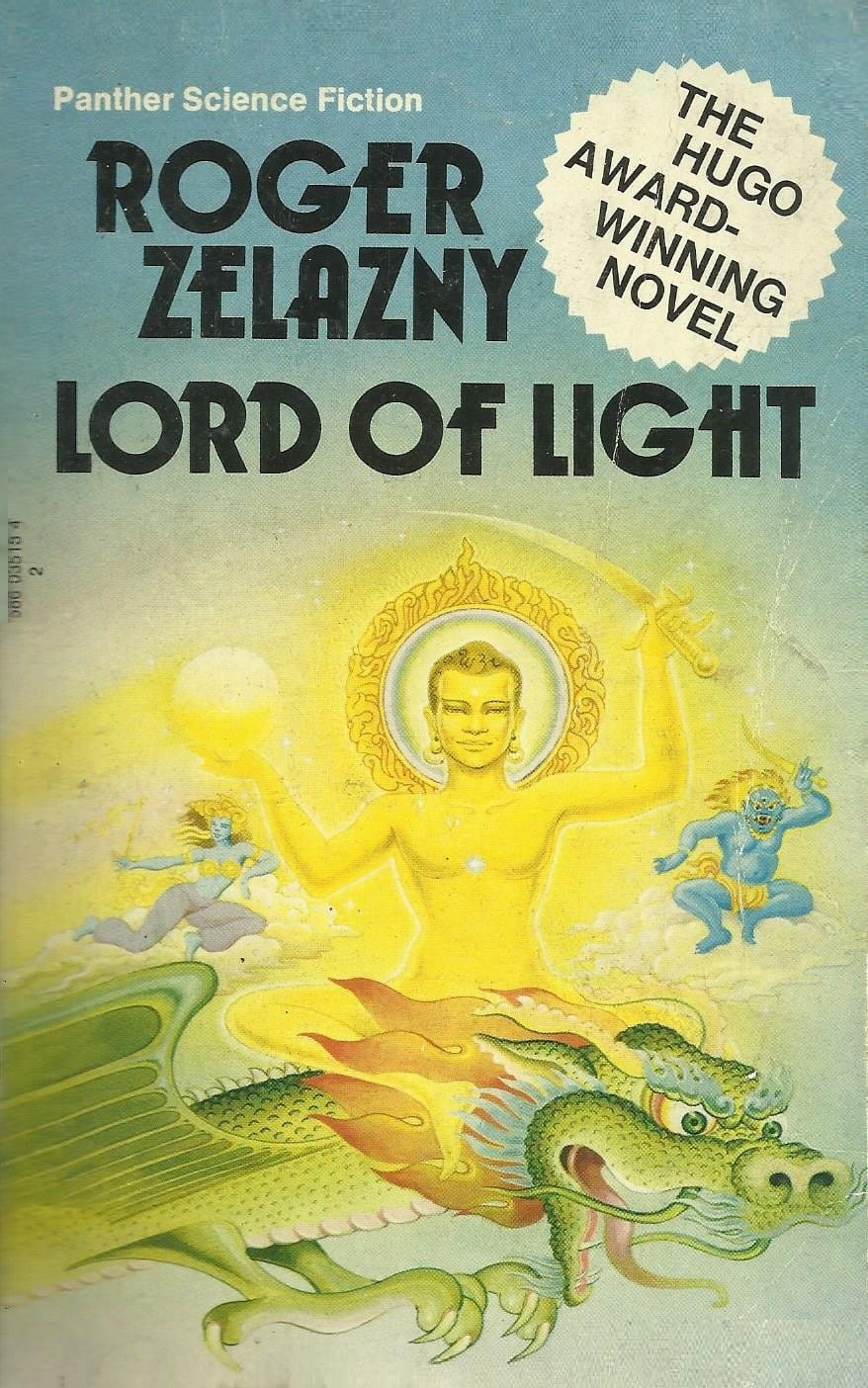
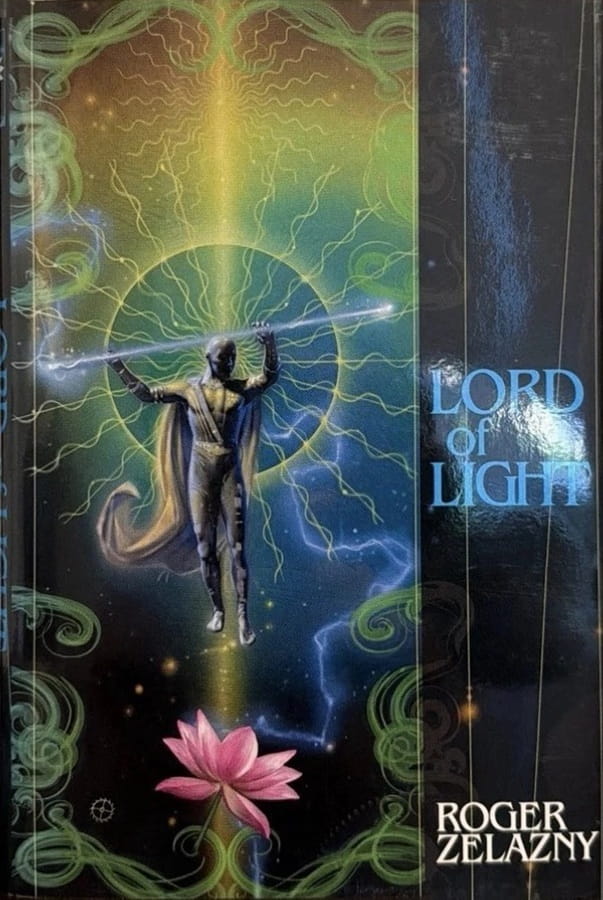
Lord of Light (Avon Eos, May 2004). Cover by Steve Stone
I think it may be one of Lord of Light’s strong points that Zelazny leaves the question unanswered — even Sam can’t guess the answer. But this also gives depth to Yama as a character, in his chronologically first appearance (though not his first narratively, as the story begins in medias res, like a proper epic).
Most of Sam’s struggles, on the other hand, take a more physical form, from his initial raid on the Wardens of Karma in one city to the culminating battle, where one three-page passage gives us three betrayals, three deaths, and two mortal injuries, and shows the true loyalties of all the major characters. Here we have Sam and Yama with their masks off: Sam, the Odyssean trickster, reciting verses from Ecclesiastes (apparently Zelazny’s favorite book of scripture!) over a dying foe; Yama in terror and grief that finally inspire pity for him. Here, too, we see the fates of all of Sam’s allies from earlier parts of the novel.
Lord of Light’s style, like that of many of Zelazny’s stories, often suggests film noir. It has touches of humor, including a memorably terrible pun in Chapter II. Some parts of it may grate on modern sensibilities, particularly the portrayal of a lesbian character in that same chapter.
But it remains one of my favorite science fiction novels, not so much for its worldbuilding or its speculation, despite Zelazny’s memorable disavowal of fantasy, as for its characterization, and for its ability to involve me with its characters. Lord of Light is a well told adventure story, and one of the best literary treatments of superhuman powers that I know of, but even more than that, it brings its characters to life.
“She is my daughter,” said Yama. “Her name is Murga.”
“I never knew you had a daughter.”
“She is retarded. She suffered some brain damage. . .”
“Congenital, or transfer effect?” asked Kubera.
“Transfer effect.”
“I see.”
“She is my daughter,” repeated Yama. “Murga.”
“Yes,” said Kubera.
William H. Stoddard is a professional copy editor specializing in scholarly and scientific publications. As a secondary career, he has written more than two dozen books for Steve Jackson Games, starting in 2000 with GURPS Steampunk. He lives in Lawrence, Kansas with his wife, their cat (a ginger tabby), and a hundred shelf feet of books, including large amounts of science fiction, fantasy, and graphic novels.
I love those Avon paperback covers! That was how I first encountered this book, Creatures of Light & Darkness, and the original Amber books.
Having said which, while I was a big Zelazny fan back in high school, I did kind of bounce off his more experimental SF — both Lord of Light and Creatures of Light & Darkness. It took some years (and reading one of LoL’s component sections in a Gardner Dozois anthology) to convince me to give it another go, and I’m glad I did — it really is a great book — but I also see why I had trouble with it at a younger age.
Hell yes. Lord of Light is my favorite book of all time. Every few years I re read it and fall in love again. Thanks for the memory jog. Looks like its time again.
My favorite scene, so redolent of Mr. Zelazny’s homage to and parody of mythological and religious concepts is the scene in which Rild, a killer sent by Kali, is converted to Buddhism by the Buddha’s seemingly unconcern about this assassination attempt. Said unconcern strongly aided by a quicksand trap for Rild, of course. *chef’s kiss*