Forgotten Authors: Rog Phillips
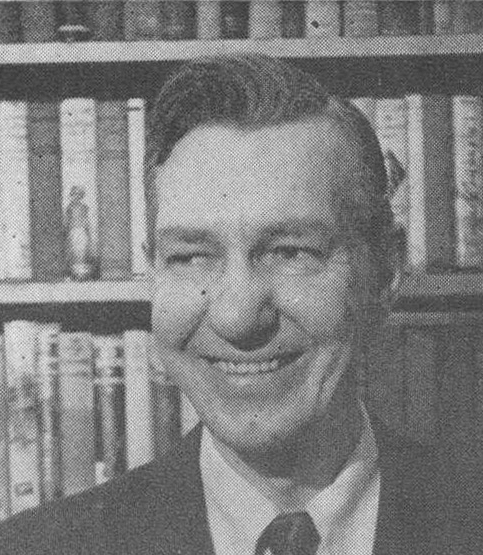
Roger Phillip Graham was born in Spokane, Washington on February 20, 1909 to John Alfred Graham and Abbie Susan (née McCalmont). His family moved often, spending time in Oklahoma, among other places. He returned to Spokane to attend Gonzaga College, from which he graduated in 1931 and did some graduate work at the University of Washington. Most of his sf work appeared under the name Rog Phillips.
During the pre-war years, Phillips held a variety of jobs, including working as a farm worker, plumber, construction worker, and carpenter. During World War II, he worked as a power plant engineer and a shipyard welder.
Graham married Eleanor Cora Smith on October 8, 1938 in Spokane, although they were divorced by 1950, when he married sf fan and author Mari Wolf. They divorced in 1955 and the following year, he married another fan, Honey Wood, to whom he remained married until his death. Wood and Phillip were members of the Outlanders, a subset of LASFS fans who lived just outside Los Angeles.
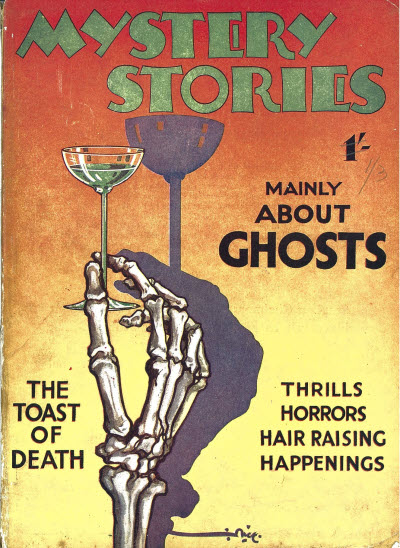
Phillips published his first short stories in Mystery Stories in 1939 under the name Roger Graham. His next story, “Let Freedom Ring,” appeared after the war in the December 1945 issue of Amazing Stories, a magazine which would be his main place of publication, along with its sister magazine Fantastic Adventures.
His first novel, Time Trap, was published in 1949. His other novels appeared in 1950 and 1951. Later novels appeared in magazines, with one of them, These Are My Children, which first appeared as a serialization in Other Worlds Science Stories in 1952 seeing its first stand-alone publication in 2018. Other small presses have published collections of his work in the twenty-first century, most recently Rog Phillips, Ace of Science Fiction Digests in 2023.
During the 1950s, he lived in Chicago and wrote “The Club House” a column covering science fiction fan gatherings and short reviews of fanzines, first for Amazing Stories from 1948-1953 and later in Universe Science Fiction from 1954-1955, and finally in Other Worlds Science Stories from 1955-1956. “The Club House” introduced fannish culture to people, including a young Robert Silverberg.
Phillips wrote under a variety of house names, including Craig Browning, Franklin Bahl, Peter Worth and Melva Rogers, in addition to his own name. He also used the pseudonym John Wiley for mystery and detective stories. He used other pseudonyms as well.
In 1956, Phillips was a Hugo finalist in the “Best Feature Writer” category in the only year it was awarded. He lost to Willy Ley. Other nominees included L. Sprague de Camp, Robert A. Madle, and R.S. Richardson. Three years later, his story “Rat in the Skull” was nominated for Best Novelette, losing to Clifford D. Simak’s “The Big Front Yard.”
Phillips served as best man at SF author Chad Oliver’s wedding. He also served as godfather to Earl Terry Kemp, the son of Earl Kemp, who chaired the 1962 Chicon. The younger Kemp has revived “The Club House” and has also edited collections of Phillips’ work.
He died on March 2, 1966 in San Francisco.
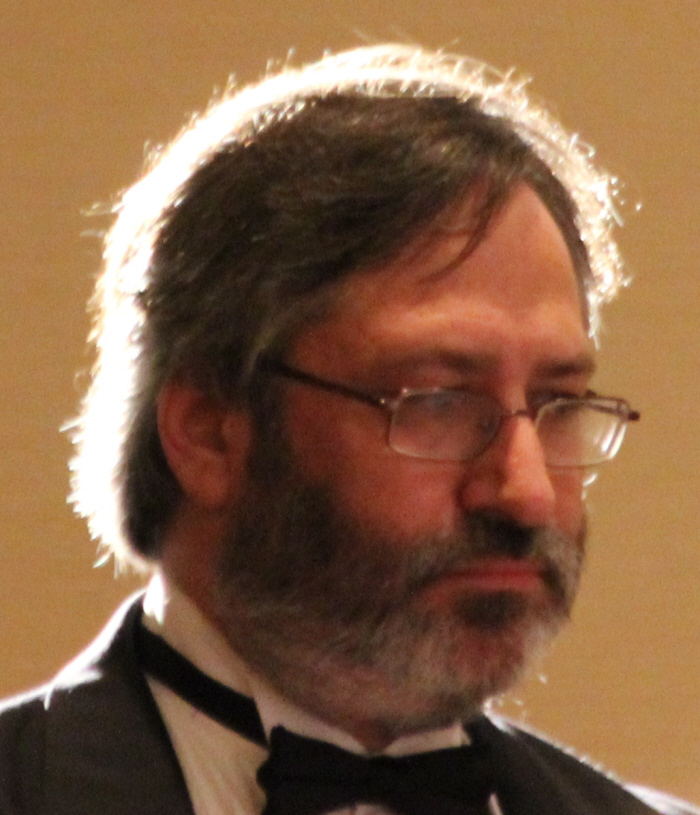 Steven H Silver is a twenty-two-time Hugo Award nominee and was the publisher of the Hugo-nominated fanzine Argentus as well as the editor and publisher of ISFiC Press for eight years. He has also edited books for DAW, NESFA Press, and ZNB. His most recent anthology is Alternate Peace and his novel After Hastings was published in 2020. Steven has chaired the first Midwest Construction, Windycon three times, and the SFWA Nebula Conference numerous times. He was programming chair for Chicon 2000 and Vice Chair of Chicon 7.
The one story I remember Phillips for is “The Yellow Pill” (Astounding, October 1958), which has been VERY widely reprinted. (Some examples: Judith Merril’s Best of the Year, Edmund Crispin’s British Best SF 4, Isaac Asimov’s selection of the best for that year, and as one of the reprints Ellen Datlow chose for Sci Fiction.)