Forgotten Authors: Robert Moore Williams

Robert Moore Williams was born in Farmington, Missouri on June 19, 1907 and attended the Missouri School of Journalism, from which he graduated in 1931 with a Bachelor of Arts in journalism. He married Margaret Jelley in 1938 and they had one daughter. The couple divorced in 1952.
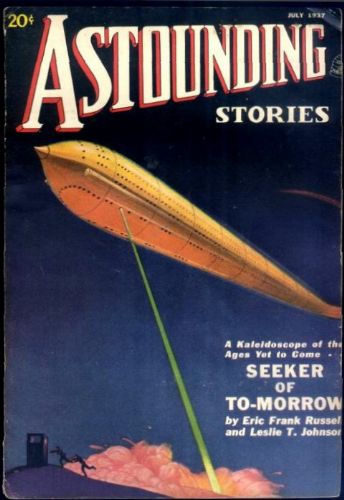
Williams published his first short story, “Zero as a Limit” in the July 1937 issue of Astounding Science Fiction, at the time still edited by F. Orlin Tremaine. Later in 1937, he published a story in Thrilling Wonder Stories, edited by Mort Weissinger, and his third story, “Flight of the Dawn Star” appeared in the March 1938 issue of Astounding, now edited by John W. Campbell, Jr. By the end of 1938, he added Amazing Stories, edited by Raymond A. Palmer to the list of magazines and editors he sold to.
In addition to science fiction, Williams published in a variety of other genres, occasionally using pseudonyms, including John S. Browning, H.H. Harmon, and Russell Storm. He also used the house name E.K. Jarvis on some stories written for the Ziff-Davis magazines, such as “Hickson’s Strange Adventure.” Although Williams was the most prolific (and possibly only) author to use the Jarvis name in the 40s, Robert Bloch used it most often in the 50s, with seven stories appearing under that byline. Other authors to use it included Paul W. Fairman, Harlan Ellison, Robert Silverberg, and Henry Slesar.
 By the end of the 1950s, Williams had sold more than 120 stories to the magazines, and would consider selling short stories throughout most of the decade. He published his first novel, The Chaos Fighters, in 1955, after which he focused primarily on novels, although he had several short stories continue to appear through the end of the decade. Ten of his stories appeared as part of the Ace Doubles series between 1955 and 1964, backed with authors included Leigh Brackett, Eric Frank Russell, John Brunner, Keith Laumer, Terry Carr, and Samuel R. Delany.
While most of the novels Williams published were standalone novels, he did publish novels in two series. The three Jongor novels, which started as novellas published in Fantastic Adventures between 1940 and 1951, were published in book form in 1970 and are a Tarzanesque series focusing on Jongor (born John Gordon) in an Africanized Australia.
His other series, four books about Zanthar, was published as original novels between 1967 and 1969. Just as the Jangor novels were a pastiche of Tarzan, Zanthar is more in line with Burrough’s Barsoom novels, setting human physicist John Zanthar to a foreign and primitive planet courtesy of a cyclotron.
His 1970 novel, Love Is Forever—We are For Tonight has been described by multiple sources as autobiographical and shows a man who has subscribed to Dianetics and Scientology. Other, more science fictional works of the last years of Williams life also have a tendency towards fringe theories. When describing Love Is Forever—We are For Tonight in a Curiosities piece publishe din the January 2007 issue of F&SF, Graham Andrews wrote it “captures his surely unique blend of madness and/or vision in its simon-pure form.”
Gerald W. Page noted that Williams “doesn’t seem to have very often probed deeply into any of his ideas or themes, and this makes some of his work, while perfectly readable on the surface, seem disturbingly incomplete.”
Williams died in Dateland, Arizona on May 12, 1977.
Don D’Ammassa reviewed Williams’ novels on his website, concluding that “Despite his many faults as a writer, Williams is above average for the pulp SF adventure of the 1940s and 1950s. His reputation began to slip during the 1960s as standards for publication rose…”
 Steven H Silver is a twenty-one-time Hugo Award nominee and was the publisher of the Hugo-nominated fanzine Argentus as well as the editor and publisher of ISFiC Press for eight years. He has also edited books for DAW, NESFA Press, and ZNB. His most recent anthology is Alternate Peace and his novel After Hastings was published in 2020. Steven has chaired the first Midwest Construction, Windycon three times, and the SFWA Nebula Conference numerous times. He was programming chair for Chicon 2000 and Vice Chair of Chicon 7.
I’ve read a couple of Williams books (Ace doubles, of course). The Dawn Before Tomorrow struck me as one of the most sloppily written pieces of incompetent hackwork I’ve ever made it all the way through…so of course I had to read another RMW. King of the Fourth Planet I quite enjoyed, so I don’t know what the hell to make of him. The only way to break the tie is to read a third book, I guess, and I have plenty to choose from. As a Southern Californian, I’ve always been tempted by The Day They H-Bombed Los Angeles. It’s hard to go wrong with a title like that…
My favorite TITLE by Robert Moore Williams has to be “When the Spoilers Came” (Planet Stories, May 1952). He must have been really offended when some reviewer revealed one of his plot twists! 🙂
Actually the only RMW novel I’ve read is King of the Fourth Planet, which I didn’t like as much as Thomas did, even though it does arguable predict the existence of Olympus Mons, a few years before astronomers realized that area of Mars was actually a huge mountain. (https://www.blackgate.com/2016/03/03/telepathy-machines-and-strange-alien-games-rich-horton-on-king-of-the-fourth-planetcosmic-checkmate/)
I’m completely open to the idea that King of the Fourth Planet only seemed decent to me because I read it after the indescribably awful Darkness Before Tomorrow. You really should give that one a try sometime, Rich, you really should…
It doesn’t deserve all the blame, but his The Day They H-Bombed Los Angeles contributed to my delusion during the Cuban Missile Crisis that I would somehow survive what seemed like an imminent nuclear war, along with a bunch of hot girls in my age range. The rest of my family and most of the nation (outside of Curtis LeMay and his cronies on the Joint Chiefs) had a much more realistic view and a higher level of anxiety, so I guess that delusion was at least a decent psychological coping mechanism for me. Fortunately the President back then was sane and intelligent, if not always on his good behavior around the hot girls in HIS age range.