Forgotten Authors: Pauline Ashwell
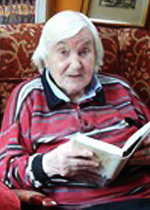
Pauline Whitby was born in Hatfield, Hertfordshire on January 25, 1926 to the headmaster and headmistress of Merchant Taylors’ School in Ashwell, the village from which she would gain her pseudonym. Whitby had a younger sister named Marie. Both of them attended the school their parents ran.
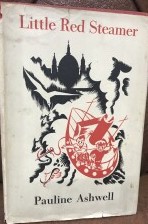
Whitby began publishing in 1941 when she was 15 years old, with the chapbook Little Red Steamer, a fantasy for children, which published by Methuen under the pseudonym Pauline Ashwell.
In July of 1942, her story “Invasion from Venus” appeared in the British magazine Yankee Science Fiction. She used the pseudonym Paul Ashwell for the story. Later, her first novelette, “Unwillingly to School” appeared in Astounding under her most famous pseudonym, Pauline Ashwell and earned her a Hugo nomination. Nine months later, her story “Big Sword” also appeared in Astounding, but again as by Paul Ash.
In 1958, Whitby, under her Paul Ash pseudonym, was one of three women nominated for the Best New Author Hugo, along with Rosel George Brown and Kit Reed. Brian W. Aldiss and Louis Charbonneau were also nominated for the award which went to No Award (with Aldiss finishing second).
White published a handful of stories on her various pseudonyms through the mid-sixties before disappearing, partly because she found it difficult to sell to British magazines. She attended St. Hilda’s College, Oxford where she studied zoology. After taking her degree, she was a lecturer at University College London and the London School of Hygiene and Medicine.
Following her time as a lecturer, Whitby traveled to Africa, where she worked for the United Nations and a Nutrition Officer in Ghana, Sierra Leone, and Zambia. She retired from this work in the mid-1970s.
She made a reappearance as an author in 1982, when her story “Rats in the Moon” was published in the November issue of Analog. This second phase of her career lasted for fifteen stories and 19 years. All of her professional sales were to either Astounding or Analog, purchased by both John W. Campbell, Jr. or Stanley Schmidt. In 1992, she collected her four stories about Lysistrata Lee, two from each phase of her career, into the collection Unwillingly from Earth. Her third book, Project FarCry, was a fix up of the “Paul Ash” stories “Big Sword” and “The Man Who Stayed Behind.”
Whitby died on November 23, 2015 in Baldock, Hertfordshire. About five years before she died, sf fan Roy Kettle tracked Whitby down after learning that she lived near him. Kettle wrote about the experience in an article that appeared in the August 2010 issue of the fanzine Sense of Wonder Stories, edited by Rich Coad.
 Steven H Silver is a twenty-two-time Hugo Award nominee and was the publisher of the Hugo-nominated fanzine Argentus as well as the editor and publisher of ISFiC Press for eight years. He has also edited books for DAW, NESFA Press, and ZNB. His most recent anthology is Alternate Peace and his novel After Hastings was published in 2020. Steven has chaired the first Midwest Construction, Windycon three times, and the SFWA Nebula Conference numerous times. He was programming chair for Chicon 2000 and Vice Chair of Chicon 7.
Any chance that this date of death is NOT a typo and that there is a time machine involved somewhere along the timeline?
“Whitby died on November 23, 1915 in Baldock, Hertfordshire.”
For some reason, I didn’t get a notification of your comment when it went live. I have now corrected, alas, the typo.
I have a copy o her “Unwillingly from Earth” collection, it has a nice Boris Vallejo piece on the cover. I also have some issues of Analog with her stories. While her output was small, the stories were good, at least the ones I’ve read. And thank you for link to the fanzine article. It complimented your piece niely.
Pauline Ashwell/Paul Ash’s stories were reliably enjoyable.
For some reason I thought that both “Paul Ash” and “Pauline Ashwell” were nominated for that Best New Writer Hugo? One of the oddest results in Hugo history, I’ve often thought. Two great writers (Aldiss and Reed), two very good writers (Ashwell/Ash and Brown) and … Louis Charbonneau! And somehow No Award won? I wonder how the winner was determined back then. (Also, I wonder how Aldiss was eligible: first published SF story in 1954! First “novel” in 1955, though admittedly it wasn’t SF. Granted, he didn’t appear in the US until 1958 with “Judas Danced” and with “Let’s Be Frank” reprinted in Judith Merril’s anthology.
Looking at an article I did on Barry B. Longyear a few years ago, https://www.blackgate.com/2019/01/26/the-golden-age-of-science-fiction-barry-b-longyear/ , I did note that Ash and Ashwell appeared on the ballot separately. As for Aldiss’s eligibility, in the early years of the Hugos, categories and eligibility were much more loosy goosy.