Browsed by
Tag: TSR

Ad Review: The Dragon Magazine 41, Part I
Ad Review: The Dragon Magazine 41, Part I

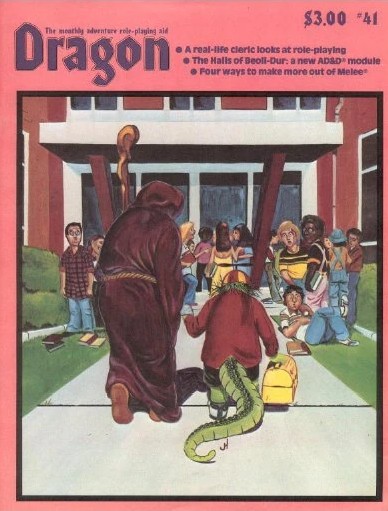
The Dragon, Issue 41, cover by James Holloway

In  August of 1980, I wandered into Klipper’s, my local toy shop that had a counter devoted to Dungeons and Dragons and other role playing games, and picked up a copy of The Dragon, issue 41. It was the first issue I purchased. On the cover, by James Holloway, a man in a wizard’s robe carrying a staff was walking a lizard child carrying a lunchbox to school, while the human students were starting wide-eyed.

At the time, I was most interested in the parts of the magazine that could most directly be added to my game. Dragon’s Bestiary, introducing the silkie and tomb tapper, the Giants of the Earth, which not only gave me heroes I could use, but introduced me to fantasy novels to track down, the Bazaar of the Bizarre. I remember incorporating the idea of dragon’s blood advanced by Robert Plamondon into my campaign. I ran my players through The Halls of Beoll-Dur, and enjoyed the exploits of Finieous Fingers.

Other parts were of lesser interest. I was not playing Metagaming’s Melee, which seven pages and four articles were devoted to. Similarly, the Avalon Hill articles by John Prados and Tom Wham were not things I was looking for at that time. Since I didn’t have a TRS-80, the computer program offered by Mark Herro didn’t offer me anything. The article on Napoleonic guerilla warfare was targeted at wargamers, not RPGers.

Revisiting this issue 46 years later, I’m looking at a different aspect entirely.  I found myself wondering “What was advertised in that issue of The Dragon and did any of the advertisers make enough of a splash to still be around after all this time?”
Read More Read More

Come and Get Me, Coppers … in Gangbusters

Come and Get Me, Coppers … in Gangbusters

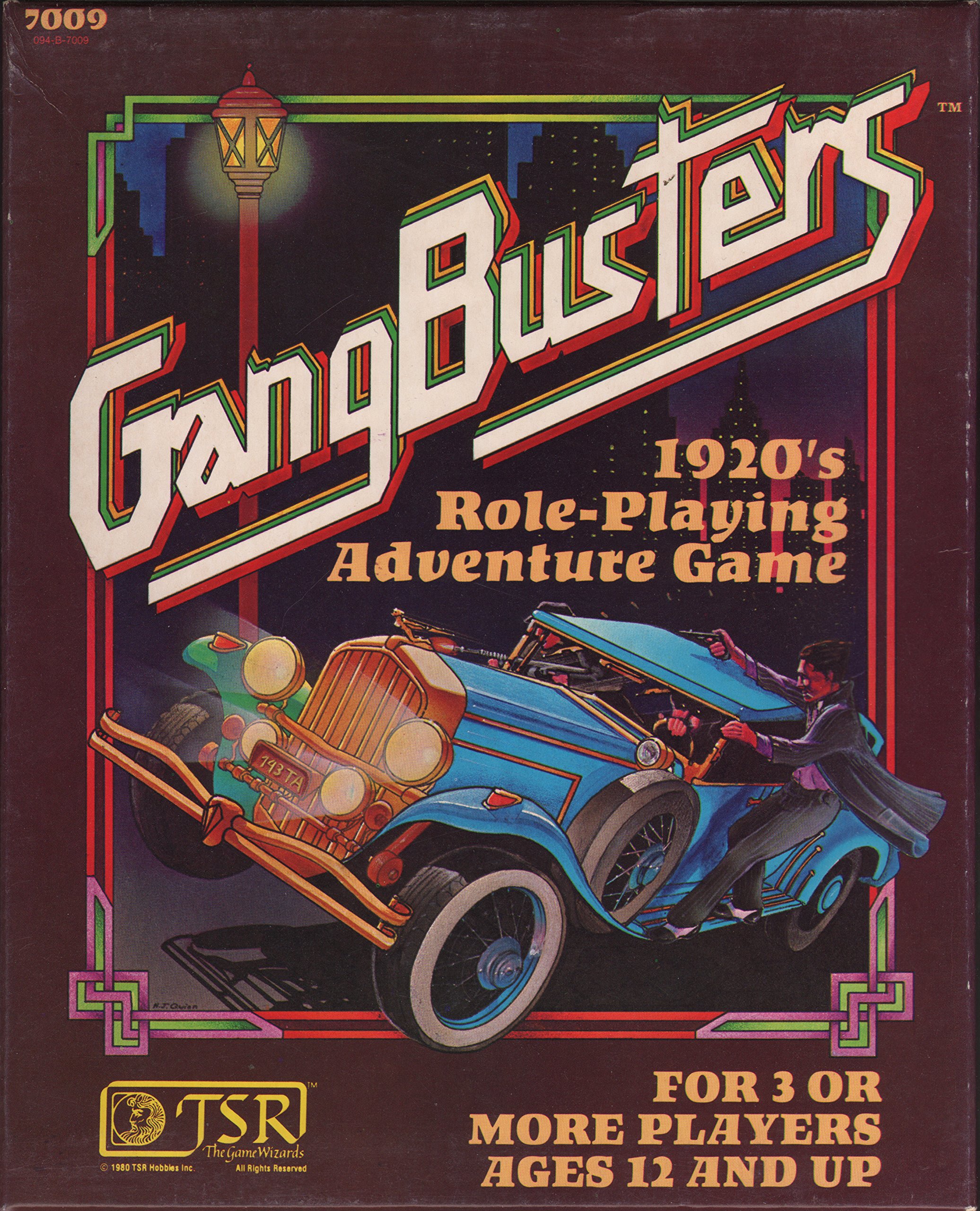
Though it no longer exists, the gaming company known as TSR, Inc., will always be associated with Dungeons & Dragons. However, TSR published a lot more tabletop roleplaying games than D&D. The science fiction game Star Frontiers to this day has a strong fan base, and the game Gamma World continues to find some love. That being said, many of TSR’s other RPGs tend to have been forgotten by a wider audience though they might still have a community of followers.

Such a game is Gangbusters.

Designed by Rick Krebs and originally published in 1982, Gangbusters takes place in the America of the 1920s and 1930s in the fictional Lakefront City. This is a game of cops and robbers, of gangsters and crime lords and Tommy guns. Historical figures such as Al Capone or Pretty Boy Floyd might make an appearance along with fictional characters like Sam Spade or Philip Marlowe, but players also have the opportunity to play the bad guys. Or they can play the good guys and join the side of the law. Or they can be something in between, like a newspaper reporter or photographer.

The original version of Gangbusters included multiple maps, two ten-sided die, and a 64-page book of rules. Today 64 pages might not seem like much for a rules book, but Gangbusters had plenty of information packed into those pages.

Read More Read More

Basic Dungeons and Dragons is Still Kicking: An Interview with Module Writer Geoff Gander

Basic Dungeons and Dragons is Still Kicking: An Interview with Module Writer Geoff Gander

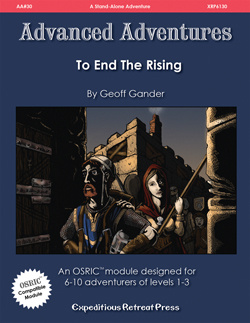
To_End_the_Rising_Web_CoverGeoff Gander is a dark fantasy writer and D&D module-creator living in Ottawa, Canada. Geoff and I met over early morning coffee to talk gaming.

Derek: So, you write Basic D&D modules. You’ve had 2 modules printed by Expeditious Retreat Press. Even when I was a small town teenager, I could still get my hands on a variety of role playing games, especially AD&D, making Basic seem like yesterday’s news. Now, twenty-five years later, people are paying you money to write modules for Basic. Where’s that market coming from?

Geoff: We’re seeing the rise of old school gaming in classic pen-and-paper RPGs as well as computers. Many old schoolers who played D&D and similar games in the 80s are now introducing the games to their children, or they may have followed the general flow of gaming culture towards the latest products on the market, and have grown nostalgic for what got them into the hobby in the first place.

There are also people like me, who grew dissatisfied with the quality of mainstream gaming products and stayed with the systems they enjoyed, long after they went out of print.

Read More Read More