Browsed by
Category: Reviews

The Call of Cthulhu Movie, 2005

The Call of Cthulhu Movie, 2005

the_call_of_cthulhu_dvd_coverDirected by Andrew Leman; starring Matt Foyer, Chad Fifer, Noah Wagner, Ramon Allen Jr., and Ralph Lucas.

I cannot say I’ve ever been impressed with any film I’ve seen purporting to be based on a story by H.P. Lovecraft, as they have all tended to stray pretty far from what makes Lovecraft’s stories interesting in the first place. And they generally show the limits of their budget as well as being both poorly shot and acted. But then I heard about this little gem, distributed by the H.P. Lovecraft Historical Society, that adapts Lovecraft’s foundational short ‘The Call of Cthulhu’ in as loyal and accurate a way as possible. Not only that — and here’s the really interesting bit — the movie itself is a black and white silent film, as if it had been filmed at the time of the story’s publication in the 1920s.

The choice to make this a silent film was a smart one. Firstly, it does help evoke the period of Lovecraft in a way no film before it ever has (all of the ones I’ve ever seen where contemporary pieces, for a start), and also makes it feel like a world apart from our own. In leaving some things unseen and unsaid, and in creating an at times stylized environment, this film activates the viewer’s imagination to fill in the blanks — and speeches or effects which would seem silly or dreadful when laid bare in a modern film are instead left in the shadows. In surmounting the very limited budget for this project, the choice could not have been better.

Read More Read More

The “Other” Harryhausen: The 3 Worlds of Gulliver

The “Other” Harryhausen: The 3 Worlds of Gulliver

3_worlds_of_gulliver_posterThe 3 Worlds of Gulliver (1960)
Directed by Jack Sher. Starring Kerwin Mathews, June Thorburn, Grégoire Aslan, Basil Sydney, Jo Morrow, Sherri Alberoni, Peter Bull.

First there was the Dynamation spectacle of The 7th Voyage of Sinbad. Then there was Mysterious Island. Then the miracle of Jason and the Argonauts, and… wait, I seem to have skipped one. Oh yes, The 3 Worlds of Gulliver, made right after Sinbad. Now how did that one slip away?

Among the “Core Ten” Harryhausen films, the ten color fantasy and period science-fiction pictures he made between 1958 and his retirement in 1981 (all but one produced with Charles H. Schneer), The 3 Worlds of Gulliver gets the least amount of love now. For most of the 1980s, it was probably the unfortunate The Valley of Gwangi that suffered the most neglect, but that was because of its unavailability on video. (The weird name wasn’t helping it either; it certainly wasn’t the filmmakers’ first choice for the title.) Today, The 3 Worlds of Gulliver has turned into something of “the other movie” in the list of Harryhausen classics, even though it came out in 1960 fresh after the smash global success of The 7th Voyage Sinbad and featured that movie’s star, Kerwin Mathews, and its composer, Bernard Herrmann. In fact, Herrmann’s score is well-loved and appreciated among music fans through multiple re-recordings, but those same music lovers often haven’t watched the movie that inspired the music.

Read More Read More

My Favorite Robert E. Howard story: “Pigeons from Hell”

My Favorite Robert E. Howard story: “Pigeons from Hell”

pigeon-from-hellWhen other genre-lovers find out I’m a fan of Robert E. Howard, they often ask me what my favorite of his stories is. They probably expect I’ll name one of the Conan yarns, or perhaps a Solomon Kane or Kull story. (Kull is, indeed, my favorite Howard character.) If they already know something of my background in history, they may think I’ll name one of the Crusader stories that appeared in Magic Carpet Magazine.

But instead I say, without hesitation, “Pigeons from Hell.” And, after an inevitable moment of surprise, they always answer back: “Oh, that’s a great story! I had almost forgotten about that one!”

The irony of my love for “Pigeons from Hell” isn’t lost on me: I praise Howard for his foundational contribution to sword-and-sorcery and historical action tales, and yet my personal favorite story he wrote is a contemporary America-set horror story. But “Pigeons from Hell” is quintessentially Robert E. Howard from first word to last; Howard was an author who knew how to transform naturalism into the “weird tale,” and who also took great inspiration from the folklore of his small world of rural central Texas.

Read More Read More

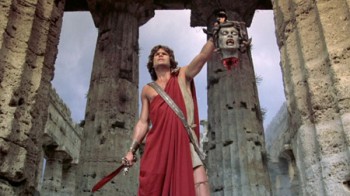
Hercules vs. the Giant Robots

Hercules vs. the Giant Robots

herculesposter1983Hercules (1983)Last week I reviewed a silly Conan pastiche novel. Today, I offer a sequel of sorts: a review of a very silly Hercules movie. The 1983 Hercules, sporting former mean, green, grunting machine Lou “Hulk” Ferrigno and the best special effects the Italian film industry can sort of buy, is one of the grandly awful pieces of entertaining oddness ever to come from a Roman studio. And Rome has given us some odd stuff. Aside from sanitation, medicine, education, wine, public order, irrigation, roads, the fresh water system, and public health, of course.

I encountered this Hercules when I was eleven years old. I adored Greek mythology since I was in second grade and was well-read in the topic, for which I can thank Clash of the Titans for the initial push. One Friday night, a friend and I watched Hercules when it premiered on cable. It sounded like a sure-winner for kids still not old enough to go out on weekend nights: Greek mythology, monsters, and that guy who played the Hulk. (Plus girls in skimpy outfits, but at eleven we weren’t willing to admit that was already a motivation.)

I’m not certain what I expected from Hercules back then, but it certainly wasn’t what I ended up getting. I had this strange illusion, which only an eleven-year-old can sustain, that a mystical law forced filmmakers to adhere to their source material as closely as they could. When I saw this oddball Hercules film on television, my young boy’s illusions died forever. Which is safer for my sanity, although I still feel the pains from the 1998 Roland Emmerich Godzilla and Jan de Bont’s 1999 demolishing of The Haunting [of Hill House]. The 1983 Hercules has only the most tenuous connection to Greek mythology, and appears like a mishmash of tiny bits and pieces of Hellenic legendary in a goopy stew of trendy science-fiction clichés from the SF-explosion of the late-‘70s. Welcome to Battlestar Hercules. Or perhaps Krull is the most appropriate comparison.

Read More Read More

Pastiches ‘R’ Us: Conan the Free Lance

Pastiches ‘R’ Us: Conan the Free Lance

conan-free-lanceConan the Free Lance

Steve Perry (Tor, 1990)

Let’s see … I’ve reviewed a Conan pastiche novel each from Leonard Carpenter and John Maddox Roberts. So next up, Steve Perry.

If there’s one word I would used to describe Steve Perry’s Conan novels, it’s goofy. Perry has a reputation among Conan fandom for overkill and general silliness. He apparently loves high fantasy. Perhaps he loves it too much. His Conan books burst at the seams with fantastic monsters, strange races, and weird magic … and not in an ideal way. Although Perry has an enormous imagination, it gets away from him and creates a world that has almost no resemblance to Robert E. Howard’s Hyborian Age. It’s not so much that these elements are silly, but that they seem so when placed in Howard’s setting. They would work fine in the Star Wars universe — and Perry has written some good Star Wars novels to prove it; I’ll admit I enjoyed his Shadows of the Empire, even if LucasFilm tried shoving it down my throat first. But in the grittier, more-historically centered Hyborian Age, where magic is rare and sinister, Perry’s style feels like someone trying to write a Forbidden Realms novel who accidentally wandered into Robert E. Howard-land.

Conan the Free Lance (yes, two words, not one, according to the actual title page — Conan isn’t picking up occasional assignments for the New Yorker) won’t change anyone’s mind about Perry’s style. The story occurs in an overt wonderland akin to high fantasy. Its villain and the instigator of our plot, Dimma the Mist Mage, lives in fortress on a bed of sargasso weeds in a Karpash Mountains lake. He needs a talisman to restore his body to its solid form, and so he sends his shapeshifting servants the selkies to fetch it from the Tree Folk. Conan, while on his way to Shadizar, rescues Cheen, a medicine woman of the Tree Folk, from the draconian hunting beasts of the reptilian-descended Pili. (Okay, we already have far too many demi-human races running around.) Conan helps the Tree Folk repulse the selkie attack, but the selkie leader Kleg escapes with the talisman—the ‘Seed’ which the Tree Folk need to make their tree homes grow. He also kidnaps Cheen’s young brother, Hok. Conan joins the Tree Folk in the quest to save Hok and recapture the Seed.

Read More Read More

Short Fiction Review #18: Paradox-Final Issue

Short Fiction Review #18: Paradox-Final Issue

paradox-cover043It’s nothing new to hear that yet another print publication has gone the way of the dinosaurs.  Still, for those of us who retain affection for inked dead trees, it’s always a cheerless day to learn of yet another comet strike.

The latest victim is Paradox, Editor/Publisher Christopher Cevasco’s biannual magazine of  historical speculative fiction, which is now, well, history. After thirteen issues (read into the significance of the number what you will), Cevasco has retired the magazine effective with the Spring 2009 edition. Although he hints that an on-line version may arise from the ashes at some point, or that there may be a future Paradox-themed anthology, it would appear this is not going to be a Lance Armstrong/Bret Favre kind of retirement – Cevasco seems pretty adamant that this is it for the magazine.

Read More Read More

Charles R. Saunders’ ‘Luendi’

Charles R. Saunders’ ‘Luendi’

0_61_100906_diamondCharles Saunders has posted a terrific short story over at the blog section of his website — the sort of story that would not have been out of place in a classic issue of Weird Tales. ‘Luendi’ is in four, rather short, parts, and gives us the fate of one Piet van Brug, a man that embodies all the vilest characteristics of imperialism. Colonial Africa in 1890 is the setting, or more precisely an unexplored section of the interior beyond the British and Boer possessions of South Africa dubbed ‘Azungaland’ by its conqueror. It is an area rich in diamonds — rich enough to bring the yoke down around the heads of the peaceful and previously unknown people that live there.

The Azunga rescued van Brug from disease and death in the wake of a disastrous expedition sponsored by Cecil Rhodes to explore the land “between the Zambezi River and the upper reaches of the Kalahari Desert.” Peaceful, living in a fabulous stone kraal akin to the ruins of Zimbabwe, the Azunga welcome van Brug with kindness and are repaid with treachery. When van Brug discovers they posses a rich seam of diamonds in a cave nearby, he returns to Johannesburg, raises an expeditionary army with the diamonds he managed to steal, and returns to enslave the people that had saved his life.

Read More Read More

Dragonlance: Dragons of Autumn Twilight

Dragonlance: Dragons of Autumn Twilight

dragonlanceDragonlance: Dragons of Autumn Twilight
Directed by Will Meugniot. Featuring the Voices of Keifer Sutherland, Lucy Lawless, Michael Rosenbaum, Michelle Trachtenberg, Jason Marsden, Rino Romano.

During one of the classic episodes of Mystery Science Theater 3000, while Mike and the ‘Bots are watching the conclusion of the delightfully weird and wretched 1960’s Coleman Francis masterpiece The Skydivers, Mike abruptly remarks: “I don’t know guys. I still like this movie better than Top Gun. A lot better.”

So I will say this about the recent animated film adaptation of Dragons of Autumn Twilight: “I still like this movie better than the 2000 Dungeons & Dragons movie. A lot better.”

Be warned: these will be the last friendly words you are likely to hear in this review.

If Wizards of the Coast, the current owners of the Dungeons & Dragons media franchise, had serious intentions of starting a successful line of direct-to-video animated films based on the Dragonlance and Forgotten Realms novels, they couldn’t have done a finer job of slicing themselves off at the knees with a broadsword than this disaster of a movie. The DVD came out in January, and the reason you probably haven’t heard much about it until now is because so many people are trying to abide by “If you can’t say anything nice…” Or else the film immediately slipped their memory after seeing it. Both concepts make sense.

Read More Read More

A Fine and Private Place after almost 50 years

A Fine and Private Place after almost 50 years

a-fine-and-private-place1A Fine and Private Place
Peter S. Beagle (Viking, 1960)

Peter S. Beagle wrote his first novel, A Fine and Private Place, fifty years ago at the age of nineteen. Which really annoys me because the book is so blasted good, making me aware that, although I was a skilled nineteen-year-old in my day, there was no conceivable way I could have crafted at that age a work as beautiful and knowledgeable about life, death, and love as A Fine and Private Place.

And Beagle’s greatest work, the traditional fantasy classic The Last Unicorn, still lay ahead of him.

I’ll try not to take this all personally and just feel glad we have A Fine and Private Place around… and still in-print, a minor miracle considering how fast our culture embraces new and tosses everything else into the dustbin.

A Fine and Private Place is one of the masterpieces of contemporary fantasy, and only the long shadow cast by The Last Unicorn keeps it from getting more notice. The tale occurs almost exclusively within an enormous graveyard, features ghosts and a talking raven, but it isn’t a horror story or even a dark fantasy, but a gentle and often sorrowful look at the difficulties of love and the realities of death, neither of which work out the way any person living or dead might expect.

Read More Read More

Rome (2005)

Rome (2005)

I just watched about 25 hours of what I consider the best Sword and Sorcery I’ve seen in about the same number of years.

I’m speaking about HBO’s Rome, of course, the very expensive historical fiction epic that ran for two seasons 2005-2007. I’m sure many of you have seen it, but it was new to me (we don’t have cable). Apart from a few quibbles about some of the portrayals, specifically Cato the Younger and Octavian in the second season, I found it a fascinating peek into another age.

Read More Read More