Last Night I Finished This Crooked Way
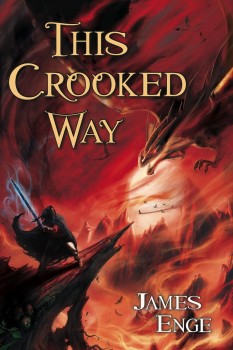
Last night I finished This Crooked Way, by James Enge.
I was on the train, halfway home. There is very little more irritating than finishing a book when you’re just halfway to your destination. Luckily, I had George R.R. Martin’s Fevre Dream in my backpack, the first two chapters of which were quite good, so I didn’t suffer long. And anyway, good as it was, I kept being drawn back to thoughts of This Crooked Way, connecting dots, remembering the heights, the depths, the scaffolding of each story, and how it made me laugh – out loud – so often that I surprised myself.
There are some books that make me read them aloud – mostly their dialogue, but also certain killer phrases or descriptions. It’s my actor’s training, I suppose. Plays are not meant to be read on the page; you have to voice them lest they lose vibrancy and dimension. Some books, my favorite kind of books, leap into my throat and start declaiming themselves. And it doesn’t matter if I’m on a public train, or tromping to work in the snow with my fingers freezing, because I’ve left off my gloves, because it’s hard to turn pages with gloves on – none of that matters, because the words are just that important.
And This Crooked Way is like that.
 Well, entering the year (both in terms of typing the title and having lived to see
 it) was a little weird to write. The first chapter of The Martian Chronicles is January 1999, which from the vantage point of the middle of the 20th century, when the German V-rockets had landed not on another planet, but London, that seemed about right for when humanity might be “reaching for the stars” as it was called. The book ends in April 2026 which, with luck, proper diet and exercise, and health care reform I might actually still be alive to see. And which more than likely humankind, assuming it hasn’t blown itself up, will remain earthbound.
 As some of you may know, I’ve been talking and thinking and blogging (not necessarily in that order) about reading more, and reading better over the course of the last year. Today being New Year’s Day, the day of resolutions and goal-setting, I thought I’d link to some of the posts I’ve written on the subject for those interested in focusing on ratcheting up their reading in the coming year.
 As 2009 comes to an end I find the events of the last twelve months firing past my sub-conscious like the recap sequence before one of those lame “it was all a dream” mini-series endings.
 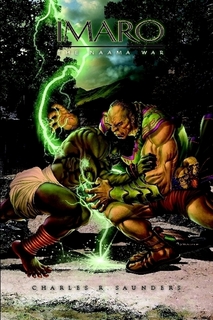 Back when Black Gate‘s editor John O’Neill lived in Ottawa in the early 80s, he was a member of a small SF fan club. His first meeting featured a reading from the editor of an excellent local fanzine, Stardock, who had just completed his first novel. The author was Charles Saunders, the novel was Imaro, and the reading he never forgot.
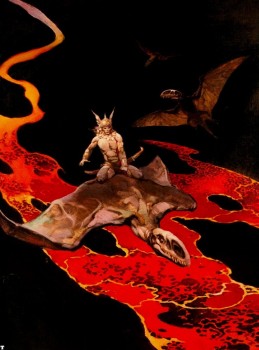 Cameron’s inspirations for AVATAR span the gamut of everything from Edgar Rice Burroughs’ BARSOOM (John Carter of Mars) stories to Lucas’ STAR WARS (which were inspired by FLASH GORDON comic strips, among others), to the deep myths of the Old West, stone-age adventures, Jungle Tales comics, American Indian mythology, and wraps it all in a lush visual style worthy of the master Frank Frazetta himself.
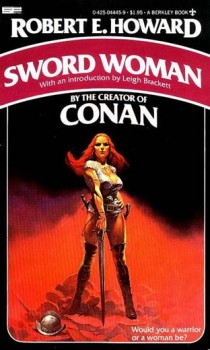 It’s strange that Robert E. Howard’s most famous female character is one he didn’t actually create: Red Sonja, the work of comic book writer Roy Thomas and artist Barry Windsor-Smith, based on the historic adventuress Red Sonya from the story “The Shadow of the Vulture.” Red Sonja has been erroneously credited to Howard for years; even the movie Red Sonja lists him as the creator on the main credits.
 Luke Forney
 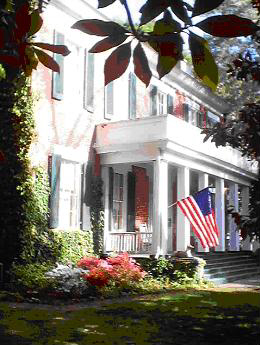 Mr. Goth Chick is a civil war buff and two summers ago on a road trip, we stopped off to tour the battlefield at Shiloh, spending the night at a gorgeous old southern mansion a few towns away, called