Browsed by
Author: James McGlothlin

Law vs. Chaos replaces Good vs. Evil?
Law vs. Chaos replaces Good vs. Evil?

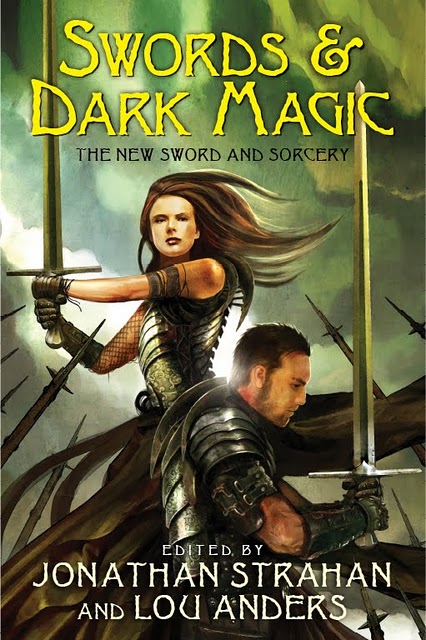
swords-dark-magic-256Jonathan Strahan and Lou Anders dedicate their sword and sorcery anthology Swords and Dark Magic to Robert E. Howard, Fritz Leiber, and Michael Moorcock as “the great literary swordsmen who made it possible.”  Creating one of the most memorable characters in the genre — the “anti-hero” of Elric of Melniboné — would be enough to earn Moorcock this acknowledgment.  But Strahan and Anders suggest that:

It might be his alteration of the battle of Good versus Evil into that of Law versus Chaos (with disastrous consequences implied if either side ultimately triumphed over the other) that made the most significant contribution to fantasy literature (p. xv).

For those who may be unfamiliar with this distinction, Moorcock’s fantasy universe (or multi-verse) is populated, and seemingly controlled to some extent, by the Lords of Law and the Lords of Chaos. These god-like beings seemingly have mysterious and unfathomable intentions.

But they often appear to desire to exert their Lawful or Chaotic control over mortals and their worlds. As Strahan and Anders note, results are calamitous for any such world and its inhabitants when the scale tips too far towards either Law or Chaos.

No doubt this “alteration” has been significant. Outside the realm of fantasy literature, Moorcock’s Law versus Chaos contrast is most notably seen in the early Dungeons and Dragons rules. Its famous notion of alignment spawned a whole cosmological picture upon which this historically important game was built.  (See Appendix 1 “The Known Planes of Existence” in Deities and Demigods.)

Nevertheless, I disagree with Strahan and Anders’s wording of this LC contrast. They seem to suggest — and they are not the first to do so — that Moorcock’s LC is a replacement of the traditional Good versus Evil dynamic within his famous sword and sorcery tales.

I want to suggest that it is rather an added facet. I’ll look at just one of Moorcock’s famous Elric stories to make this case.
…

Read More Read More

James McGlothlin Reviews Writing Fantasy Heroes: Powerful Advice From the Pros

James McGlothlin Reviews Writing Fantasy Heroes: Powerful Advice From the Pros

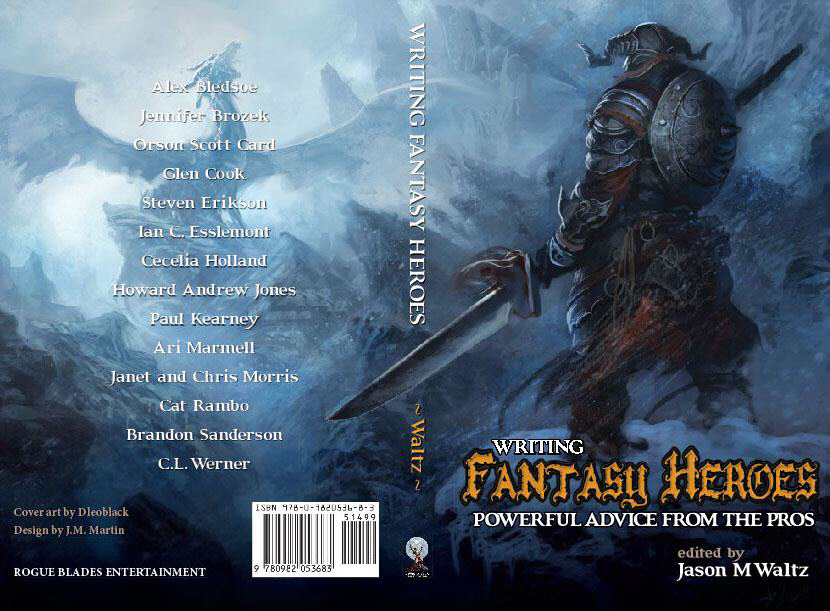
Writing Fantasy HeroesWriting Fantasy Heroes: Powerful Advice From the Pros
Edited by Jason M. Waltz
Rogue Blades Entertainment (202 pp, $14.99, trade paperback, February 2013)

In recent days, Sarah Avery has been doing some excellent in-depth posts reviewing Writing Fantasy Heroes, a collection of essays from some of the best fantasy practitioners in the field. Having recently been one of the winners of a contest for this book, Black Gate has allowed me the opportunity to give my two cents concerning the book as well. I won’t pretend to improve on any of Avery’s review here. Rather, I’ll offer some comments on just a few of the essays that I reacted most strongly to.

For me, hands down, the chapter by Howard Andrew Jones concerning character development through dialogue was the best essay in the book. Jones, along with Saladin Ahmed and Ari Marmell (who also has a chapter in this volume), is part of a small but seemingly growing band of authors who are writing fantasy fiction in a Middle-eastern milieu — think 1001 Arabian Nights! In his essay, Jones shows how the discussions among characters in a story can go a long way towards fleshing out these characters. His examples were quite apt and I especially enjoyed the McCoy and Spock dialogue taken from the original Star Trek series.

Jones’s discussion reminded me of at least one reason why I enjoy books like George R. R. Martin’s A Song of Ice and Fire series as well as, say, Quentin Tarantino screenplays. Both artists do an excellent job of making their characters multi-faceted, and thus compelling, by the use of dialogue in their stories. I think Jones’s essay shows how poor interchanges among characters do more to make a story feel artificial than the use of fantasy tropes!

…

Read More Read More