The Literacy Crisis: Literary Devices

Good Afterevenmorn, Readers!
This is the last of the rants related to my misguided venture back into social media (must try and market, you know?) that resulted in several eyebrow-raising arguments in the bookish corner of those spaces.
This last one is perhaps most forgivable, and could be chalked up to not paying attention in English class, and perhaps not being especially well read. Clearly the original poster was not aware of certain literary devices (and maybe English in general).
It still raised my brows, however. Let’s dive in.
It all began with this post.
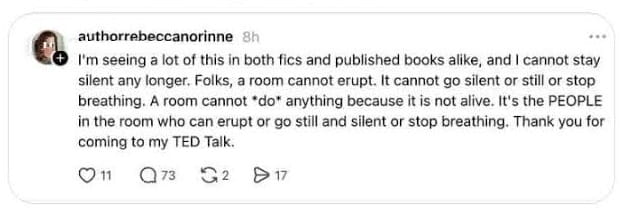
Which, I mean… on a very literal level, I suppose, she’s absolutely correct (except for the volcano thing). On a literary level, however, she is very, very wrong.
What she appears to have issue with is a long used literary device known as metonymy; in which one thing stands for another which the first is an attribute of or associated with.
Some common metonyms we use outside of literature as well as in include:
The crown. Of course a crown cannot do anything, or own anything, or have whims or responsibilities. But we use the object to represent the person. The crown isn’t talking about the crown itself, but what it represents; the regent — king or queen, and perhaps to a lesser extent, their advisors — who wear the crown and make decisions from the position of regent. The crown doesn’t own the land, the regent does. But we often note the lands belonging to the crown. The crown is an inanimate object. Expecting it to do anything is quite silly. Yet one might hear of the responsibilities of the crown. Or its privileges. Or its whims.
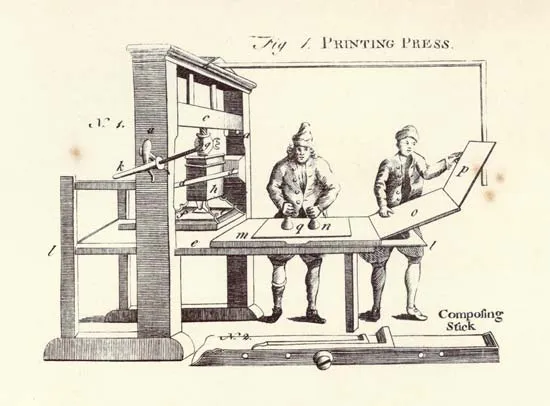
We also use the press quite often, as a general stand in for journalists; particularly of legacy media. Now a press isn’t really capable of doing any kind of investigation. It cannot speak, so asking questions is out of its abilities. The press is simply a machine on which pamphlets, books, and newspapers were once printed. For the youngin’s, a newspaper was a thing… You know what, look it up.
While the press itself has long been replaced by computers, the name survives, even if only as its metonym. It is, of course, not referring to the old machine itself, but to the aforementioned journalists reporting on newsworthy stories.
So, by extension, a room is a metonym covering everyone, or nearly everyone, in a confined space (the room). It is the people. It’s just clunky and unnecessary to say “the people in the room” when the literary device provides brevity and meaning in one lovely little package. Much like it would be really, really unwieldy to list every single animal in the woods which have ceased calling when the sentence “the forest fell silent” works just the same, with just as clear a meaning.
Look, I’m not really angry about this one, like I am the others. Though I do find it highly concerning that the poster is an author that is ignorant of literary devices.
In her defence, I had to look up the name of the device, because it has been thousands of years since I attended school, and have quite forgotten most of the details of my classes. I just knew it was a device of some kind.
Incidentally, before anyone jumps on the above, I just used another literary device known as hyperbole. I think more people are familiar with the name of this device than the other, but just in case eyebrows were raised, no, I am not a vampire or any other kind of immortal. I am hyperbolic. It wasn’t literally thousands of years ago, though I often joke I was taught way back in the Bronze Age, when the internet was not yet invented and cursive writing was still part of the curriculum.
Not the point. The point is, the post was made in ignorance of literary devices, and points to a large part of the problem with this ongoing literacy crisis we appear to be experiencing. Of greatest concern was the fact that this was an author. Someone responsible for conveying ideas creatively through (presumably) the English language. Surely they ought to have known better.

This isn’t to say that I believe a formal education in English is necessary to becoming a writer. I didn’t take English beyond high school. I just read a whole lot. I learned to recognise, subconsciously, literary devices and how they’re used (honestly, I am the worst when asked for writing advice because my most honest answer to pretty much everything to do with the English language is, “I don’t actually know. I just do.” Absolutely useless).
Rather than rail against this author, who is in all likelihood a product of the education system’s wide and varied failures, I would like to instead turn this into something of a quickie education of literary devices from someone who has to look them up because, again, I don’t know. I just do.
Synecdoche: a word when part of a thing is used to denote the entire thing. Hired hands, for example, we know to be workers. No one is paying disembodied hands to do anything. That would require a specialist necromancer, I imagine. This one is quite obscure, and I only came across it when I was trying to find the name of the device in question.
Personification: When a non-human thing is given human-like traits. For example, the angry wind howled. Wind is wind. It can’t be angry. Nor does it howl. It can vibrate things to make a howl-like sound, but try and write that down and the prose suddenly become less evocative. It might be more accurate, but what’s the fun in that?
Parallelism: Constructing a sentence in order to create balance and rhythm. This is one of my favourites, most often employed unconsciously. It can make for a wonderful flow in the prose.
These are just three I tend to use. Of them, I only knew the name of personification off the top of my head.

Now, the fact that an author was ignorant of at least one quite common literary device at all, and not just the name of it is incredibly disheartening to me. Part of what upsets me, I think, is the unwillingness to not just look up what might be happening (clue: if it’s happening a great deal, even in work that has access to paid editors, there is likely a reason for it), but it also shows a considerable lack of creative and symbolic thought.
Of course a room cannot erupt, or fall silent. It is a room. Knowing this, a literal interpretation of the oft-used phrase is probably not the way to try and understand it. Perhaps the room may be a metaphor or a symbol for something, then (obviously, it is. It stands in for the folks in that room, but I’m trying to handhold here)? Where has the ability to think creatively gone? I’m not just talking about imagination. I do mean creative thought, problem solving, understanding symbolism.
This is one that I don’t have any idea how to fix. I would have once said education is key. And perhaps it is. But education is lost on those without the desire to be educated. I worry that we are increasingly unable to be taught and worse still, to educate ourselves. If we lose that skill, I fear we are lost.
Now I’m really depressed. I’m going to bury my melancholy in a pint of ice cream. Not symbolically. Literally.
When S.M. Carrière isn’t brutally killing your favorite characters, she spends her time teaching martial arts, live streaming video games, and sometimes painting. In other words, she spends her time teaching others to kill, streaming her digital kills… and sometimes relaxing. Her most recent titles include Skylark, Human and The Timbercreek Incident.
my dictionary has “the people who are present in a room” as one of the definitions of “room”. so that particular word might’ve gone past metonym into just standard usage, or what have you.
I think this example of the Literary Crisis refers back to your first article/rant on this subject – ‘use simpler words’ – a total disconnect from what language can be aside from the most basic level of communication. Sad.