From Woking to Ansby: The High Crusade by Poul Anderson
 |
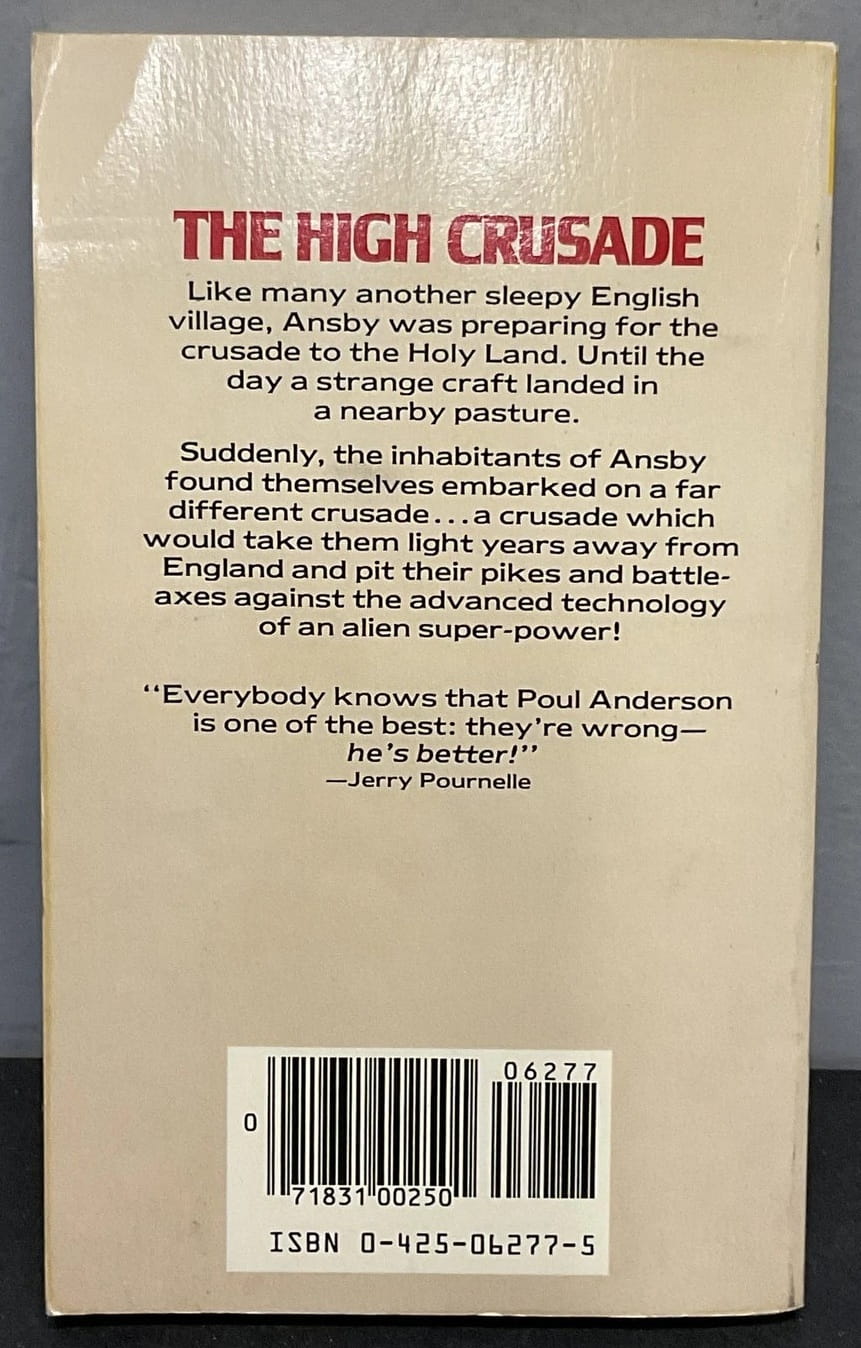 |
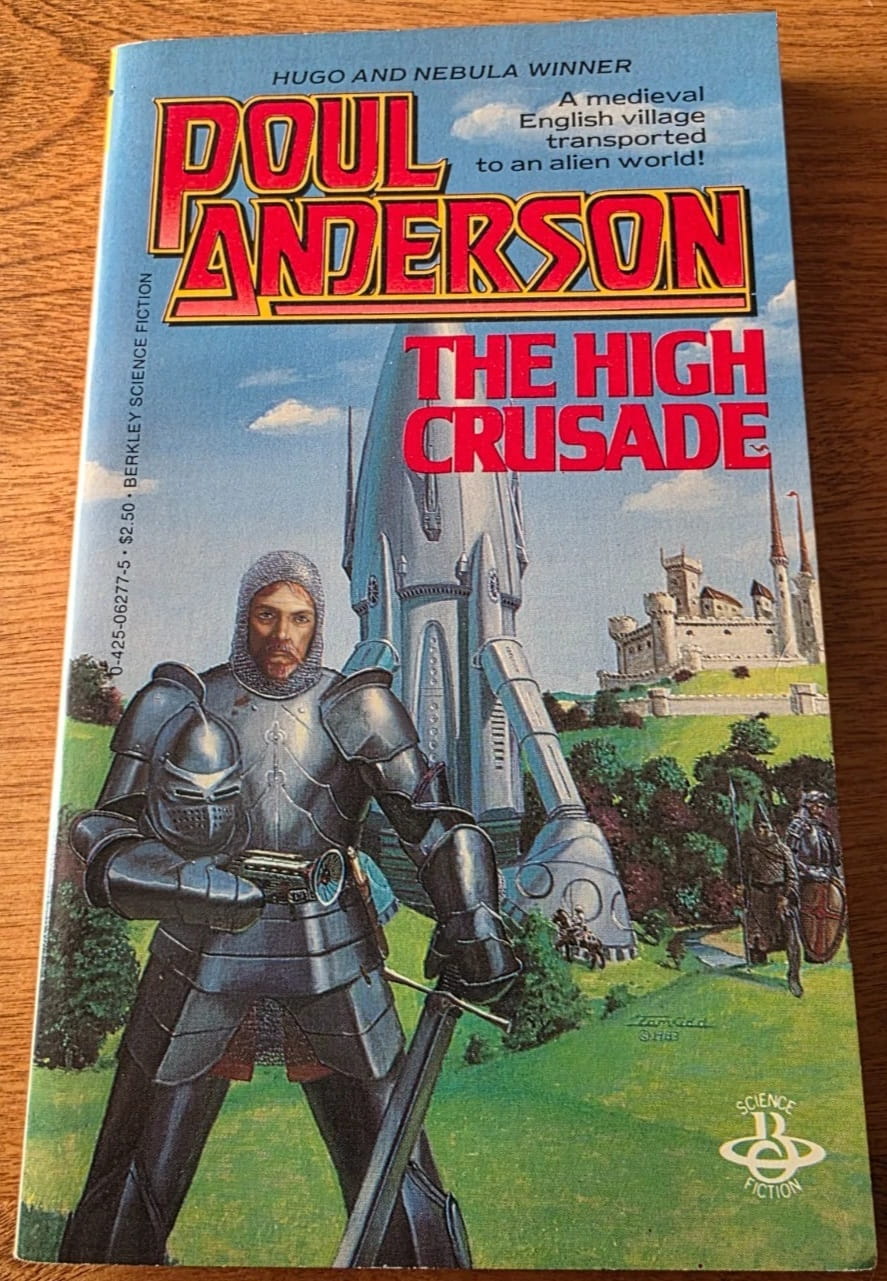
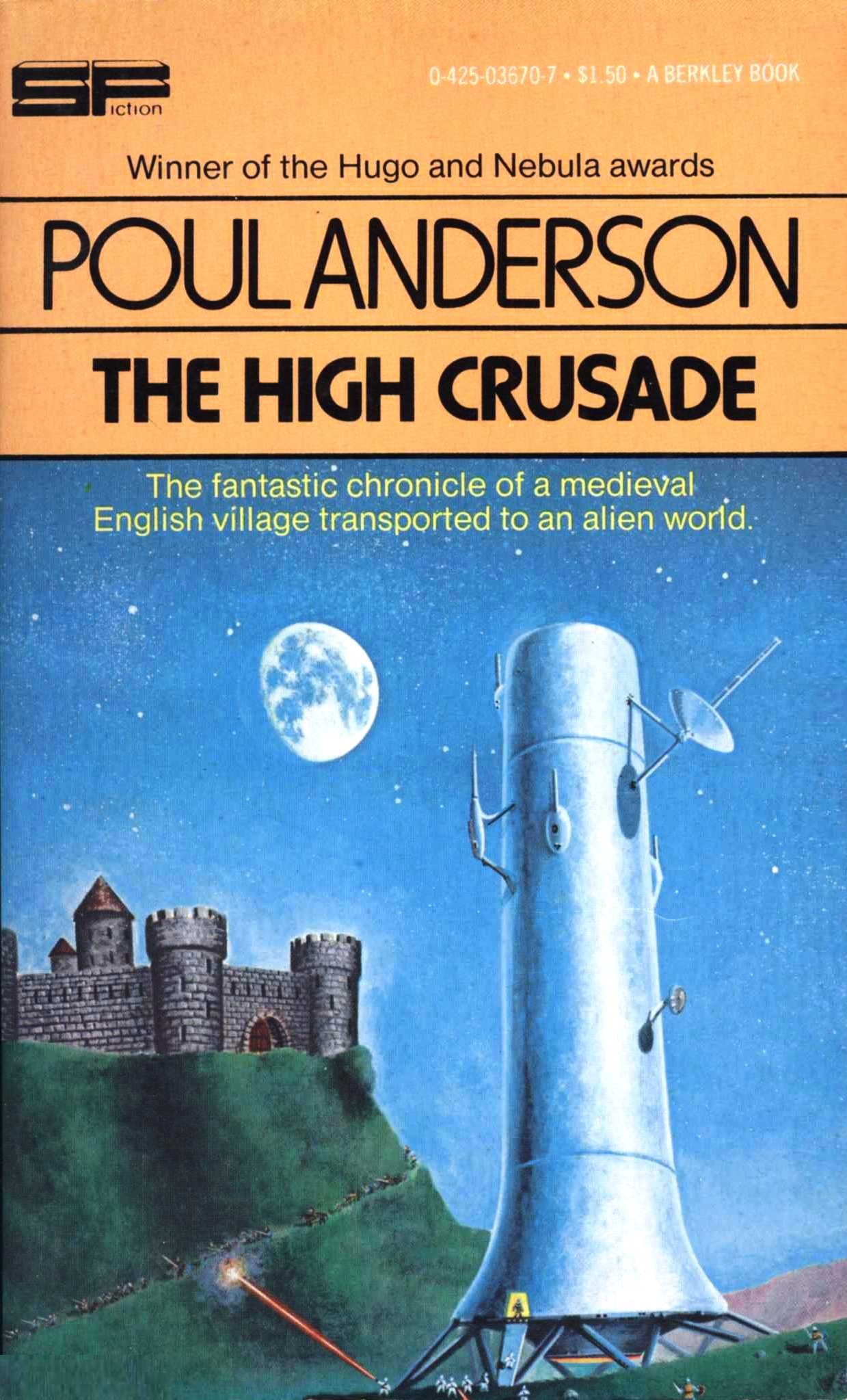
The High Crusade (Berkley Books, October 1983). Cover by Tom Kidd
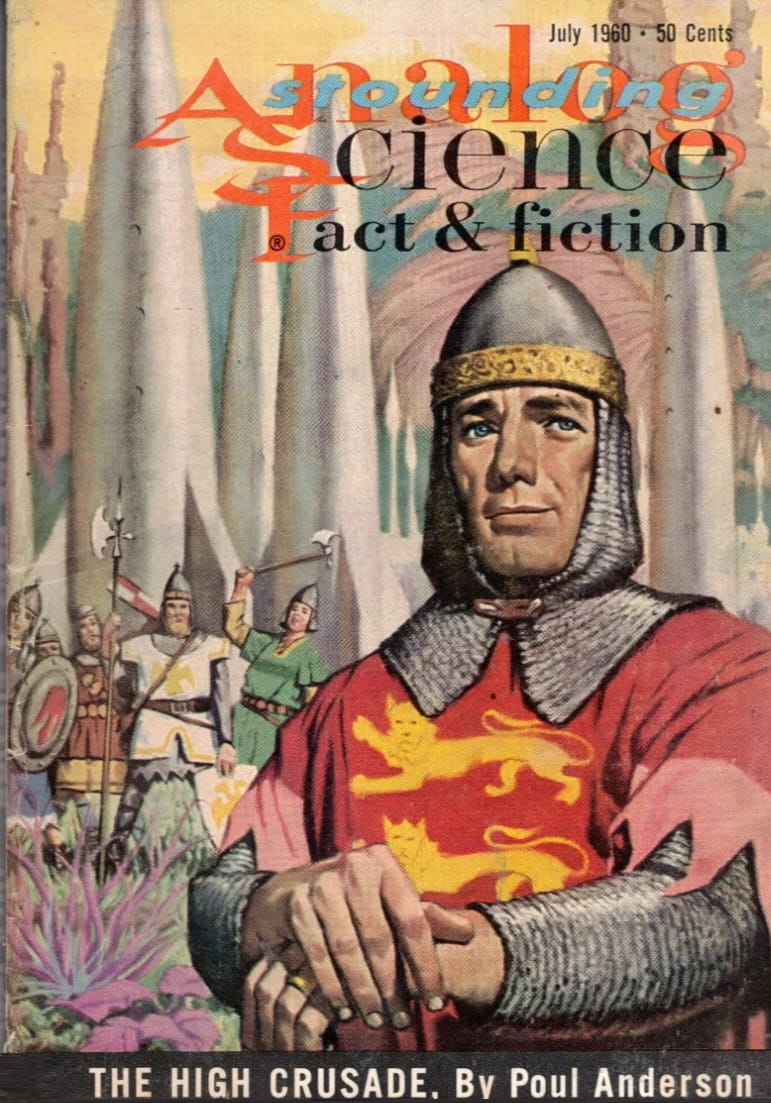
The High Crusade is one of the earlier novels in Poul Anderson’s long career: serialized in Astounding Science Fiction in the summer of 1960 (just as it was changing its title to Analog), published in book form that same year, and nominated for a Hugo Award for Best Novel in 1961, though it lost to A Canticle for Leibowitz. It remained popular and is still in print. In a lot of ways the story is a romp, but it also has themes that Anderson returned to more seriously in later books.
The High Crusade starts out as an alien invasion story, of a form going back to H.G. Wells’s The War of the Worlds: A spacecraft lands in England, and mysterious beings emerge from it, wielding advanced weapons and killing people to show their power. We have the same contrast between human and alien military technologies. But in this story, Anderson plays a trick he loved to do, especially early in his career (in stories such as “Journeys End” and “The Man Who Came Early”): he reverses the expected outcome from earlier stories.
Anderson’s Earth people are medieval knights, mercenaries, and villagers, with nothing like the torpedo ram Thunder Child from Wells’s novel; but they meet the alien attack with instant aggression. Before the day is over, only one of the aliens survives. Where Wells’s Martians devastated Woking, Anderson’s Wersgorix are wiped out at Ansby.
Anderson’s Wersgorix aren’t nearly as alien biologically as Wells’s Martians; rather than vaguely resembling octopuses, they’re generally humanoid, though scaly, blueskinned, and reptilian. They’re also not examples of advanced biological evolution. Where Wells thought of his Martians as having preserved distinctively human traits of brain, eyes, and hands, grotesquely enlarged, while all their other organs were radically simplified, the Wersgorix differ mainly in culture: They live in a society with a centralized government and no local institutions such as landed nobility, churches, or guilds. Apparently they are accustomed to having the government protect them and have forgotten such primitive arts as hand-to-hand combat, which is what enables the Ansby villagers to overwhelm them.
 |
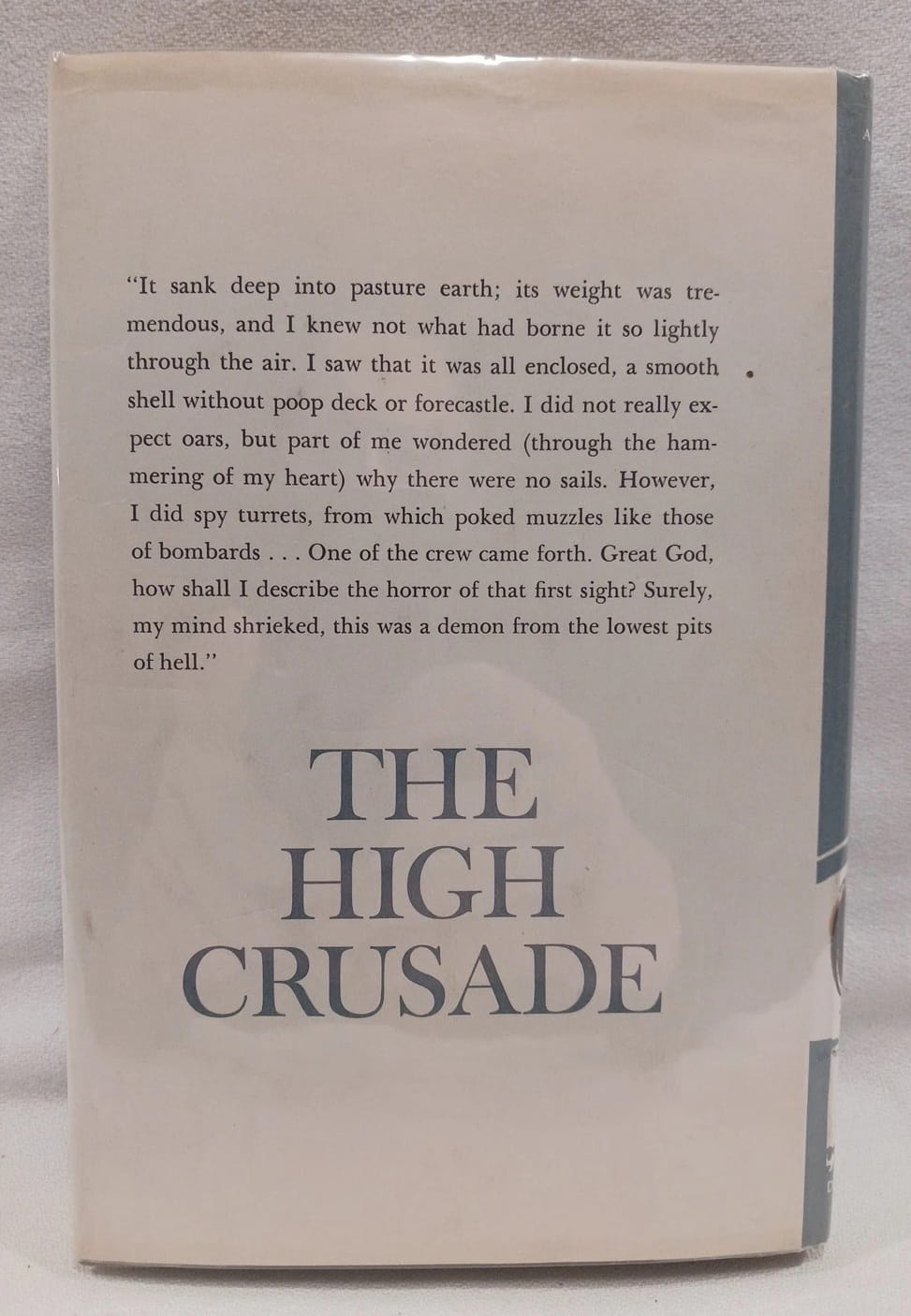 |
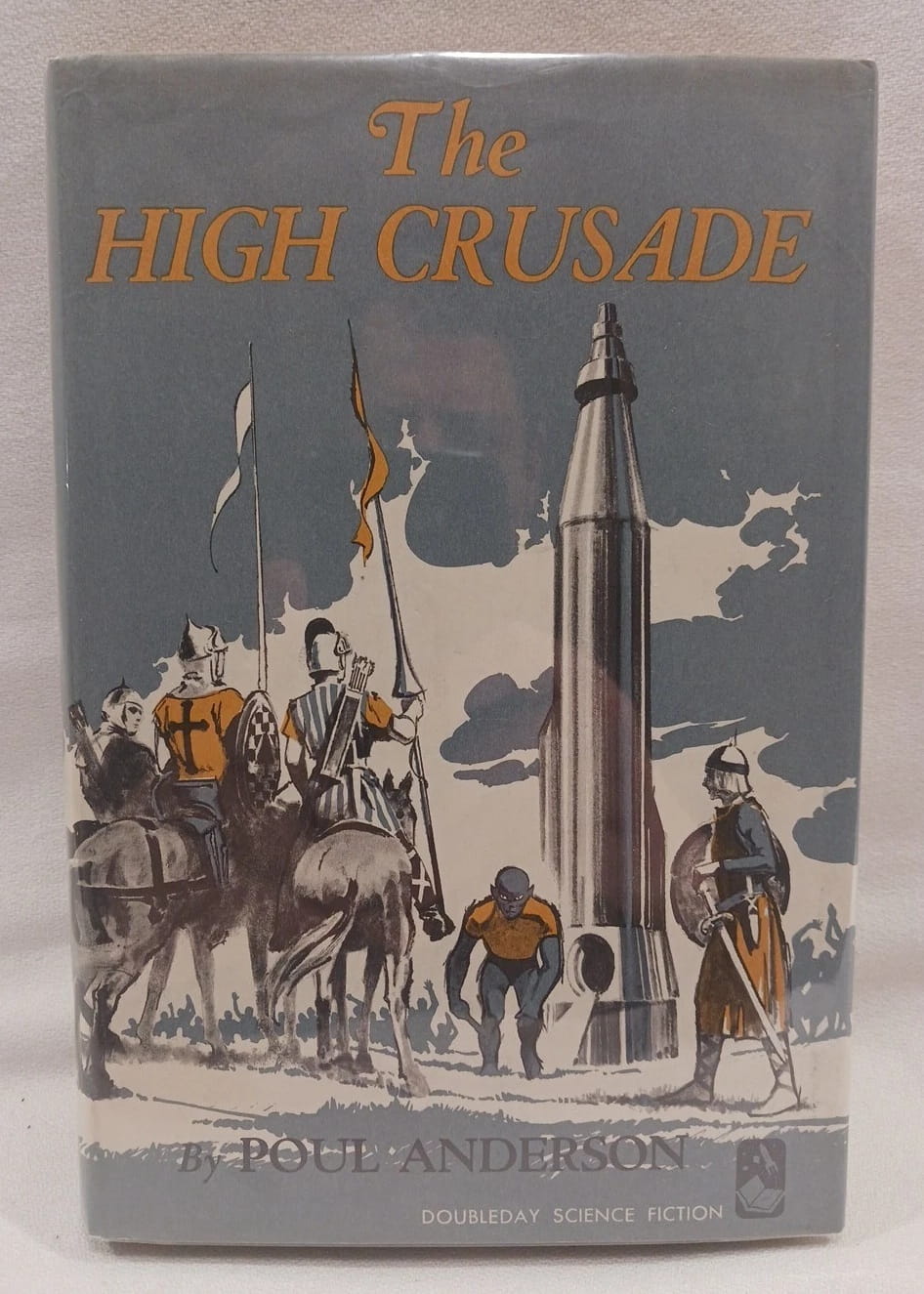
The High Crusade (Doubleday, 1960). Cover by Harry Schaare
At this point, the baron of Ansby, Sir Roger de Tourneville, comes up with a brilliant idea: He’ll use the alien spacecraft to take his entire village, first to France, and then to the Holy Land. The alien ship has more than room enough, being two thousand feet high. He names the ship Crusader and orders the surviving Wersgor, Branithar, to pilot the ship to France.
Instead, Branithar programs the ship to pilot itself to its home port, Tharixan. Now Sir Roger faces a desperate situation: Not daring to surrender to the Wersgorix, he attacks one of their military bases and captures it, and then resorts to a combination of reckless attacks, bluffing, and subversion to strengthen his own position, and ultimately to take on the entire Wersgor empire. This is the point from which Anderson’s whole story takes off.
 |
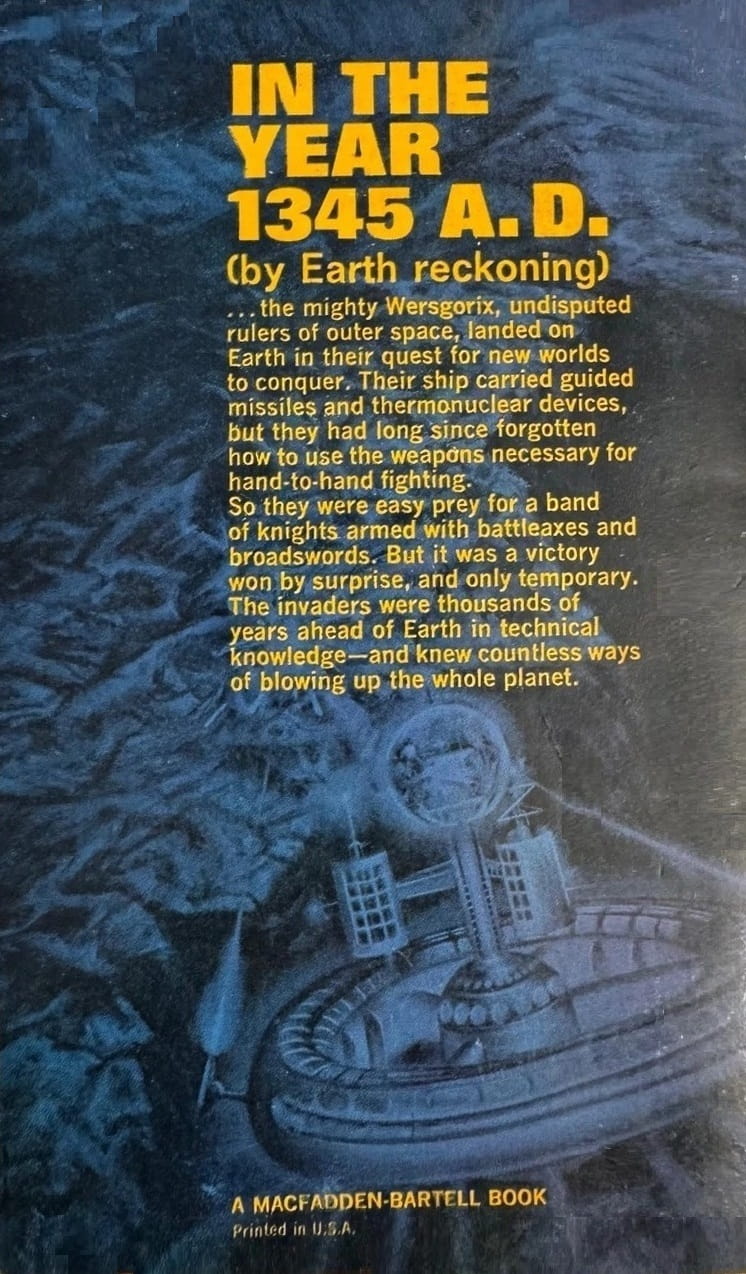 |
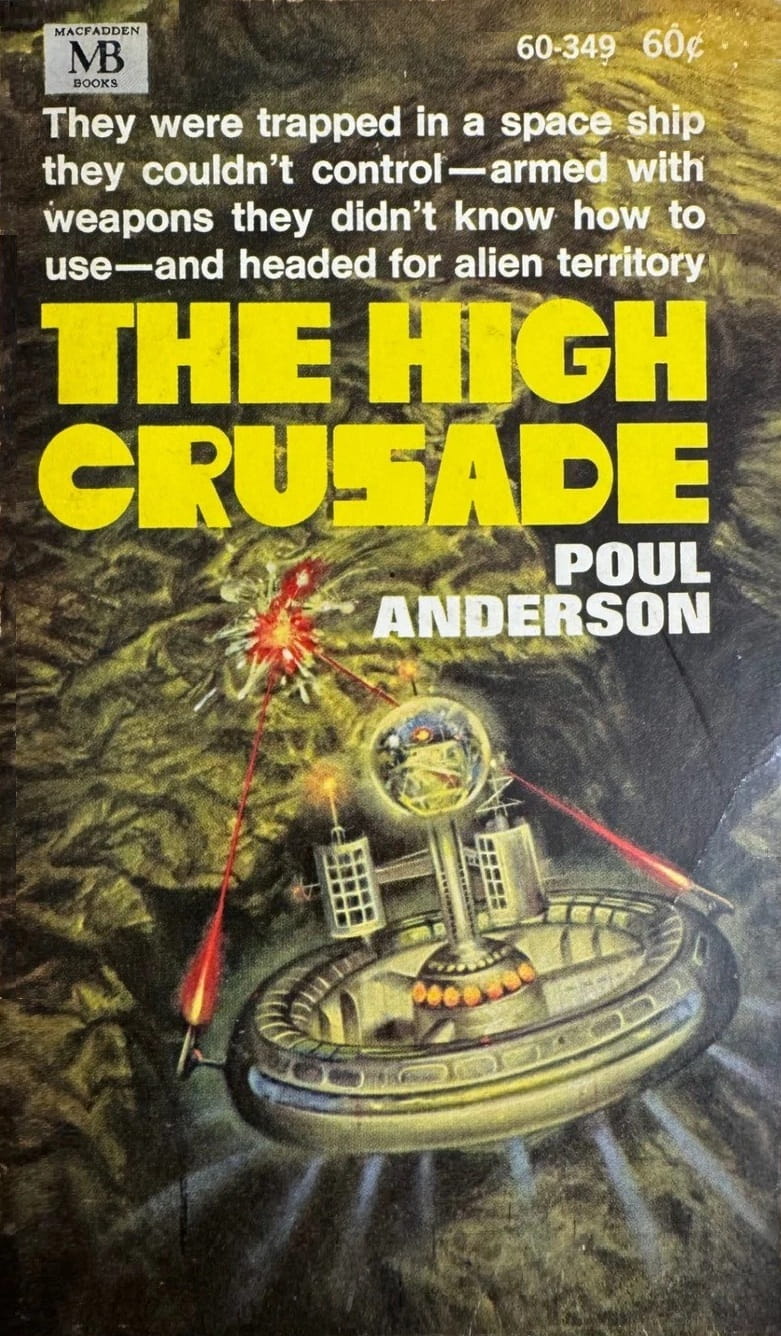
The High Crusade (Macfadden-Bartell, September 1968). Cover by Jack Faragasso
The High Crusade is told in first person; its viewpoint character, Brother Parvus (Latin for “puny”), originally a tutor for Sir Roger’s children, is assigned to teach Branithar Latin and himself to learn the Wersgor language, and as a result, he becomes a witness to most of the crucial events — though he confesses that, in the style of earlier historians, he falls back on “inventing whole scenes, that folk now dust may live again and be known” (which also lets Anderson dramatize his story rather than narrating it).
Crucial characters, other than Sir Roger, are Red John Hameward, his huge captain of archers; his wife, Lady Catherine, who feels that she married beneath her station; and Sir Owain Montbelle, a younger knight with courtly manners. The expedition includes one other knight, Sir Brian Fitz-William, who plays little part in the story.
Anderson’s plot weaves together three sources of tension: First, can the English ever find their way back to Earth, since the Wersgor navigator was killed and the Crusader is wrecked early in the story? second, will Lady Catherine forgive Sir Roger for bringing her far from home and into peril, or will she be tempted by Sir Owain’s courting her? and third, and most important, how can the Wersgorix be prevented from finding Earth again and conquering or destroying it?
 |
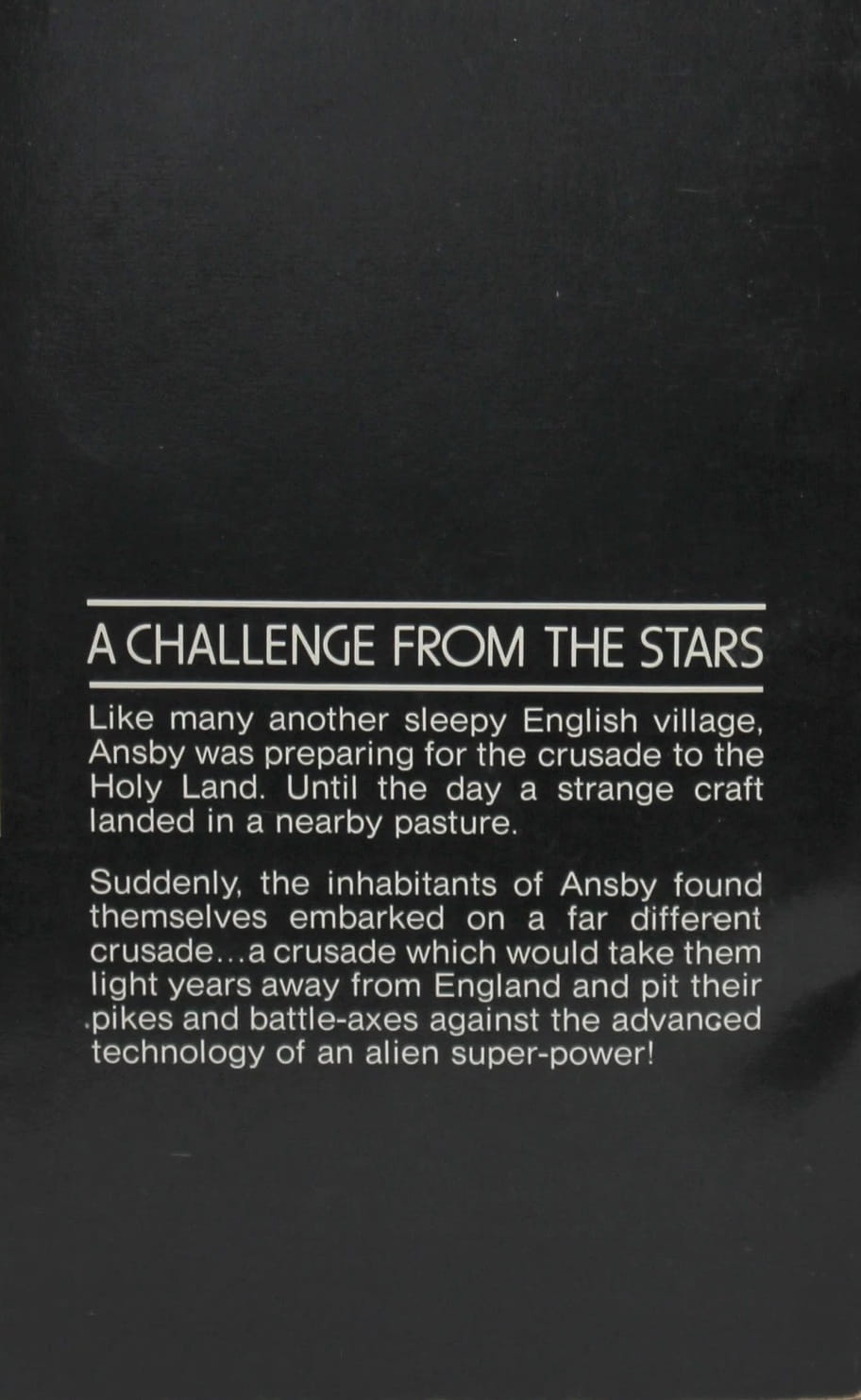 |
The High Crusade (Berkley Medallion, March 1978). Cover artist unknown
The first two issues are most visible for most of the story; the third turns out to be Sir Roger’s deepest concern, which drives his desperate war against the Wersgor empire. The climactic chapter brings together all three issues, as all of the central characters have to choose sides and take action. I thought it was one of Anderson’s more dramatic scenes when I reread The High Crusade.
What also stood out for me, though, was that this book turns on a political idea that Anderson has explored in other works, from “No Truce with Kings” to Orion Shall Rise: The contrast between the unitary state, which accepts no smaller loyalties between itself and its people, and the society of local loyalties. In other words, Anderson is looking at how a case can be made for feudalism as a political system.
It’s worth noting that not many years later, Anderson became a founding member of the Society for Creative Anachronism, which came up with its own idealized version of feudalism. And The High Crusade in many ways embodies a similarly playful approach to the feudal past, with the odds against the English adventurers even surviving being treated optimistically, and the sheer ferocity of medieval society not so much denied as kept off stage most of the time.
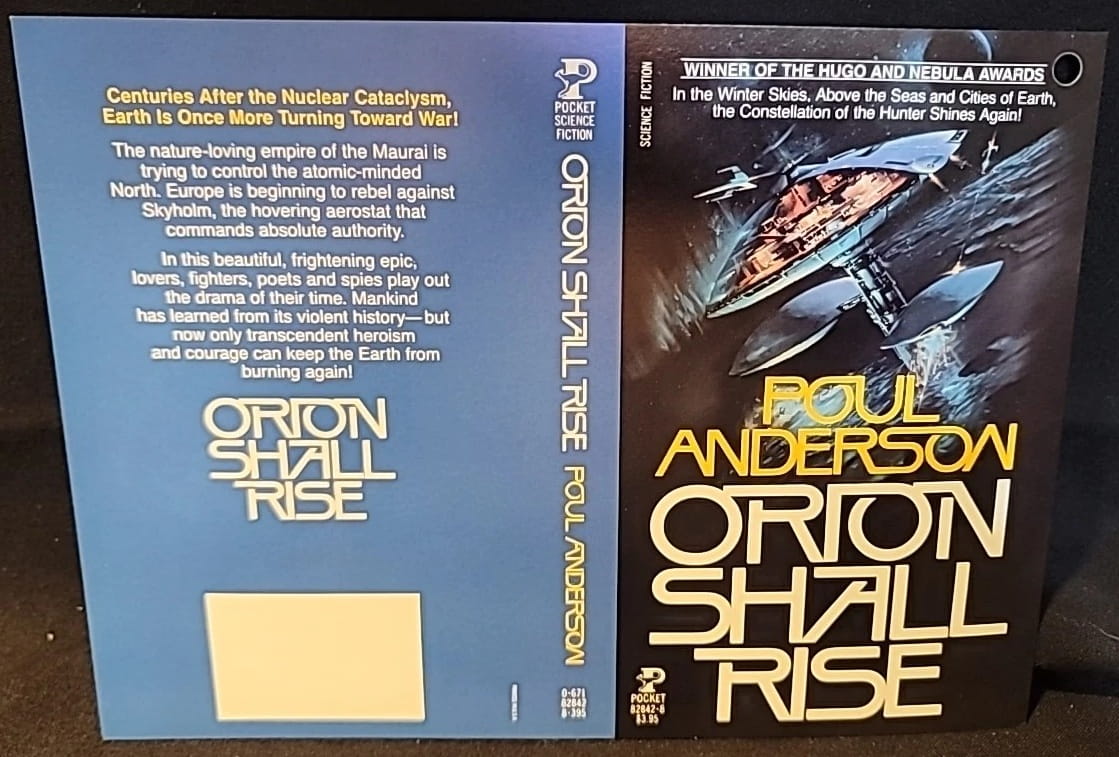
But it’s also a precursor to Anderson’s continuing exploration of whether feudalism might not be a better way of life for human beings than the greater impersonality of modern societies. Orion Shall Rise, for example, offers sympathetic portrayals of three different societies: one libertarian, one aristocratic, and one Green. And while I think we were better off getting rid of feudalism as an institution, I find Anderson’s examination of it interesting — and it certainly makes for some great storytelling in this book.
The crucial moment that characterizes Anderson’s vision of a more humane feudalism (one that owes something to Kipling, one of his favorite writers) takes place in Sir Roger’s negotiation with Sir Owain near the end:
She faced Sir Roger, smiling and weeping. “My love, we can go home again!”
He glanced at her, once. “But what of the folk we led hither?”
“Nay, I cannot risk taking them with us.” Sir Owain shrugged. “They’re lowborn anyway.”
Sir Roger nodded. “Ah,” he said. “So.”
Once more he looked at his wife. Then he kicked backward. The spur of knighthood struck into the belly of the Wersgor behind him.
William H. Stoddard is a professional copy editor specializing in scholarly and scientific publications. As a secondary career, he has written more than two dozen books for Steve Jackson Games, starting in 2000 with GURPS Steampunk. He lives in Lawrence, Kansas with his wife, their cat (a ginger tabby), and a hundred shelf feet of books, including large amounts of science fiction, fantasy, and graphic novels.
I picture a younger, svelter, Brian Blessed as our lead. A hill to die on.
This was the very first science fiction novel I ever read, and a happy memory it still remains after all these years.
From the descriptions in the novel, it rather seems that Sir Owain is young and good looking and courtly, while Sir Roger is older, rough-hewn, and lower class than his wife (though still a nobleman). I don’t quite envision him as svelte.
Let’s replace“svelter” with “still in fighting trim.”