A Heaven of Action: Mistress of Mistresses by E.R. Eddison
I heard her say, faint as the breath of nightflowers under the stars,
“The fabled land of Zimiamvia. Is it true, will you think, which poets tell us of that fortunate land: that no mortal foot may tread it, but the blessed souls do inhabit it of the dead that be departed: of them that were great upon earth and did great deeds while they were living, that scorned not earth and the delights and the glories of earth, and yet did justly and were not dastards nor yet oppressors?”
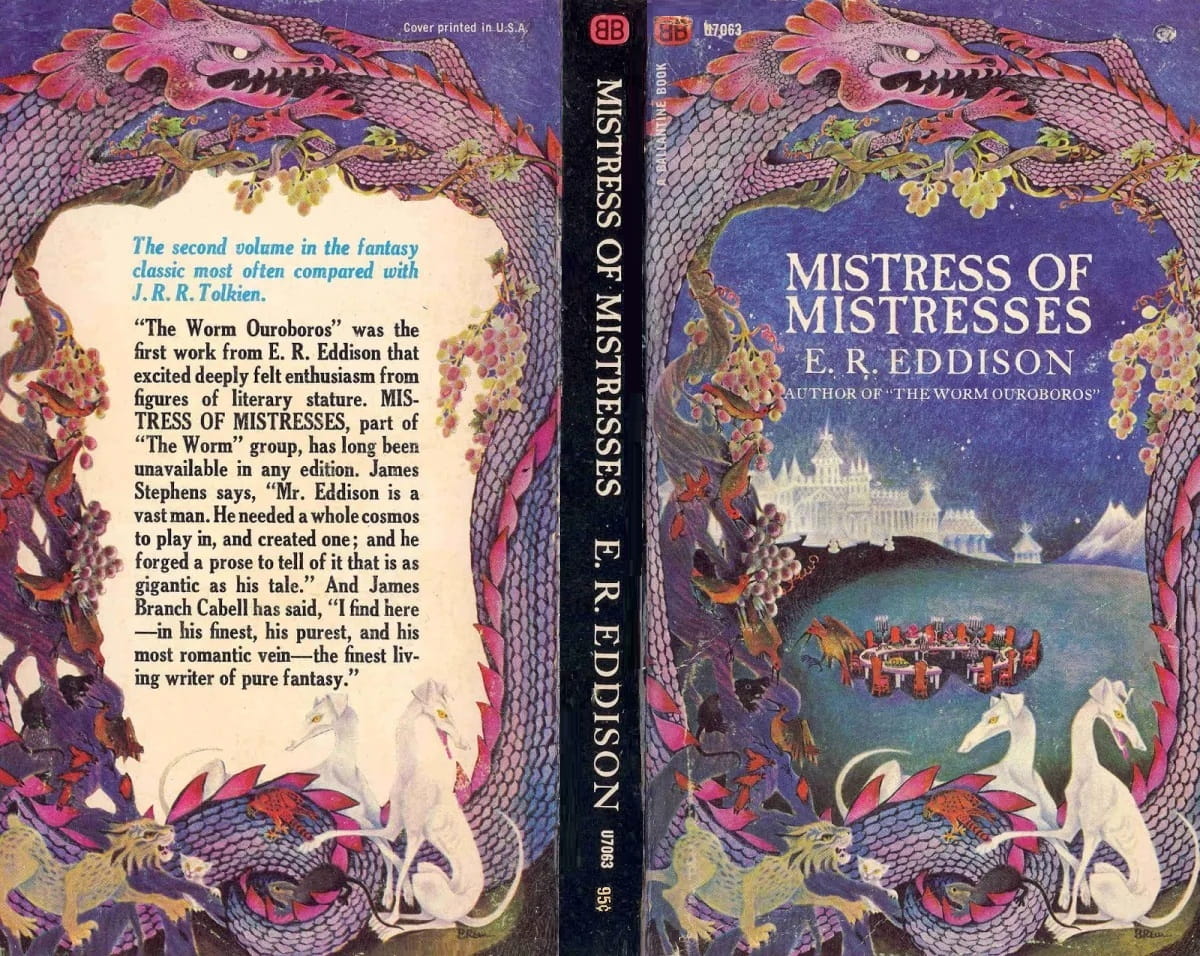
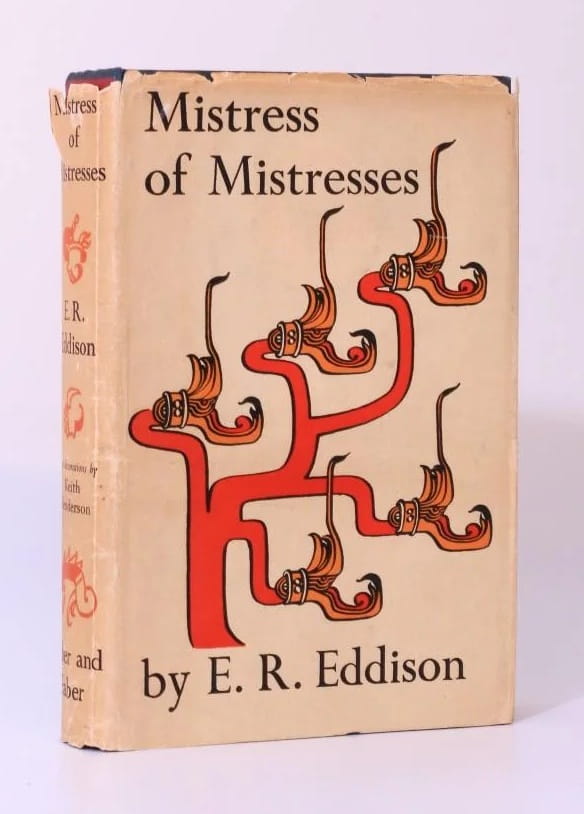
Very shortly after the paperback publication of The Lord of the Rings made it a best seller, Ballantine Books began treating publishing other paperback fantasy novels, turning fantasy into a genre. Some of these were by contemporary authors, such as Joy Chant, Katherine Kurtz, or Evangeline Walton; but many more were older works being brought back into print. Among these older works was E.R. Eddison’s Mistress of Mistresses, first published in 1935.
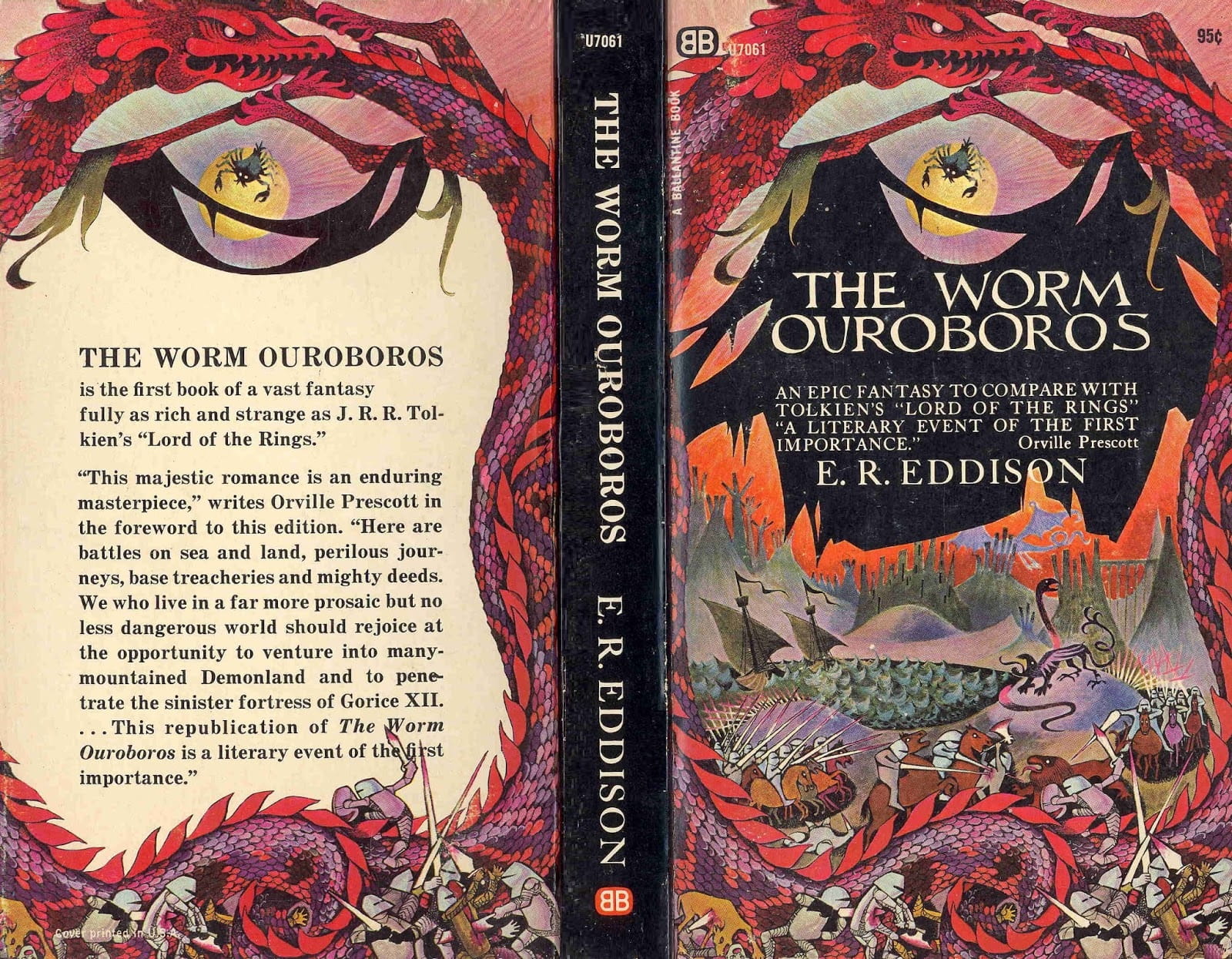
Eddison had begun writing fantasy in 1922 with The Worm Ourobouros, which Ballantine also republished, a little earlier. In fact they treated them as two volumes of a series. There is indeed a minor linkage between them: The Worm Ourobouros begins by introducing a viewpoint character named Lessingham, who has a dream in which his consciousness is transported to Mercury and witnesses the events of the novel proper, though he doesn’t take part in them and soon enough is no longer mentioned even as a witness.
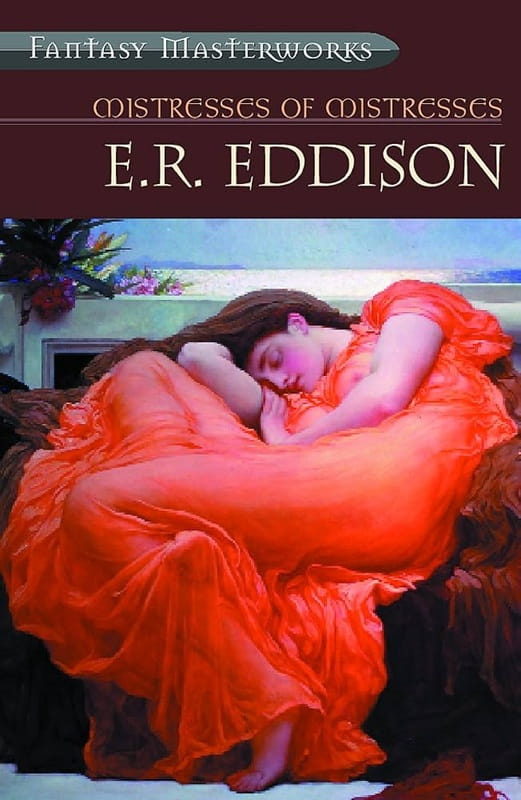
[Click the images for heavenly versions.]
In Mistress of Mistresses, this same Lessingham is lying dead in Norway, having reached the age of ninety, and is attended by a single old friend and by the mysterious Señorita Aspasia del Rio Amargo, who asks the question quoted above, and then says I have promised and I will perform. (Her allegorical surname, “of the bitter river,” seems to hint at her competence to do so.)
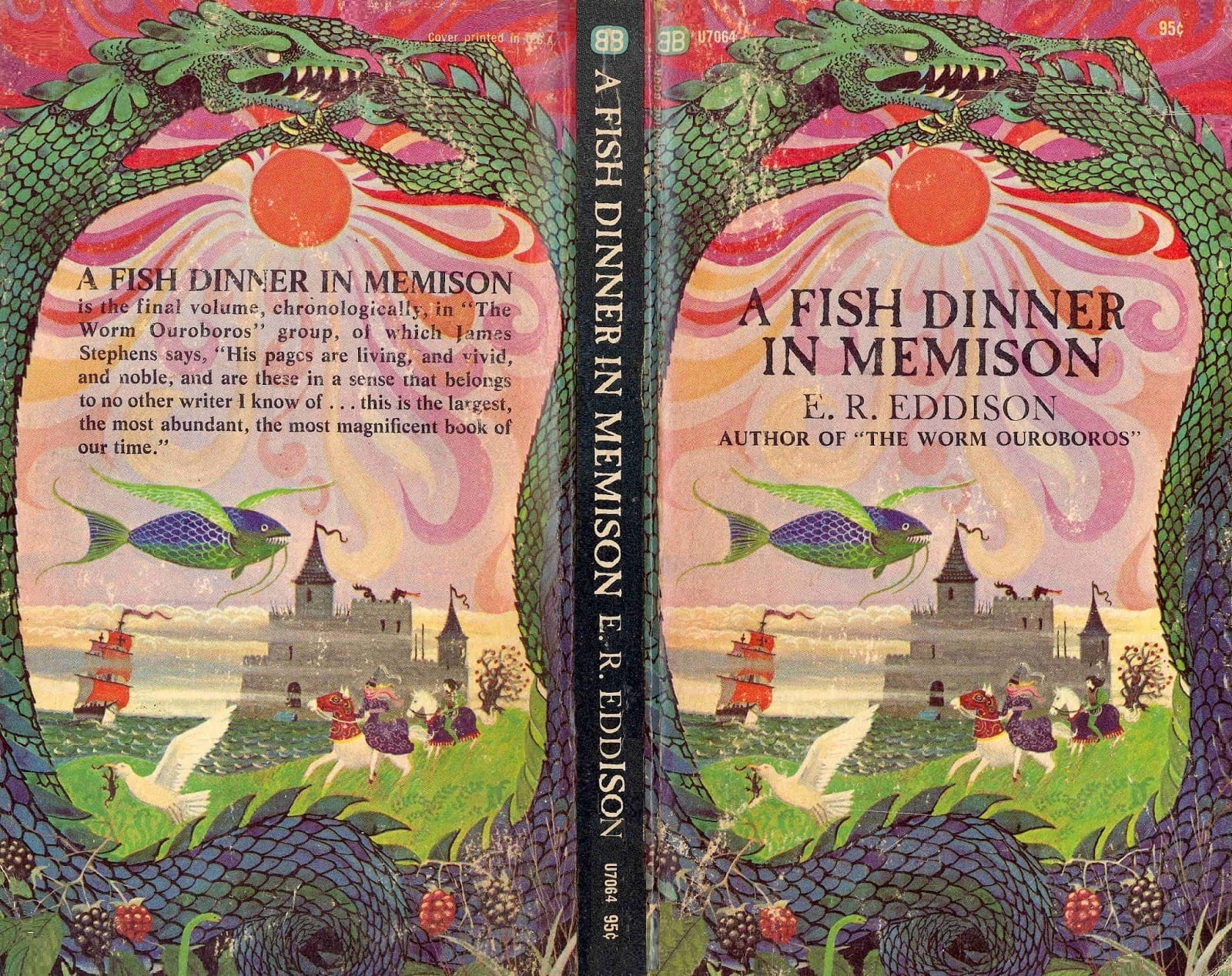
Eddison’s Mercury is not the Mercury of the astronomers, airless and uninhabitably hot from its nearness to the sun, but a human world, and a setting for adventurers. The Worm Ourobouros hints that Zimiamvia is an inaccessible region of that fantasy Mercury, but its relation to Earth emerges as more complex than that in Mistress of Mistresses and especially its sequel A Fish Dinner in Memison. Eddison says nothing of Mercury in these later novels. Rather, Zimiamvia is a realm of the blessed dead, whose geographical or astronomical location is as incidental to this function as is the location of the Elysian Fields at the far west of a flat Earth.
Or, at least, Zimiamvia is the abode of one of the blessed dead. After the prologue, the novel begins in medias res, as Lessingham, a man of twenty-five, comes back to himself after a brief distraction to resume a conversation with his right-hand man, Amaury, about the political and military situation. Amaury thinks that Lessingham’s plans are at best reckless, and his trust in “the Vicar” (meaning not a religious office, but a person who acts in another’s place) misplaced, but he despairs of changing Lessingham’s mind, and won’t abandon him however foolish he seems.
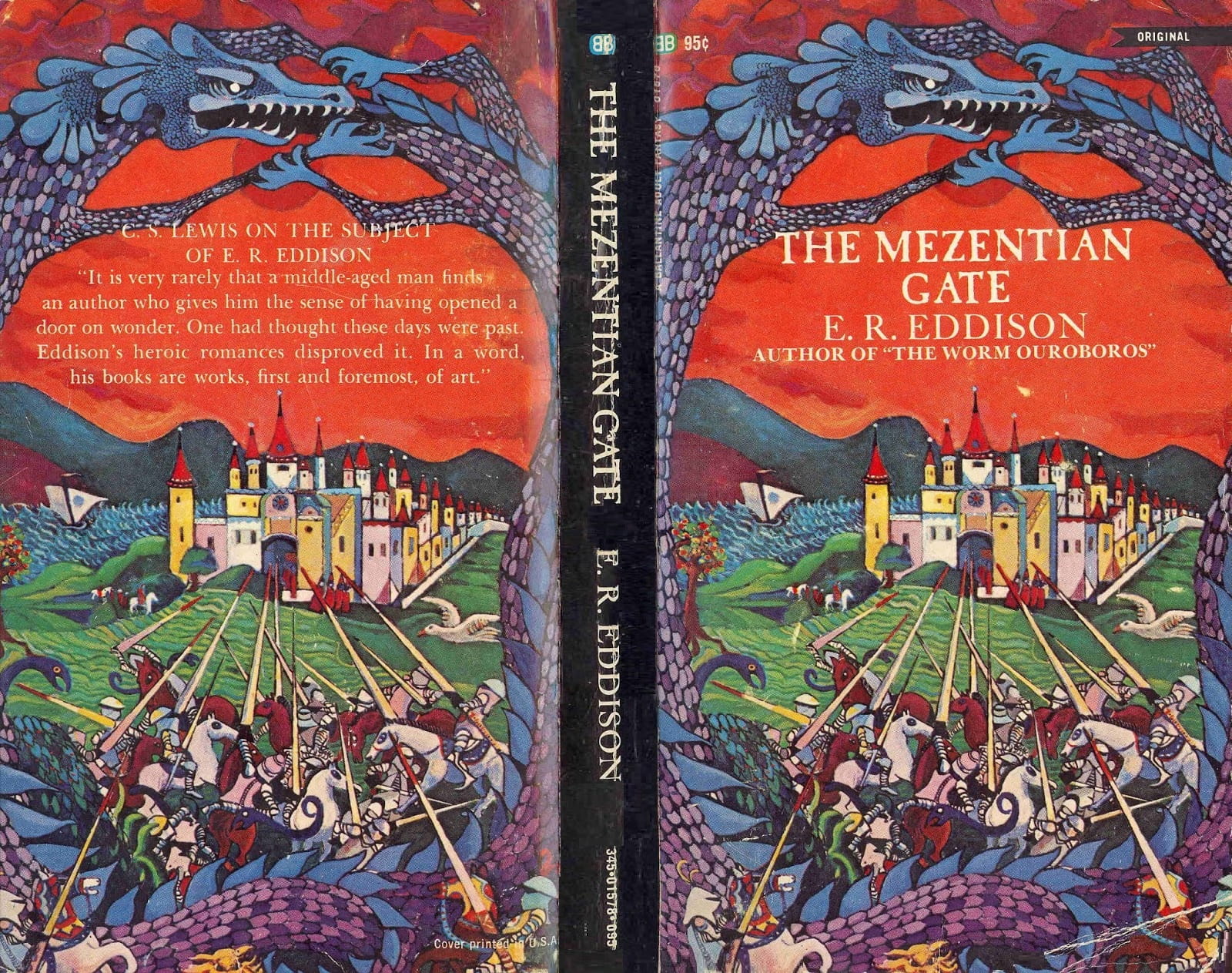
If Zimiamvia is a heaven, it’s one that suits a man of action, with complicated politics in the style of Renaissance Italy. Not long before the opening scene, King Mezentius, ruler by birth of the northern kingdom of Fingiswold, and conqueror of the middle kingdom of Rerek and the southern one of Meszria, died. He left behind a legitimate son, Styllis, and daughter, Antiope, and also a bastard, Barganax, a duke in Meszria, with Styllis as heir to the throne, and Antiope next in succession.
But the terms of the inheritance are a source of conflict between Duke Barganax; the king’s three commissioners, Admiral Jeronimy, Earl Roder, and Chancellor Beroald; and Horius Parry, the Vicar of Rerek (“vicar” is not a religious office, but someone who acts for someone else of higher rank). The Vicar is Lessingham’s cousin, and Lessingham is in his service, sometimes as a military commander and sometimes as a diplomatic envoy — but in either role, tends to do what he thinks is right, which often brings the two of them into conflict.
The Vicar is the great adversarial figure in this story, which is driven by his ambitions and his treacheries. And he’s a gorgeous monster, both physically — not tall, but strong and massively built, with fiery red hair and grotesque features — and morally, being cunning, ferociously ambitious, and always ready to break his word or change sides if there’s anything to gain.
I’ve thought of him for many years as a plausible model for Frank Herbert’s Baron Harkonnen, both in characterization and in his role in the plot; but a more compellingly written one, especially in his dialogue, which is manipulative and full of real and manufactured grievances.
“Cousin,” said Lessingham, “you did throw a knife at me.”
The Vicar was ill at ease under Lessingham’s secure and disturbing smile. “Tush,” he said, “’twas but in sport.”
“You shall find it a dangerous sport,” said Lessingham. “Be advised, cousin. Leave that sport.”
But Lessingham has another side: one that shows up in his encounters with Barganax. For Barganax is passionately in love with Fiorinda, the younger sister of Chancellor Beroald; and Fiorinda has moments of a kind of transcendent self-awareness that raise her above the level of mortals. In that self-awareness, she chooses Barganax as her lover.
And later in the novel, Lessingham meets Antiope, King Mezentius’s daughter, and there are scenes where she has a similar self-awareness — and chooses Lessingham. And while Barganax and Lessingham don’t share the same state of consciousness, their stature is more than that of mortal men. And most importantly, they have an affinity for each other, shown memorably in a scene where each looks in a mirror and sees the other’s face, and then evoked again at the very end. So this is also a story about erotic love.
One particular marker of this bond is that Fiorinda is associated with an aged philosopher, Doctor Vandermast, who is at once a provider of maxims quoted from Spinoza (in the original Latin); a practitioner of magic; and the patron of Anthea and Campaspe, a pair of nymphs with the power to change shape — Anthea into a wildcat, and Campaspe into a water rat. The two of them appear as diversions for Lessingham, also as attendants on both Fiorinda and Antiope, at different times. And Vandermast appears as knowing more about the true natures of all four characters than any of them is able to know, except in moments.
Vandermast is also a servant, in part to Barganax, and one of three whom Eddison groups together in his Dramatis Personae. Another is Lessingham’s loyal friend Amaury. And a third is Gabriel Flores, the Vicar’s secretary, and as manipulative and treacherous as he is—except in being not merely terrified of him, but devoted to him. Flores both gives the Vicar someone to talk with openly about his schemes, and is often a tool for carrying out those schemes. But he also has his own motives, especially where Lessingham is concerned.
Those schemes lead, in the first place, to warfare, of an older sort fought on a more human scale, where a thousand men are a substantial force and ten thousand a nearly unmanageable horde. I find it interesting that though the customs of Zimiamvia are largely those of Renaissance Europe (but with scarcely a trace of Christianity, and paganism widespread), its military technology is not: There is no gunpowder here, and none of the kind of fortresses built to withstand cannonfire. In fact there are scarcely any bows, crossbows, or slings, let alone catapults; combat seems to be man to man. And this anachronism leads to some exciting scenes, especially in the large battles at the end.
 |
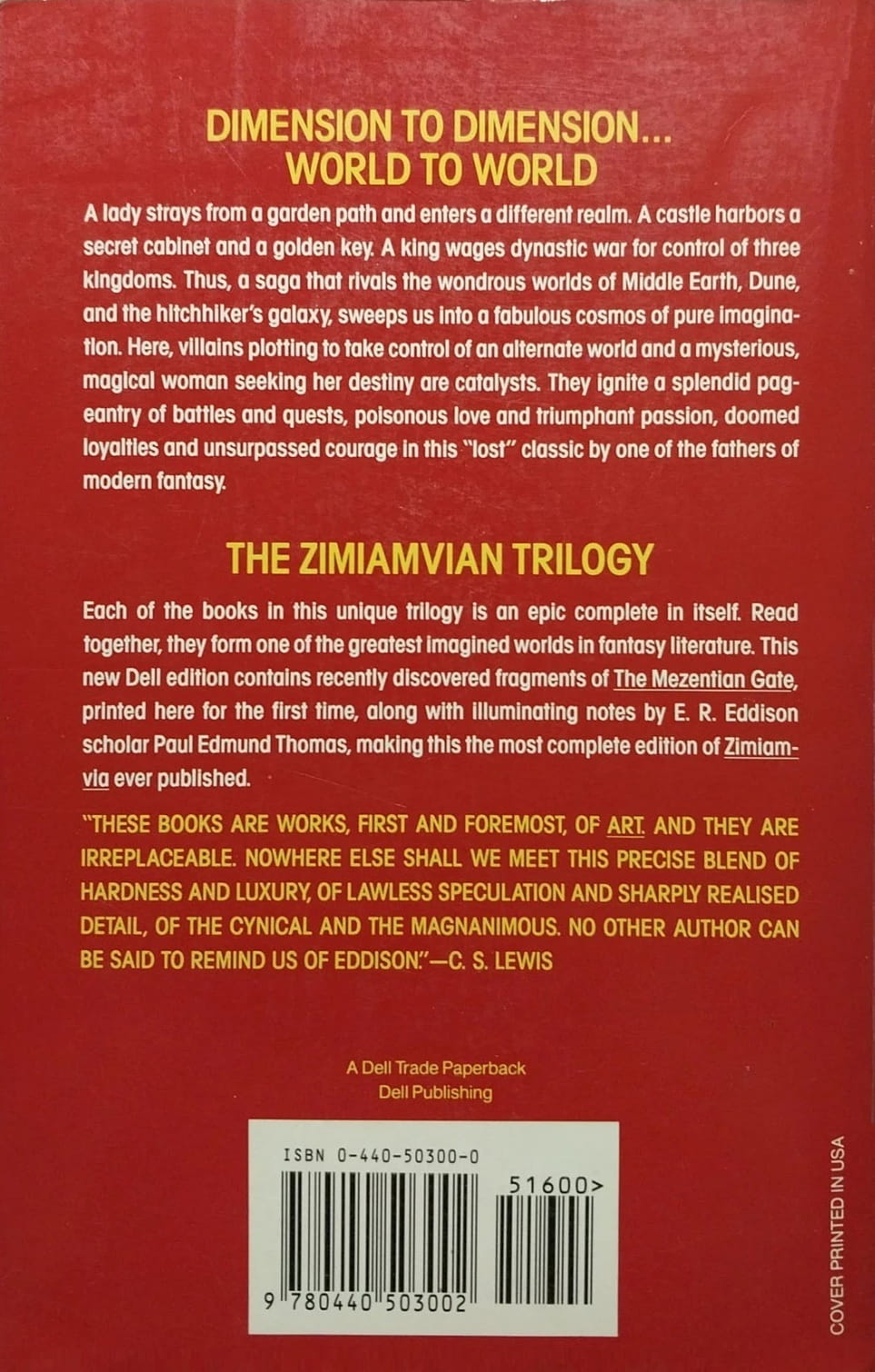 |
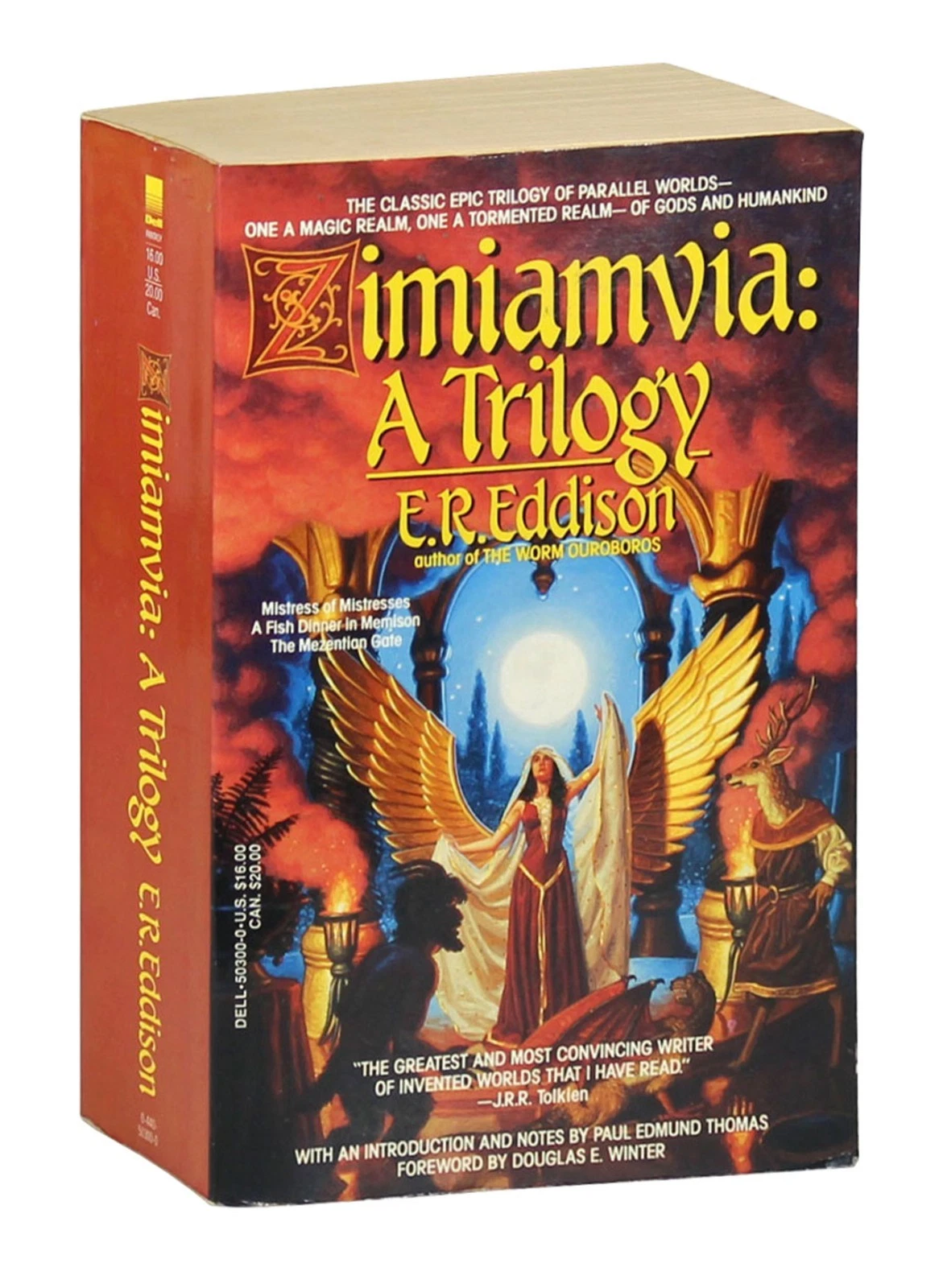
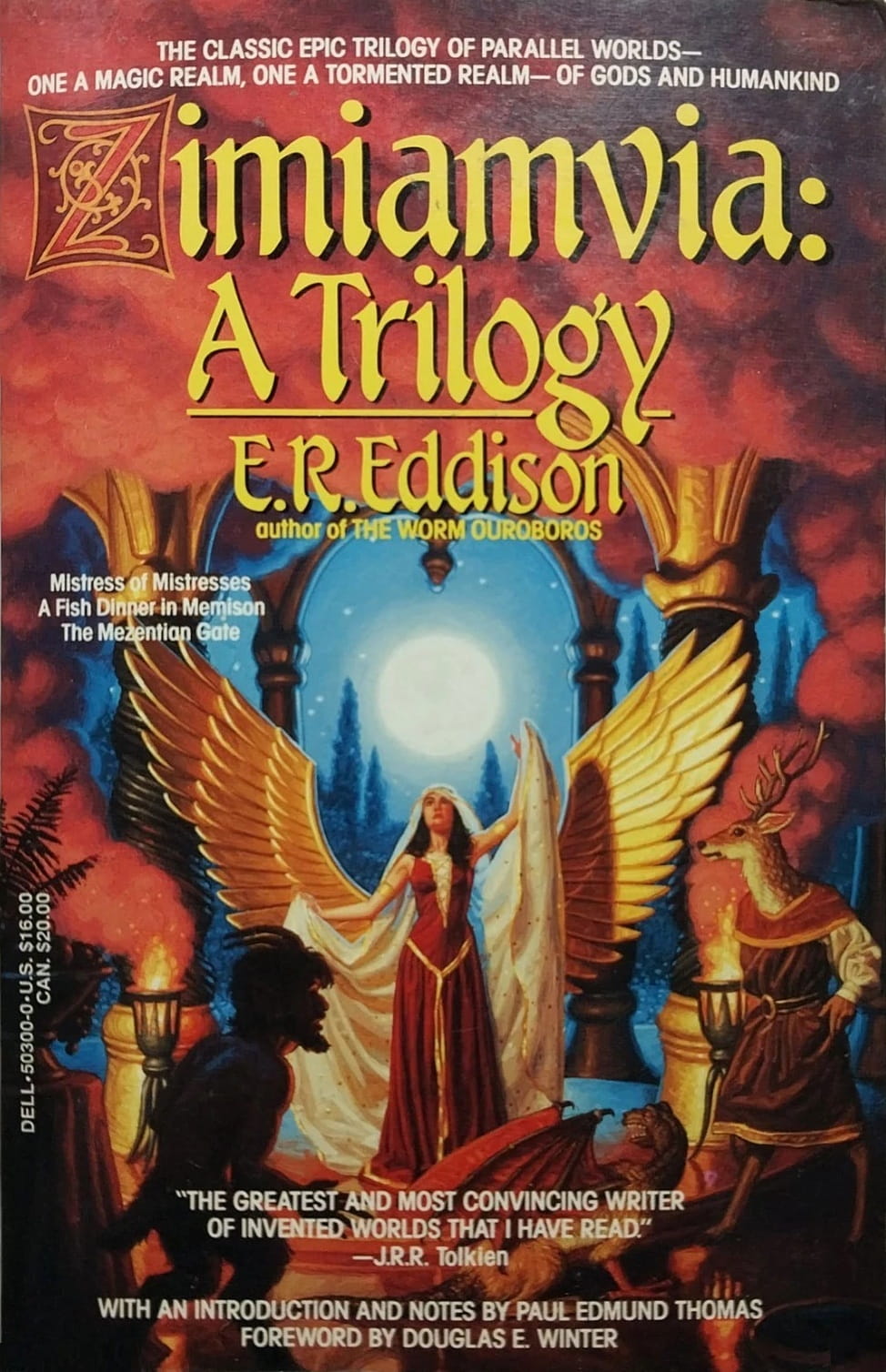
Zimiamvia: A Trilogy (Dell, September 1992). Cover by Keith Henderson
But in the second place, they inspire intrigue, and the sort of courtly manners that provide a vehicle for intrigue. There’s a lot of this in the scenes with the Vicar; but there’s also a higher level of it at Antiope’s court, at which Antiope herself proves an adept player.
And in the third place, this story seems to be about Eddison’s views of statecraft, as embodied in Barganax and the Vicar, but above all in Lessingham — because Zimiamvia is specifically a heaven provided by divine favor for Lessingham, a man gifted in all the arts, in war, and in statecraft, and in Zimiamvia provided with occasion to practice the latter two (Barganax seems to be the heir to his artistry), without which noplace could be heaven for him. This is more nearly a Valhalla than a Christian Heaven or even an Elysian fields.
 |
 |
 |
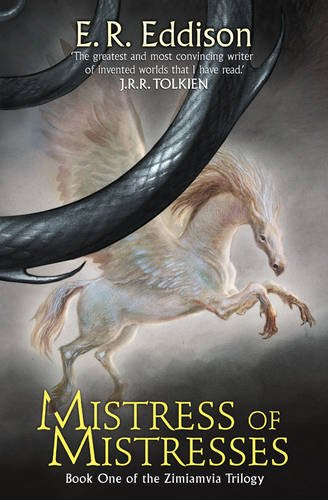 |
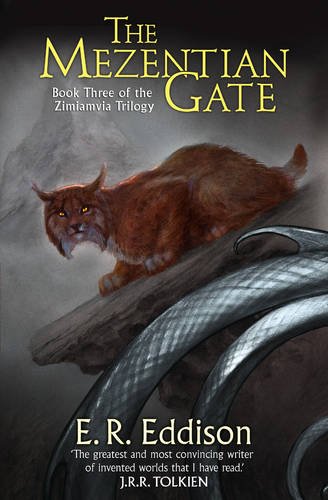
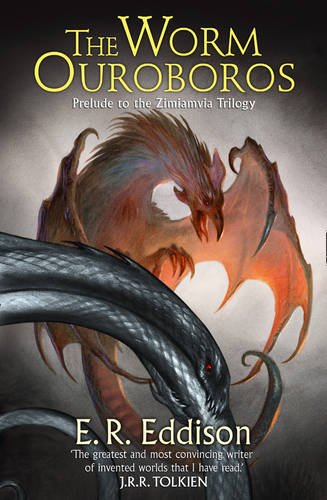
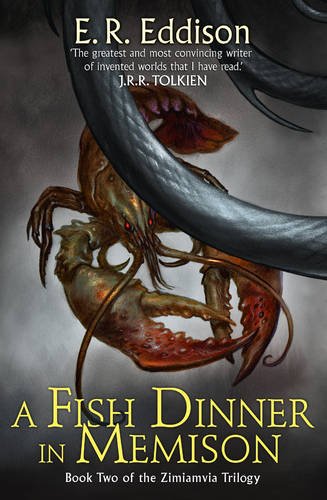
HarperCollins editions, October 9 and December 4, 2014. Covers by John Howe
In Tolkien’s Modern Reading, Holly Ordway quotes Eddison’s statement that Zimiamvia was a heaven of action and therefore had to contain evil and even tragedy — a view that Tolkien rejected, though Tolkien’s own legendarium has all these elements and would have been poorer without them.
The great driving force in all of this is Lessingham’s willing service of the Vicar, and conversely, the Vicar’s continuing acceptance of that service, even when Lessingham binds him to agreements that anger him nearly mortally. Eddison doesn’t spell out why either happens, but provides hint from both men.
So this is a story of passionate love and huge conflicts between characters larger than life; the kind of thing, perhaps, that George R.R. Martin was aiming at. And it has ingenious plot turns and even moments of humor. But it also has one other feature that I came to enjoy, and that I found also in Dorothy Dunnett’s Lymond Chronicles, published in the 1960s: frequent passages in verse in multiple languages, and similarly multilingual dialogue.
Dunnett and Eddison, between them, gave me a peculiar taste for multilinguality as a style. And Eddison adds to this the ability to write in a plausible imitation of Elizabethan English (though scenes in A Fish Dinner in Memison show that he could also do modern prose quite skillfully). The language his characters use seems to make them more convincing as characters, in the fashion Ursula Le Guin wrote about in “From Elfland to Poughkeepsie.”

I suspect that whether a reader can enjoy this approach to language may be the most decisive reason for them to love Eddison or find him intolerable.
Mère des souvenirs, maîtresse des maîtresses,
O toi, tous mes plaisir! O toi, tous mes devoirs!
Tu te rappelleras la beauté des caresses,
La douceur du foyer et le charme des soir,
Mère des souvenirs, maîtresse des maîtresses![Mother of memories, mistress of mistresses!
O you, my pleasures and my duties all!
You will call back the beauty of caresses,
The sweetness of the hearth and the evening’s enchantment,
Mother of memories, mistress of mistresses!]
See our previous discussions of E.R. Eddison and The Zimiamvian Trilogy here at Black Gate:
Vintage Treasures: Zimiamvia: A Trilogy by E.R. Eddison
Discover the Prototype for The Lord of the Rings: The Zimiamvia Trilogy by E. R. Eddison
“It Is Neither Allegory Nor Fable But A Story To Be Read For Its Own Sake”: E.R. Eddison, The Worm Ouroboros, and Zimiamvia, by Matthew David Surridge
William H. Stoddard is a professional copy editor specializing in scholarly and scientific publications. As a secondary career, he has written more than two dozen books for Steve Jackson Games, starting in 2000 with GURPS Steampunk. He lives in Lawrence, Kansas with his wife, their cat (a ginger tabby), and a hundred shelf feet of books, including large amounts of science fiction, fantasy, and graphic novels.
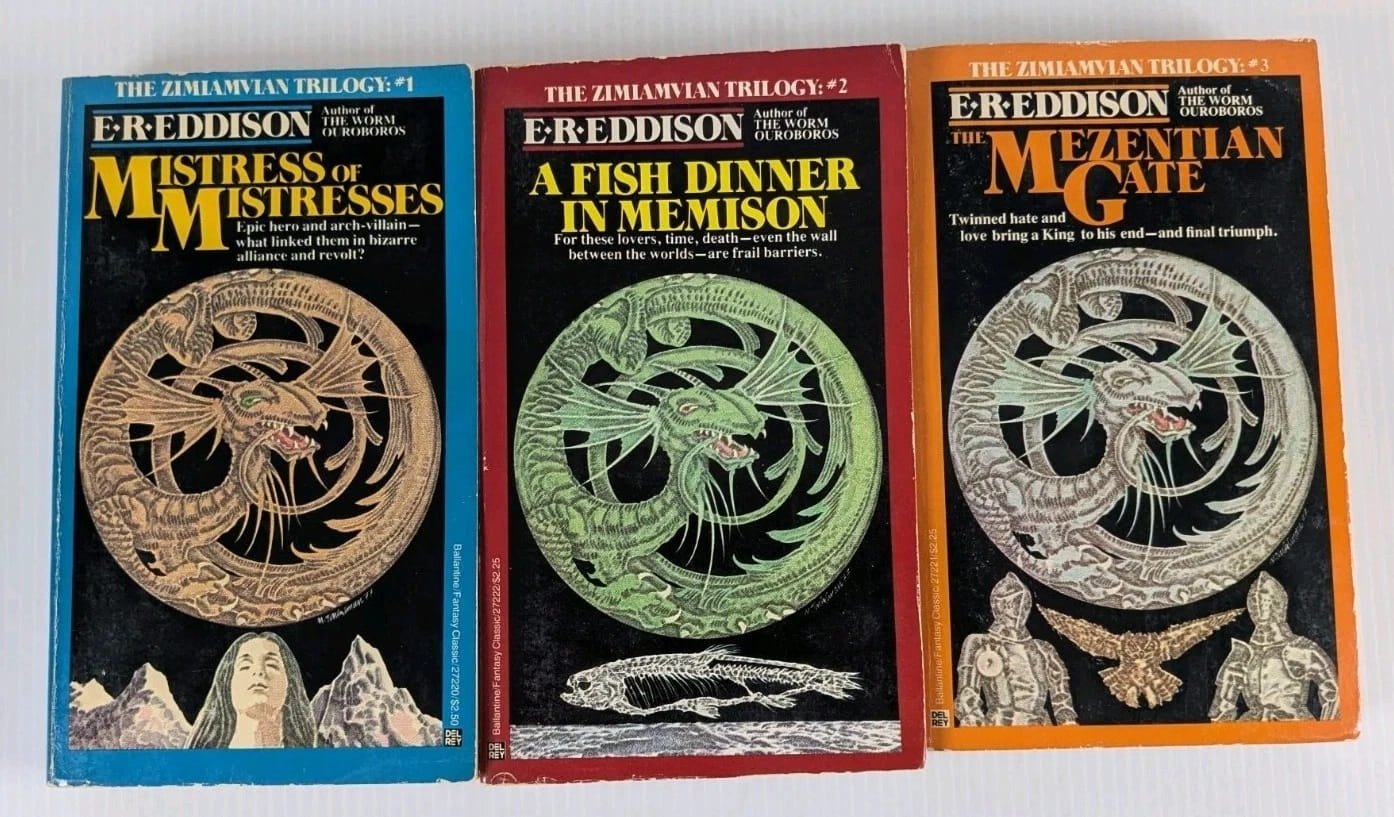
I adore the Worm (heavens, what a statement!) and have the three Zimiamvian books in the gorgeous old Ballantine paperback editions that you picture here but have never taken the plunge. It’s probably because of Lin Carter, who didn’t like them. He said, I believe (memory here), that the Worm was Homeric and the other three books were Machiavellian, and he enjoyed reading Homer more than Machiavelli.
Fair enough, but they’re books that I do intend to get to in retirement, in another year or two. They seem made for leisurely reading.
I too adore the Worm and reread it every couple of years. I tried Mistress of Mistresses and Fish Dinner many years ago but gave up halfway through the second book. I suspect that it was a fault in my younger self that caused me to quit. Eddison is an author who requires and rewards careful reading! I’ll have to give the trilogy another chance.
I think I might like these books MORE than Worm Ouroborous and it’s a tragedy of Shakespearean proportions that Mezentian Gate was left incomplete. (But also thank all the gods and powers that nobody, especially nobody named Lin or Lyman, took it upon themselves to try to posthumously “complete” it.)
The Vicar is one of the great ones; I never knew until now that his title in this instance was not a religious one.
Isn’t he an amazing character? I’m glad to have illuminated that point about his title; I used to wonder about it too. I have to say that I find the first two volumes, and some of the bits that Eddison actually wrote for the third, far more compelling than I do the Worm, though the Worm has some marvelous dry humor.
Yeah, Worm is very “jolly Edwardian adventures” if you start scratching too deeply beneath the surface.
But I LOVE the prose in both Worm and the Zimiamvia books — this is one of the very few cases I can think of where an author is writing in a deliberately archaic style and manages to actually pull it off. (See The Night Land for a counter-example.)
William Morris?
He probably comes closest after Eddison.
To be fair, Susanna Clarke also nails it in Strange & Norrell.
I second that. In fact I’m rather at a loss as to how Morris’s books don’t have more of a following. I find them quietly lovely. Perhaps somebody at Black Gate would consider writing an appreciation?
I think it’s the fact that Morris’s books require patience. (The way he writes, it takes patience to finish a paragraph or even, sometimes, a sentence.) Lin Carter (yes, him again) considered The Well at the World’s End to be the first true fantasy novel in the sense that we use the term today, and I think he was right about that. And the more I think about it, the more I think that it’s the greatest of them all. (C.S. Lewis said a wonderful thing – “No mountains in literature are as far away as distant mountains in Morris.”) He truly deserves to be more read and better remembered.
I love these drawings by 10 year old Eddison:
http://www.ereddison.com/fantasy-novels/origins-worm-ouroboros/
I’ll just say I think the Ballantine covers are by FAR the superior!
The Harper-Collins covers are _weird_ because of the way they put Worm in the upper right corner and then circle clockwise. Which I suppose was to try to replicate the feel of a worm or serpent.
Fine discussion of a tragically underappreciated work. I had a few words to say about it here. https://dmrbooks.com/test-blog/tag/E.R.+Eddison
I would put in a kind word for the Dell omnibus edition as it is annotated by Paul Edmund Thomas with an introduction to the mythos and extensive endnotes.