Into the Weird: Weird Tales, March 1923 (Volume 1, Number 1) Part 1
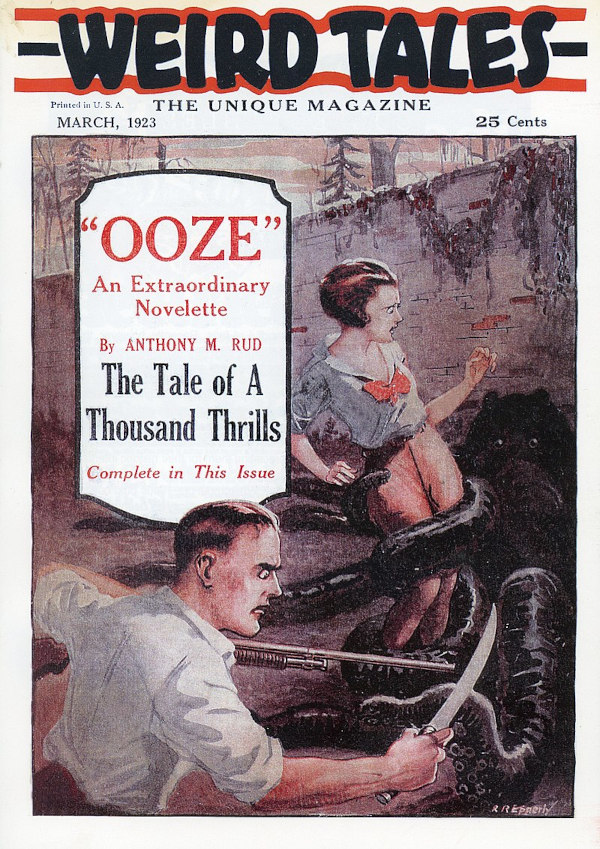
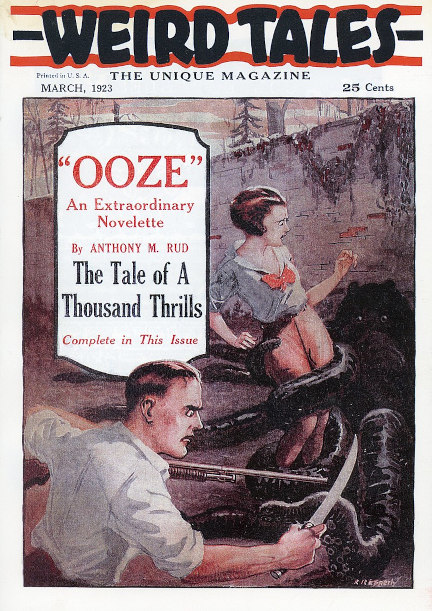
The first issue of Weird Tales landed on newsstands in late February of 1923. 192 pages long, it measured about 6 inches by 9, a standard size for a pulp fiction magazine. There were two different versions of the cover, perhaps due to a printing error; the illustration’s the same, a man with knife and gun fighting a shadowy tentacled monster which has grabbed a nearby young lady, but the colouring’s different. Either way, the cover advertised “‘OOZE’ / An Extraordinary / Novelette / by Anthony M. Rud / The Tale of A / Thousand Thrills.” Perhaps most intriguing, though, was the subhead below the logo: “The Unique Magazine.”
Thanks to modern technology it’s possible for anyone with an internet connection to flip through issue 1 of Weird Tales, if in a virtual format. In a later post I’ll write about the fiction the issue holds, but today I want to consider the magazine as an object (to the extent that’s possible working from a PDF). What do we see as we page through it? What signs of its times stand out? And what can be deduced about the editorial team’s vision?
 |
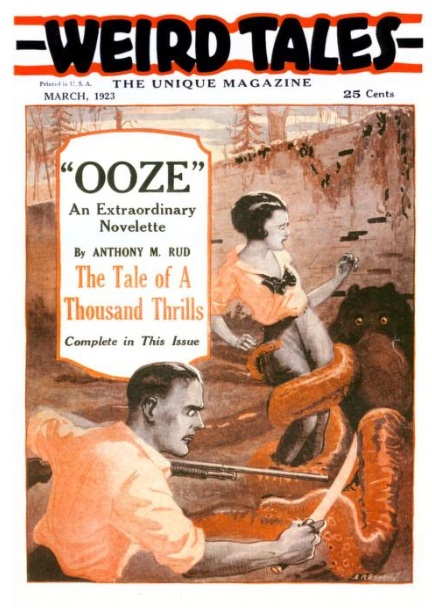 |
Both versions of the first issue. Note the color variation.
I’ll be working here with a copy of the scan on the Internet Archive. I note that file’s lacking whatever might have been on the inside front and back covers. But all 192 internal pages are present, and that’s enough to be getting on with.
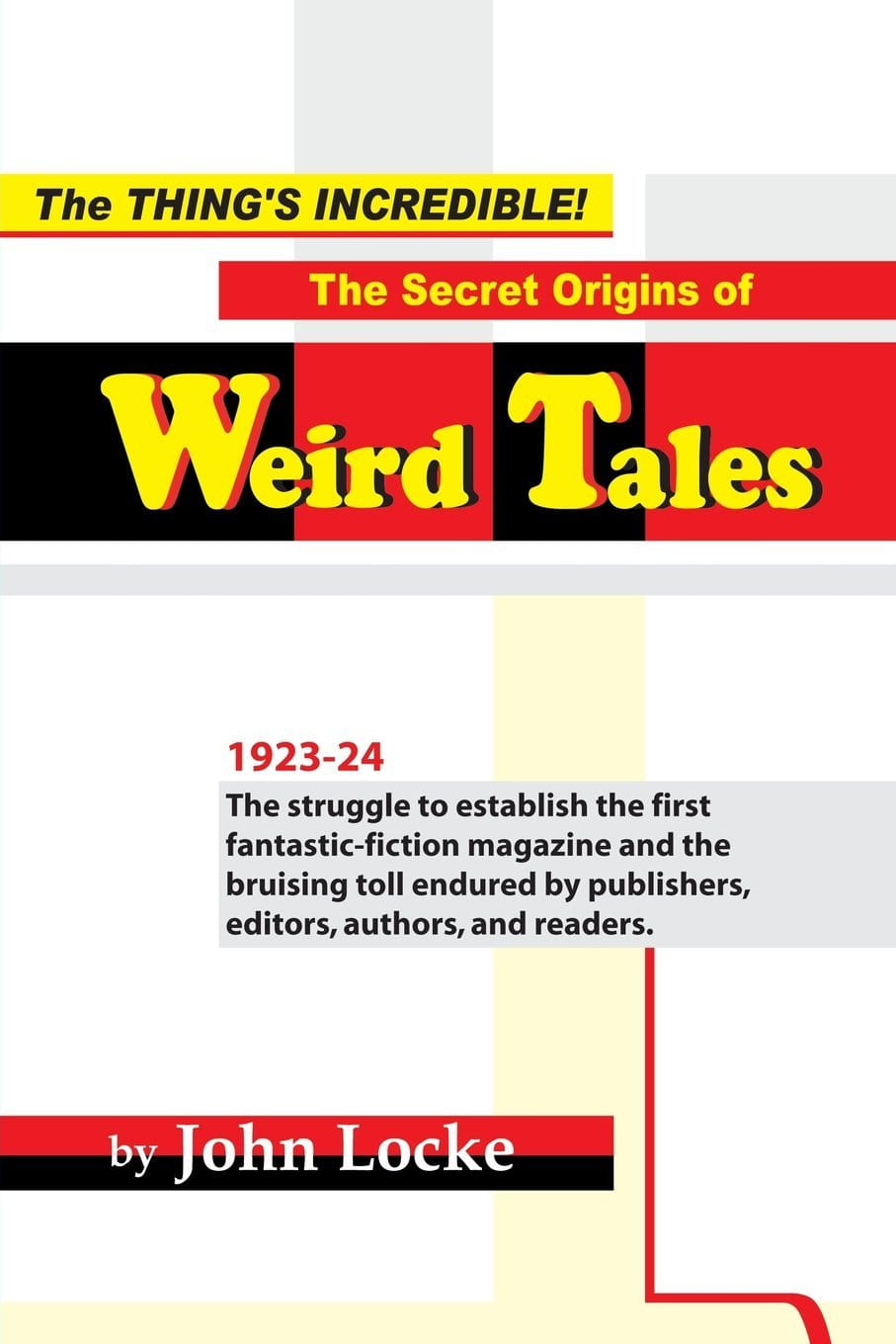
Before looking at the magazine itself, it’s worth briefly discussing how it came to be. (And I note that I’m indebted for much of what follows to John Locke’s excellent and well-researched The Thing’s Incredible! The Secret Origins of Weird Tales.) That means beginning with J.C. Henneberger and J.M. Lansinger. The Pennsylvania-born Jacob Clark Henneberger earned a degree in philosophy in 1913, worked briefly in advertising, enlisted in the Navy during World War I, then after the war took various jobs in newspapers and magazines.
 |
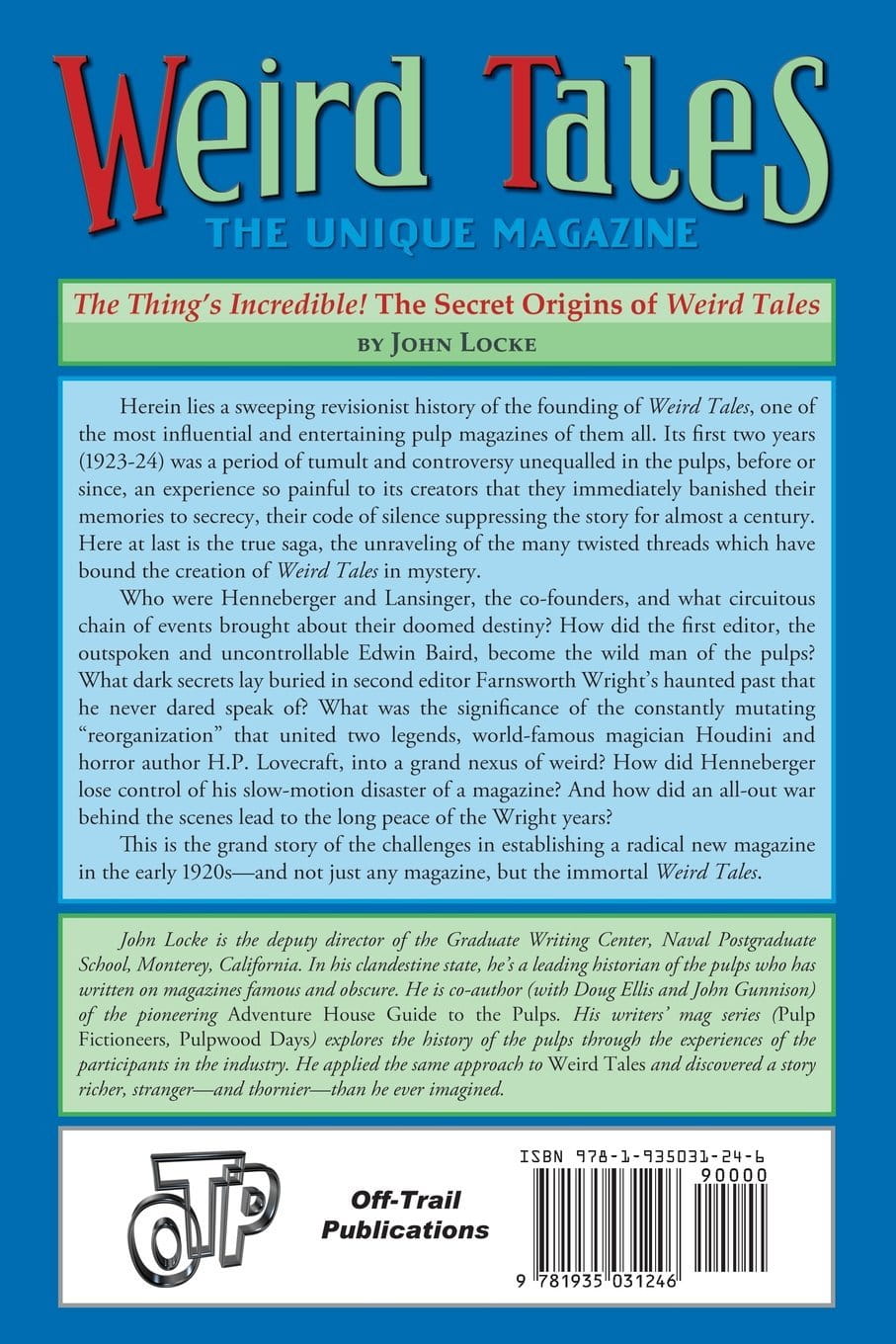 |
The Thing’s Incredible! The Secret Origins of Weird Tales by John Locke
(Off-Trail Publications, June 19, 2018). Click for bigger versions
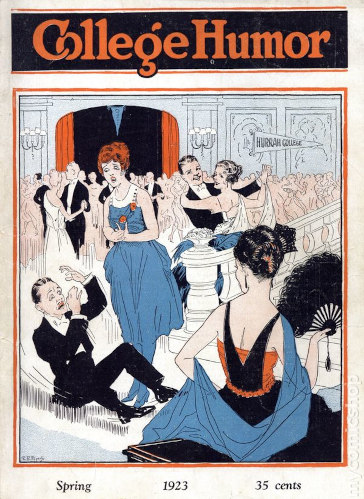
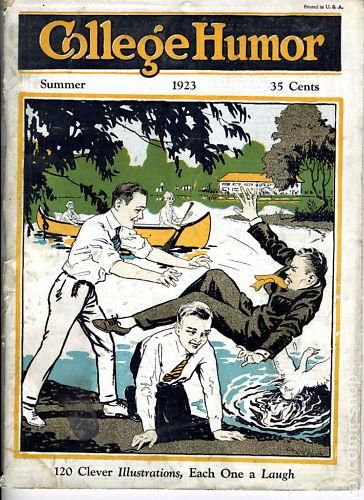
He turned to publishing with the launch in 1920 of a magazine called The Collegiate World, rebranded more successfully as College Humor. In August of 1921 he began The Magazine of Fun, and was soon soliciting short stories in trade magazines as he planned a move into publishing fiction.
Meanwhile, John Marcus Lansinger, a fraternity brother of Henneberger’s, had left college without a degree and worked various jobs including a stint as subscription manager for a women’s magazine. In 1922 he reunited with Henneberger, becoming treasurer of the company Henneberger had established to publish College Humor.
At the time, publishers frequently created new companies for each magazine they published, isolating the business links between magazines; Henneberger included Lansinger in his plan to crack the fiction market, and they created another company, originally Independent Publishers, Incorporated, and then renamed the Rural Publishing Corporation.
 |
 |
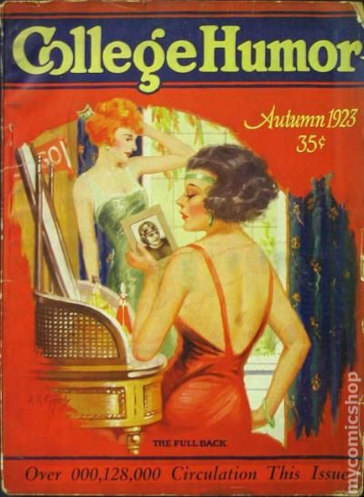 |
College Humor magazine, Spring, Summer and Autumn 1923 (Collegiate World Publishing)
In September the first issue of Rural Publishing’s Detective Tales appeared. The magazine didn’t take off at once, though it’d end up being published in one form or another until 1985. Still, by around November, Henneberger and Lansinger were planning another magazine. This may have been an attempt to split the costs of Detective Tales across another title, or may have always been a part of their plans; perhaps both. In any event, this second magazine was Weird Tales. Henneberger, who loved the work of Edgar Allan Poe, had realised that there was no magazine on the stands specifically dedicated to similar stories — tales beyond conventional reality; tales of the occult, of the fantastic, and of what we would now call science fiction.
For editor, Henneberger and Lansinger turned to the man who was already editing Detective Tales: Edwin Baird. In his late 30s in 1923, a few years older than Henneberger and Lansinger, Baird had published a number of short stories and novels in such venues as The Argosy. His novel of urban melodrama The City of Purple Dreams had been adapted into a movie in 1918, and would be again in 1928. It has been said that Baird was more interested in Detective Tales than Weird Tales, and certainly he would complain in public, indeed even in the pages of the magazine itself, about the quality of submissions he’d have to deal with for Weird Tales. As editor of both magazines, Baird also found himself having to pay writers lower rates than he would have liked, and having to pay on publication (and sometimes well after) rather than on acceptance.
 |
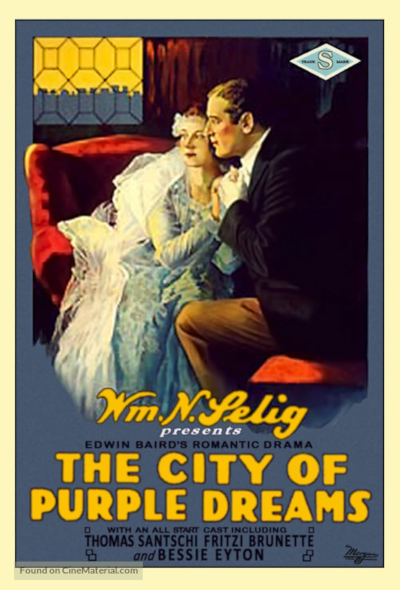 |
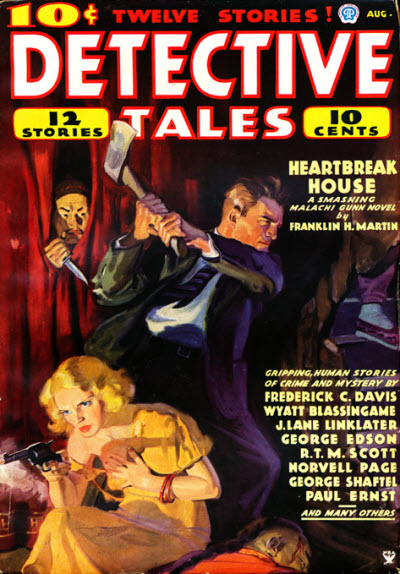
Left: Detective Tales magazine, August 1935. Right: poster for
The City of Purple Dreams (Selig Polyscope Company, 1918)
In the first issue of Detective Tales Baird wrote: “No fancy covers for Detective Tales. No coated paper, or pretty pictures, or decorative names in its Table of Contents. No shallow ornamentation. But the very best detective fiction.” This was what you’d call making a virtue of necessity. There weren’t particularly deep pockets behind Dectective Tales, and they hadn’t gotten any deeper when Henneberger and Lansinger started Weird Tales. Two relatively young men with some experience in publishing but no breakout hit behind them were launching a new venture. There weren’t resources for things like elaborate cover art, a large editorial staff, or competitive rates for writers.
Without for the moment considering the actual fiction, what does the resulting magazine look like? To start with, the cover format of Weird Tales volume 1, number 1 echoes the look of that month’s issue of Detective Tales — the same artist, but also the same colour scheme, same logo style (the word ‘Tales’ in a similar but slightly different font), same design and layout, and the similar visual idea of a badge cutting into the art to promote the cover story. Later issues of the two magazines would not share this sort of harmonised approach. The logo that appears over this issue won’t be reused, either.
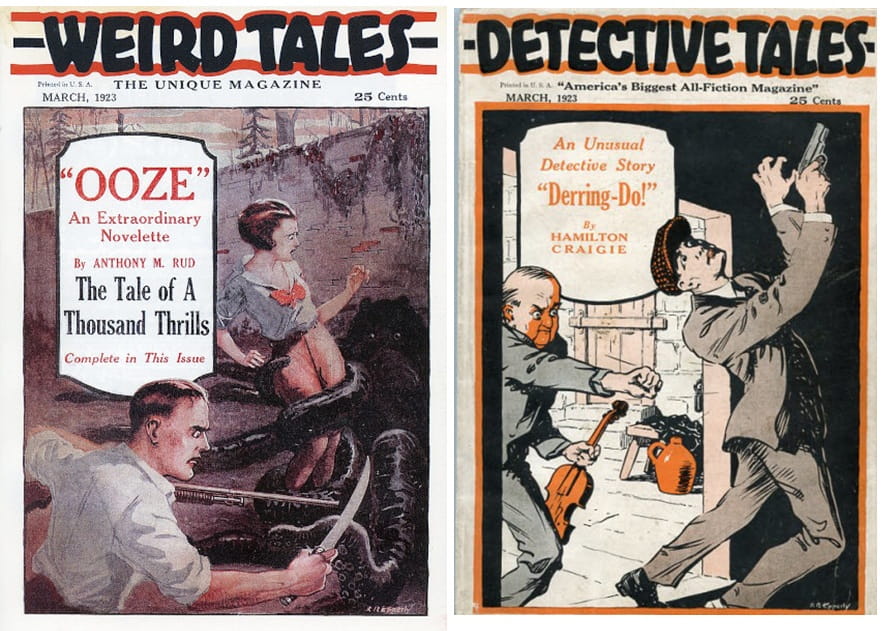
The price is 25 cents (inside one will find subscriptions are not discounted but run a full $3 for a year of issues). That’s more than many of the other story pulps — at the time, Adventure is a quarter, but Argosy All-Story Weekly is just a dime for a comparable amount of fiction, and Blue Book is 20 cents — and the equivalent of something close to $5 in 2026. Given that, it’s notable that only one story gets billed on the cover; then as now readers were drawn to their favourite writers, so promoting just a single tale would seem to limit the magazine’s appeal. Perhaps Henneberger believed that Weird Tales would sell based on the kind of story it contained; that he’d identified an audience no other magazine was serving.
At any rate, the image that dominates the cover comes from Richard Ruh Epperly, at that time a commercial artist in the Chicago area. He’d go on to have quite a career not only in commercial art but also as a portraitist, at one point painting Pope John XXIII. That was far in the future when he drew this image of an amoeboid creature, a woman in danger, and a man struggling with rifle and blade against a shadowy monster.
It’s not as eye-catching an image as you might find on the covers of major magazines like Argosy or Adventure, but it serves its purpose. The damsel is perhaps less overtly distressed than she is appalled, but the composition’s dramatic even if the draftsmanship’s unspectacular. The version of the cover with less orange gives us a shadowy creature against a shadowy background, black tentacles coiling about, and a determined rifleman who admittedly appears to be looking in slightly the wrong direction. Crucially, it conveys the idea of adventure and danger; the darker version in particular even evokes an atmosphere — a sense of the unknown and the fearsome.
(The back cover’s an ad from T.G. Cooke of “The University of Applied Science” for a book of “Actual Reports of Secret Service Operator 38,” which you could use to “Be a Finger Print Expert” and “Make $5,000 to $10,000 Dollars a Year.” The ad promises a book of true-crime stories, so you can “see what possibilities this most fascinating and eventful of all professions offers to you.” Since “to command the highest fees, the Secret Service man must also be a Finger Print Expert,” you get a second book free, with 12 “real crimes solved by Finger Print evidence.” Luckily, “this profession may be easily learned at home, in your spare time. … Wonderful opportunity in this UNCROWDED, PROFITABLE field.”)
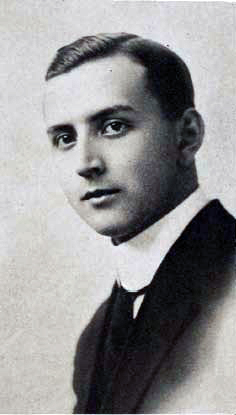
J.C. Henneberger
Let’s look now at the interior of the magazine. The layout’s simple and clean. The first interior page is a mostly text-based ad — “Get Ready For A Big Pay Job / Electrical Expert” (“You Can Be A Big Money Maker”) followed by a two-page table of contents boasting “twenty-two remarkable short stories,” “three unusual novelettes,” “a strange novel in two parts,” and an editorial section titled “The Eyrie.” “Also,” says a final note, “a number of odd facts and queer fancies, crowded in for good measure.” These last will take the form of mostly one-paragraph pieces following some of the stories toward the back of the magazine, filling up the space left on a page after the text of a story ends. Colophons and blurbs promoting future issues and stories perform the same function.
After the table of contents comes a one-page ad for Weird Tales in the form of a kind of manifesto; I’ll return to this later. That’s followed by two text-dominated full-page ads, and then the fiction begins. There’s no interior art in this issue, but each story has a different style for its title, sometimes using all-caps, or italics, or occasionally double-underlining, though the typeface remains the same.
The format’s relatively standard for story pulps, other perhaps than the lack of interior art. Two columns of text per page, with stories often subdivided into sections marked out by italicised Roman numerals followed by drop caps. Story titles are in headers on the left-hand pages, writers’ names on the right-hand pages. Every so often there’s an inset text box promoting the magazine — in the cover story, Anthony M. Rud’s “Ooze,” for example, there’s a box telling readers that “ANTHONY M. RUD / Master of Goose Flesh Fiction / Contributes An Astounding / Story in / WEIRD TALES / FOR APRIL / “The Square of Canvas” / A Tale of Shuddering Horror.” The term “goose flesh story” is one Baird seems to have liked as a descriptor; again, I’ll come back to that.
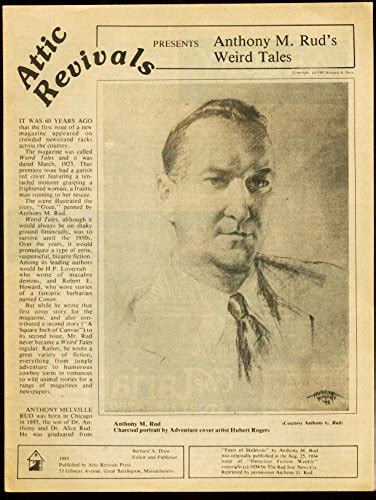
Anthony M. Rud
The editorial at the end of the issue is two pages of single-columned text, after which there are 11 pages of ads and the concluding page or paragraphs of stories from earlier in the issue. Ads don’t interrupt the fiction otherwise. Again, this follows the format of other magazines.
Let’s take a look at these ads, bearing in mind they may provide a hint about who the magazine saw as its audience as well as giving us a window into the world of 1923. To start with, there are four ads for Detective Tales, one of them a full page. Bearing the back cover ad in mind, it’s interesting that the full-page interior ad (for “America’s Greatest Magazine of Detective Fiction,” with “not a dull line in the entire magazine”) specifically mentions “articles by experienced detectives and Secret Service agents” and “fingerprint advice.” It’s probable some of the advertisers in this issue originally contracted for Detective Tales, or were given a cut rate for an ad in Weird Tales.
There are other promises of jobs, including a guarantee of a position from “The U.S. School of Finger Prints.” Apparently fingerprints were big business in 1923. There are also ads for learning how to build and repair radios, and an ad seeking railway mail clerks — clerks to sort mail aboard special train cars, railway post offices. That ad specifically looks for “Men — Boys 17 or over,” but if there’s a gendered aspect to the ads promising work, there’s also a full-page ad for a dress from the Martha Adams Company, with extensive burbling copy putatively from Martha Adams herself: “For just one dollar with your request, I’ll send you this dress, postage prepaid, in your proper size, to examine as carefully as you please, to try on to your heart’s content. The dollar that you send me brings the dress delivered to your house without one further penny’s outlay, without the bother of any C. O. D., without even a thought of money until you decide you want it and to keep it.” There was in fact no Martha Adams; the Martha Adams Company was a subsidiary of the direct market retailer Spiegel, May, Stern, and Company, and Martha was a fiction. But the ad’s clearly aimed at women and girls, and is both large and relatively prominent — the first ad after the editorial.

Margaret Sanger
There is also a full-page ad in the opening pages of the magazine, just after the table of contents, for a book by Margaret Sanger — described in the ad as “the great birth control advocate,” Sanger is perhaps best known today as the founder of Planned Parenthood. An activist who aimed to promote knowledge of contraception and reproductive health, she created the term ‘birth control.’ In an era when knowledge of sexuality was far less widespread than it is today, Sanger wrote openly about contraception in numerous books and magazines, and advertised those writings in pulps including, as it turns out, Weird Tales.
There are ads for what appear to be less reputable medical products. One is the “plapao-pad,” which aims to replace trusses for hernias. On the other hand, you could also send off for a 60-day trial of the Sanden Hercules Belt, also the Sanden Electric Belt, “if you suffer from Debility, Nervousness, Insomnia, Lack of Vigor, Rheumatism, Lumbago, Lame Back, Poor Circulation, Dyspepsia, kidney, liver, bladder weakness, or any trouble due to low vitality.”
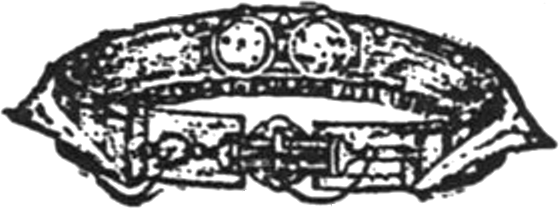
The Sanden Electric Belt (Images from here to the end of the article from the Project Gutenberg edition of Weird Tales 1)
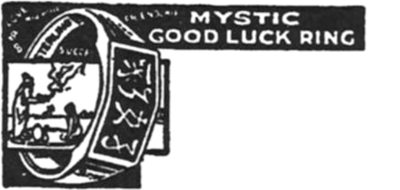
There are ads for cheap jewelry. You can pay between $2.84 and $4.27 (about $50-$85 in 2026 money) for rings for men or women featuring “corodite diamonds,” apparently some kind of fake gemstone. Or you could order rings with “Arabian diamonds” — “The most wonderful and latest discovery of science. The greatest flashing gem ever made. Has same dashing beauty as the finest genuine diamonds. They stood acid and fire tests—fool everybody. Only trusted diamond men with testing lens can tell the difference.” Or you could choose between two different “Egyptian” luck rings, one of which claims to “bring power and success to men—charm, admiration, and love to women,” and states also that “Cleopatra is said to have worn one of these rings to protect her from misfortune.” Which I am not sure is quite the testimonial the advertiser thinks. At any rate, there are also two ads for watches, one of which gives you the “choice of gold, silver, radium or fancy engraved dial” for $3.30 ($65 in 2026 money).
And then there are also two ads for guns. $9.80 (about $195 today) will get you a 20-shot automatic pistol with no money down. Or you can send a dollar and get a “Western Special” firing .32 or .38 caliber bullets: “A real man’s gun.” You’ll have to pay another $10.95 C.O.D. plus postage, so a total of $11.95 (about $240).
You could get a free course on public speaking by mail, offered “strictly for advertising purposes.” Or, perhaps more appropriate for Weird Tales, you could send away for an astrological reading. Maybe the most practical ad, and one of the simplest, is for typewriters. Finally, the last interior page of the magazine is another full-page ad, for Arthur Murray’s dance course by mail. Murray was 28 at this time; this would have been relatively early in his career promoting his dance classes, but he’s already using the diagrams of footprints that would become his calling-card.
What do these ads imply about the magazine’s expected readership? There are ads aimed at both men and women, and perhaps more aimed at younger people (or at least at men looking for careers) than older — though the medical devices might on balance appeal more to older readers. The gun ads perhaps imply an adventure-oriented magazine (and readership), but the typewriter ad suggests a potential readership of would-be writers. The ad for horoscopes aside, and possibly the lucky rings, there doesn’t seem to be anything too esoteric. There’s no sign I can see of advertisers aiming at a Weird Tales audience with distinctive interests. That would have to emerge over time.
Let us therefore turn to editor Edwin Baird’s two text pieces in the issue, and see what he suggests about the aim of the magazine. Surprisingly, the ad following the table of contents is more concrete than his editorial. That ad opens with a large-print phrase beside one paragraph of text: “‘Goose-flesh’ Stories.” A second paragraph is accompanied by another phrase: “The Unique MAGAZINE.”
Colophon from Weird Tales 1
Baird claims in the first paragraph that editors of other magazines shun horror or “goose-flesh” stories, but Weird Tales believes there are “tens of thousands — perhaps hundreds of thousands — of intelligent readers” who enjoy horror. The magazine, he goes on to say, will offer “fantastic stories, extraordinary stories, grotesque stories, stories of strange and bizarre adventure — the sort of stories, in brief, that will startle and amaze you.” Some of the stories “are creepy, some deal in masterly fashion with ‘forbidden’ subjects, like insanity, some are concerned with the supernatural and others with material things of horror—all are out of the ordinary, surprisingly new and unusual. A sensational departure from the beaten track—that is the reason for Weird Tales.”
This sounds about right as a description of the fiction in the first issue. It’s not a bad summation of the weird tale overall: something horrific, but unusual, maybe with some element of adventure. If there’s anything out of place it is Baird’s reference to “the material things of horror,” implying non-supernatural horror stories. It is interesting, too, that he refers to insanity as a “forbidden” subject. Perhaps Baird’s correctly assessed that a sense of transgression heightens the appeal of horror.
The editorial, on the other hand, spends a lot of time insisting on the novelty of the magazine — “a sensational variation from the established rules that are supposed to govern magazine publishing” — but doesn’t really specify in what way it is novel, or what kind of stories the magazine will publish. Only, Baird promises, the stories will be “unusual, uncanny, unparalleled.” Baird does insist they “will not offend one’s moral sense,” but will provide “exhilarating diversion.” This makes for an interesting contrast with part of the submission guidelines for Adventure magazine at this time (the link goes to the issue dated September 30, 1923, but the same text is in the issue for late November 1922): “We want only clean stories. Sex, morbid, ‘problem,’ psychological and supernatural stories barred.” That’s an explicit example of one of the big pulps refusing to publish fantasy — though in fact Adventure did occasionally publish what they called “Off-the-Trail” stories, which might have fantasy or science-fictional elements — and lumping it in with horror and sexuality. Baird may have wanted to evoke the transgressive, but perhaps he had good reason to specify the moral tone of a magazine dedicated to horror.

He goes on to quote from a letter by Anthony Rud, writer of “Ooze,” which praises the idea of the magazine and claims “stories of horror, of magic, of hypernatural experience” are popular with most readers. Rud cites The Grim Thirteen, a 1917 anthology edited by Frederick Stuart Greene, as an example of a quality horror bestseller; looking at the table of contents of the book, I will have to take his word for it, as the authors’ names are all unfamiliar to me.
Rud also emphasises that there’s no necessary moral degeneracy involved in horror, and describes being frightened by Poe’s work but finding himself always eventually coming back to it. Again, whether the editorial’s apparent concern with moral issues is real or an attempt to create a mystique of danger surrounding the magazine is now likely unknowable. At any rate, Rud’s letter mainly promotes the story Rud will have in issue two, “A Blank Square of Canvas.” Per Baird, “It’s all that Mr. Rud says it is, and more besides! It’s a terrifying, hair-raising tale, and no mistake! It’s a bear! You can read it in twenty minutes, but those twenty minutes will fairly bristle!” Baird goes on to promote the opening story of issue one, urges readers to write in to the magazine, and closes by again insisting on the strangeness of upcoming stories, concluding with the promise: “You will not be bored!”
Time may have lent the self-promotion charm, but there’s an odd sense that Baird’s talking around what he really wants to say. He writes at length about the novelty of Weird Tales, but avoids specifics. And the idea of newness is a little at odds with Rud’s mention of Poe, who died 74 years prior. It’s tempting to think that Baird doesn’t really know what he’s going to do with the magazine, and isn’t sure where it’s going to go.
But then, it is also fair to say that he didn’t have much of an accepted vocabulary of terms to use. What we call ‘genres’ in the sense of types of stories — westerns, mysteries, science fiction — are still developing their conventions. Some of them, including science fiction, have not yet been named. Vague words like “different” are sometimes used to refer to what we now call ‘fantastika,’ stories of fantasy, science fiction, and horror. It’s difficult to specify what genre of fiction you’re talking about when genres have not yet been defined.
This may have been a good thing for Baird. Because he didn’t have much of a taxonomy of accepted terms to use in articulating what kind of stories would go into Weird Tales, he had to emphasise their tone. Rather than say that he would publish things fitting into a certain kind of genre using certain sets of conventions, he could promise things that were unusual, that were transgressive, that were, in a word, weird.
Still, the prose in this first issue of Weird Tales doesn’t much resemble what the magazine would become known for. I’ll look at the fiction next week; for the moment I want to end with a consideration of six non-fiction pieces in the issue, the short news items that follow some of the stories in the second half of the magazine. Presumably the editorial staff considered them weird; what they thought would fit in with the magazine they envisioned. These six pieces, five of them one paragraph long, have no byline. As far as I can tell, Baird had no assistants at this time — Otis Adelbert Kline and Farnsworth Wright would join his staff later in the year, but don’t seem to have been part of the magazine for the first issue. So it’s a reasonable assumption Baird wrote them up himself.

The first two pieces follow the same story, W.H. Holmes’ “The Weaving Shadows,” and are both to do with Africa. The first is a brief exoticising description of the El Molo people, stating they’re a recently “found” tribe and claiming that “they cannot live for more than an hour without water.” The next paragraph claims that African peoples generally (“the wild tribes of Africa”) consider fat beautiful, that families deliberately fatten their daughters, and that the bride price of these daughters depends upon the fatness of the bride-to-be. One may analyse the racism of these pieces at some length; here I will note only the assessment of what is to be considered ‘weird’ — ways of life that are different from those of mainstream North America.
The next two pieces also appear together. One tells of a woman who died of elephantiasis, weighing 710 pounds and requiring ten pallbearers. The next is about a cat hoarder whose neighbours found her one day “starving, surrounded by a great swarm of cats and more than 200 empty milk bottles.” The description of this woman, Mary Bosanti, verges on the supernatural: “Twenty or more cats always tagged at her heels, and when she spoke to them in a lowered tone they seemed to know what she said. They obeyed her every command.” But the main thrust of these pieces is to cast as ‘weird’ what are essentially rare pathologies. Again: what is uncommon is ‘weird.’

Skipping over the next-to-last piece for the moment, the final paragraph describes a rampage by a man in the Philippines allegedly triggered by his niece “spurning” him. He attacked several people, wounding and mutilating them, before trying to kill himself; the paragraph claims that the locals say he was possessed. As with the cat lady, mental illness of a kind that has become more generally known in recent decades is here given a supernatural colouring. At a time when people in general were on average less exposed to news and true-crime stories, it was possible for the magazine to present the attack as ‘weird.’
Reading these pieces, especially the paragraphs about African peoples, is almost like reading some medieval travel manuscript. You’re intensely conscious of a writer confidently describing things they may not know as much about as they think. In the case of some of these paragraphs, you also notice the temptation to hint at the occult or supernatural in things which deviate from expected social norms or everyday North American life. This is a way in which weirdness can be limiting: a fencing off of new concepts, an insistence on the irrationality or the bizarreness of what is merely novel. At worst, it is a mindset in which the mainstream, the probable, or the majority become unmarked while the individual, marginalised, or idiosyncratic become utterly alien; become weird, in the sense of ‘thing to be shunned as threatening,’ rather than ‘thing to be investigated because it is fascinating.’
Good weird writing avoids that pitfall. I think the next-to-last nonfiction piece is an example. It’s a four-paragraph piece describing the breaching of the seal of the tomb of King Tutankhamun on November 26, 1922 (two of the four paragraphs quote from an account one of the explorers, Lord Carnarvon, wrote for the London Times, but the piece claims that the passage comes from something Carnarvon “wrote to a Chicago newspaper correspondent”). It’s effective because it doesn’t try to elaborate on the facts, and doesn’t need to. It’s literally about the discovery of a mysterious tomb filled with magnificent treasures. That’s quite evocative enough. It can’t help but spur the imagination. And indeed the discovery of Tutankhamun’s tomb was a spectacular event in popular culture, inspiring songs and stories.
This, I think, is the good weird. It brings home the antiquity of the world, and the secrets within it. It creates a little bit of what the Science Fiction Encyclopedia usefully describes as a time abyss: a dizzying sense of the vastness between the present moment and eras past, and as well the possibility of catching a glimpse of something across that immensity. It suggests the everyday world is not the only one that might be. It destabilises the normal.
The first issue of Weird Tales looks like it’s trying to find its way. That’s not surprising for a publication striving to be “the unique magazine.” It’s working out the specific tone it wants. If there’s little obvious uniqueness in the appearance of the magazine and the physical package the editors have put together, you can see some in the editorial text. But of course this is not the most important part of the magazine. In two weeks I’ll consider the fiction, the 26 stories that make up the issue. The sense of a publication trying to find its way is apparent there, too.
Find all my posts about Weird Tales here!
Matthew David Surridge is the author of “The Word of Azrael,” from Black Gate 14. You can buy collections of his essays on fantasy novels here and here. His Patreon, hosting a short fiction project based around the lore within a Victorian Book of Days, is here. You can find him on Facebook, or follow his Bluesky account, @bookofdays.
Sanger was an enthusiastic eugenics promoter and racist, fitting into that strain of popular sentiment that marked Weird Tales’s most illustrious regular contributor.
She was definitely a eugenicist, but from what I’ve read, there’s considerable debate about whether she was especially racist — her eugenics tended to be more focussed on ‘improving’ humanity in general. Which is ugly enough. I’ll have a bit more of a detailed look at this in one of the upcoming pieces about attitudes in 1923.
brilliant work.
Thank you very much!
I don’t know… I kind of like Epperly’s damsel. She makes me think he knew women who spent time in the garden, the ones who knew the way to deal with a slimy predator is to grab the Morton’s salt canister. Much more compelling character than the screamers who became de rigueur, so perhaps he was ahead of his time.
Good analysis of the different types of “weird.” It’ll be neat to see how that limits or directs the magazine’s contents through its early development. Looking forward to your next article.
I take your point; there is an appealing kind of self-possession to her.
Thanks for the feedback!
Great article! Frankly, I’m just surprised nobody thought of doing this before now, as it would be of particular interest to Black Gate readers (especially given the easy access to PDF versions of the magazine) – and yeah the damsel in distress looks more appalled than terrified. I’m guessing the printers mixed up the colour separation? Apparently CYMK was a thing even back then.
Thank you, Aonghus! It’s good to be back here.
Don’t rely too heavily on John Locke’s book. He’s a good researcher, but he tends to mix some odd speculation in rather heavily, and he presents this stuff like its secret history when most of it has been public knowledge to researchers and WT fans for decades.
I definitely detected a certain breathlessness in his writing. But the research I thought really made the book valuable, if, as you say, something to read with a critical eye. At least, for myself I found a goodly amount of information I couldn’t track down on the internet.
I’m looking forward to the whole series — excellent stuff so far!
Surely the less-orange cover is the correct one! I honestly don’t think I’d ever seen the first issue’s cover design, which seems odd of me.
Thank you, Rich! I think you’re right about the less-orange one. There’s an idea I came across, and I can’t remember now where, that there might have been a printer’s error that wasn’t caught until after a good chunk of magazines had been printed, resulting in a bunch being too orange. Rather than eat the cost of the faulty issues, the publishers decided it was good enough to put on the market.