Neverwhens: Existential Horror and Medieval Mystery Play meet in Between Two Fires
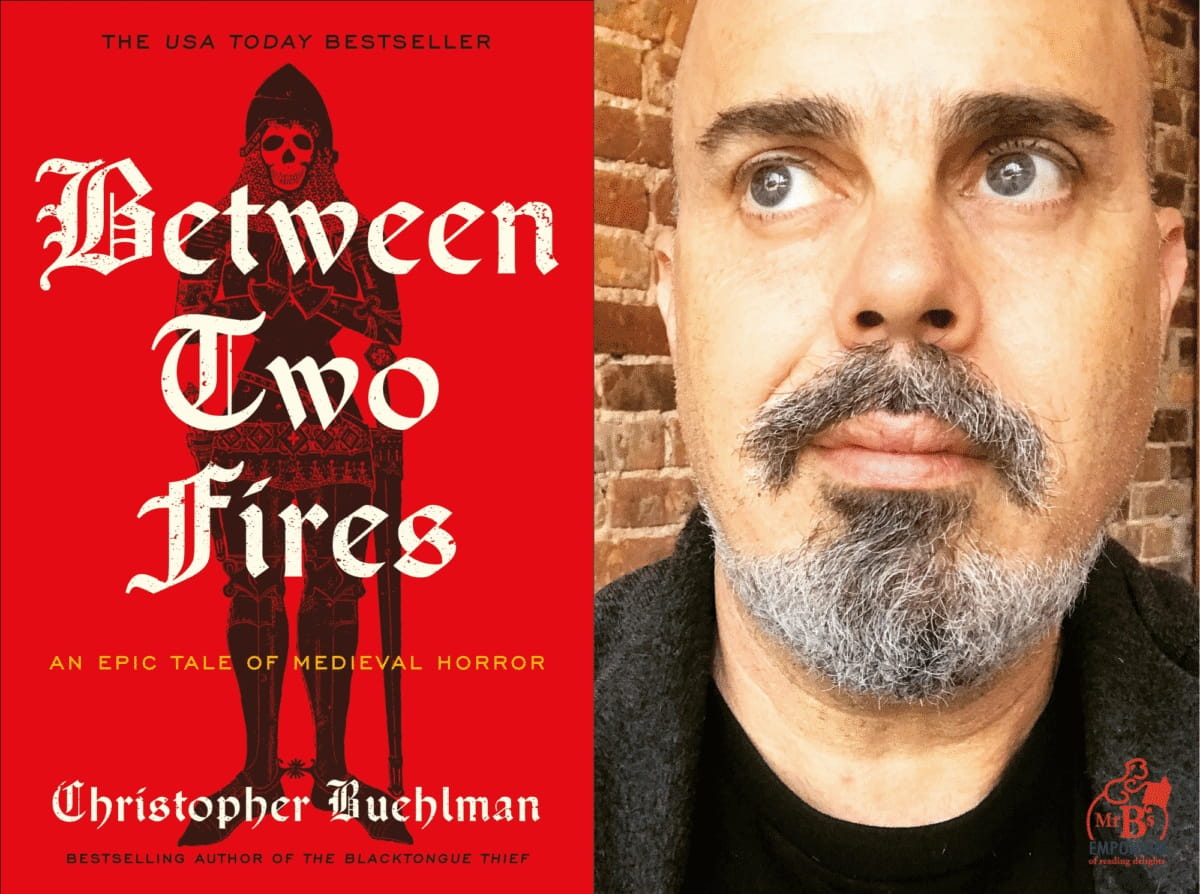
Last week, I had the dumb good luck to be sitting to dinner with Christopher Buehlman just after the news came out that Nightfire’s new edition of Between Two Fires had hit #4 on the Bestseller list.
I want the record to show I was on the BTF train long before that.
Indeed, Buehlman, who’s garnered a lot of (deserved) attention for his recent fantasy novels The Black Tongue Thief and The Daughter’s War, had a previous career writing horror, including some of the most creative horror novels (IMO) of the 21st century I have had the privilege to read, and definitely one of the best vampire novels of all time (The Lesser Dead).
But any student of the fantasy genre knows that horror and fantasy, especially the sort of “street level” fantasy found in Sword & Sorcery or Grimdark, shares a large dose of its literary DNA with horror. And so, over a dozen years ago, Christopher Buehlman penned his first fantasy novel under the guise of horror (or is it horror under the guise of fantasy?): Between Two Towers. The premise was brilliant: what if what medieval people believed was simply… true… and the Black Death was a supernatural event, devils running amok on Earth.
The year is 1348. Thomas, a disgraced knight, has found a young girl alone in a dead Norman village. An orphan of the Black Death, and an almost unnerving picture of innocence, she tells Thomas that plague is only part of a larger cataclysm — that the fallen angels under Lucifer are rising in a second war on heaven, and that the world of men has fallen behind the lines of conflict.
Is it delirium or is it faith? She believes she has seen the angels of God. She believes the righteous dead speak to her in dreams. And now she has convinced the faithless Thomas to shepherd her across a depraved landscape to Avignon. There, she tells Thomas, she will fulfill her mission to confront the evil that has devastated the earth, and to restore to this betrayed, murderous knight the nobility and hope of salvation he long abandoned.
As hell unleashes its wrath, and as the true nature of the girl is revealed, Thomas will find himself on a macabre battleground of angels and demons, saints, and the risen dead, and in the midst of a desperate struggle for nothing less than the soul of man.
Sexy, right?
Unfortunately, the book crashed-and-burned in the realm of sales, stalled its author’s career in the horror genre and really was only known by those who were already fans — 14th-century history geeks like me.
Flash forward to two successful fantasy novels and Tor suddenly gets the brilliant idea it should re-release the novel (via its horror imprint) in a hardcover with sprayed pages and fancy endpapers and voila! A success. It should be. It always should have been. You should read it. Because, although the above synopsis is spot on covering the plot, it only sort of tells you what the novel is about.
Certainly, this is a book with some big action sequences, following the format of a quest novel as our characters travel down a river and make their way to Avignon. But you know, The Heart of Darkness is a “journey down a river” story too, and yet a lot more is going on inside the narrator’s head and in the eventual meeting at journey’s end, than the plot about steamer trip down the Congo with an attack by natives, and a very much failed attempt to bring the missing man back.
In a very similar vein, BTF is far more Heart of Darkness than Lord of the Rings: each of our characters are very much on a journey inward as they outwardly travel, and the very palpable, very real manifestations of Hell have the powers they do because of what lives in the human heart. Along the way, the author is creating a story comprised of common genre tropes and turns them all on their heads.
Trope #1 The Young Savior and Old Guardian
We know this one: a young, pre-pubescent girl or boy is the unbeknownst savior of humanity and must make some dangerous journey. Along the way they are befriended by a grizzled, disenchanted or unlikely warrior past his prime, forming an odd couple. Name your story and characters here: from the original intent of Strider vis-a-vis Frodo to John Connor and the T800 in Terminator 2: Judgment Day, to the tale of Arya Stark and the Hound in A Song of Ice and Fire.
Eragon has this. The movie Ladyhawke has a lower-stakes version of it, with a love-story thrown in. Hell, you can probably wedge Luke and Han in there, because Luke’s such a youthful innocent in Episode 4. Point is, it’s been done, a lot, with lots of variations.
Yet BTF’s Delphine is literally not that pre-pubescent heroine (for reasons I will withhold) and she really may be mad. Also, in this case our tale is told far more from the PoV of the disgraced knight-turned-routier, Thomas, so we can debate who is truly assisting whom…
Trope #2 The Embittered Hero-Despite-Himself
Thomas is our *primary* PoV character, which is unusual in the Young Savior story, but the embittered, fallen man who suddenly finds himself with a chance to be something more “this one last time” is not. This story has played out so many times, in so many ways, I’d waste my time listing them but think of much of Clint Eastwood’s later film career from Unforgiven forward, about half of the noir cannon, and so forth.
But tropes are only problematic when they have nothing new to give and there is a great deal here. All I will say is that anyone will see some of themselves in Thomas if they can recall being 20 and full of dreams, then one day being middle-aged and not sure how they got there; or has had a marriage fail or lost a dear friend and knows they own some of that failure; or who finds themselves struggling to believe in a higher purpose or ideals in a world that seems increasingly not just callous, but actively ruled by the hostile. Like the best of “literature,” BTF is being driven by these characters, whom you will come to love and worry about, and whatever they are. Only, unlike a lot of modern literature, it actually uses the workings of plot to help tell their tale.
Trope #3 The Quest
I mean, duh. It’s literally a journey to bring a message to the Pope from God (or not). Quests are old as time, and they are often linear. The in-world name of The Hobbit is literally “There and Back Again.” One could argue that a linear journey “there and back” is all that drives The Lord of the Rings, or in Woodrow Coll and Gus Macrae’s long journey in the greatest American quest novel, Lonesome Dove. (Maybe someday I will sit down and write a column on why the real “American Tolkien” is not white-bearded, former TV-writer with an unfinished hack-job of the War of the Roses with elements directly lifted from better writers but Larry McMurtry, but I digress.)
But without doing a Joseph Campbell deep-dive, the “quest” tale is a mythic version of the pilgrimage — a journey part and parcel to the Medieval lived experience, and still lived today. Santiago de Campostella, Rome, Jersualem — theses were the great destinations, but many more existed from Chartes to Canterbury. The Quest, expressly the Grail Quest, had dominated medieval literature since the 12th century and was decidedly popular in the 14th, and southern France, site of the fallen “Languedoc” with its Cathars, and Marian-cult, its Courtly Love — and a lot of the Grail literature, is where the French popes had set up shop. Sauron squatting in Minas Tirith.
This makes Avignon the PERFECT place for our heroes to travel in a world in which the devils of Hell are literally running amok. Avignon was *not* a pilgrim’s destination; rather it was the seat of the Babylonian Captivity of the Church, a vast, beautiful papal residence that had begun as a forced retreat for the Bishop of Rome, and then the gilded cage where the papal institution found itself captive to the ambitions of French kings and French cardinals. The damage caused in the fight to return the papacy to Rome cast a long shadow that takes us to the deadly Wars of Religion in the 16th century. In a way, nothing could be more the Mordor of Christendom, whatever the pope’s role as Vicar of Christ on Earth.
So now, imagine if Frodo’s job was to go find Sauron and say, “hey buddy, I know you and the Valar had a falling out, but I have a message from Eru the One, and he needs you to listen so you can save us from Morgoth.” Gonzo, right?
Trope #4: The Devil
This is the biggie. Lucifer the Lightbringer, Satan, Old Nick — the Adversary is a recurrent theme in literature who really only lost his power as a compelling villain in the post-modern world, which sometimes struggles to even acknowledge the idea of *evil*. The modern literary Devil’s largely relegated to film, which needs to make its supernatural villains easily understandable to wide audiences, or he is “contemporized” as one more dark god in a universe with counterparts like Loki, Set, Hades, yadda yadda (see, for example, the way Lucifer fits in to the DC Universe in Hellblazer or The Sandman). Sometimes, he’s even just a chummy ne’er-do-well you can’t help but like, as in the novel Good Omens. Even a lot of modern possession stories just choose to dodge an explanation of Devil or Hell — Demons are “something otherworldly” and malevolent, and that’s that.
The only major exception to this I can think of in novels is so-called “Christian Lit” where the Devil is very much real, there’s very much a battle, but it is also all very black and white… and strangely it all makes exactly sense via the lens of American conservative Evangelicalism. The Devil is pretty much behind everything bad about the modern world, and the angels those sweet, lovely people you see in card shops….
Yeah, forget all of that.
To understand what is happening in Buehlman’s world, you need to look at evil and Hell through medieval eyes. These are the tormentors of Dante, and the fever dreams of Bosch; these are the fallen angels in the famous 14th-centurty Apocalypse Tapestries in Anger and the tempters of medieval romance: monsters horrible to behold, wielders of glamour and deception, doomed creatures eternally hopeful of overthrowing their Creator — or to at least have vengeance via the destruction of His favored creature: Mankind. You cannot reason with them, you cannot win a contest of bargaining, they are incapable of mercy, and you cannot truly comprehend them for they are made of a different sort of spiritual stuff than you are.
But worst of all, the Devil “doesn’t make you do it.” You do it because the capacity for Evil is in you, and devils merely know just how to bring that out.
And the Angels?
Sure, angels sometimes walk among men in human form — see the Annunciation — but that is not their true form, nor how they appear when they represent the Creator’s divine wrath. The angels you will meet herein are the cherubim and seraphim that destroyed Sodom and Gomorrah, the heavenly warriors of Revelations and the Book of Daniel — creatures so powerful and alien to the mortal world that they are “terrible to behold.”
Lovecraft has nothing on them with his servitors of the Outer Gods in terms of weirdness, and when Heaven does make its presence known, it is decidedly not Gandalf’s arrival on the third day with the Rohirrim at Helm’s Deep. Instead, readers become reminded how the words awe and awful are related terms.
A Medieval Mystery Play
But what makes Between Two Fires so much more than the sum of its parts isn’t the way Buehlman reworks these tropes, but instead, well-versed in Tudor literature and medieval history, how he casts his story in the form of a medieval saints play and a medieval morality play.
Saints plays were stories highlighting the moments in a Saint’s life that were notable to their elevation — their martyrdom, miracles, etc. — and was a creative way to teach such to the faithful, although the plays themselves soon became secular. On one hand, this is very much the story of Delphine, who claims to talk to God, and who, if she is not mad, is the one person with the knowledge to prevent Hell’s triumph.
Morality plays, were more complex: an allegory, told through drama, and like most medieval quest literature, was written to be understood on more than one level. Its characters are personified abstractions with a protagonist who represents either humanity as a whole (Everyman) or an entire social class (as in Magnificence). Antagonists and supporting characters are not individuals, per se, but rather personifications of abstract virtues or vices, especially the seven deadly sins. Most often, morality plays were an externalized dramatization of a psychological or spiritual struggle: “The battle between the forces of good and evil in the human soul.”
The driving force is the hero’s own internal flaws and his struggle to overcome them. Perhaps the most famous of these, The Castle of Perseverance, is one of the oldest and is about the battle between vice and virtue, the mixing of allegorical and diabolical figures, and the enactment of Death and Judgment, with Good and Bad Angels on either side. This is literally the ride we are on with Thomas during the novel’s course.
I am not sure whether or not this was all consciously in Buehlman’s mind as he wrote, but it does not matter: a medieval morality play is exactly what he has written, only for the modern agnostic living in a world very much sure of its materialism, not always comfortable with its inner life. Between Two Towers is packed not with assurance, but with crisis. This is a story about inner struggle — with failure, with self-worth and self-identity, with hope, and indeed, with faith. That seems an odd thought in a story where literal devils are running amok, but as we are told at the start of the tale…”and Heaven made no answer.”
There is much of that problem in this story: how does one believe in God, or let us say godliness, when so much evil prevails. It’s a very inward-looking novel… told in the midst of a dark fantasy with monsters and battles. It is not a religious novel — the story will take its shots at religion, but also ruminate on its worth, but it is a deeply spiritual one in the oldest sense of that word.
That’s the best you can ask from a novel.
I have to emphasize that while I’ve called this Buehlman’s first fantasy novel, the horrific elements are truly horrible. I will not tell you much other than to say that from a literal “noble court of the damned” to a river monster, to the final denouement in Avignon, the scenes with the powers of Heaven & Hell are truly disturbing, relentless and at times, terrifying — the stuff of nightmares.
But then, what devils are more terrible than those that dance inside our own troubled minds?