T.P. Caravan was born Charles Carroll Muñoz on July 2, 1926 in the Bronx, New York. His parents were O.A. and Constance (née Stoutenburgh) Muñoz.
During World War II, Muñoz served in the United States Navy as an aerial gunner, flying in Avenger bombers. When the war was over, he remained in the U.S. Merchant Marines, serving as a radio officer on freighters, tankers, and passenger ships. He also served during both the Korean and Vietnam Wars on munitions ships.
He earned his Master’s degree from Columbia in 1953 with a thesis about the eighteen century English poet Edward Young. In 1952, while attending Columbia University, he began publishing science fiction under the Caravan name with the short story “Happy Solution,” which appeared in the January issue of Other Worlds. Several other science fiction stories followed over the next thirteen years, including seven sequels to “Happy Solution.”
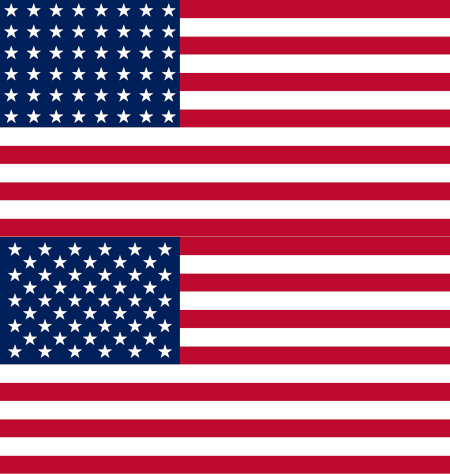
The flag of the United States of America, with 48 stars at top and with 50 at bottom.
This post is the fourth in a series reflecting on the world of 1923, and the 1920s generally, as a background to early issues of Weird Tales. Imagine that you’re an American in 1923, and you’re taking a walk to the newsstand to buy the first issue of a new pulp fiction magazine. What sort of things will you see?
You might, for example, see a flagpole with an American flag on it. It is a flag with a regular grid of stars in the corner, six rows of eight stars apiece, representing the 48 states of the Union. The United States in 1923 is a different place from what it will become a hundred years later, with a population that is distributed differently, different territories, a different self-image and different ideas about the nature of its peoples.
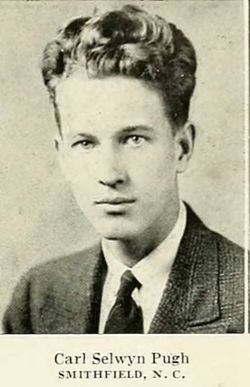
Carl Selwyn Pugh, Jr. was born on December 12, 1918 on Roanoke Island, North Carolina to Carl Selwyn Pugh and Amelia (née Myatt). He was the first of two sons.
He attended the University of North Carolina where he edited the college humor magazine. After college, he moved to New York where he attempted to sell jokes to humor magazines, achieved a small amount of success, but not enough to sustain himself.
During World War II, he served as a lieutenant in the Signal Corps and after the war he worked as a scenario writer at the Signal Corps Photographic Center in Astoria, writing military training films.
His science fiction, published using the name Carl Selwyn, appeared during and immediately after World War II, with his first story, “The Strange Death of Richard Sefton,” being published in the January 1940 issue of Amazing Stories. his next story, “Revolt on the Earth-Star” was his debut in Planet Stories, where most of his fiction appeared.
Weird Tales, April 1923
The table of contents of the second issue of Weird Tales advertises “Sixteen thrilling short stories / Two complete novelettes / Two two-part stories / Interesting, odd, and weird happenings.” More specifically, one of the two-part stories, the cover story, begins this month while the other concludes. As for the “interesting, odd, and weird happenings,” I wrote about them here, so now let’s get to the fiction. (Note that discussion of one of these stories necessitates quoting an ethnic slur, directed against the French, of all people.)
The first of the tales on offer in this issue is one of the novelettes, “The Scar,” by Carl Ramus (whose surname’s misspelled in the table of contents as ‘Rasmus’). It’s the only known published story by Ramus, though his sister Sybla was a writer whose work would later appear in Weird Tales. Carl Ramus had a day job as a doctor, and as it happens “The Scar” is a tale of a dashing young doctor pulled into a kidnapping plot. It’s not a terrible story, but it’s a surprising choice to lead off the issue as there’s little supernatural about it — the heroine claims to be able to bring on a fever by willing it and the hero believes he has a knack for hypnotism — and nothing I can see as ‘weird’ in any other sense. If the magazine’s still in the process of defining itself, then editor Edwin Baird has a different sense of where he intends it to go than we might expect from our later perspective.
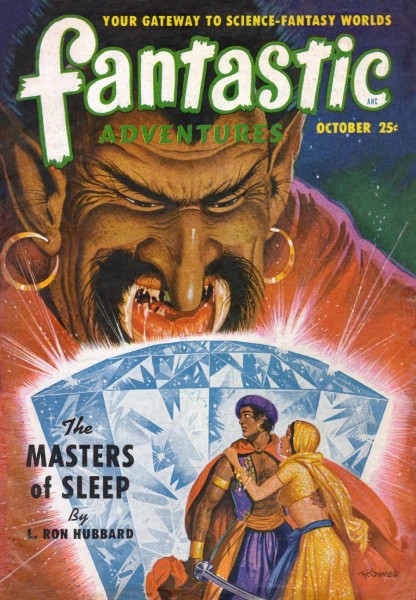
Fantastic Adventures, October 1950, cover by Robert Gibson Jones
Dave Dryfoos was born on March 29, 1915 in San Francisco, California to Jesse and Beatrice (née Goodman) Dryfoos. He attended Lowell High School and attained the rank of Eagle Scott before attending the University of California at Berkeley. He earned a law degree from the University of California’s Hastings School of Law before being admitted to the bar in 1936.
In 1942, Dryfoos married Dorothea Gallatin and shortly afterwards was drafted into the Army, serving in Australia, New Guinea, and the Philippines during World War II before being mustered out in 1946 as a staff sergeant. He returned to Benicia California after the war.
Dryfoos published his first short story in the October 1950 issue of Fantastic Adventures: “Lest Ye Be Judged…” Over the next six years, he published twenty-one additional short stories, including “Some Like It Cold,” “The Old-Fashioned Spaceman,” and “Younger by the Minute.” His work appeared in Galaxy, Startling Stories, Thrilling Wonder Stories, The Magazine of Fantasy and Science Fiction, as well as several other magazines. He stopped published in 1955 with “Seller of the Sky,” which appeared in the February issue of If.
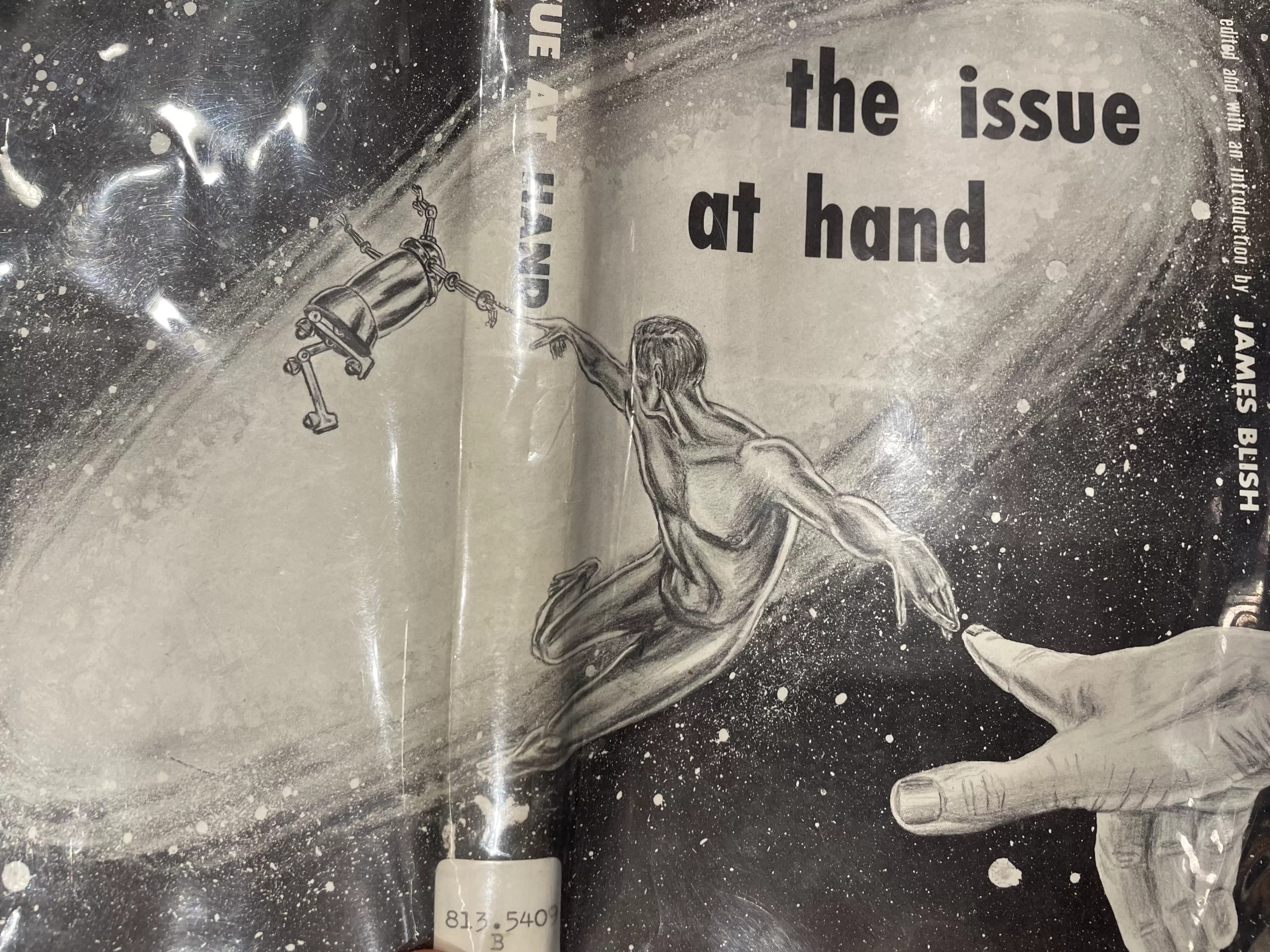
The Issue at Hand, by William Atheling, Jr., AKA James Blish (Advent: Publishers, 1964). Cover by Jon Stopa
In 1952, a science fiction fanzine, Sky Hook, began publishing a series of critical essays by William Atheling, Jr. When its publisher, Redd Boggs, suspended publication, the science fiction writer James Blish publicly revealed that this was a pseudonym he had adopted. But a few years later, he revived “Atheling” for more criticism, published in another fanzine, Axe.
In 1964, Advent: Publishers collected his critical writings, including both fanzine articles and addresses given at science fiction conventions under his own name, as The Issue at Hand, credited to Atheling, “edited and with an introduction by James Blish,” though the book made no secret of the author’s identity. In 1970, a second collection appeared, More Issues at Hand.
This post is the third in a series reflecting on the world of 1923, and the 1920s generally, as a background to early issues of Weird Tales. Imagine that you’re an American in 1923, and you’re taking a walk to the newsstand to buy the first issue of a new pulp fiction magazine. What sort of things will you see?
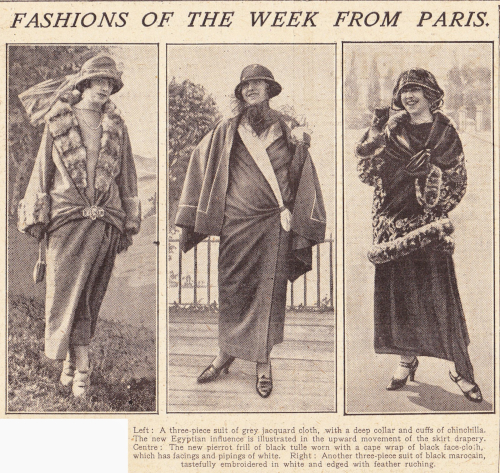
Walk down a city street and you’ll observe other people around you, meaning you’ll see the fashions of the time. Any given era has its characteristic clothes and hairstyles, and the nineteen-twenties are no exception. Interesting to me personally are the reasons behind the adoption of specific fashions, and what they have to say about the way the world is changing. I’m writing these background posts as though one aspect of the 1920s can be divided from the others, but the truth is that then as now everything’s mashed together. Fashion’s affected by technology and politics, by ideas about formality and ideas about sexuality; and it can create images that will, for later years, define its moment.
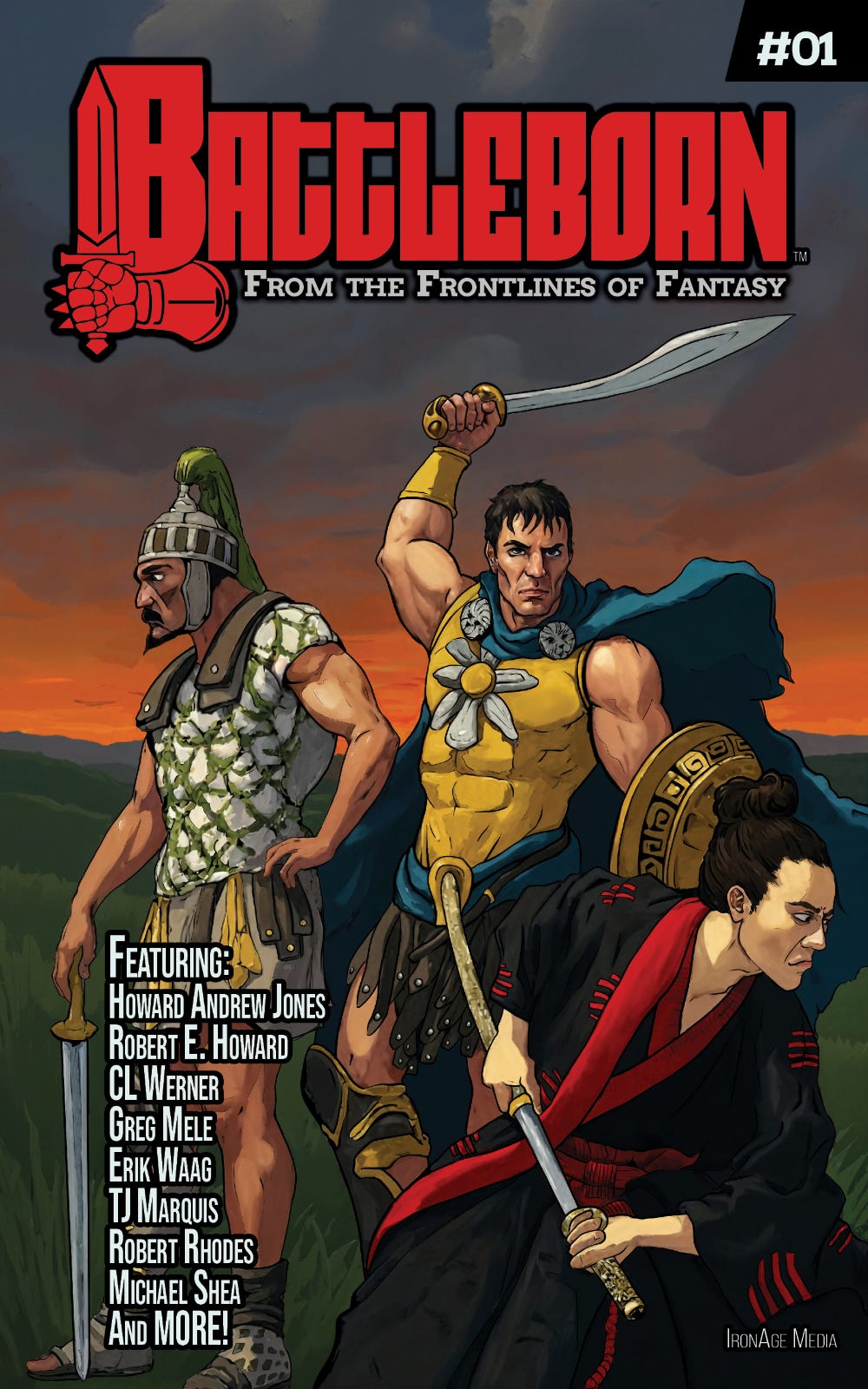
Battleborn magazine, issue 1 (Iron Age Media, , May 31, 2026). Cover by Samuel Dillon
This is a man’s, man’s, man’s world
— James Brown
One blustery Maine spring day, I blew off class to spend an hour hanging out with a friend in the math department’s student lounge. Picture a Coke welded to my hand and a coffee to hers, as we discussed fantasy and science fiction and divers other subjects in the “wrong” lounge (we were English majors, but it was the English/Math Building and the math lounge was empty. What can I say?). Picture my friend as the reason I figured out I’m a feminist a lot sooner than I would have otherwise. Picture the talk turning to men, a gender to which only one of us is attracted.
“I’m fine with men,” she said. Then she said something I hadn’t heard before, but have heard other women echo many times since: “I just want them to remember women hold up half the sky.”
Edwin K. Sloat was born on March 1, 1895 in Denmark, Iowa.
The attended State Normal College in Edmond, Oklahoma (now University of Central Oklahoma), graduating in 1916. Following his graduation, he worked as a newspaperman, an employee of the post office, and as a band leader during World War I, in which he was a Musician 1st Class Petty Officer.
After the war, he married Corinne Evelyn Lake in 1922 and they had two sons, Jerry and Donald.
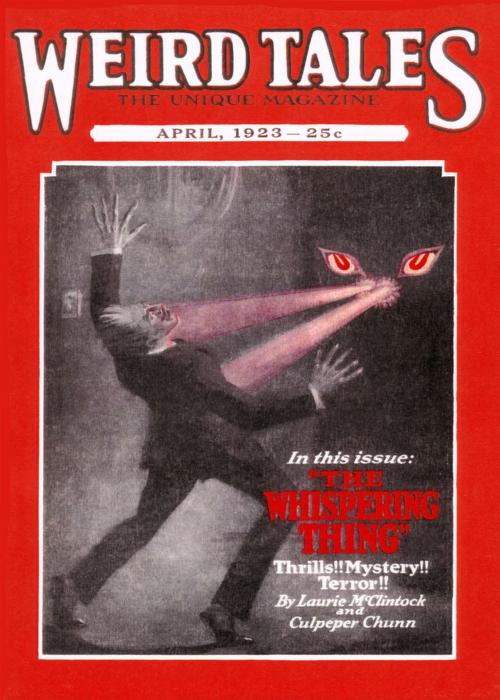
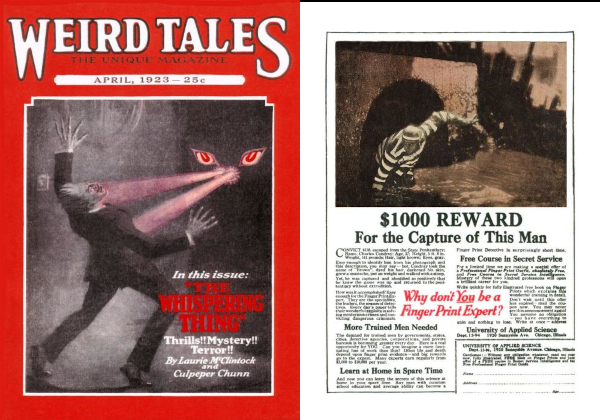
The second issue of Weird Tales, on sale from March of 1923 through to April, looked much like the first: a pulp magazine roughly 6 and a half inches by 9 and a half, with 192 pages. The April issue was .75 of an inch shorter and half an inch narrower. The black-white-and-red cover was more striking than the previous issue’s, with the main image contained in a thick red frame, and the date and price more easily visible under the title. There was a new and smoother-looking logo. Unlike the first issue, this cover didn’t share a format with that month’s issue of Weird Tales’ older sister publication Detective Tales. Although to phrase it that way may be misleading; John Locke, in The Thing’s Incredible! The Secret Origins of Weird Tales, argues that what is referred to as the April/May 1923 issue of Detective Tales was actually an issue that came out in May which the publisher retroactively dated as a bimonthly issue, and if that’s so then there was no Detective Tales issue in April for the second issue of Weird Tales to parallel.
Either way, the cover’s about all you might hope for from a magazine called Weird Tales. Mysterious gigantic eyes stare out of darkness, while from just below them pink rays shoot out to strike a man who screams and throws out his hands. It’s not terribly sophisticated — background details are nonexistent or lost in the ink wash, and you can’t help but wonder if the mysterious creature in shadows is firing rays from its nostrils. But it is an image that tells you things supernatural and horrific lurk within these pages.
This post will take a look at the physical and editorial package of the second issue of Weird Tales, with an eye to tracking the magazine’s evolution. It’ll run long, because I’ve included numerous extracts from pulp magazine editorials — mostly for the sake of making an argument about how Weird Tales was positioning itself in its marketplace, but partly, I have to admit, for historical interest and potential amusement value.