There will soon be more going on here than meets the eye… or the ear.
100:
Well, hidey-ho there, friend! Let me ask you something. Have you or a loved one ever been writing something – say, a novel, or a short story, or heck, even a sonnet– and found yourself apprehensive about the dialogue to come? Or have you ever felt the reverse, an all-encompassing need to document the details of every character’s chit-chat? If so, you might be on the Dialogue Malappropriation Spectrum, or DMS for short. Golly, I’m not sure. Can you tell me more? Continue from 180. I most certainly do not! Continue from 320. I do. I really do! Continue from 440. You again? Listen, I thought I made it clear I’m just here for the stories and gaming stuff. Continue from 230.
Too many layers, or 100% necessary? Let’s examine this together, Friend!
100: Well, howdy there, Friend! Let me ask you a question. Do you or a spouse struggle with Character Development Mania, known more commonly as CDM? Oh, I hear you, Friend. It’s not easy to admit it when you have a problem and need help. But you can trust me, I’m in sales! This sounds serious. Tell me more about CDM! Continue from 230. This doesn’t sound like a real thing. Continue from 350. I’m mostly here for the fiction and game stuff, not the writing advice. Continue from 410.
Hello, Friend! Are you a writer who struggles with Scene Development Instability, sometimes called SDI? I know, it can be hard to talk about in public, but let me reassure you, Friend, that SDI can be treated!
Great, tell me more! Read on from 400. I’m not actually a Writer! Read on from 300. I only write short stories, so I’m immune to SDI. Read on from 200.
I snapped awake once more, realizing I’d dozed off again. The therapist sat back on her chair, her crisp white jacket and black pencil skirt the picture of professional cool. I moved my eyes left and right, trying to remind myself where, exactly, I was.
The evaluation vault was warm, bright white, and, if the monitor above the therapist’s head was to be believed, well over ninety-nine percent germ free. I blinked and squinted in the brightness, still recovering after my ejection from the the pressure sauna, which had left my skin a bright pink, save for the circles around my eyes from the protective goggles, and, under my white paper medical gown, a similarly protected region provided by the official Black Gate thong I’d been assigned to use while within, which had since been reclaimed.
The modern edition has more safety features, of course.
“Am I in the Black Gate medical wing?” I guessed, trying furiously to remember how I might have gotten there.
“That’s right,” the therapist said, her voice soothing. “Now, I want you to think back. What’s the last thing you remember? Before the incident?”
“I, um, well, I remember being brought to the medical wing because of a… paper cut?” That didn’t seem quite right.
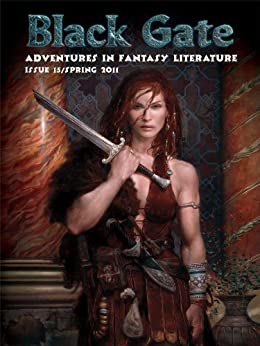
“Yes,” the therapist replied. “A paper cut. With all 384 pages of the print edition of Black Gate #15. Naturally, we couldn’t have you bleeding out on the contents of the archives, so you were brought here. While we managed to save your life – and most of your organs – we were forced to use an experimental rescue technique, and have you clinically frozen until technology was advanced enough to revive you.”
“Wait. Are you saying I’ve been… frozen?”
“That’s right. Welcome back, Mr. Starr! You’ve been gone a long time.”
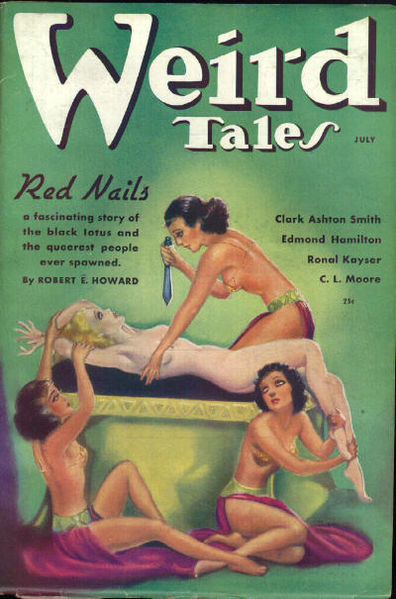
We return to the golden age of Weird Tales to consider the eleven stories in the July 1936 issue. This time around we’re dealing with many familiar authors, led by the triumvirate of C. L. Moore, Clark Ashton Smith, and Robert E. Howard, one H. P. Lovecraft short of perfection. The big three present classic tales from their popular fantasy series (Northwest Smith, Zothique, Conan). The other familiar names deliver more of a mixed bag, but for the most part come through with decent offerings.
Edmond Hamilton, a prolific pulpster for WT and countless other genre magazines contributes one of his weakest efforts in a tale concerning germs from space. The August Derleth and Manly Wade Wellman stories are both decent, if slight, and the Arthur Conan Doyle reprint, for a change, rises above the level of curiosity.
Of the eleven stories, seven are contemporary (64%), three are set in the future (27%), and one in the past (9%), though it’s a little complicated because two stories use framing devices that cut across temporal periods. Six take place in the United States (55%), one starts in the US then goes off on a round the world tour (9%), two are in fictitious realms (18%), one in France (9%), and one on the Moon (9%).
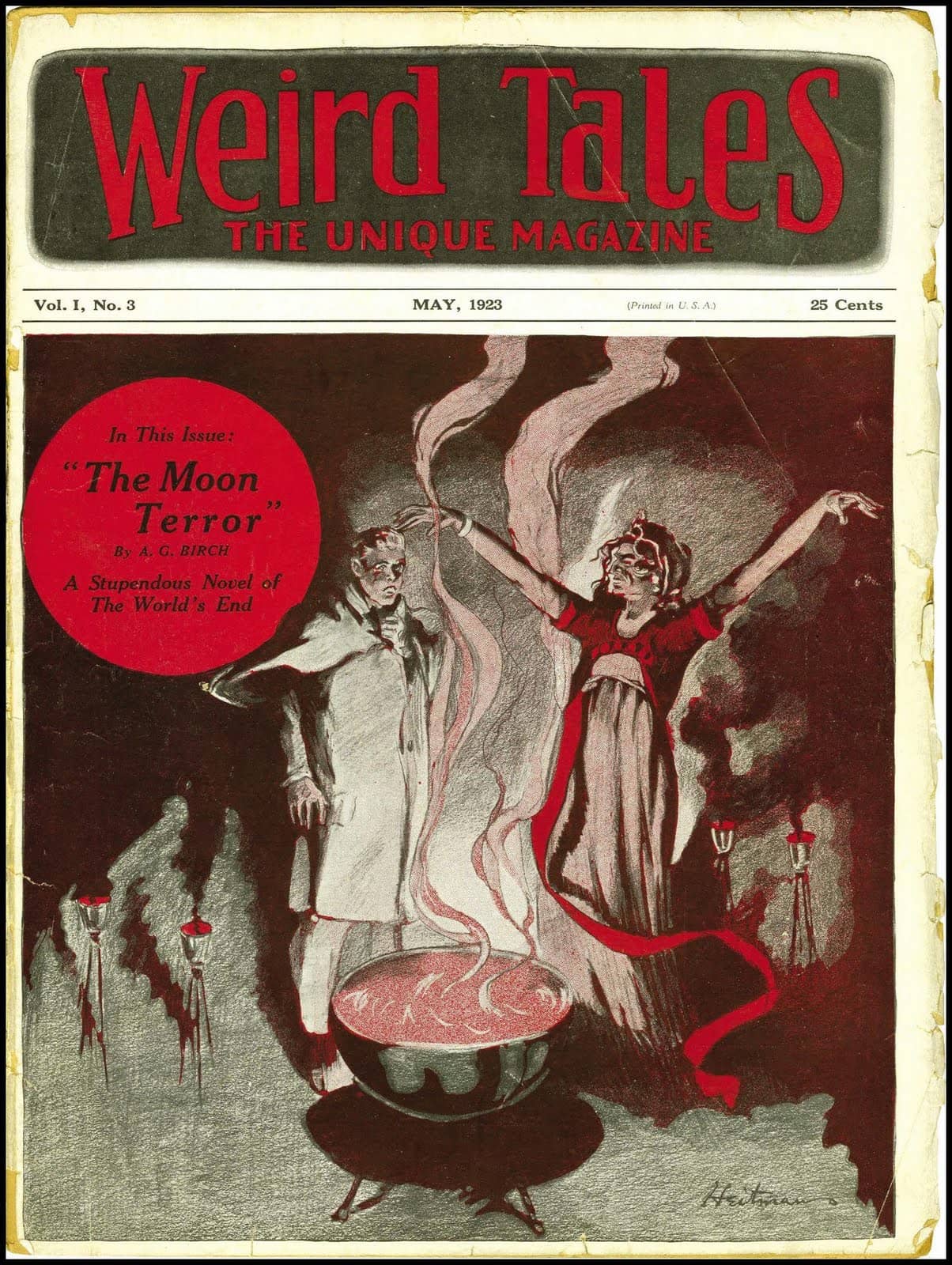
This time we’re considering another early Weird Tales, the third issue, May 1923. This was one of the oversized bed-sheet sized issues and contained 21 stories by 22 authors. Astonishingly, fourteen of these authors were one and done, with no additional published stories in the sf/fan field. Another two have two stories listed at the Internet Speculative Fiction Database.
The two most significant authors in this issue are Vincent Starrett, a long-time newspaper man who produced several out of genre books and a single slim collection of fantasy stories published by Arkham House in 1965. The other is Edward Bulwar-Lytton (yes, of a “dark and stormy night” fame), represented by a reprint that is more of a curiosity than anything else.
The other author worth commenting is Culpeper Chunn (a byline that screams pseudonym), whose real name was Seymour Cunningham Chunn (1889-1927). His two stories in Weird Tales are his only listed genre works, but if you google his name you’ll find repeated offers for his book Plotting the Short Story (it’s in public domain, so naturally it’s currently available in countless editions, even on Amazon) so he must have some kind of track record, somewhere. But that’s not why he gets a mention here. The protagonist of “The Whispering Thing,” co-authored by Laurie McClintock (who otherwise has left no trace in the written record), is Jules Peret, a French-born ex-policeman and current consulting detective, “a small, effeminate man with delicate features, small hands and feet,” given to uttering extravagant oaths. Sound familiar? The first Jules de Granden story appeared in Weird Tales in 1925. I have no explanation for this extraordinary coincidence.
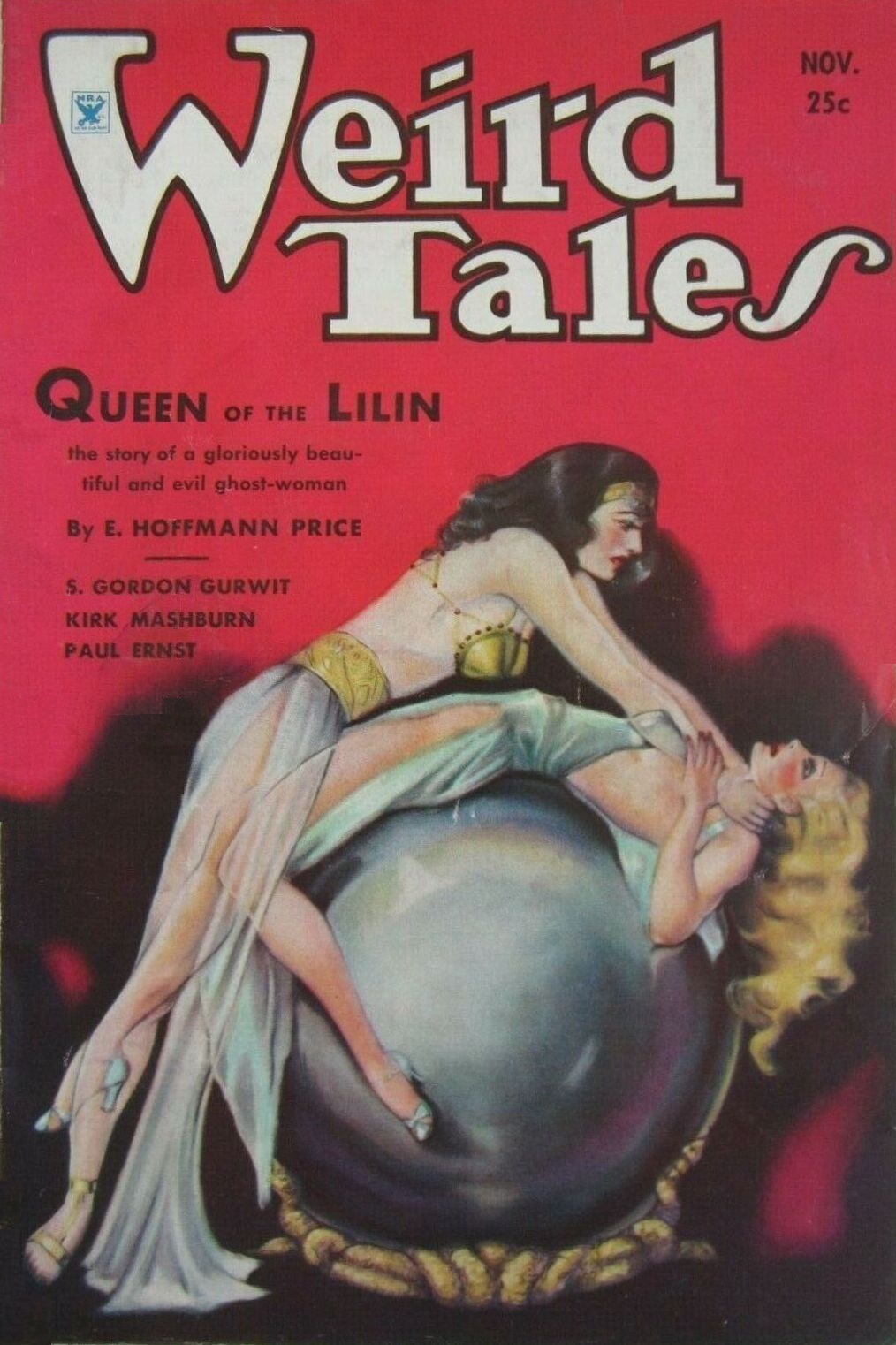
Weird Tales, November 1934. Cover by Margaret Brundage (for “Queen of the Lillin”)
We’re back on more familiar ground with this issue of Weird Tales from its classic period. More familiar authors are represented, and although not every story is a classic the editors at least avoided any real stumbles this. The issue grades out to a 2.1, which all in all is pretty decent.
Both Howard and Lovecraft appear, although the Lovecraft tale is a reprint and the Howard is the last installment of a serial. E. Hoffman Price, Paul Ernst, and August Derleth, seasoned pulp veterans all, also contributed stories. Price tale’s is part of his Pierre d’Atois stories; , d’Atois, like another Frenchman who appears in a series of WT stories, is an occult detective. The Ernst is one of his slighter efforts. The Derleth is somewhat more unusual, although, as is common, also rather slight. We have to cover already trodden ground with two serials this time around. I’ve included the information on those stories for those who haven’t read all the posts in this series.
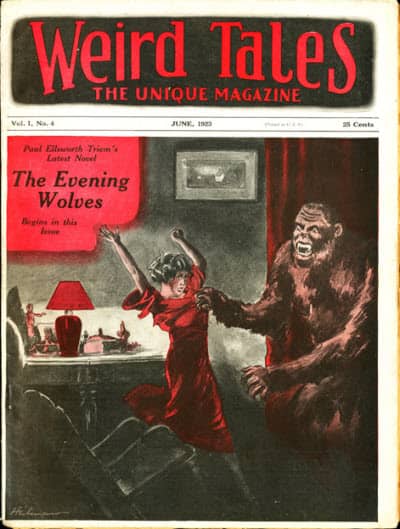
June 1923 was the magazine’s fourth issue, and it was still clearly a magazine in search of itself.
There are very few authors who had a major impact on the magazine appeared in this issue. The most notable name, of course, is Edgar Allen Poe with a reprint of one of his most famous tales (“The Murders in the Rue Morgue”) and, secondarily, Otis Adelbert Kline, with a story largely forgotten today, but which I found to be a cut above many of his others, though ultimately somewhat slight. That’s about it. Two of the best stories were by authors totally forgotten today, Paul Ellsworth Triem and Loual B. Sugarman, with only the later tale having fantastic elements. In fact, only seven of the 18 stories in this issue had fantastic elements (39%), all were set in contemporaneous times (of course, the Poe story was written in the 1840s), and most (13 or 72%) were set in the United States.
On the whole, many of the stories were no better than mediocre, but really poor efforts were largely avoided (four 4’s and one 5). Also largely avoided were the overtly racist tropes too readily present in many early WT’s, with the Birch effort going all in on the Yellow Peril theme. Overall, this issue rated out to 3.00, which notably lags behind the classic early 1930s issues previously covered.
We have another nine stories to consider this time around, but what is particularly noteworthy is that all nine of the authors are at least somewhat well known. The most obscure on the list is probably Anthony Rud (here writing under the name of R. Anthony, perhaps best known for his story “Oooze,” arguably the best offering in WT’s initial issue [3-23]), which is partially due to his passing in 1942 at the relatively young age of 49. Also unknown today is Arlton Eadie, who died even earlier (1935) also at 49, but everyone else had long writing careers, although some, of course, have fallen by the wayside due to the relentless march of time.
Of the nine stories, eight (89%) are either fantasy or science fiction, several actually in the gray area between the two genres. Seven stories (78%) have contemporary settings, one (11%) is set in the far past and one (11%) in the future. Four (44%) take place in the United States, and one each in a fictitious realm in the far past, on the planet Mars, in the South Seas (mostly), Great Britain, and a fictional Central European country. Three (33%) are part of a series.
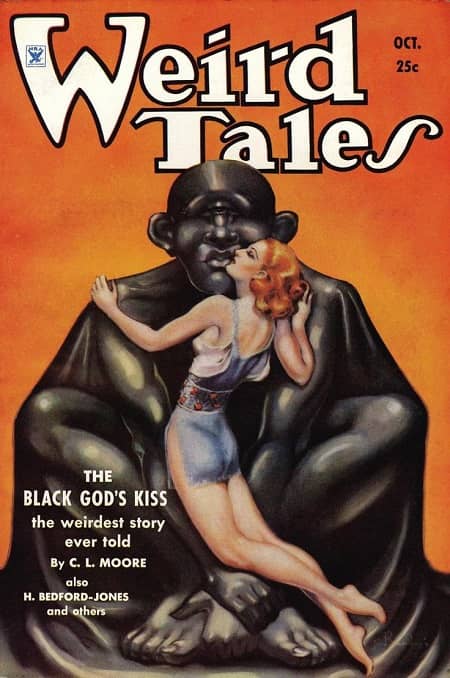
This third installment of the Weird Tales deep read covers the eleven stories in the October 1934 issue, including the first Jirel of Joiry story by C. L. Moore. Her flame didn’t burn as long in the Unique Magazine as the Lovecraft-Howard-Smith trinity’s did, but it did burn as brightly. Moore had sixteen stories in Weird Tales between 1933-1939, twelve in an incredible burst of creativity in the years 1934-1936.
This issue had three stories set in the U.S. (27%) and one each in France, Hyperborea, the U. K., Hyboria, Africa, Serbia, Italy, and an unknown locale (9%). Six had a contemporary setting (55%) and five were set in the past (45%). All in all a decent issue, with the stories averaging 2.27, the score being dragged down by some of the shorter pieces, which were largely undistinguished.
Notable authors include Clark Ashton Smith, Robert E. Howard, with one of his longest and most ambitious stories, the aforementioned C. L. Moore, and fairly reliable veterans Paul Ernst and H. Bedford-Jones, and Manly Wade Wellman. The Ernst and Eadie offerings could be considered science fiction, the rest fantasy.