Steamed: D&D Meets Management Sims – Dungeons & Dynasties
 Management simulation (sims) games have been around a long time. I remember working those olive farms in Caesar, in the 90s. I’m sure I played SimCity, though I don’t really remember that. Tropico was the one I had the most fun with.
More recently, I sank a bunch of time into Railway Empire, which was a lot of fun. And I play Total War: Warhammer, for the empire-building elements: I auto-play the battles. I never got into The Sims, which was hugely popular for a while (maybe still is?). Without a doubt my own favorite is Out of the Park Baseball (OotP), which I even have on old floppy diskettes. In OotP you can take over a team and manage them season-to-season. You trade players, sign free agents, manage the roster, rotation, etc.. It’s not an arcade baseball game.
Football Manager has been a very popular British soccer sim since the 1990s. And that is sort of the model for a sim, Dungeons and Dynasties (Dungeons).
In Dungeons, you manage a guild in a typical fantasy medieval kingdom. You manage a guild, competing against other guilds in trials (matches), to ‘move up the ladder.’ Some parameters may change, but here is how my game is going so far.
THE PYRAMID
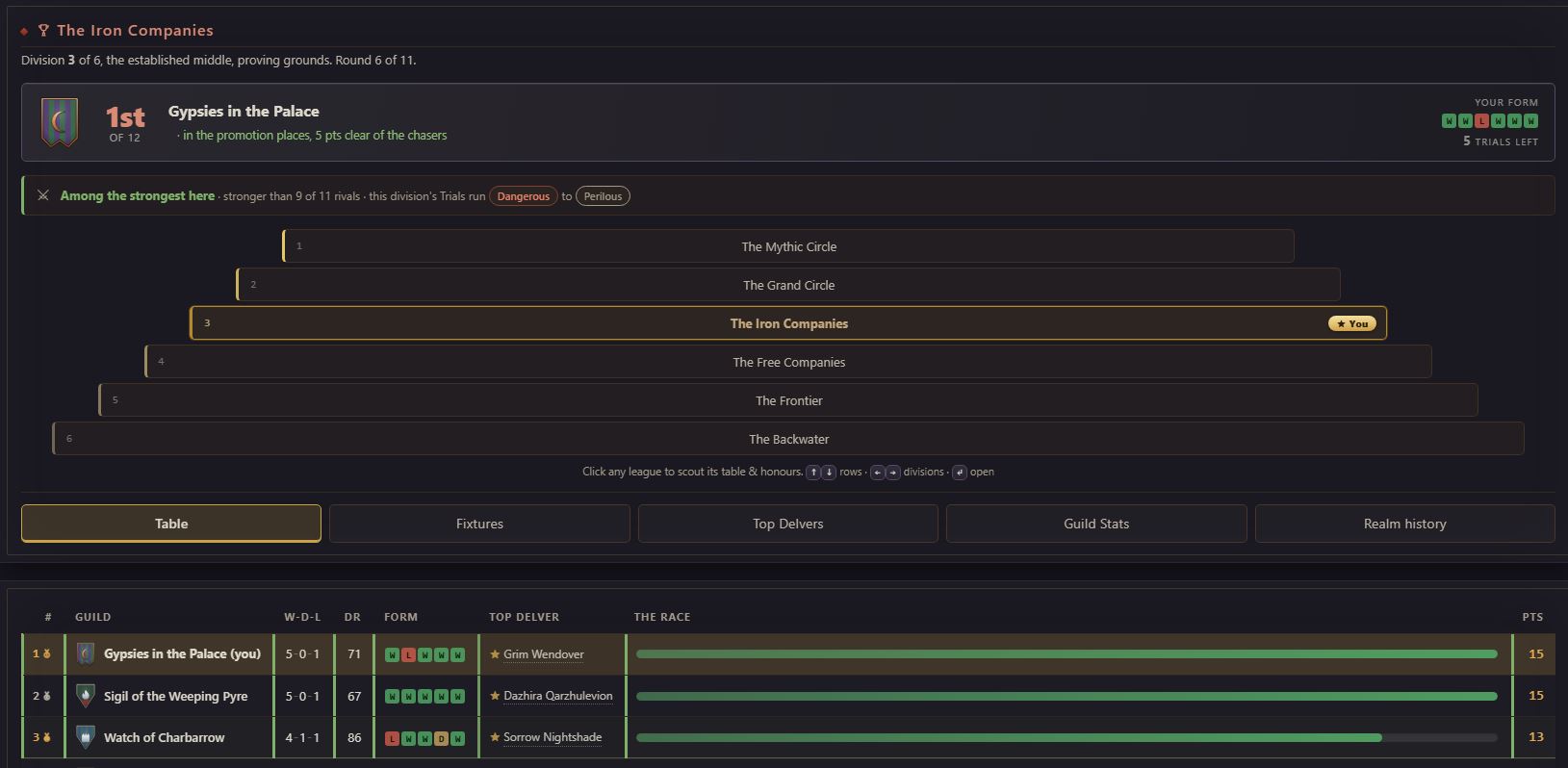
There are six Leagues of 12 teams each, shaped as a pyramid, bottom (the worst) to top (best). You get placed in one (I began in #5, The Frontier). You play each of the other 11 teams in a season, amassing points with wins (3 points) draws (1 point), and losses (0 points). The top 3 move up at the end of each season, while the bottom 3 are relegated. Just like most soccer outside leagues of the US.
THE TUTORIAL
There’s a basic tutorial that explains each of the elements (Roster, Training, Staff, Delves, Quest Board, Hometown, etc) that are the menu items you constantly manage. You should do this as part of your first season. They’re helpful, but I was kinda confused.
This is a one-person/AI-developed game, and you will just have to learn things as you go. I had a couple false starts, but I’ve got a chunk figured out now.
I HIGHLY recommend using that How To Play option when you start. There’s also a Compendium with helpful info, which I only realized as I typed this post, and I’m in season 10. Maybe check that out too!
THE ROSTER
The roster is what it’s really all about. You have a certain number of slots based on the size of your Guild Hall (more below on that). Adventurers are called Delvers. They are of three types; Tanks (meat shields), DPS’ (damage dealers) and Healers (duh). There are three classes within each group, with different aspects.
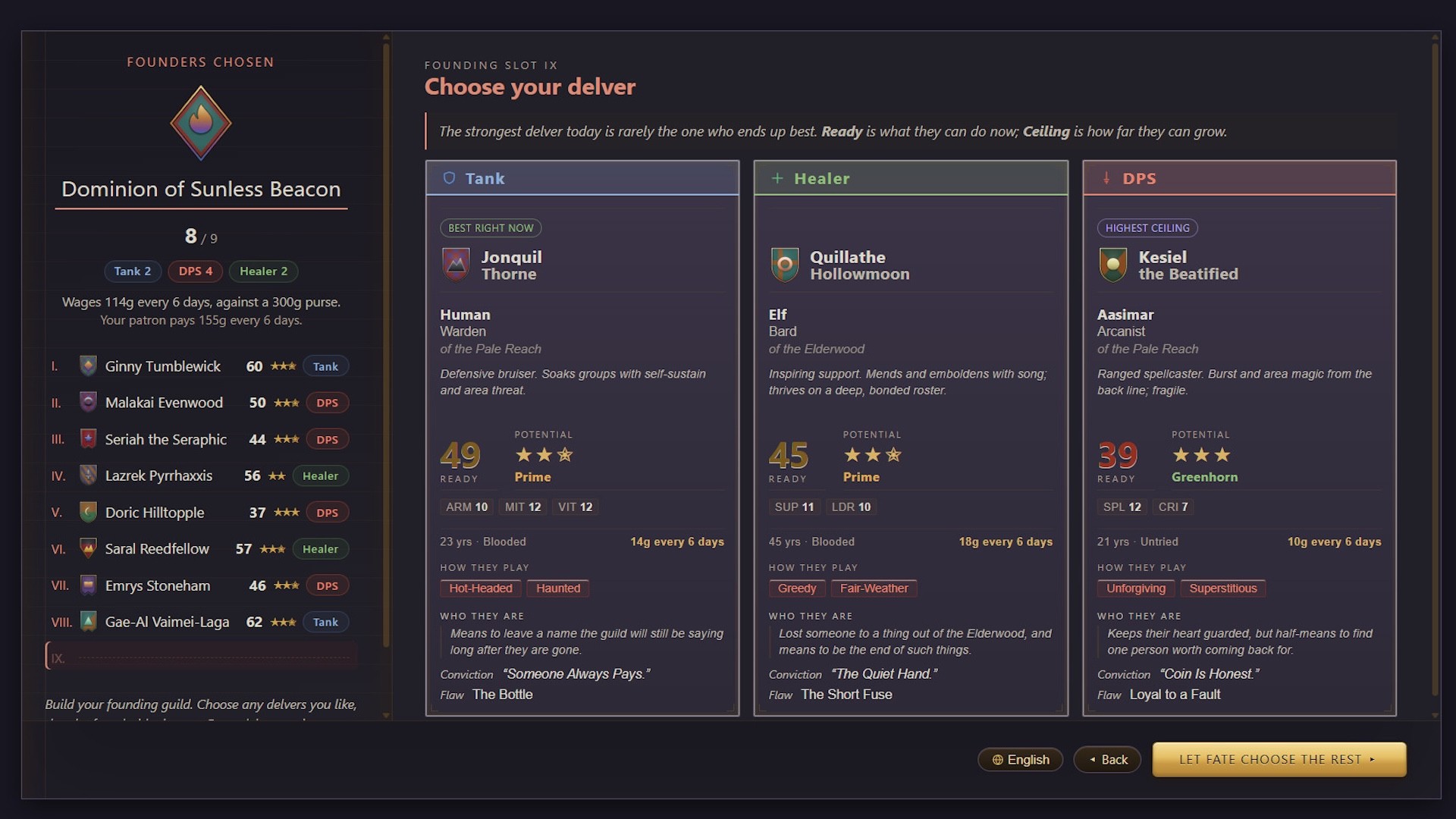 You build a roster with multiples of all three types. They will fight the trials, and go on quests, delves (dungeon crawls) and other types of events. They gain experience, and you can upgrade their gear (called a kit) as you go. Of course, the key in ‘leveling them up’ (they have a Rating which is their level) is to keep them alive. They die. There are ways to mitigate the chances of that. But it happens. One year I lost 7 delvers and people were reluctant to join my Guild. Not so good. Apparently fighting for me was a good way to get killed.
You can sign free agents from the Delvers Market, trade for folks (I haven’t done one of those yet), build an Academy and raise them up yourself, and sign them from the Tavern, where you can grab generally younger Delvers, to build up. Delvers have a current, and a potential score from 1 to 5 stars, so in managing your roster, you weigh current Rating vs. potential future Rating.
And you need a decent-sized roster because you don’t just do the 11 Trial matches. You need to be constantly grinding for the dollars. You are sending Delvers out on Delves and Quests, to make money, gain experience, and pick up renown (your Guild has a renown score that affects how quickly you can upgrade your Guild Hall.
MONEY
My main goal each year is to not get relegated. Over 8 seasons, I moved up from league 5 to league 2. Where I promptly got my butt handed to me this last season, and was relegated back down to league 3. That’s fine.
But this game is also about making money. Constantly. You’ve got bills to pay! And sometimes, you need an ending year balance set by your Patron (if you have one). Plus you wanna expand your Guild Hall. And keep building your roster. And yeah, you need to pay these folks. Plus, there are Staff to hire.
Sometimes, other guilds will try to buy your players. You can refuse. But sometimes, the delver is pissed and leaves. I had my top DPS leave like that. Also, a superstar can demand a bigger share. Twice I’ve tried to haggle down their demand. They quit both times. Ungrateful wretches!
Your Guild Hall has buildings that do different things. Once you build them, that is. And they can be upgraded multiple times. As can the Hall itself. That takes big money – relatively a lot, early on. There’s also a Hometown that provides benefits of some types, and you can put money into that. You can also ‘park’ Delvers there. They don’t really grow, but they do only count for one-tenth of their pay. My biggest money issue in season 10 is meeting my Patron’s ridiculous ‘money in the bank’ demand as a success condition at season’s end. But early on, I even had a hard time making a couple paydays.
There’s a Finances page that shows revenues and expenditures, and you will get a good handle on your cash flow. But while you want to climb the pyramid, it gets harder and more expensive, so you need to keep grinding cash to have the roster and infrastructure to survive.
DUNGEONS
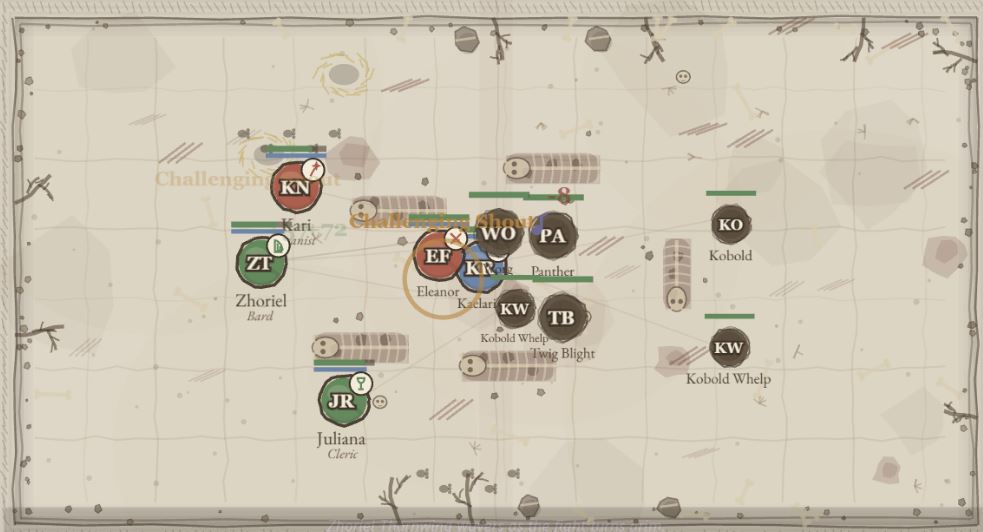 The next two items are related. You pick a party, mixing the types to suit your roster, and the demands of the dungeon (which is actually called a Delve. But you do a Trial in a Delve, and a Delve is a separate option, so we’ll call it a dungeon, okay?)
So you pick 5 (or 6) at higher levels) delvers, who go room-by-room, though a dungeon. A room will have foes, traps, loot, or maybe nothing. You can turn back at any point and keep whatever you’ve already looted. The final room always has a boss.
You just observe what happens in each room as your delvers explore. You don’t control things. And you monitor your party’s health and stress after each room. You earn money and experience. Hopefully with nobody dying. Dungeons are graded from 1 to 9 for danger; the more dangerous, the bigger the payout. You get a prediction of how your party will fare before you go. Including if a death is likely.
TRIALS
Trials are league matches. They function like a dungeon. As your Guild gets stronger, you can better ‘scry,’ which is basically scouting your foes, In a Trial, you pick your team (usually my strongest lineup) and go to the last room of the dungeon. There, you can choose to retreat and take 1 point, but lose some renown. Or go on. If the other team did the same, you fight them, not a boss. You win or lose, and delvers may die. Win and you get 3 points and renown. And you determined how many points the other team got. Scrying before the Trail starts can help you decide if you wanna take on that other guild, or just go home. Alive and with 1 point.
There’s definite strategy on whether to fight or retreat, based on league standings.
DELVE
A Delve is a dungeon crawl you do to make money and gain experience (no renown). You are constantly sending delvers out on on these to make money. Especially early on. Delvers can die here. You need to balance the money vs. the danger. At the root of things, a season is managing your roster, earning enough points in trials to avoid getting relegated, and doing Delves to bring in cash.
THE GUILD HALL
It’s not just about the individual delvers. You have a Guild Hall, with 9 different types of buildings that have different benefits. The Infirmary helps your delvers heal faster. The Tavern Wing increases the number of potential recruits at the Tavern. The Training Ground improves your Training abilities. The Hall has 6 levels (I think). And each building can be upgraded 3 times after building it. By season 10, I had maxed out all my building upgrades, with 2 Hall levels left. Upgrading costs money. And you have to balance building your roster with upgrading your buildings. Again, especially early on. The Hall size determines how many beds you have/roster size.
There are Staff who can be hired to work in each building. They bring various benefits. And they sit on a five seat council – though I’m not sure what the council does.
ARMOURY
One of the buildings is an Armoury. And you can store extra equipment here. I regularly ‘unequip’ my roster and let it auto-equip them. You can sell excess equipment. And end up having higher-level equipment forged. Just another aspect you can manage to help.
HOMETOWN
You can choose to be affiliated with a Hometown. There are some vague benefits associated with that, and also ways to spend your money. I don’t see any upside to NOT having a Hometown. And 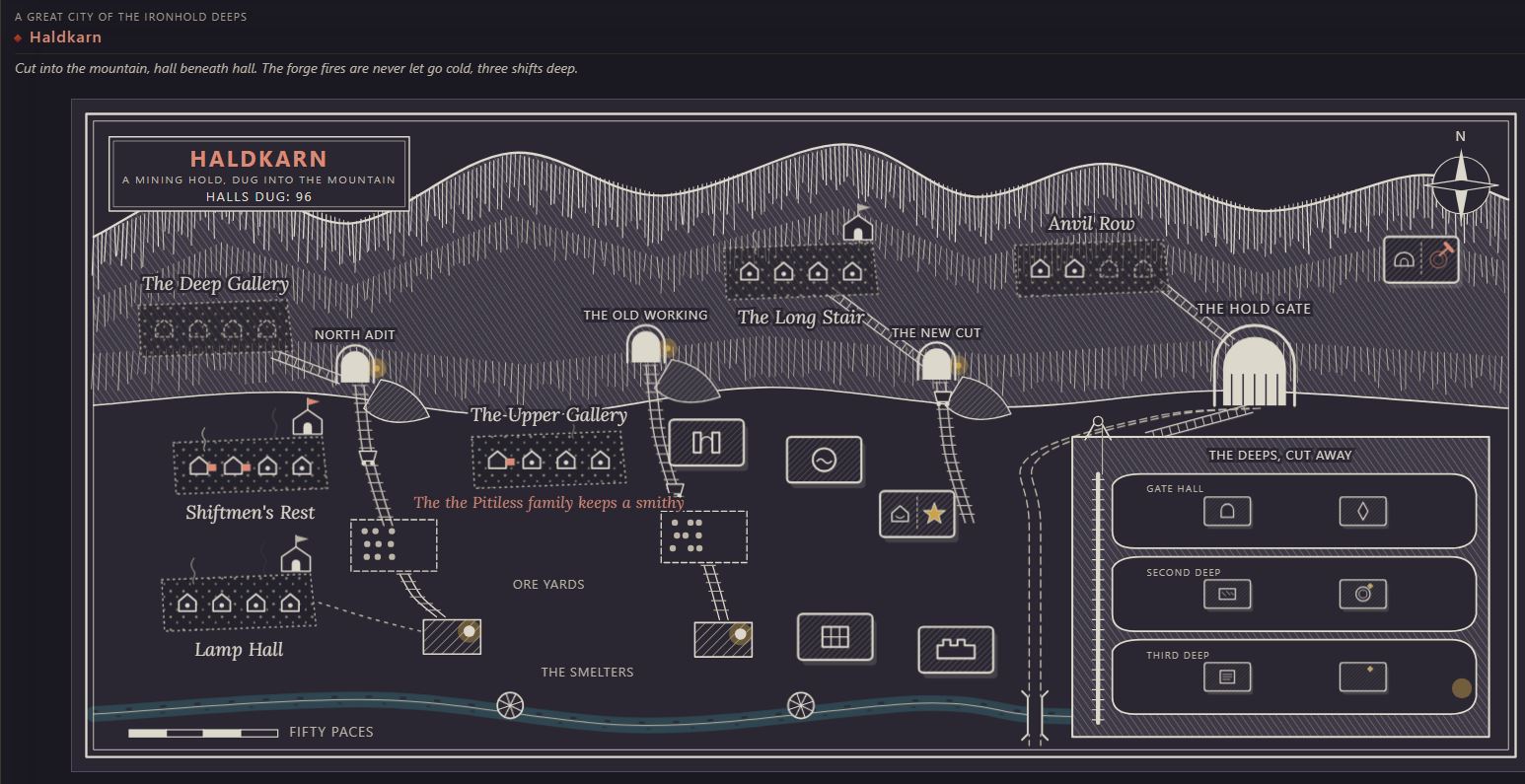 you can mostly ignore it if you want.
THE SEASON
There are other special events that happen each season, which you can often ignore for a loss of renown. Or send one or more people to, to gain some benefits. There are different Quests you can send delvers on. After the beginning, they’re usually of minor impact to you, but it keeps lesser delvers contributing.
You play every team once, and there’s a sort of Realm-wide tournament of champions at the very end. That’s a season (I only got into that big tourney once, for winning my league). Getting relegated isn’t the end of the world, but you want to maintain, or go up. I mean, you’re trying to win the game, right?
MISC
Each delver has some type of Vow they want to fulfill. You can select them for events (like a Quest or marching to a War) to allow them to accomplish them. Some get fulfilled kind of on their own. But you want to keep your delvers happy. Less chance they’ll leave, or be disgruntled around the Guild Hall.
Crusader Kings 2 looked like my kind of thing. And I tried a couple times. But it was SOOOO overwhelming. I literally couldn’t grasp it. The learning curve was tremendous. Dungeons & Dynasties has a lot of moving parts, but I figured out enough, after three or four quick starts. As I type this, I’m in season 10 (having been relegated back down to league 3), and I’m atop the league halfway through.
I really haven’t figured out how to maximize training at all. Which is part of me trying to figure out how to level up specific delvers faster. That’s a way to try and address holes in your roster. I’m very strong on Tanks and Healers, but DPS folks are more average.
I’ve enjoyed a few different types of sims games over the years. And I’m a life-long D&D geek. This is a pretty cool idea. And I think it’s a pretty decent game, from what I’ve figured out. I’m sure it turns into a grind. But if you get bored with a successful Guild run, you could start a new one. Pick a higher starting league, or play a different style, and see how it goes.
This is pretty cool sim.
Steamed: Gaming with Bob (all my videogaming posts in one)
What I’ve Been Playing: November, 2026 (Lord of the Rings Online, Dungeons & Dynasties, Murder on the Orient Express)
Guns or Butter: Total War Warhammer II
Looking Back at RTS: Myth Lords
Fortnite (one of several short looks I’ve done at it)
What I’ve Been Playing: 2025
What I’ve Been Playing: December, 2023 (Hard West, Curse of Feldar Vale, Solasta, Dungeon of Naheulbeuk)
What I’ve Been Playing: October, 2022 (Elder Scrolls Online, Total War: WH II, Conan Exiles, Titan Quest)
Mount and Blade: Part Two
Mount and Blade: Part One
 Bob Byrne’s ‘A (Black) Gat in the Hand’ made its Black Gate debut in 2018 and has returned every Summer since.
His ‘The Public Life of Sherlock Holmes’ column ran every Monday morning at Black Gate from March, 2014 through March, 2017. And he irregularly posts on Rex Stout’s gargantuan detective in ‘Nero Wolfe’s Brownstone.’ He is a member of the Praed Street Irregulars, and founded www.SolarPons.com (the only website dedicated to the ‘Sherlock Holmes of Praed Street’).
He organized Black Gate’s award-nominated ‘Discovering Robert E. Howard’ series, as well as the award-winning ‘Hither Came Conan’ series. Which is now part of THE Definitive guide to Conan. He also organized 2023’s ‘Talking Tolkien.’
He has contributed stories to The MX Book of New Sherlock Holmes Stories — Parts III, IV, V, VI, XXI, and XXXIII.
He has written introductions for Steeger Books, and appeared in several magazines, including Black Mask, Sherlock Holmes Mystery Magazine, The Strand Magazine, and Sherlock Magazine.
You can definitely ‘experience the Bobness’ at Jason Waltz’s ’24? in 42′ podcast.