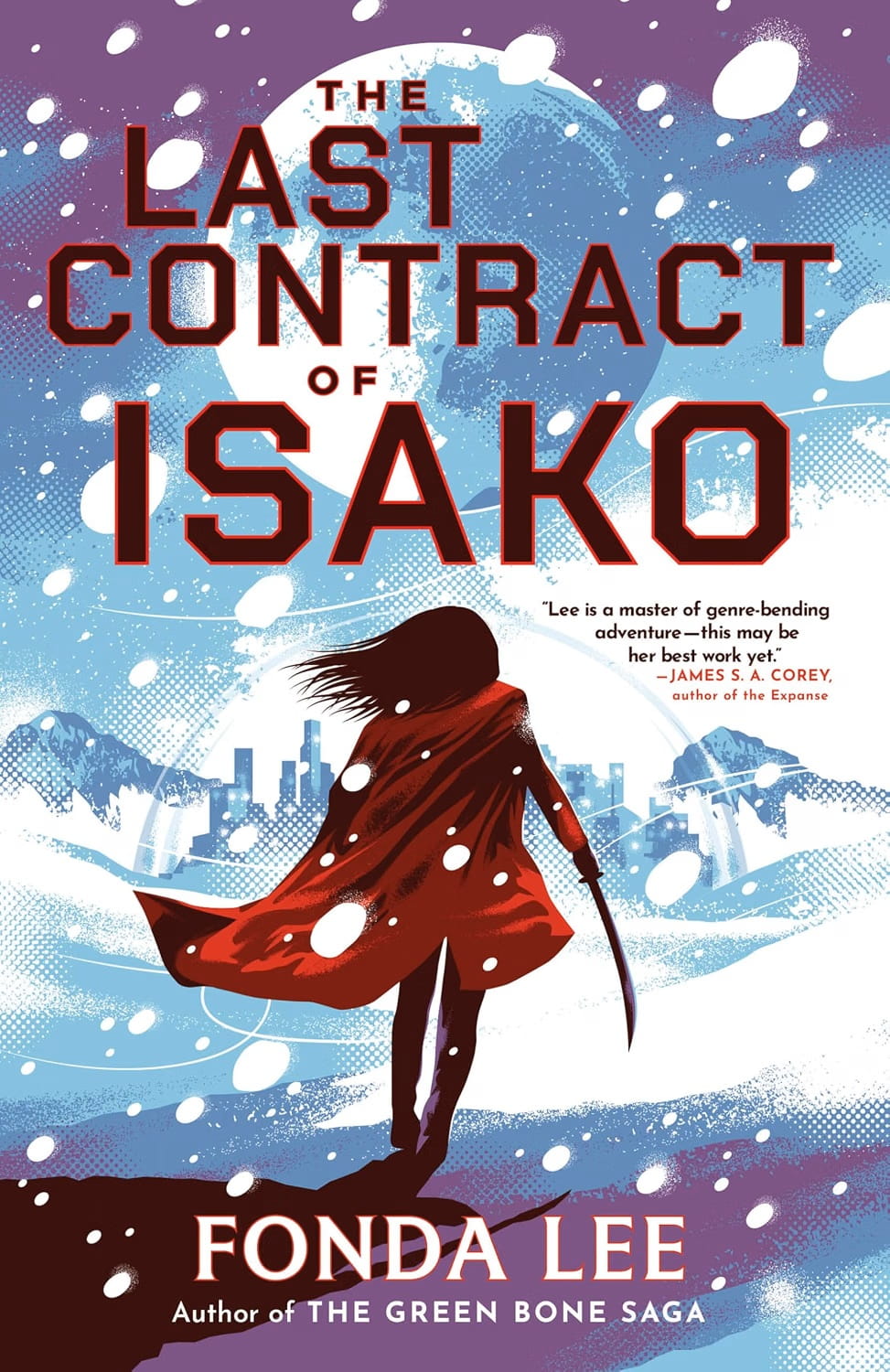
Samurai Noir Meets Boardroom Politicking: The Last Contract of Isako by Fonda Lee
I spent my professional working life as a freelancer, temporarily employed by various corporations, ad and media companies, start-ups, and consultants on a project, on-call, or contractual for a stated number of months basis. Work might last a month or two, sometimes as much as a year, and then I never hear from the employer again; others develop into long-term relationships, albeit at time with gaps (sometimes long gaps) between assignments.
As a “disposable asset,” I cost the organization less (even as I earn higher pay because there is no overhead expense) and am easier to terminate than a salaried employee. While in today’s gig economy job-seekers often have little choice but to settle for contract work, I turned down offers of full-time permanent employment (though “permanent” is a misnomer given the trend of corporate “restructurings” and “force redeployments” and other such euphemisms to disguise layoffs).
I have low tolerance for office politics, silly team building exercises and other such attempts by an organization to pretend to care about people when they otherwise treat them shoddily, not to mention the general dreariness of cubicle dwelling. Sure, I’ve had bad bosses, but I only have to tolerate them until the end of the contract. And the only performance review that matters is that I get done exactly what I’m supposed to get done by the time it is supposed to get done. Then I get paid and go about my business. Straightforward, with for the most part minimal BS.
Of course, there are downsides. You take work when you can, even if that means 60 hour workweeks for a time, because there are fallow periods, so buying a Porsche when you don’t have a regular paycheck isn’t usually a wise financial move. And while some assignments are less than exciting (what jobs aren’t?) at least there’s a foreseeable endpoint. Though sometimes the endpoint can come unexpectedly whenever the organization decides it needs to cut costs, and letting go contractors is a no brainer. Hence what I mean by disposable asset.
All of which brings me to The Last Contract of Isako by Fonda Lee. Because I can relate.

Some 500 years ago, a probe ship funded by PVK Capital and its subsidiary Starhome Exploration Group landed on Aquilo. Shortly thereafter it lost all contact with Earth in what’s called the Great Silence, leaving the crew and its descendants to build and live beneath an air dome to protect them from the planet’s hostile environment — Aquilo gets its name from the Greek god of winter and cold wind. A corporate governing body simply called The Company evolved to run the various industrial activities required to maintain and expand the air dome’s living conditions.
Of course, just like any corporate or government entity, politics trumps the greater good of the average worker and citizen. The political camps jockeying for influence are roughly divided, with some independents, into two camps on how best to deploy limited resources of industrial capacity. The so-far dominant camp advocates terraforming to make the planet habitable and maintain self-governance; the minority opposing view argues a better outcome is working to re-establish communication with Earth and getting help from home.
Isthmus (all the character first names derive from Earth geographies or features of nature) Isako is an atier, i.e., an “A” tier top level strategist contracted to directors of various divisions of the Company. She works for the Agency, an entity independent of the Company but dedicated to serving its interest.
In a world where resources are limited, resources expended for whatever side loses the latest political skirmish become expendable. One of Isako’s duties is to notify wagemen dismissed from her director’s division, Astrocommunications (in the reunionists with Earth camp), as a result of its recent takeover by Satellite Operations (in the terraforming camp). Here’s the rub: those terminated are literally terminated. They receive a payout for their families and then walk out of the air dome to their deaths.
Most go reluctantly, though with a cultural sense of responsibility to kin and, however misplaced, the Company. As for those who don’t, Isako is also a trained assassin (part of her contractual duties), a highly regarded samurai who has earned the nickname of Quickblade (guns for the most past are outlawed, though there are exceptions that play a pivotal role in the plot).

Taking the blame for the failure of his division, Isako’s director opts to walk out into the Aquilo cold along with his terminated employees. Now without a client, Isako has a two year grace period allowed to atiers to obtain a new contract. An atier without a contract is a ronin (a wandering person, denoting a samurai without a master in feudal Japan, also used in modern Japanese as a term for an unemployed worker). A ronin without a contract after two years is expected to take the walk outside.
At 50, Isako is still a highly regarded professional, but suffering from burn-out; she is reconciled to take the walk. However, against her wishes, her contract is bought out by SatOps director Savannah Minto. Isako’s titular last contract is to block, in whatever ways necessary, the ascension of another director, Sandbar Uchi, to the Company Board, which potentially represents a rebalance of power in favor of the reunionist faction.
Further complicating matters is that Uchi’s atier, rising star and Isako protege, Dragonfly Martrim is missing, feared dead. But Uchi has not reported this as required by Agency protocol. What has happened to Martrim and what are the Uchi’s ulterior motivations? How can Isako fulfill her last contract in accordance with the Code of the atier that has dictated her professional conduct? And will her relationship with old colleague and now ronin Rain Kob develop into something beyond professional friendship, Kob’s discomfort with Isako’s last contract notwithstanding?
These questions are resolved in part through a narrative shift from the perspective of Isako just as she is seemingly about to accomplish her contract’s objective to that of Martrim, backtracking to the days when he first wins his atier contract with Uchi. (Lee notes in an afterward that this was one of the most difficult books for her to write, requiring a significant restructuring which I’m guessing may have resulted in the change up.) Along the way there a few twists (one of which I saw coming) that lead to a conclusion, in classic noir style, that no matter how much you try to do good, more powerful forces are at work.
Fonda Lee’s bio notes that she is a former corporate strategist and a black belt martial artist. She obviously writes from experience about how corporate life kills your spirit, as well as how you could actually kill someone.
David Soyka is one of the founding bloggers at Black Gate. He’s written over 200 articles for us since 2008. See them all here.
I really enjoyed The Last Contract of Isako. I like Lee’s Jade War too but for my money, Isako was another level. Remined me of Richard K. Morgan’s Takshi novels.
It did also make me think of my corporate job..Kudos for you makeing it as a contractor. Wish I could.
Has anyone read her YA novel she did with Brue Lee’s daughter, based on Bruce Lee? I almost picked it-up a few times but not a fan of YA.
I’ll have to add this one to my list — I really enjoyed the Jade War books.
Thanks Soyka for introducing me to a new author. I have added it to my list of books to look for. It’s interesting how the corporate villain is back in vogue (or did it ever leave?)