Forgotten Authors: Raymond F. Jones
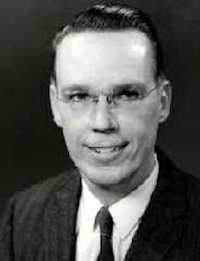 Raymond F. Jones was born in Salt Lake City on November 15, 1915. He studied engineer and English at the University of Utah before working as a radio engineer. He later suggested that getting an English degree is one of the worst things a writer could do. He had a reasonable amount of success as an author, with his novel This Island Earth being the work he is best known for. It was adapted into a film in 1955, starring Jeff Morrow and featuring Russell Johnson, who would go on to portray the Professor on Gilligan’s Island, and Richard Deacon, who played Mel Cooley on The Dick van Dyke Show.
According to Jones, he was introduced to science fiction in 1927 when he read H.G. Wells’ War of the Worlds. He decided he never wanted to read it again because he was afraid it couldn’t live up to the “thrill of that first contact with the realm of imagined science.”
After graduating college, he served on a mission in Galveston, Texas and worked installing telephone exchange equipment for Western Electric in Texas, but after marrying Elaine Kimball on June 27, 1940, he took a job with the Weather Bureau to cut down on travel. During World War II, he used his radio engineering degree at Bendix Radio in Baltimore before settling in Arizona after the war.
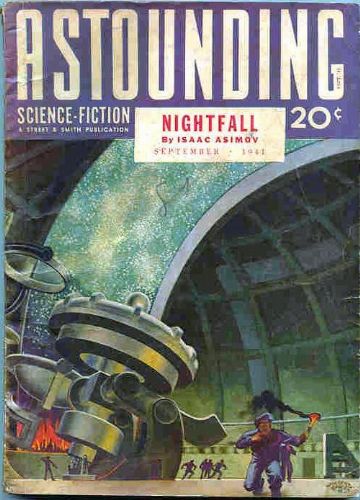
Jones’ first short story, “Test of the Gods,” was published in the September 1941 issue of Astounding, in which it was overshadowed by the cover story, Isaac Asimov’s “Nightfall.” This is a pattern that would be repeated, leading Gerald W. Page to note that while Jones was a “writer of surprising versatility. But the price of this seems to be that too often he came on the scene with a perfectly good story that was still second best to the similar works of someone else.”
Jones wrote 15 novels in addition to This Island Earth, beginning in 1951 with the novel Renaissance (which was reprinted as Man of Two Worlds).
In addition to This Island Earth, two other stories by Jones were adapted by Hollywood. “The Children’s Room,” originally published in 1947, was an episode of the anthology series Tales of Tomorrow in 1952, and 1950’s “Divided We Fall” was adapted for the anthology series Out of This World in 1962.
 His 1950 story “Tools of the Trade” is believed to be the first description of 3D printing.
Jones not only wrote science fiction, he also wrote non-fiction, with four juvenile science books ranging from The World of Weather to Animals of Long Ago. He also wrote the study Ice Formation on Aircraft.
Jones was a Hugo finalist in 1967 for his short story “Rat Race,” which lost to Larry Niven’s “Neutron Star.” In 1996, his story “Correspondence Course,” was remembered by enough people to earn him a Retro-Hugo nomination, where he lost to Hal Clement’s “Common Sense.”
Elaine died on July 23, 1970 and on May 2, 1973, Jones married Lillian Wats. Jones and Elaine had five children and eighteen grandchildren. When he married Lillian, he gained five step-children.
Jones died in Sandy, Utah on January 24, 1994 after suffering from pancreatic cancer. For no reason other than the same first name, I tend to think of Jones along with author Raymond Z. Gallun (1911-1994). Coincidentally, both of their obituaries appeared in the same issue of Locus, with Jones coming in second to Gallun’s.
I reviewed Jones’ short story “Death Eternal” in 2018 as part of my Birthday Reviews series on Blackgate.
 Steven H Silver is a twenty-one-time Hugo Award nominee and was the publisher of the Hugo-nominated fanzine Argentus as well as the editor and publisher of ISFiC Press for eight years. He has also edited books for DAW, NESFA Press, and ZNB. His most recent anthology is Alternate Peace and his novel After Hastings was published in 2020. Steven has chaired the first Midwest Construction, Windycon three times, and the SFWA Nebula Conference numerous times. He was programming chair for Chicon 2000 and Vice Chair of Chicon 7.
I have an old Pyramid paperback of Man of Two Worlds on my Maybe Get to it One of These Days shelf; the book looks mildly intriguing every time I pick it up, but it always winds up back on the shelf. Hang on until summer vacation, Ray, and I’ll rescue you from the land of the forgotten, if only for a couple of days!
I re-read The Year When Stardust Fell a couple years back and it was not bad at all. One of the Winston SF books for “juveniles” (as they would have been classified back in the 1960s, when I first read it). I still have Renaissance (or Man of Two Worlds) around somewhere, will have to try re-reading that one sometime. My recollection is it had a more conventional story arc for that time, despite having more SF bells and whistles than TYWSF.