Their Oath shall drive them, and yet betray them, and ever snatch away the very treasures that they have sworn to pursue. To evil end shall all things turn that they begin well; and by treason of kin unto kin, and the fear of treason, shall this come to pass. The Dispossessed they be for ever.
from Chapter 9 The Flight of the Noldor
I took The Silmarillion to camp with me the summer of 1978. I’d gotten it for Christmas the previous year, but I was put off by its Biblical diction. Still, I was determined to make my way through it. I mean, Tolkien was my favorite author, and I’d already read The Hobbit twice and Lord of the Rings, including the appendices.
I did read it that summer in the woods of Upper Delaware Valley. For all the activities, there was always free time to read, and read I did. Beside Tolkien’s book, I read Cajus Bekker’s A War Diary of the German Luftwaffe. Bekker’s book was a relatively easy undertaking, Tolkien’s was not.
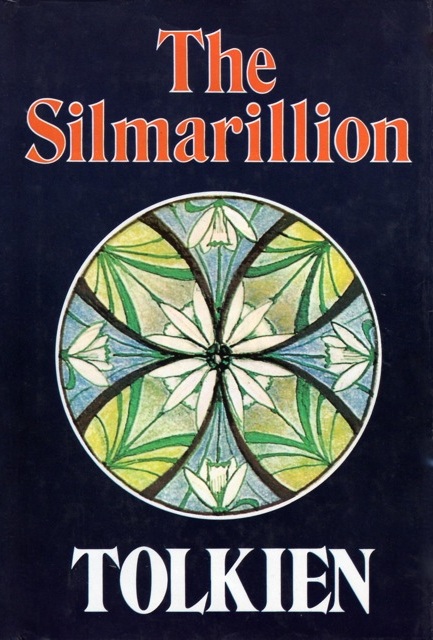
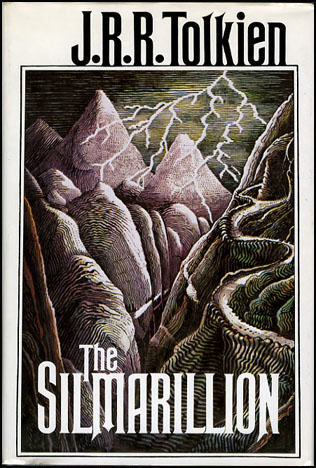
First edition, US
I had to work to comprehend everything that the book was doing. I don’t think I understood it wasn’t actually written as it existed by JRR Tolkien, but was the work of his son Christopher and Guy Gavriel Kay. While there is a clear throughline to The Silmarillion, it’s comprised of several distinct sections, some with less of an emphasis on narrative than others. Of all of Tolkien’s main works, it’s the one I’ve read the least, and this time around is only the third time I’ve read it to the end.
There is a long and complicated history behind The Silmarillion that best left to the other hands. Suffice it to say, Tolkien set out to create an English myth cycle like the Finnish Kalevala. From 1914 till his death in 1973, he worked on a vast collection of tales, songs, and poems that laid out the history of his created universe and serves as the foundation of the Lord of the Rings.
Left incomplete at his death, his son Christopher set out to draft a coherent work out of the most important components of his father’s stories. To do this, at times, he had to write his own speculative bit to fill in gaps in his father’s work. Some have complained his makes The Silmarillion less of a JRR Tolkien work than a collaboration, at best. Only later with the twelve volumes of the The History of Middle-earth did, edited by Christopher, was everything published.
The Silmarillion is a dense work. The first two sections, the Ainulindalë and the Valaquenta, tell of the supreme being, Eru Ilúvatar, and the creation of the universe, Eä. From his thoughts spring the angelic Ainur. From their songs spring the Universe and the world.
Then Ilúvatar said to them: ‘Of the theme that I have declared to you, I will now that ye make in harmony together a Great Music. And since I have kindled you with the Flame Imperishable, ye shall show forth your powers in adorning this theme, each with his own thoughts and devices, if he will. But I will sit and hearken, and be glad that through you great beauty has been wakened into song.’
The mightiest of their number, Melkor, in pride and for power, sings his own song. That discordance serves as the ultimate source for all the terrible tales that fill the last three parts of book, the Quenta Silmarillion, the Akallabêth, and Of the Rings of Power and the Third Age. Together, they make up the greater portion of the book. It is the Quenta Silmarillion, the History of the Silmarils, that is the heart of the book.
The heart of that book is greed, the lust for the Silmarils, jewels of unparalleled beauty that are filled with holy light. That need to own, to possess them, leads ultimately to the destruction of much of Middle-earth. Along the way there are countless murders, betrayals, suicides, and battles of almost incomprehensible calamitousness.
Melkor kicks things off with the theft of the Silmarils. Having already destroyed, first the two Lamps that lit the world, then the two Trees grown to replace them, he steals the three gems that have been imbued with the light of the Trees.
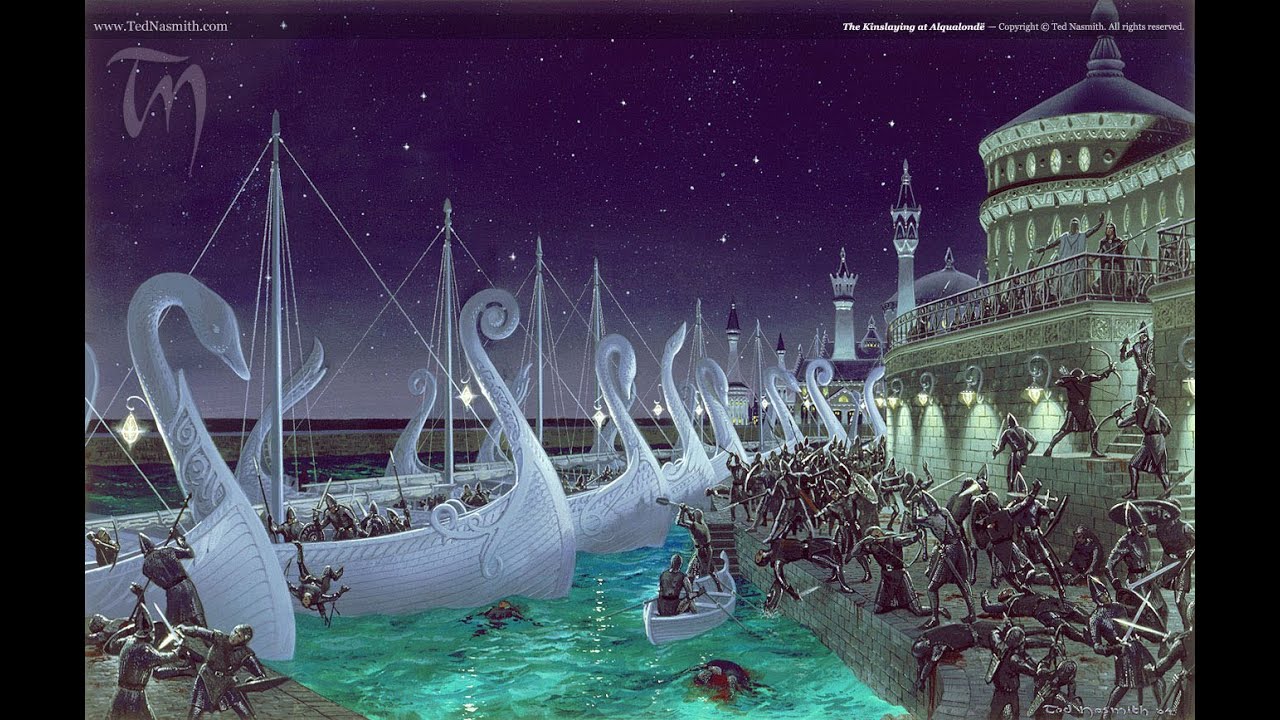
Kinslaying of the Teleri
Enraged by the theft, the Silmaril’s creator, the elf lord Fëanor and his sons swear an oath from which can only flow doom.
Then Fëanor swore a terrible oath. His seven sons leapt straightaway to his side and took the selfsame vow together, and red as blood shone their drawn swords in the glare of the torches. They swore an oath which none shall break, and none should take, by the name even of Ilúvatar, calling the Everlasting Dark upon them if they kept it not; and Manwë they name in witness, and Varda, and the hallowed mountain of Taniquetil, vowing to pursue with vengeance and hatred to the ends of the World Vala, Demon, Elf or Man as yet unborn, or any creature, great or small, good or evil, that time should bring forth unto the end of days, whoso should hold or take or keep a Silmaril from their possession.
Despite being warned by the Valar against making such a pledge, Fëanor and most of his people, the Noldor, set out to enforce it and follow Melkor, now called Morgoth, the Dark Enemy, to Middle-earth. From that act arises, first, the murder of other elves, then battles of almost unimaginable calamitousness, murder, torture, suicide, incest, and rape. Off stage, just because, it would seem, there’s a bit of genocide, too. Oh, and a sing off between an elf lord and Morgoth’s lieutenant, Sauron.
Thus befell the contest of Sauron and Felagund which is renowned. For Felagund strove with Sauron in songs of power, and the power of the King was very great; but Sauron had the mastery, as is told in the Lay of Leithian:
He chanted a song of wizardry,
Of piercing, opening, of treachery,
Revealing, uncovering, betraying.
Then sudden Felagund there swaying
Sang in answer a song of staying,
Resisting, battling against power,
Of secrets kept, strength like a tower,
And trust unbroken, freedom, escape;
Of changing and of shifting shape,
Of snares eluded, broken traps,
The prison opening, the chain that snaps.
Backwards and forwards swayed their song.
Reeling and foundering, as ever more strong
The chanting swelled, Felagund fought,
And all the magic and might he brought
Of Elvenesse into his words.
Softly in the gloom they heard the birds
Singing afar in Nargothrond,
The sighing of the Sea beyond,
Beyond the western world, on sand,
On sand of pearls in Elvenland.
Then the gloom gathered; darkness growing
In Valinor, the red blood flowing
Beside the Sea, where the Noldor slew
The Foamriders, and stealing drew
Their white ships with their white sails
From lamplit havens. The wind wails,
The wolf howls. The ravens flee.
The ice mutters in the mouths of the Sea.
The captives sad in Angband mourn.
Thunder rumbles, the fires burn—
And Finrod fell before the throne.
Then Sauron stripped from them their disguise, and they stood before him naked and afraid. But though their kinds were revealed, Sauron could not discover their names or their purposes. He cast them therefore into a deep pit, dark and silent, and threatened to slay them cruelly, unless one would betray the truth to him. From time to time they saw two eyes kindled in the dark, and a werewolf devoured one of the companions; but none betrayed their lord.
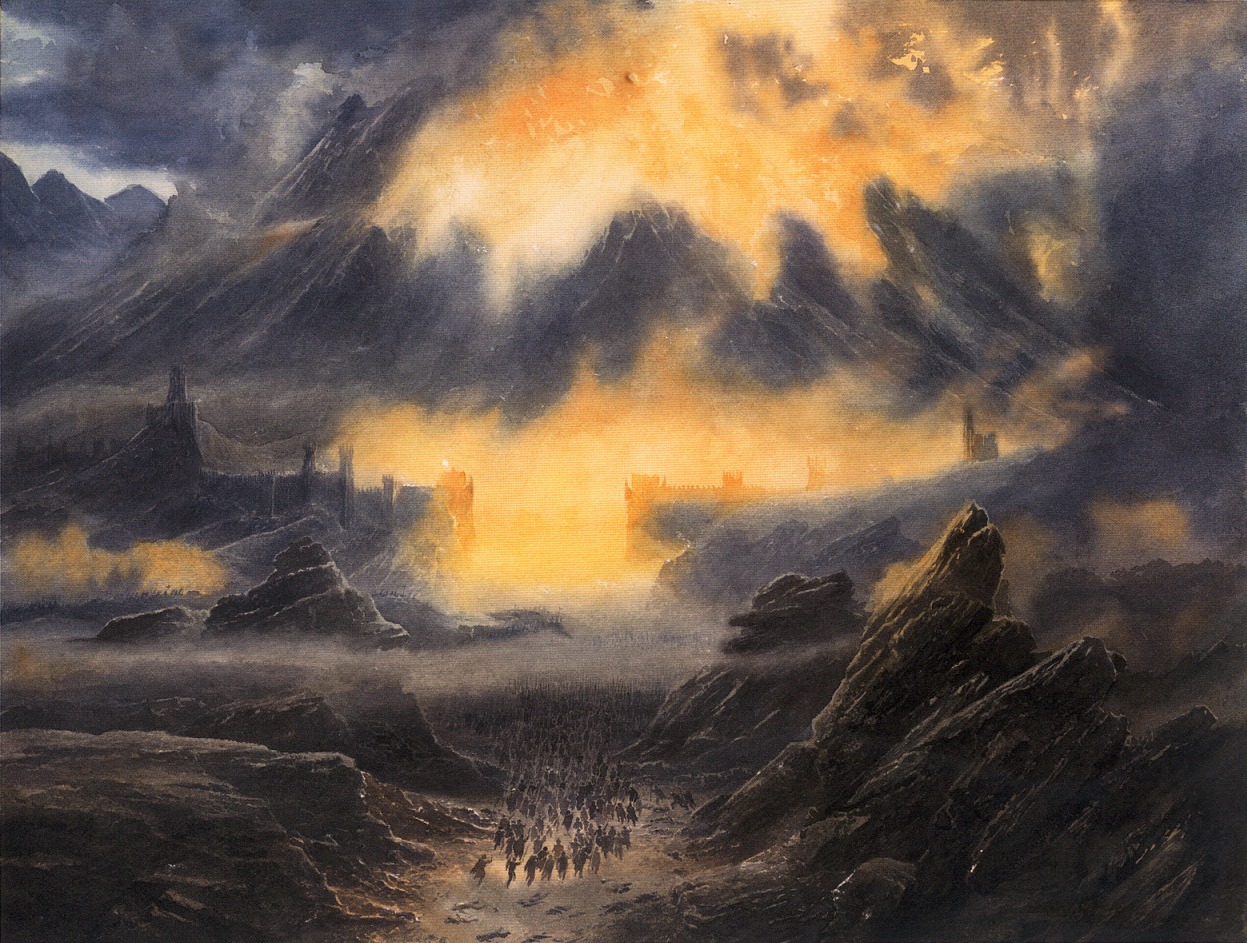
Dagor Bragollach by Alan Lee
Seriously, though, the Quenta Silmarillion is a dark story. It might end in victory over Morgoth and his banishment to the Void outside time and space, but most of the story’s main characters are dead and the lands it takes place in have been destroyed and sunk beneath the ocean.
The broad narrative of the Quenta is the ongoing effort by the elves, and later, the men, of Middle-earth to stand against, and possibly, even, defeat Morgoth. Set within that is the effort of Fëanor’s sons to recover the Silmarils, regardless of who possesses them or why. Aside from the first battle, none of this goes well, and the assorted elven domains go down to ruin in the face of increasingly overwhelming odds. As usual with Tolkien, warfare, even if necessary, is brutal, unforgiving, and terrible for the victor as well as the loser.
There came a time of winter, when night was dark and without moon; and the wide plain of Ard-galen stretched dim beneath the cold stars, from the hill-forts of the Noldor to the feet of Thangorodrim. The watchfires burned low, and the guards were few; on the plain few were waking in the camps of the horsemen of Hithlum. Then suddenly Morgoth sent forth great rivers of flame that ran down swifter than Balrogs from Thangorodrim, and poured over all the plain; and the Mountains of Iron belched forth fires of many poisonous hues, and the fume of them stank upon the air, and was deadly. Thus Ard-galen perished, and fire devoured its grasses; and it became a burned and desolate waste, full of a choking dust, barren and lifeless. Thereafter its name was changed, and it was called Anfauglith, the Gasping Dust. Many charred bones had there their roofless grave; for many of the Noldor perished in that burning, who were caught by the running flame and could not fly to the hills. The heights of Dorthonion and Ered Wethrin held back the fiery torrents, but their woods upon the slopes that looked towards Angband were all kindled, and the smoke wrought confusion among the defenders. Thus began the fourth of the great battles, Dagor Bragollach, the Battle of Sudden Flame. In the front of that fire came Glaurung the golden, father of dragons, in his full might; and in his train were Balrogs, and behind them came the black armies of the Orcs in multitudes such as the Noldor had never before seen or imagined. And they assaulted the fortresses of the Noldor, and broke the leaguer about Angband, and slew wherever they found them the Noldor and their allies, Grey elves and Men. Many of the stoutest of the foes of Morgoth were destroyed in the first days of that war, bewildered and dispersed and unable to muster their strength. War ceased not wholly ever again in Beleriand; but the Battle of Sudden Flame is held to have ended with the coming of spring, when the onslaught of Morgoth grew less.
Embedded in the Quenta are three distinct short stories, those of Beren and Lúthien, the doom of Túrin Turambar, and finally, the fall of the hidden elven city, Gondolin. All have since been expanded and released as distinct volumes, respectively Beren and Lúthien (2017), The Children of Húrin (2007) (written about by me here), and The Fall of Gondolin (2018).
Where the rest of the Quenta reads like a historical recounting of long ago events (in fact, at one point, Tolkien envisioned these tales as exactly that, the work of scholars in the distant future of Middle-earth), the assorted characters in these stories are more developed, with more depth and personality.
Beren and Lúthien’s tale is Middle-earth’s great love story, one that brings men and elves together and removes one of the Silmarils from Morgoth’s possession. This only makes things worse, and leads to the murder of more innocents at the hands of Fëanor’s sons.
Not only does the story feature the song contest, there’s even more singing, when Lúthien uses songs to blind and overpower Morgoth himself. This story, of how a mortal man wins the heart and hand of the most beautiful immortal was clearly dear to Prof. Tolkien’s heart and the two lover’s names are inscribed on his and his wife’s own tombstone. It’s also the brightest, least bleak portion of the Quenta.
Inspired by the bleak tales such as the Germanic Völsunga saga and previously mentioned Kalevala, Túrin Turambar’s story is one of mighty deeds and great foolhardiness. His father, Hurin, was imprisoned and cursed by Morgoth when he refused to reveal the location of Gondolin. Chained to a seat on a mountaintop, the Dark Lord empowered and forced him to see everything that would befall his wife and children.
Túrin is raised mostly and trained by elves, and becomes a great warrior and hero. Later, after unintentionally killing someone, he flees and becomes an outlaw. Later, he will become a hero once more and directly cause the downfall of one of the remaining elf kingdoms. In the end, he is broken beyond all hope, as much by his own impetuousness as Morgoth’s curse.
The fall of Gondolin feels almost like an afterthought compared to the other two stories. Hidden deep in the mountains, it is the last important surviving elf kingdom. By treachery, driven by hatred and lust, the city’s location is revealed to Morgoth, and his armies of orcs, dragons, and balrogs, besiege and eventually take the city. There are survivors, but the might of Morgoth is unopposed by any significant forces in Middle-earth.
The Quenta ends with the powers of the West arraying themselves against Morgoth’s victorious forces and utterly crushing them. Dragons are cast down from the skies, and the surviving orcs and balrogs are driven into hiding. As payment for their service against Morgoth, the men who fought alongside the elves are given their own homeland, an island continent, Númenor, to the west of the new coastline of Middle-earth.
The downfall of Númenor as recounted in the Akallabêth is sordid one. The Gift of Ilúvatar, mortality, is what separates men from elves. While their fate on death is unknown, it is untethered to Middle-earth. Instead of seeing it as a gift, the Númenoreans become fearful of death and jealous of of the elves’ immortality. The deceitful words of Sauron only increase their fear and jealousy. Morgoth’s successor as Middle-earth’s Dark Lord, he’d willingly submitted himself to the Númenoreans. He convinces them to offer up human sacrifices to Morgoth and, eventually, storm the land of the Valar itself.
Thereafter the fire and smoke went up without ceasing; for the power of Sauron daily increased, and in that temple, with spilling of blood and torment and great wickedness, men made sacrifice to Melkor that he should release them from Death. And most often from among the Faithful they chose their victims; yet never openly on the charge that they would not worship Melkor, the Giver of Freedom, rather was cause sought against them that they hated the King and were his rebels, or that they plotted against their kin, devising lies and poisons. These charges were for the most part false; yet those were bitter days, and hate brings forth hate. But for all this Death did not depart from the land, rather it came sooner and more often, and in many dreadful guises.
Things do not end well, and Númenor is sunk beneath the waves and some of the non-human-sacrificing survivors escape to Middle-earth, founding the twin kingdoms of Arnor and Gondor.
The final section, Of the Rings of Power and the Third Age, is the part of The Silmarillion most explicitly tied to the Lord of the Rings. In a few pages, it tells the history of the rings made by the elves led by Celebrimor, the only grandson of Fëanor. Unwittingly aided by Sauron, things do not go well for the elves, and, well anyone. And that’s it. Thousands of years of an invented history of tremendous detail and, at times, surprisingly moving passages, which provide the vast background against which The Hobbit and The Lord of the Rings rest.
So, I’ve stalled for weeks writing this piece. What exactly do I think of The Silmarillion and what’s it all about? Well, I do like it, mostly. Tolkien clearly understood the deep tropes of our stories and myths and knew how to create striking images and situations that feel like they could be real legends. There is a divine huntsman riding down evil creatures in the dawn of times, and a goddess walks silently in deep forests. There is music that makes whole universes and smaller songs that can bind a dark lord. As a work of creation, it is unassailable.
There’s a real Old Testament feel to The Silmarillion, aside from the stylized prose. There’s the creation story, of course, but there’s also the story of beings possessed of free will, freely choosing to turn their backs on their creator and suffering the consequences. Just like the Israelites, the elves and, later, the men, succumb to the temptation to do what they want in their own fashion, rejecting the old customs and laws. It’s even clearer in the Akallabêth. The Numenoreans are explicitly told to not travel to the West. With Sauron making a pretty good stand in for the Serpent, it’s pretty obvious that disobeying that directive will not end well. Tolkien understood the weight of sin and defiance. He understood that crimes have consequences that can reverberate down the years and set the stage for future doom. The problem with books like The Sword of Shannara and many other similarly Tolkien-inspired works, is they can mimic the surface events of Tolkien, but rarely take the time to capture the moral depths he explored.
Reading The Silmarillion’s can be a bit of a hard go. It’s a jumble, not a clear narrative, let alone a novel, and the endless supply of character names and place names had me longing for the relative ease of War and Peace with all its multi-names characters. It doesn’t even flow like a collection of tales. At times it seems like Tolkien the son was just grabbing the bits that caught his fancy the most and shoehorning them together. Also, the prose can be cumbersome and detract from the potential beauty or emotional weight of a particular scene. I can only imagine what the Quenta Silmarillion would be like if Tolkien or his son had turned it into a proper novel (or trilogy!). There’re deep, intriguing things in The Silmarillion, but the style and construction can be a real hindrance at times to enjoying them.
I’m glad I read it, especially so close on the heels of his other books. I can see better how many of the elements of Tolkien’s creation fit together. The thing is, while I can imagine skimming it, I will probably never pull down The Silmarillion to just read it on a lark like I will, undoubtedly, with The Hobbit and LOTR. For all its strengths, for all the interesting parts, it’s just too much of a jumble to just isn’t as enjoyable as his other books. I’m much more likely to reread The Children of Hurin. Its expanded telling of the rise and fall of Túrin Turambar is better fleshed out and is more potent. I don’t know if that’ll hold true for Beren and Lúthien and The Fall of Gondolin, but I’m looking forward to reading both of those in the coming weeks.
If you’ve read The Hobbit and the Lord of the Rings, however, I think it’s almost incumbent on you to read The Silmarillion and see just how deep the story behind those books is. At the very least, when Sam says how he and Frodo are part of the same story that started with Beren trying to steal a Silmaril from Morgoth you’ll understand what he’s talking about.
Fletcher Vredenburgh writes a column each first Sunday of the month at Black Gate, mostly about older books he hasn’t read before. He also posts at his own site, Stuff I Like when his muse hits him.
Subscribe
20 Comments
Oldest
NewestMost Voted
Eugene R.
8 months ago
Of the major works of Middle-Earth, I liked The Silmarillion best, mostly from its “biblical” look and feel, a collection of different books, written at different times by separate authors, all linked together by us later folk as “scripture”. Anyone who reads The Lord of the Rings and lingers over the appendices is clearly the audience for The Silmarillion. Was I daunted by the stilted prose and torrent of names and titles? Oh, yes, but I did resort to J. E. A. Tyler’s The New Tolkien Companion, which did cover some of the material from The Silmarillion. Heck, I resorted to it while reading LotR, so why stop there?
Would I take The Silmarillion down to thumb through? Yes, I have, not as often as I might with LotR, but some. Would I re-read it? Hmm. If I did a re-read of LotR, then I would put aside time for The Silmarillion, too. Like with the original 3 Dune novels, I see it as a connected story-line, even if the connections are a bit tenuous. Still, a universe sung into existence is a place worth visiting and re-visiting, once in a while.
Thank you, Mr. Vredenburgh, for bringing the Music of the Ainur back to our attention.
You’re welcome, and thank you. I didn’t have any of the various guides or companions until much later and this time around with The Silmarillion I just went to Tolkiengateway.com
Tolkien Gateway? I go there for chronology and mythology questions. Plus maps!
Joe H.
8 months ago
Of the three Great Tales (Beren & Luthien; Narn i Hin Hurin; Fall of Gondolin), Children of Hurin is really the only one that got the full narrative treatment to the point that it could be published (with minimal emendation) as a standalone piece. The standalone volumes of Beren & Luthien and Fall of Gondolin are much more … scholarly, showing bits & pieces of multiple fragmentary drafts written at different times across the decades and showing different notions — did you know that at one point Sauron was a cat? I’m glad I read them the once, but on the whole, next time I do a Tolkien reread I’ll probably just stick with my core books: Silmarillion, Unfinished Tales (which includes a version of Children of Hurin that’s about 99% similar to the standalone), Hobbit and LotR.
Yeah, well, we all knew that was going to be your response, heretic! 😉
Jim Pederson
8 months ago
Thank you for the review, Fletcher. It has been quite awhile since I read “The Silmarillion” and I don’t see myself re-reading it. As you noted, it is quite bleak. I think of “The Silmarillion” as a rite of passage for fantasy readers, a way to show you’ve done the fantasy “heavy lifting”. I was trying to think of a similar work of science fiction, perhaps “Dune” (which I’ve read) or maybe “Dhalgren” (which I haven’t).
Dhalgren, for sure! I actually picked up a copy of that and Nova ages ago and don’t think I’ve looked at them since. Heck, with the wave of presentism that’s overwhelmed sci fi and fantasy fiction, does anyone under forty even know about Delaney?
I’ve read the Silmarilian twice (and change, since I dig into it for the occasional essay). It is quite a good read. It is tough though because Tolkien does this thing where, after a while, he changes people’s names, and since many of his characters are immortal, it can make it challenging to get through. Take notes!
Will you be commenting on The Notion Club Papers eventually? Actually a fascinating work, which has reminded me of Alan Garner’s The Owl Service and Lovecraft’s The Shadow Out of Time.
I have a History degree, and write military history, so I actually enjoy both The Silmarillion, and studies of how it was assembled. I love those bleak stories. Tolkien is like Glen Cook, or maybe the reverse, in that neither pull their punches to make the stories they tell more user-friendly with happy endings.
As to how The Silmarillion was assembled, I highly recommend Reconstructing Arda, Douglas C. Kane. He shows precisely which texts were used by Christopher Tolkien and Guy Kay to cut and paste the published Silmarillion into existence. Of course, it is extremely dry reading for those not interested in such minutia.
Christopher Tolkien has admitted that he could have, later, assembled a much-superior Silmarillion, once he had prepared the HOME series and become familiar with the sources. I don’t think the Tolkien Estate has plans to produce any such work, not even for the 50th Anniversary in 2027, though I hope I’m wrong. However, various internet sleuths have produced guides to reading the HOME in such a way as to form an ersatz Superior Silmarillion.
Hi Bob, yes, I’ve seen that. I mentioned Glen because I know Fletcher had been doing a Black Company reading. I do hope someone publishes the last (or will it be second-to-last?) Garrett book. I’m glad Black Gate continues to publicize Glen Cook and Robert E. Howard. I bought and enjoyed a copy of Hither Came Conan, from you fine folks. I bought Lies Weeping for my uncle, who devoured it, and then sent it along to me. I’ll get to it some time in 2026, hopefully ahead of the next volume. My OCD is delighted that Lies Weeping uses the same cover design and fonts and such as Port of Shadows!
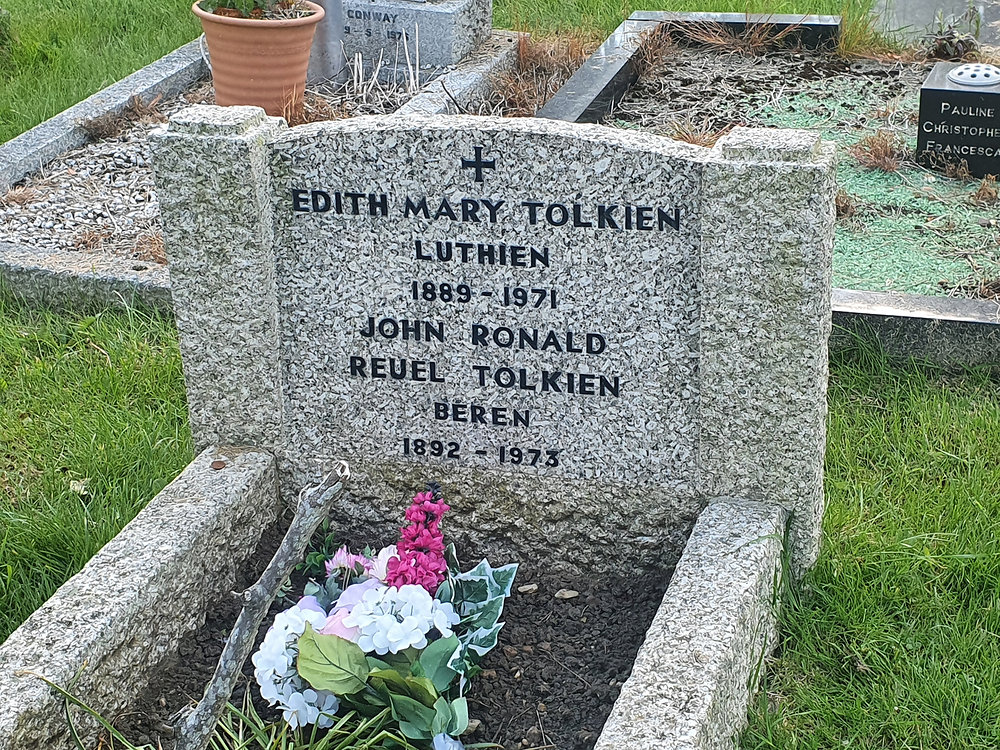 Beren and Lúthien’s tale is Middle-earth’s great love story, one that brings men and elves together and removes one of the Silmarils from Morgoth’s possession. This only makes things worse, and leads to the murder of more innocents at the hands of Fëanor’s sons.
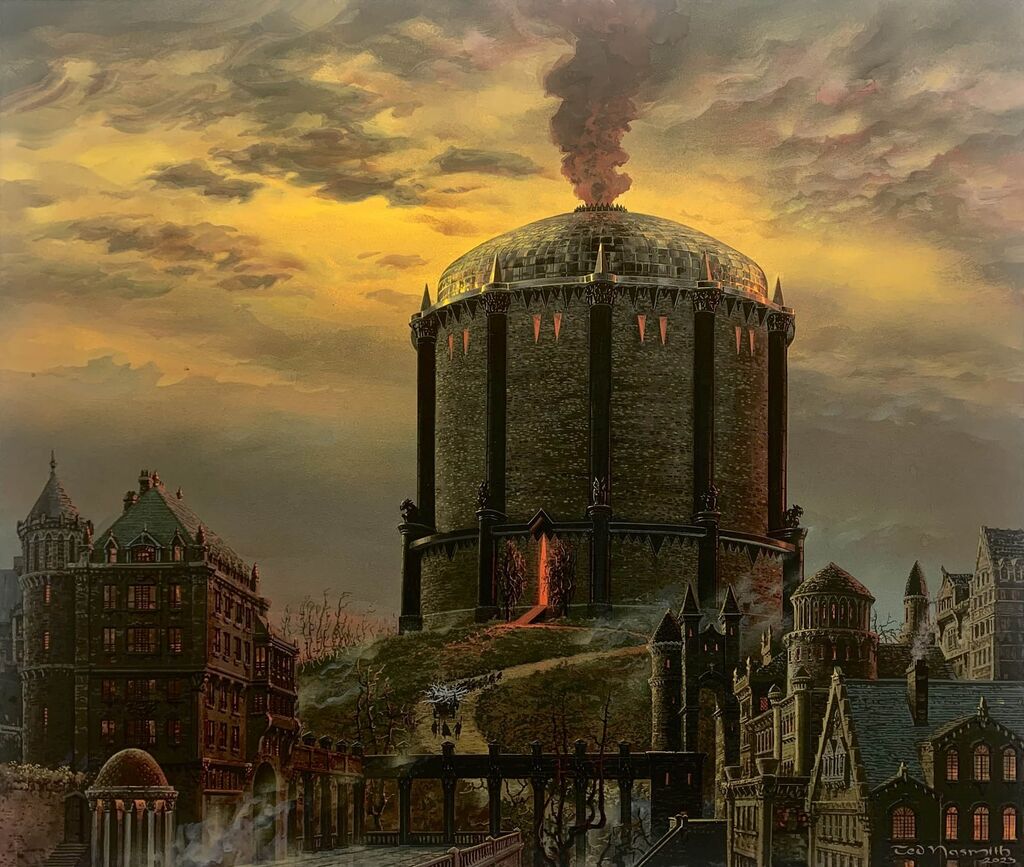 The downfall of Númenor as recounted in the Akallabêth is sordid one. The Gift of Ilúvatar, mortality, is what separates men from elves. While their fate on death is unknown, it is untethered to Middle-earth. Instead of seeing it as a gift, the Númenoreans become fearful of death and jealous of of the elves’ immortality. The deceitful words of Sauron only increase their fear and jealousy. Morgoth’s successor as Middle-earth’s Dark Lord, he’d willingly submitted himself to the Númenoreans. He convinces them to offer up human sacrifices to Morgoth and, eventually, storm the land of the Valar itself.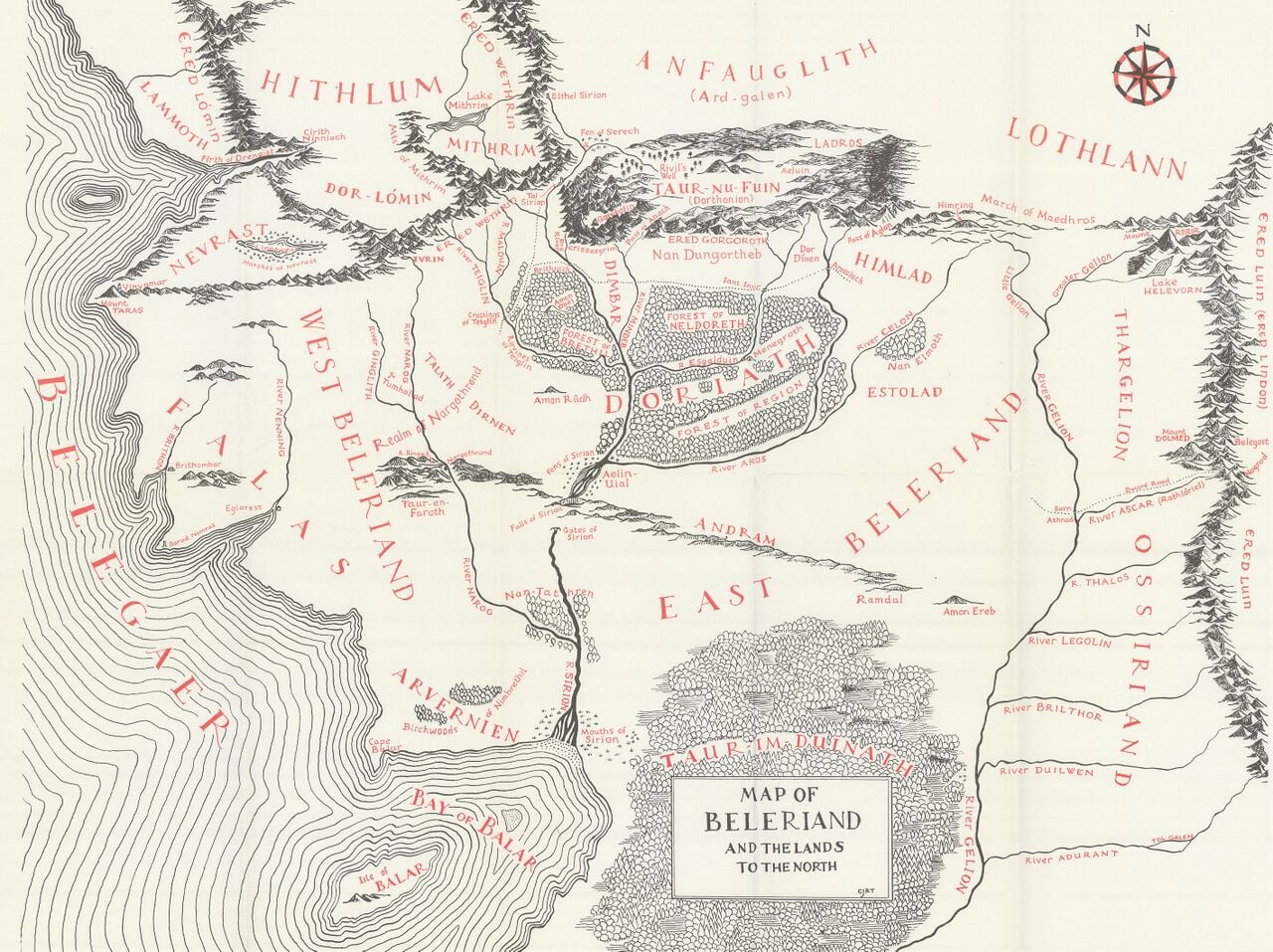
Of the major works of Middle-Earth, I liked The Silmarillion best, mostly from its “biblical” look and feel, a collection of different books, written at different times by separate authors, all linked together by us later folk as “scripture”. Anyone who reads The Lord of the Rings and lingers over the appendices is clearly the audience for The Silmarillion. Was I daunted by the stilted prose and torrent of names and titles? Oh, yes, but I did resort to J. E. A. Tyler’s The New Tolkien Companion, which did cover some of the material from The Silmarillion. Heck, I resorted to it while reading LotR, so why stop there?
Would I take The Silmarillion down to thumb through? Yes, I have, not as often as I might with LotR, but some. Would I re-read it? Hmm. If I did a re-read of LotR, then I would put aside time for The Silmarillion, too. Like with the original 3 Dune novels, I see it as a connected story-line, even if the connections are a bit tenuous. Still, a universe sung into existence is a place worth visiting and re-visiting, once in a while.
Thank you, Mr. Vredenburgh, for bringing the Music of the Ainur back to our attention.
You’re welcome, and thank you. I didn’t have any of the various guides or companions until much later and this time around with The Silmarillion I just went to Tolkiengateway.com
Tolkien Gateway? I go there for chronology and mythology questions. Plus maps!
Of the three Great Tales (Beren & Luthien; Narn i Hin Hurin; Fall of Gondolin), Children of Hurin is really the only one that got the full narrative treatment to the point that it could be published (with minimal emendation) as a standalone piece. The standalone volumes of Beren & Luthien and Fall of Gondolin are much more … scholarly, showing bits & pieces of multiple fragmentary drafts written at different times across the decades and showing different notions — did you know that at one point Sauron was a cat? I’m glad I read them the once, but on the whole, next time I do a Tolkien reread I’ll probably just stick with my core books: Silmarillion, Unfinished Tales (which includes a version of Children of Hurin that’s about 99% similar to the standalone), Hobbit and LotR.
Oh, well. Still, this is the time for me to read them. I’m not ready to end this series quite yet
I’ll definitely be curious to hear your thoughts.
My favorite Tolkien. And I peruse the HoME books, rather than re-read The Hobbit, or LotR.
Some day I’m going to finish this:
https://www.blackgate.com/2023/07/29/talking-tolkien-the-lay-of-the-nauglamir/
Yeah, well, we all knew that was going to be your response, heretic! 😉
Thank you for the review, Fletcher. It has been quite awhile since I read “The Silmarillion” and I don’t see myself re-reading it. As you noted, it is quite bleak. I think of “The Silmarillion” as a rite of passage for fantasy readers, a way to show you’ve done the fantasy “heavy lifting”. I was trying to think of a similar work of science fiction, perhaps “Dune” (which I’ve read) or maybe “Dhalgren” (which I haven’t).
Dhalgren, for sure! I actually picked up a copy of that and Nova ages ago and don’t think I’ve looked at them since. Heck, with the wave of presentism that’s overwhelmed sci fi and fantasy fiction, does anyone under forty even know about Delaney?
I’ve read the Silmarilian twice (and change, since I dig into it for the occasional essay). It is quite a good read. It is tough though because Tolkien does this thing where, after a while, he changes people’s names, and since many of his characters are immortal, it can make it challenging to get through. Take notes!
Notes were taken!
Will you be commenting on The Notion Club Papers eventually? Actually a fascinating work, which has reminded me of Alan Garner’s The Owl Service and Lovecraft’s The Shadow Out of Time.
I will now!
I have a History degree, and write military history, so I actually enjoy both The Silmarillion, and studies of how it was assembled. I love those bleak stories. Tolkien is like Glen Cook, or maybe the reverse, in that neither pull their punches to make the stories they tell more user-friendly with happy endings.
As to how The Silmarillion was assembled, I highly recommend Reconstructing Arda, Douglas C. Kane. He shows precisely which texts were used by Christopher Tolkien and Guy Kay to cut and paste the published Silmarillion into existence. Of course, it is extremely dry reading for those not interested in such minutia.
Christopher Tolkien has admitted that he could have, later, assembled a much-superior Silmarillion, once he had prepared the HOME series and become familiar with the sources. I don’t think the Tolkien Estate has plans to produce any such work, not even for the 50th Anniversary in 2027, though I hope I’m wrong. However, various internet sleuths have produced guides to reading the HOME in such a way as to form an ersatz Superior Silmarillion.
In case you missed the Q&A with Glen Cook. LOVE his stuff. Got Lies Weeping for myself forChristmas.
https://www.blackgate.com/2024/04/08/glen-cook-the-garrett-pi-qa-at-black-gate/
Hi Bob, yes, I’ve seen that. I mentioned Glen because I know Fletcher had been doing a Black Company reading. I do hope someone publishes the last (or will it be second-to-last?) Garrett book. I’m glad Black Gate continues to publicize Glen Cook and Robert E. Howard. I bought and enjoyed a copy of Hither Came Conan, from you fine folks. I bought Lies Weeping for my uncle, who devoured it, and then sent it along to me. I’ll get to it some time in 2026, hopefully ahead of the next volume. My OCD is delighted that Lies Weeping uses the same cover design and fonts and such as Port of Shadows!
Gotta catch up on the Black Company, too. After rereading all the original books, I took a break.
The bleakness is fine, it’s the jumbleness I could do without.
My favourite Tolkien by far, also, and the greatest epic fantasy ever.