Tor Doubles #36: Fritz Leiber’s Conjure Wife and Our Lady of Darkness
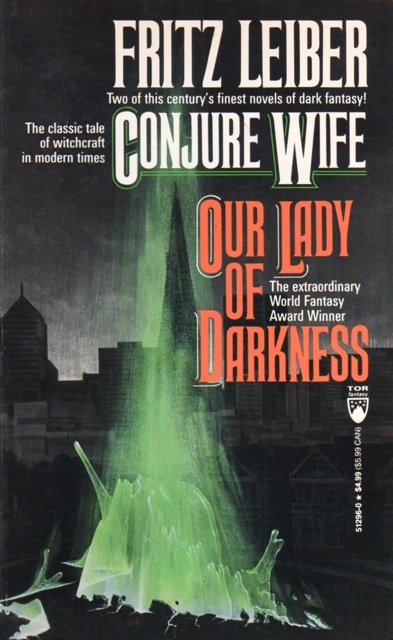
Originally published in August 1991, Tor Double #36 offers two stories by Fritz Leiber, doubling the number of his stories included in the series. It also brings the official Tor Double series to an end, although just as I began by looking at a proto-volume in the series, I’ll be covering one last Tor Double next which, which was never published.
Conjure Wife was an originally published in Unknown Worlds in April 1943. The novel would eventually be awarded a Retro-Hugo, beating out works by C.L. Moore & Henry Kuttner, Herman Hesse, C.S. Lewis, A.E. van Vogt, and Leiber, himself. The novel is also listed in James Cawthorn & Michael Moocock’s Fantasy: The 100 Best Books and David Pringle’s Modern Fantasy: The Hundred Best Novels.
The novel follows Norman Saylor, a sociology professor at a small, conservative liberal arts college, Hempnell College. Saylor’s life is going well, he and his wife, Tansy, have a large circle of friends, his students respect him, and he is up for appointment to head the sociology department. Despite these seemingly close relationships with Tansy and their friends, most of the novel is focused on Norman’s thoughts and broodings, with little real interaction with anyone, certainly not over the important matters that concern him.
Unfortunately, the basic premise of Conjure Wife is misogynistic. Tansy Saylor is meant to be content supporting her husband and participating in the various faculty wife auxiliaries. Her entire life and motivation is meant to be focused on her husband and his career. While Leiber claims that the two are in love, there is little communication between them, and what there is takes the form of commands and ultimatums from Norman.
Early in the novella, the scientifically minded Saylor discovers that his wife has been practicing witchcraft, ostensibly to keep him safe from the spells and jealousies of the other faculty wives (of course, there would be no female faculty members). While Saylor is fine studying witchcraft and magic in “primitive” cultures, he can’t abide it in the rational confines of his own home and orders Tansy to destroy all the charms she has prepared. The obedient wife, she destroys them, “forgetting” about one.
As soon as Norman finds and burns the last charm, his luck turns and he finds himself accused of making sexual overtures to a female student, threatened by a student he failed, under investigation for his private life, accused of plagiarism, and his appointment to head the department threatened. Initially dismissing everything as coincidence to placate his rational mind, Saylor slowly comes to realize that there are dark forces aligned against him, forces which Tansy may have actually been keeping at bay.
While Conjure Wife could have been an excellent example of a gothic horror novel, Leiber’s literary decisions weaken the slowly building tension that would have strengthened the story. One of the early signs that magic is real, a stone dragon on a roof that seems to be moving is handled to tenuously that it neither offers a threat, nor an indication of the heightened paranoia that Saylor should be building. The murder of the Saylor’s pet is handled so perfunctorily that it has no emotional resonance for the characters or the reader.
Focusing on Norman’s inner turmoil could have helped the story, but Saylor is so intent on applying logic and rationality to the events he is experiencing, there is little sense that his sanity may be slipping. Rather than allow Norman to react to events around him, or better, to interact with the people around him, Leiber is intent on having Norman analyze everything to an extent that it robs the story of any emotional impact, undermining the horror aspect of Conjure Wife.
(Masculine) rationality must win out over (feminine) emotion and superstition. Saylor doesn’t win his victory because he is morally right, takes the correct action,, or build any sort of coalition. He wins because Leiber stacks the deck in his favor. Norman’s disregard for women as individuals, including Tansy, only serves to heighten his own sense that his view of the world is the only one that is correct or matters. The lack of communication between Norman and any of the characters should have an isolating effect on him and his state of mind, but is simply serves the cause the horrors he is facing to be watered down.
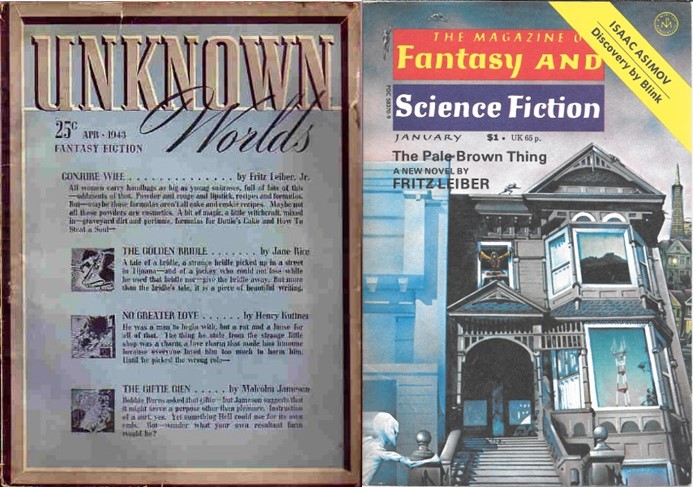
The Magazine of Fantasy and Science Fiction January 1977 cover by Ron Walotsky
Our Lady of Darkness was originally published “The Pale Brown Thing” in two issues of The Magazine of Fantasy and Science Fiction and as a stand-alone novel by Berkley/Putnam in February, 1977. The novel version is an expanded version of the story and Leiber views them as two different tellings of the same events. The novel was nominated for the Ditmar Award, the Gandalf Award, and the World Fantasy Award, winning the last. Pringle also lists it in his Modern Fantasy: The Hundred Best Novels.
It represents a revisiting of the occult in the real world for Leiber, this time set in San Francisco instead of at a fictitious Northeastern college. With references to real life authors and thinly disguised versions of science fiction fans and authors, as well as Leiber being the model for the protagonist, Our Lady of Darkness offers Leiber a chance to create a more textured world than in Conjure Wife.
Leiber starts out on the right foot with a suitably gothic description of San Francisco before introducing his protagonist, Franz Westen, the similarity of whose first name indicates that he is at least loosely based on Leiber himself. Westen lives in a resident hotel, but while Saylor in Conjure Wife lived with his wife and had friends, but was secluded from them all, Westen has a thriving support group in the other residents of the hotel, as well as the landlady and her family, almost immediately making Westen a more sympathetic and fully formed character than Saylor.
A recovering alcoholic and widower, Westen is a writer who manages to make a living writing novelizations of a television show and trying to bring literary merit to them. His adventure into darkness begins when he thinks he sees an odd figure on the top of Corona Heights. When he visits the hill and looks back at this apartment through binoculars, he thinks he sees the figure moving around inside his apartment.
His sense that something supernatural may be happening is heightened by his reading of a journal he believes to have belonged to author Clark Ashton Smith, as well as a book called Megapolisomancy: A New Science of Cities, by a mysterious author named Thibaut de Castries. Smith, the book by de Castries, and the feeling of supernatural beings combine together to build up tension about what is real and how spirits might continue to inhabit buildings and cities long past their supposed deaths.
While Leiber does a mostly excellent job of building up the tension as Westen discovers more and more parallels between himself and de Castries, he does, unfortunately, undermine the gothic feel of the story when Westen visits his friend, Jaime Donaldus Byers, which results in a length ata dump in which Byers provides Westen with the missing information about de Castries, his life, and theories. Once Westen has this information, however, Leiber is able to recapture the darkness and paranoia the story needs in order to be successful.
Our Lady of Darkness is also a love letter to the authors who influenced Leiber’s career and style. In addition to Clark Ashton Smith’s journal playing a major role in Westen’s descent into madness, authors like Ambrose Bierce, H.P. Lovecraft, and Jack London are all woven into de Castries’ story, with the implication that their own fates were all tied to de Castries’ ideology and curse, which Westen comes to believe has targeted him.
Although Our Lady of Darkness is a stronger story than Conjure Wife, the two novellas form a fantastic pairing with both following the gras the supernatural and paranoia have on an individual. In one case, Saylor is intellectually and emotionally isolated from those who surround him. In the other case, Westen, who appears to be isolated, is surrounded by a strong support system of friends who are able to help him work through the issues, because even if he doesn’t, or can’t, tell them everything, he is able to share enough with them that they can be there for him.
Wayne Barlowe provided the cover. In 2014, Black Gate editor John O’Neill discussed several of the covers used for reprints of Conjure Darkness over the years, although he didn’t discuss this one. When Orb books reprinted the book in trade paperback in 1999, it used the title Dark Ladies. This was the final volume in the Tor Double series and, at 347 pages, is the longest book in the series.
 Steven H Silver is a twenty-one-time Hugo Award nominee and was the publisher of the Hugo-nominated fanzine Argentus as well as the editor and publisher of ISFiC Press for eight years. He has also edited books for DAW, NESFA Press, and ZNB. His most recent anthology is Alternate Peace and his novel After Hastings was published in 2020. Steven has chaired the first Midwest Construction, Windycon three times, and the SFWA Nebula Conference numerous times. He was programming chair for Chicon 2000 and Vice Chair of Chicon 7.
On a vacation visit to San Francisco many years ago, I pointed to the Transamerica Pyramid, and said to my family, “Behold the focus of all occult energy in North America!”
They’ve grown adept at ignoring such outbursts.
After hearing so many recommendations about it, I got the 1/77 F&SF to read “The Pale Brown Thing”, and I thought it was quite good.
I get your point about the data dump in LofD. Narratively it is weak. But I thought the writing of this section was hypnotic–a real highlight that still sticks out to me from the book. I think it’s akin to dialogue between Tarantino characters–not narratively elegant, but magnetically captivating.
I haven’t made a side-by-side read of the two versions, but I’ve always preferred “The Pale Brown Thing” to Our Lady of Darkness (except for that title!). It may be nostalgia, as reading the serialized version when I was 17 was a great experience. But I have the same feeling about “You’re All Alone” and its expansion The Sinful Ones. The narrower blade cuts deeper, maybe. Or maybe I just always prefer the version I read first.
There are some great things in Conjure Wife, but I think you’re right about the misogyny spoiling it. Here’s one where I’d like to have Leiber’s second thoughts a decade or two later—maybe after some conversations with Joanna Russ. The Female Conjureman?
Thanks for this series of great reviews.
I’ve had this volume on my shelves for many years, by the title Dark Ladies, as it was called in the 1991 release. But I have to say it’s for Conjure Wife that I’ve kept it there.
I don’t think I can see Conjure Wife as misogynistic. It’s not an expression of some bias against women on Leiber’s part that has Hempnell College an institution with only male faculty, and Tansy Saylor a faculty wife without a career: It’s a realistic portrayal of how things commonly were in 1943. Consider that women in most occupations were commonly expected to retire when they married, and that so eminent a university as Harvard refused to list Cecilia Payne-Gaposchkin’s courses in its catalog until 1945, despite her high reputation in astronomy. And Leiber makes a point of Hempnell being a conservative, even stodgy institution, contrasted with big city universities, which a local politician denounces as “hotbeds of communism and free love” (which Leiber surely means ironically). I also note that Leiber shows this narrowness as a source of emotional disturbances for most of the faculty wives, against which Tansy and eventually her husband Norman struggle. In fact, the repressive treatment of women is the power source for Leiber’s plot.
I also have to say that I don’t find the plot of Our Lady of Darkness as well integrated as that of Conjure Wife. It has interesting elements, but for me it feels like Leiber writing a pastiche of Leiber. Though of course there’s no accounting for tastes.