Forgotten Authors: Nat Schachner
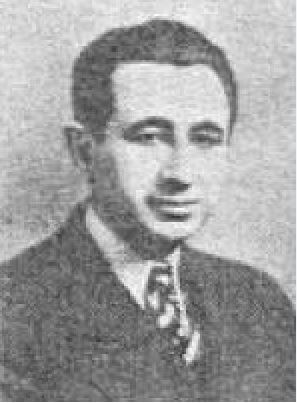
Nat Schachner was born on January 16, 1895 in New York. He earned a Bachelor of Science in chemistry from City College in 1915. He served in the U.S. Army during World War I in the chemical warfare service from 1917 to 1918 and, when he returned to New York he earned a Doctor of Jurisprudence from New York University in 1919, the same year he married Helen Lichtenstein. The couple would have a daughter. He worked as an attorney until 1933 when he became a freelance writer.
On April 4, 1930, Schachner, along with G. Edward Pendray, David Lasser, and Laurence Manning, founded the American Interplanetary Society, which would be renamed the American Rocket Society four years later. The organization designed and launched liquid fueled rockets and in 1936 the organization was awarded the Prix a’Astronautique by the Société astronomique de France.
1930 also saw the start of his career as an author with the publication of “The Tower of Evil,” which he co-wrote with Arthur Leo Zagat. The two men collaborated on eleven stories published in 1931 before both turning to their solo careers as authors.
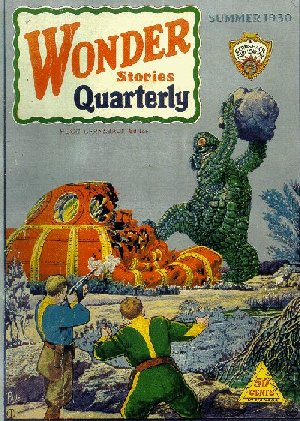
Schachner’s first solo story was “Pirates of the Gorm,” which appeared in Astounding Stories in the May 1932 issue. His most famous story appeared in the December 1933 issue, “Ancestral Voices,” a time travel story the was an early example of the grandfather paradox, although in this case, Emmet Pennypacker travels back to the fifth century and kills a Hun who was a distant ancestor of his. Although known for the grandfather paradox, Schachner has stated that the story was a commentary on the destructiveness of the concept of racial purity that was popular in the 1930s.
The same year “Ancestral Voices” was published, Schachner published the three stories which made up “The Revolt of the Scientists,” which was set in the then near-future of 1937, indicating that a technocratic society held the keys to lifting the country out of the throes of the Great Depression.
As the Nazis and Fascism rose to power in the late 1930s, Schachner continued to address their ideas in his fiction, focusing on championing human liberties in his writing, and writing stories in which authoritarianism was ultimately defeated. By 1935, he was writing “World Gone Mad” in which Schachner warns the reader of about the pending global war, although Schachner sets it in 1990, with the U.S. on one side and the Sino-Russian alliance and United Europe on the other side. Despite coming up with interesting ideas and trying to include messages in his fiction, Schachner’s fiction rarely rises about average. Paul A, Carter, writing in The Creation of Tomorrow: Fifty Years of Magazine Science Fiction, described Schachner as “the earliest of pulp science fiction’s anti-Nazi Paul Reveres…”
In 1937, Schachner published Aaron Burr: A Biography, launching a new writing career for himself. He continued to publish science fiction through 1941, with the story “Eight Who Came Back” in the November issue of Fantastic Adventures, but after that he focused on biographies, publishing books on Alexander Hamilton (1946), Thomas Jefferson (1951), and The Founding Fathers (1954). He also published a work on Medieval universities in 1938.
Serving on the editorial committee for the American Jewish Committee, he published The Price of Liberty: A History of the American Jewish Committee in 1948. He would also go on to serve as the Director of Public Relations for the National Council of Jewish Women from 1954 until 1955.
Schachner died in Hastings-on-Hudson on October 2, 1955. He is buried in Mount Hope Cemetery in Hudson-on-Hastings, New York.
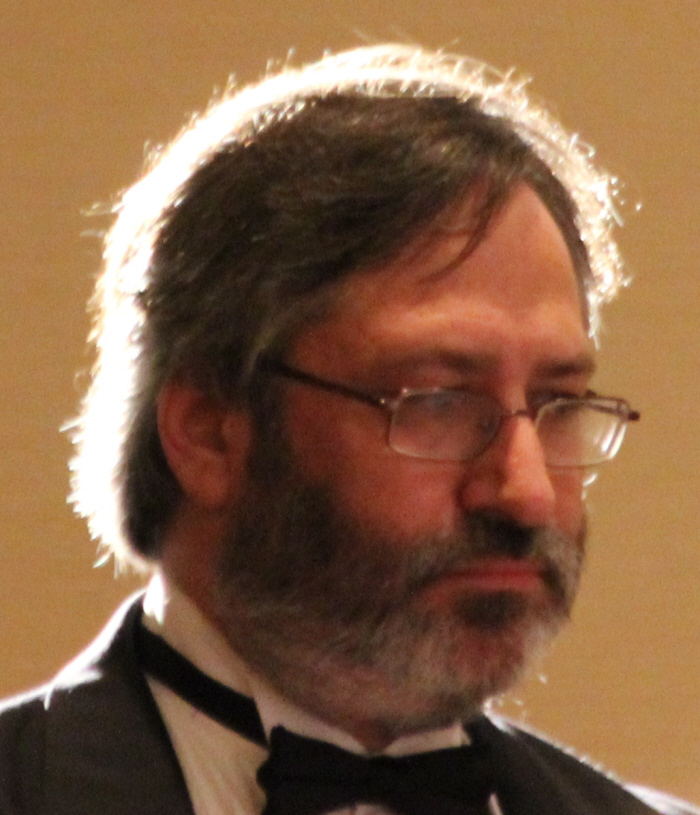 Steven H Silver is a twenty-one-time Hugo Award nominee and was the publisher of the Hugo-nominated fanzine Argentus as well as the editor and publisher of ISFiC Press for eight years. He has also edited books for DAW, NESFA Press, and ZNB. His most recent anthology is Alternate Peace and his novel After Hastings was published in 2020. Steven has chaired the first Midwest Construction, Windycon three times, and the SFWA Nebula Conference numerous times. He was programming chair for Chicon 2000 and Vice Chair of Chicon 7.
Nat Schachner was another writer I was introduced to via Isaac Asimov’s “Before the Golden Age” anthology (someone really should reprint it, but that’s another story). The Good Doctor included the story “Past, Present and Future”, of which he said, “and at the time I enjoyed it nearly as much as I did Galactic Patrol.” Of Schachner himself, Asimov said, “Schachner was one of my favorite writers for the Tremaine Astounding.”
I agree he’s forgotten, and he joins a growing legion of writers who current readers will have no clue as to who they are.