Half A Century of Reading Tolkien: Sir Gawain and the Green Knight, translated by JRR Tolkien
From beside the queen Gawain
to the king did then incline:
‘I implore with prayer plain
that this match should now be mine.’
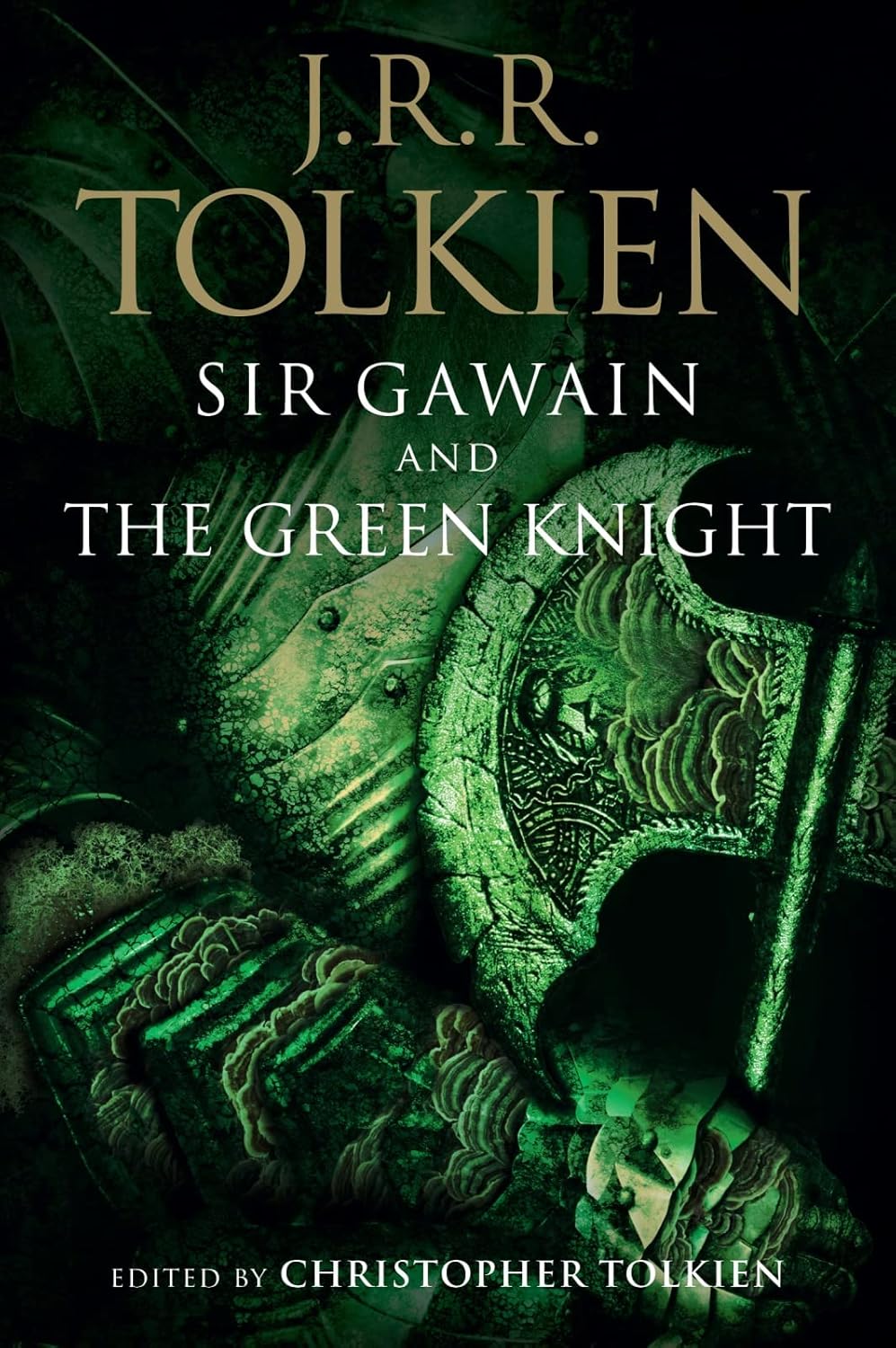
Somehow, I’ve never read Prof. Tolkien’s, let alone anyone’s, translation of Sir Gawain and the Green Knight (late 14th cent.), an English poem written by an unknown poet. Thinking on it, I know there’s a cheesy looking movie, Sword of the Valiant, from the eighties starring Miles O’Keeffe and Sean Connery, but it was only David Lowery’s 2021 The Green Knight and its critical acclaim that made me think it was maybe time to read the poem. Now I have. Additionally, and most valuable to me wrestling with my understanding of the poem, I’ve also read the professor’s 1953 WP Ker lecture on work.
The poem recounts the temptations of Sir Gawain, youngest member of King Arthur’s Round Table, as he attempts to meet the suicidal obligation he accepted when he entered a contest with a mysterious green knight. More precisely, as told, it’s about the conflict between chivalrous virtues of honor and courtesy and, specifically religious, morality.
Gawain was written in Middle English, the evolution of the language used between the Conquest in 1066 and the late 15th century. Gawain, son of Morgause, one of King Arthur’s half-sisters, is a major figure in many of the assorted Arthur tales. His roots descend back into older Welsh tales, where he was known as Gwalchmei. Pre-Christian elements, including the Beheading Game and the Wild Hunt, are integral parts of the story, despite the tale’s overt Christianity. The Beheading Game is a recurrent motif that tracks back to at least the Irish tale Fled Bricrenn featuring the hero Cú Chulainn and the Wild Hunt occurs across various Northern European myth cycles.
The poem begins with a recounting of Britain’s founding by Brutus of Troy. Noble as he was, young King Arthur of Camelot was nobler still. One Christmas season, as Arthur’s knights were celebrating with a games and contests, a strange figure entered the hall.
For hardly had the music but a moment ended,
and the first course in the court as was custom been served,
when there passed through the portals a perilous horseman,
the mightiest on middle-earth in measure of height,
from his gorge to his girdle so great and so square,
and his loins and his limbs so long and so huge,
that half a troll upon earth I trow that he was,
but the largest man alive at least I declare him;
and yet the seemliest for his size that could sit on a horse,
for though in back and in breast his body was grim,
both his paunch and his waist were properly slight,
and all his features followed his fashion so gay
in mode;
for at the hue men gaped aghast
in his face and form that showed;
as a fay-man fell he passed,
and green all over glowed.
Even his stallion is green. He has arrived at Camelot, he declares, to see how brave the knights of the Round Table really are. Not in combat, though, as they are “but beard less children.” No, what the Green Knight wants is to strike blow for blow with his great axe anyone brave enough to accept his challenge. For playing along, he will let that person keep the axe.
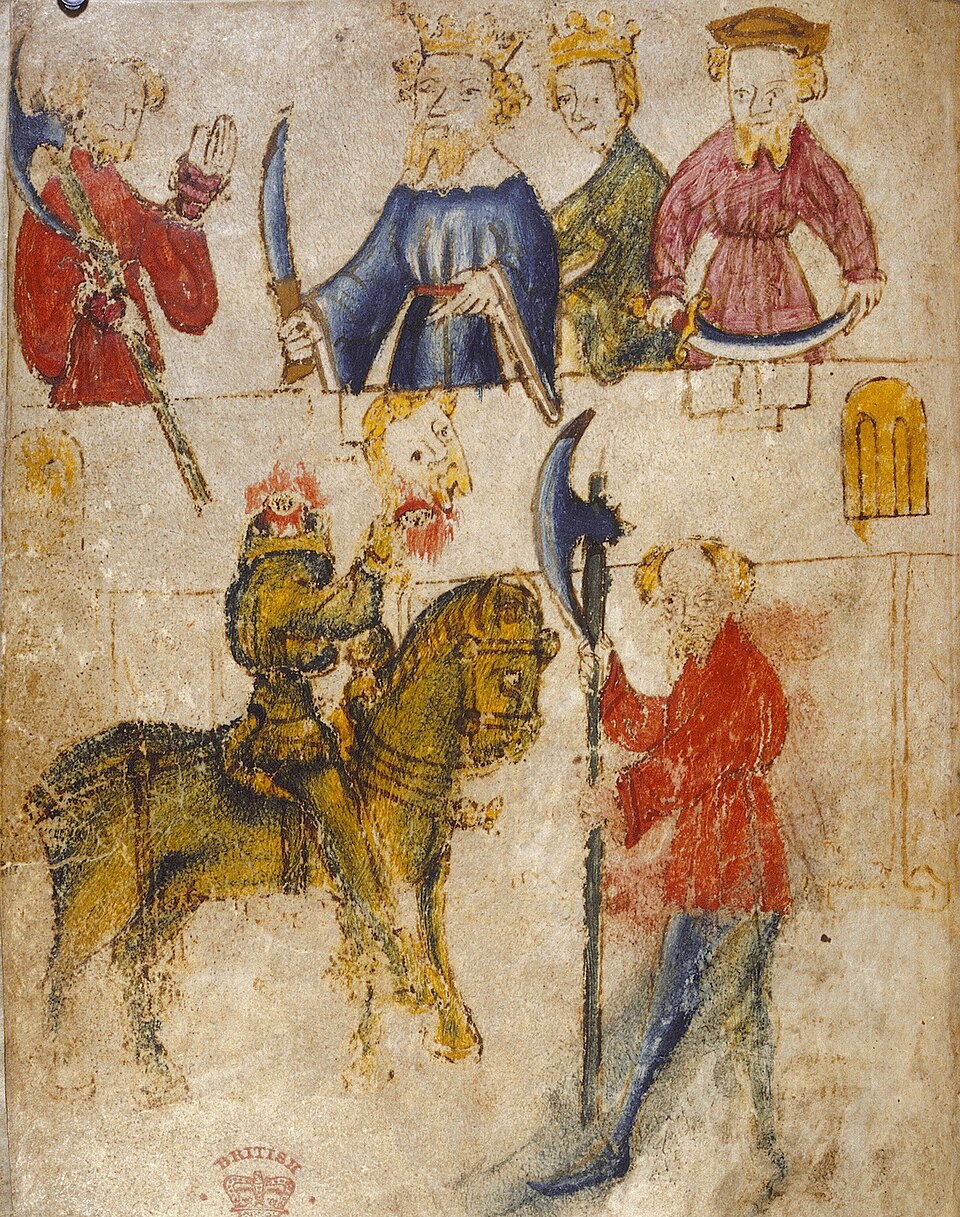 When no one steps forward, King Arthur, himself, raises his voice to take on the Green Knight, himself. At once, Gawain steps in to put himself between the king and any harm that might befall him. In a sharp bit of commentary, Gawain calls out his own weaknesses even while upbraiding his fellow knights for their apparent cowardice.
For I find it unfitting, as in fact it is held,
when a challenge in your chamber makes choices so exalted,
though you yourself be desirous to accept it in person,
while many bold men about you on bench are seated:
on earth there are, I hold, none more honest of purpose,
no figures fairer on field where fighting is waged.
I am the weakest, I am aware, and in wit feeblest,
and the least loss, if I live not, if one would learn the truth.
If his the knight’s green cast hadn’t hinted that strange things were at hand, it’s made abundantly clear once Gawain delivers his blow and lops the challenger’s head from his shoulders. Just because he’s headless, it doesn’t mean Arthur’s champion is off the hook. Never faltering, the Green Knight reaches for his head and holds it aloft to the king and his household.
For the head in his hand he held it up straight,
towards the fairest at the table he twisted his face,
and it lifted its eyelids and looked at them broadly,
and made such words with its mouth as may be recounted.
‘See thou get ready, Gawain, to go as thou vowedst,
and as faithfully seek till thou find me, good sir
as thou hast promised in this place in the presence of
these knights.
To the Green Chapel go thou, and get thee, I charge thee,
such a dint as thou has dealt — indeed thou has earned
a nimble knock in return on New Year’s morning!
One might think Gawain would set forth as soon as able, but he doesn’t, instead remaining with Arthur until All Hallows. As he prepares to leave, the poet provides a detailed description of the young knight’s livery. On both his baldric and his shield is a pentangle, a five pointed star.
First faultless was he found in his five sense,
and next in his five fingers he failed at no time,
and firmly on the Five Wounds all his faith was set
that Christ received on the cross, as the Creed tells us,
and wherever the brave man into battle come,
on this beyond all things was his earnest thought:
that ever from the Five Joys all his valour he gained
that to Heaven’s courteous Queen once came from her
Child.
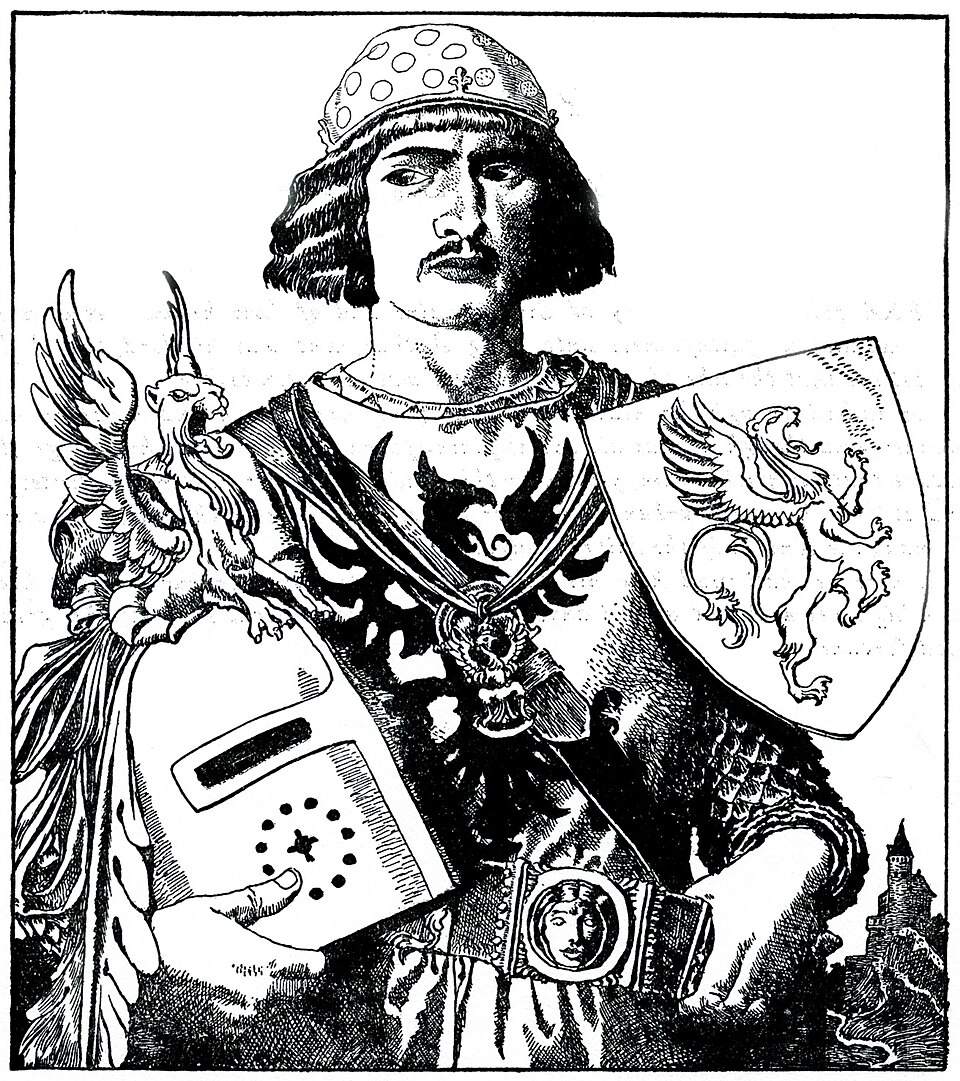 Tolkien describes this as instrumental to understanding the poem’s Christian context, as it represents the highest Christian ideals, the things Gawain aspires to embody and uphold:
For the significance that the pentangle is to bear in this poem is made plain — plain enough , that is, in general purport: it is to betoken ‘perfection’ indeed, but perfection in religion (the Christian faith), in piety and morality, and the ‘courtesy’ that flows therefrom into human relations; perfection in details of each, and a perfect and unbroken bond between the higher and lower planes.
For nearly two months, Gawain roams the land in search of the Green Chapel and its lord. Traveling across the wild countryside in search of the Green Chapel, his adventures, while extensive by any hero’s standard, are described in only a few sentences. They are merely something Gawain endures prior to the real struggle he must face in fulfilling his obligation to the Green Knight.
At every wading or water on the way that he passed
he found a foe before him, save at few for a wonder;
and so foul were they and fell that fight he must needs.
So many a marvel in the mountains he met in those lands
that ‘twould be tedious the tenth part to tell you thereof.
At whiles with worms he wars, and with wolves also,
at whiles with wood-trolls that wandered in the crags,
and with bulls and with bears and boars, too, at times;
and with ogres that hounded him from the heights of the fells.
Only a few days before New Year’s Day, Gawain comes across a castle, “the castle most comely that ever a king possessed,” deep in the wild forest. He is welcomed there by the lord and his wife. Aside from the lord and lady and their servants, there is a mysterious ugly old woman in the castle, whom everyone treats with great respect. They are honored and pleased to welcome such a notable as Arthur’s knight. On hearing of his quest, the lord tells him nearby is a path that lead to the chapel which is only two miles away. He also suggests that Gawain rest and recover until New Year’s Day, an offer the knight readily accepts. The lord also proposes a bargain; he will go hunting while the knight rests. At day’s end, the lord will give him whatever he catches in return for whatever gift the knight might receive during the day. Again, Gawain accepts the offer.
The poem continues the next morning with a detailed accounting of the lord’s hunt for deer in the forest. Tolkien points out that this is a realistic portrayal of a lord’s necessary activity during the winter as well as a providing a realistic reason for him to be away from the castle. That is important for the next part of the Gawain’s story.
It is on the very next morning that the real nature of Gawain’s struggle is revealed. What follows are three days of escalating temptation for Gawain. He is awoken by the castle’s lady with clearly lascivious intent. Her servants and maids are still asleep, and she’s “the door closed and caught with a clasp that is strong.”
To my body will you welcome be
of delight to take your fill;
for need constraineth me
to serve you, and I will.’
He is able to hold her off, though he finds doing so without being discourteous difficult. Nonetheless, he resists her persistent ardor and she retreats after giving him a single kiss. He dresses at once and proceeds to Mass.
She was an urgent wooer,
that lady fair of face;
the knight with speeches pure
replied in every case.‘Madam,’ said he merrily, ‘Mary reward you
For I have enjoyed, i n good faith, your generous favour,
and much honour have had else from others’ kind deeds ;
but as for the courtesy they accord me, since my claim is not equal,
the honour is your own, who are ever well-meaning.’
The lord returns from his hunt with supply of venison which he gives to Gawain. When the knight gives him a kiss in return, he asks him “where you won this same wealth by the wits you posses.” Gawain responds ‘That was not the covenant,’ quoth he. ‘Do not question me more.”
This is the template for the remaining two days, but in each, the risk for Gawain increases. The lady becomes more forward and direct with each new morning. The young knight finds it increasingly difficult to hold off her advances, again, remaining courteous, faithful to the lord’s hospitality, and true to Christian values.
This, Tolkien explains, is the real heart of the poem and Gawain’s challenge: “The author is chiefly interested in the competition between ‘courtesy’ and virtue (purity and loyalty); he shows us their increasing divergence, and shows us Gawain at crisis of the temptation recognizing this and choosing virtue rather than courtesy, yet preserving a graciousness of manner and a gentleness of speech belonging to the true spirit of courtesy.” He fins this made clear in the following lines.
for she, queenly and peerless, pressed him so closely,
led him so near the line, that at last he must needs
either refuse her with offence or her favours there take.
He cared for his courtesy, lest a caitiff he proved,
yet more for his sad case, if he should sin commit
and to the owner of the house, to his host, be a traitor.
‘God help me l ‘ said he. ‘Happen that shall not !’
On the second day she is more forceful and he ends up receiving two kisses. On the third, it’s three kisses, but he doesn’t escape with quite intact. The lady presses on Gawain a green girdle she wove that will prevent any who wear it to be killed “by any cunning of hand.” Prompted as much by courtesy as fear, he accepts it. More important, he does not present it to the lord as one of the gifts he received that day, instead only giving him three kisses.
As I reach the poem’s climax, I’ve realized I haven’t said anything about my own reactions to it. I guess I’d have to say I’m swayed by Prof. Tolkien’s interpretation. In the poem’s final stanzas, it’s made clear that not only was the Green Knight’s challenge a game, but everything in the tale is a game. That is, the lady’s attempted seduction of Gawain is never real, only an effort to force him to fail to uphold his professes virtues, broken on the contradictions between his obligations to the lord, the lady, and Christian morality. It was all planned as an attack on Arthur, Guinevere, and the Round Tables and its knights. I didn’t have to be swayed very much, as the poet’s intent seems fairly clear, nonetheless, I appreciate his explication.
There’s real power in the poem, as I think is clear from lines I’ve included. The moments of weirdness serve as a connection to the deeper stories that run back to very roots of myths and legends. But there’s also a real, psychological depth to Gawain that’s often lacking in characters from fairytales and the like. There’s real anguish in his struggle to simultaneously maintain his honor and his virtue. It isn’t a simple morality play, but possessed of real human complexity. It’s not without value studying Gawain’s efforts in this parlous age.
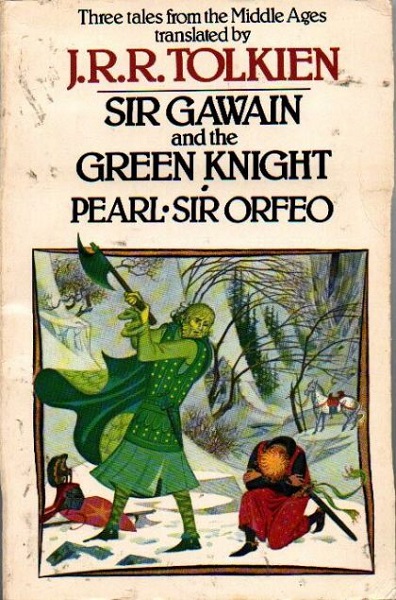 Confessing his sins the night before, on New Year’s Day, Gawain sets out. Instead of the expected chapel, the Green Knight’s abode is a cave set in an earthen mound, with more hint of Devil than Christ to it. What follows is the direst test of the young knight as he braves the “Danish axe newly dressed the dint to return, with cruel cutting-edge curved along the handlefiled on a whetstone, and four feet in width” of his challenger.
When the Green Knight swings his axe, Gawain flinches. Reproached for cowardice, a second strike is delivered, though this stops short of touching Gawain’s neck. When Gawain demands a third, true blow, he is rewarded with a slight wound to his neck. At this point, all is revealed.
The Green Knight is none other than the lord of the castle and the whole thing was planned by the old woman at the castle. She is, in fact, Morgan le Fay, Arthur’s half-sister and Gawain’s aunt. She hoped the sight of the Green Knight’s talking severed head would scare Guinevere to death and that one of Arthur’s knights would fail to maintain his virtue. He only wounded Gawain at all because he hid his receipt of the girdle.
This last breaks Gawain. He believes he has failed, giving into cowardice and not remaining true to his promise to the lord, condemning himself: ‘Cursed be ye, Coveting, and Cowardice also I In you is vileness, and vice that virtue destroyeth.’ No one else, though, agrees. The lord laughs and rejects this as Gawain, save for valuing his life a little too much, has met the other challenges perfectly and extends an invitation to his New Year’s celebrations. On returning to Arthur, the king and his knights also reject Gawain’s self-denouncement, instead, choosing the green girdle as a reminder of Gawain’s adventure and virtue.
I need to think about Sir Gawain and the Green Knight some more and reread it a few more times before I come to anymore conclusions on in it. As with Tolkien’s translation of Beowulf, I enjoyed reading this and found it flowed and moves with a nice rhythm. There are two other poems in the collection I have, Pearl and Sir Orfeo, which I haven’t read yet, but will the next time around.
Half a Century of Reading Tolkien: Part One
Half a Century of Reading Tolkien: Part Two – The Fellowship of the Ring by JRR Tolkien
Half a Century of Reading Tolkien: Part Three — The Two Towers by JRR Tolkien
Half a Century of Reading Tolkien: Part Four — The Return of the King by JRR Tolkien
Half a Century of Reading Tolkien: Part Five — From the Beginning: The Hobbit by JRR Tolkien
Half a Century of Reading Tolkien: Part Seven — The Sword of Shannara by Terry Brooks
Half a Century of Reading Tolkien: Part Eight — The Silmarillion by JRR Tolkien
Grimmer Than Grim: The Children of Húrin by J.R.R. Tolkien
Fletcher Vredenburgh writes a column each first Sunday of the month at Black Gate, mostly about older books he hasn’t read before. He also posts at his own site, Stuff I Like when his muse hits him
I bought Tolkien’s Green Knight not long after watching the newest movie. I haven’t read it yet, but it is on the (admittedly long) list.
One thing from the movie that really jumped out at me was when the Green Knight first comes into Camelot and issues his challeng and Gawain takes it up, Arthur (in a moment that both steals the scene and explains why he’s king) reminds his nephew “‘Tis just a game, Gawain.”
Which hints, to me, that Arthur knows that the rules of the game are made by whoever strikes the first blow, and that blow doesn’t have to be fatal.
I need to sit down and really watch the movie. It’s gorgeous, but doesn’t seem to have much use for the themes of the poem. Tolkien does point out, though, that both the Green Knight’s challenge and the gift swapping are only games and Gawain is far truer to their rules than anyone else.
What’s that line from the Anthony Hopkins movie “the Edge”– something like “People lost in the woods die of shame–the shame of realizing that fifteen minutes ago they made a decision that is going to get them killed.”
Gawain made a series of decisions that, shortly after he made them, revealed that he was likely to die.
As a sidelight — I’ve read and even taught Tolkien’s version, but I like better Brian Stone’s for Penguin Classics for bounce and readability. But Sir Gawain and the Green Knight and Malory’s Morte must be my favorite works of medieval literature, above (for me personally) both the Canterbury Tales and the various sagas I’ve read in translation. By the way if no one here has reviewed Grettir’s Saga, that’d be worth considering. It was, after all, Sam Moskowitz’s reprinting of a version of a key episode from that saga, in his anthology Horrors Unknown, that was one of my first glimpses of the saga-world.
I’ve been meaning to add the Icelandic Sagas to my work here at some point (I have no idea exactly when my Tolkien articles will wrap up). I’m also aiming to read Penguin’s Irish Myths this year. I still need to read Morte, especially after rereading TH White a few years ago. That, and his extensive hawking/hunting knowledge formed the basis for his book. And I’m definitely down with reading Stone’s translation. Note, does it really count as a translation if it’s ‘just’ and updating of an old form of English?
Huh. Maybe, just maybe, this is a Tolkien work I’ve read and enjoyed. When was it, when was it…was I ten? Nine? It can’t have been the translated poem version I read, so perhaps a child-adapted prose version of the story, but I remember that passage of analysis/explanation. Gosh, the memory, that was one of those afternoons when summer break seemed to last forever. Cold radiators, dancing dust motes in sunbeams, the feel of apple tree bark still pressed into one’s palms, and fresh paper at one’s fingertips. Wow. Thanks for reminding me.
“Sir Gawain and the Green Knight” was the one Arthurian tale I liked beyond the retrieval of Excalibur and the relinquishment of Excalibur. It’s a weird one, but it embodies what knights are supposed to be, down to the type of singular mistake. The pressing temptation always came across as unutterably cruel, and the queen being the vehicle thereof was distasteful, since it played into the v.-m.-or-w. paradigm for women in tales. But Gawain’s journeys in search of the chapel were wonderful, and the Green Knight himself was compelling. Infuriating in his laughter when Gawain gets angry at him for missing the chop three times, but compelling.
Funny, the things that get censored for kids. In the version I read, the girdle was a green scarf.
I need to read Malory and get into the weirdness of the Arthur Cycle. It’s one of my favorites stories, but I only really know it from modern interpretations. As to v-m-w, sure, and there’s a bit after all’s been revealed where Gawain rants about the Biblical men beguiled or betrayed by women.
That’s not surprising. X) It was probably downplayed in the child’s version, because I only vaguely recall an allusion to Delilah. Or maybe it was there, but I don’t remember because I was being called outside to climb the apple tree again.
I had to read the Tolkien version years ago for an English Literature class and was surprised at how much I enjoyed it (I’ve never been able to get into Beowulf)
The poem is interesting trying to figure out which parts predate Christianity.
I’ve also never been able to get into Mallory’s Arthur stories. They are just too bland and written as telling a list of events.
I have not gotten around to reading this.
But I LOVE The Sigurd and Gudrun book. Hope you tackle that one.
Did you try to read the Middle English? I read the Canterbury Tales in Middle English and a) found it fairly easy to get into a rhythm of reading (with occasional glances at notes or at a translation), and b) found it far superior in the original than to translations I’ve seen. I would assume Sir Gawain (and other poems by the same person such as Pearl) would also be readable, as they date to roughly the same time.
I read it back in the early eighties. I forget which edition but it may well have been the Tolkien. My admittedly surface reading was that the tale was commenting on the inherent tragedy of chivalry due to the inherent weaknesses of human nature. I enjoyed it at the time and I’d like to do a reread at some point but I’ll be looking at other versions. My take on Tolkien is that he’s a better scholar than storyteller and if I were tackling the tale for the first time I’d use his notes as supplemental reading.
I may take a look at the Lowery film adaptation someday but have to admit that whatever the widespread praise it garnered the clips I saw looked disappointingly like a crappy Netflix TV movie.