Friendships Matter
Good afterevenmorn, Readers!
I’m going to rant a bit this post, so if apologies in advance for getting too serious about things that are, in fact, quite fun.
I want to talk friendships. Friendships in fiction, specifically, and how they’re often hijacked by well-meaning, representation-starved folks, and how that robs us of examples of deep, meaningful, powerful, but entirely platonic love in real life. And I think that’s more than a shame. It’s a crime.

First, let’s all agree that fiction is absolutely both a reflection and driver of culture. There are articles upon articles about how reading fiction can help shape people and how they relate to the world around them. Reading fiction makes people more empathetic. It can give traditionally marginalised communities visibility that they might otherwise not. It can normalise relationships that might otherwise be considered “other” or “strange” and therefore unwelcome. Hell, just recently I read of a hockey player who came out publicly — one of the first in the sport — because of the wild popularity of the Canadian smash hit Heated Rivalry.
The ability of fiction to set cultural norms is incredibly powerful. Were it not, no one would bother trying to ban books.
(As an aside, if anyone is trying to ban a book, head to the nearest library and give it a read. There’s something in those pages they don’t want you to know, and we all know knowledge is power)
Anyway, the point is, the power of fiction is not hypothetical. It is real, and measurable.
And so I find myself feeling quite sad when stories involving friendships that are profound and powerful are accused of ‘queer-bating’ or have the deep, real love of a friendship ignored in favour of a romantic explanation.
Sometimes it feels like I am the only one in the world that feels that the love between friends can and should be powerful, true and profound without involving romance (or any of its analogues) at all, and that we ought to have that reflected — and accepted as such — in the fiction we consume.
I remember in high school getting into an argument with a boy in my class, who mocked the relationship between Frodo and Sam in The Lord of the Rings. You know, back in the day when “gaaaaaay” was considered both an acceptable and also somehow clever slur. I got so angry at him (for multiple reasons), not understanding how he could not see that yes, Sam and Frodo absolutely loved on another. But no, it was not gay. That was friendship; deep, profound and true. But entirely platonic.
Then I got sad. Sad for him, and everyone who thinks like him. I thought then, and still do now, that perhaps they didn’t know what friendship could be. That they didn’t feel loved and cared for by their friends. Sure, I had very few friends, and indeed still have few friends, but those I consider my friends I know I can rely on when things become hard. I feel safe and loved, and I love them fiercely in return. I would fight the devil himself for them. None of this is romantic. The love is platonic. But it is fierce, and it is profound.
This interpretation of Frodo and Sam as lovers instead of friends is pervasive. It happens constantly. And every time I get angry that friendship isn’t given the respect it deserves, and then sad because how have so few people experienced friendship in this way?
The same thing happened with Sherlock — particularly the BBC’s adaptation. Sherlock Holmes and Dr. John Watson were shipped together, accused of being written as romantic partners (but never actually being romantic partners) to queer-bait the audience, or otherwise just written off as gay by those who could not understand the nature of friendship.
I’d get the same flash of anger followed by sadness every time I would hear or read about it.
There are countless examples of friendships being hijacked by others to be queer representations, or suffer under accusations of just teetering on the edge, or outrightly dismissed. The dismissal is exponentially worse should the friendship be an opposite sex pairing.
It honestly has me astounded and saddened.
Surely people know how deep friendships can run, right? Surely they know that not every expression of love is romantic in nature, right? Surely, friends can be friends without fear of ridicule or having their relationship misconstrued?
The shipping I can understand at least. The LGBTQ+ community has long been ignored by mainstream fiction. Representation for them had to be scraped from breadcrumbs by creatives too scared to make such relationships explicit. Starved for representation, these people found community in fan fiction and forums dedicated to scraping what they could find from the crumbs they were offered.
Publishing houses are about making money. And the money can only come from sales. In order ot appeal to the broadest possible market, risks like proudly publishing the stories of marginalized folks would not really be taken (until someone does, and it usually pays in spades. Again pulling Heated Rivalry as the example here).
Only recently have such relationships been able to be explicit in more mainstream fiction, and even then, not last week I read an article about the move of the main publishing houses once again shying away from LGTBQ+ stories in fear of the modern climate. An unwelcome capitulation, I feel.
With representation being implied, it’s no wonder folks are seeing queer love everywhere, even if it’s not meant to be there.
But that still, doing this robs representation of profound platonic love. And I feel that we need examples of that more than ever. Humans, I feel, were built for connection. We’re made to love. Not every love must be romantic, however. And if we insist that romance is the only acceptable way for two adults to love one another, we’re robbing ourselves of a richer, kinder, better world.
I really feel we need more representation of profound love that is also platonic. We’ve been getting a couple that I’ve really enjoyed. I adore the friendship between Shang-Chi and Katy in Shang-Chi and the Legend of the Ten Rings. I loved that they were really good friends, with no real indication of romance involved. I needed to see that.
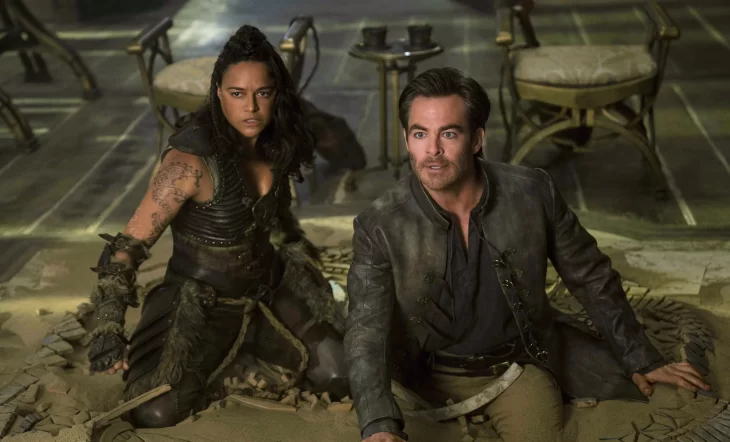
Dungeons & Dragons: Honour Among Thieves also did it right, with the friendship between Ed and Holga. Hell, they raised a child together, and never once was the love between them portrayed as romantic. They were good friends – ride or die, and it was so damned beautiful to me.
And despite all the shipping and arguments I’ve had with acquaintances, I also love the deep love between Frodo and Sam, and Sherlock and John, and I will defend their platonic depths until the end of my days.
But that’s precious little representation. And I want more. I want to see more incredible, deep loves that aren’t romantic. I want to see people who would gladly tear the world apart for one another and it’s not because they want to sleep together.
Perhaps if we see more examples in our fiction, in the things we consume to feed our minds and soul, maybe we’ll let ourselves love more freely, without fear of it being misconstrued. Maybe if we collectively decide that friendships matter in society as much as romantic relationships do, life will feel a little less lonely.
I fear for our ability to be fully human if we continually dismiss platonic love, and if we rarely ever see it portrayed in our media, we might lose the ability to model that kind of love entirely. Friendships matter, even in fiction. Especially in fiction.
Anyway, just musing out loud. What do you think?
When S.M. Carrière isn’t brutally killing your favorite characters, she spends her time teaching martial arts, live streaming video games, and sometimes painting. In other words, she spends her time teaching others to kill, streaming her digital kills, and sometimes relaxing. Her most recent titles include Daughters of Britain, Skylark and Human. Her next novel The Timbercreek Incident releases 2026.
To a large extent, I agree with you, SMC, but at the same time, I’m kind of “there’s nothing new under the sun” about it. My tracing of this round of the problem you’ve identified goes back to the ’60s, and has nothing to do with representation, but everything to do with the delight in rebellion against norms that led to the “Free Love” movement. Notice that in that movement, “love” became widely conflated with “sex” as somehow identical terms. Prior to that, western society had at least *some* understanding of the Greek verbal concept of multiple types of love (philos, eros, agape, storge, etc.), but since the ’60s we’ve been raising our kids with the confused notion that “sex=love, so love=sex.” (You ought to see the scandalized shock on people’s faces the first time they see the BBC/A&E “Pride and Prejudice,” and Mr. Bennet says, “Oh, I’m prodigiously proud of [Mr. Wickham] […] He simpers and preens and makes love to us all.” I’ve seen it happen on my oldest cousin, my generation of friends, and now my youngest cousins. It never happened on the generation that survived the ’60s, though.) Is it really a surprise that, as people in society continue to react to being told about sex “this is not correct behavior” with rejection, that they are habituated to be unable to see love as happening without sex? I mean… fnord!
It was very hurtful to me, as I was growing up, the first time someone mocked Bert and Ernie as being something other than friends. Bringing sex into the equation “Bert+Ernie=Friends” was NOT relevant to their story narrative. Moreover, it dealt a damaging blow to my young psyche, because Bert and Ernie sharing the same bed and that having to mean something more than sleep, suddenly cast the few-but-cherished sleepover parties I’d had with friends in an incorrect light. My friends were my friends, but suddenly the fact that I’d trusted them enough to share a single bed had made me vulnerable to a world that would judge us untruly. Since then, I’ve grown to learn that people developing conclusions like that are saying more about their own minds and hearts than they are about the characters they look at.
Authors cannot control how people choose to see their characters, they can only write them, and people who have such a limited imagination that they see sex everywhere will interpret the worst, while people who have a wider conception of love will see the best. There’s no way to prove a negative (“They’re simply friends.” “Oh! The author doth protest too much! They must be more.”), so some authors try to do it by defining the affirmative (“‘Ta, darling,’ said Taylor. ‘I must jet. Making dinner for my handsome husband Clive, you know.'” “…Um. We never meet Clive, and knowing Taylor’s orientation does nothing narrative for the characters. How was this a relevant detail?”), and so end up limiting their readership by virtue-signaling in some direction. It’s maladaptive. Just write the characters how you see them, and some readers will have clearer eyes than others.
…Or we can start trying to pioneer a slight misuse of the Greek words to start promoting types of friendships, if you want. (“An unsettling glee lit Don’s face as he read through the briefing Bentley had handed him. ‘Dude, this changes everything,’ he said. ‘Have I mentioned lately how much I storge you?’ ‘I know, man,’ said Bentley. ‘I storge you, too. Now, shall we?’ The learned counsel at the prosecution table suddenly shivered as his two opponents pushed through the doors into the courtroom.”)
I damned near spat my tea at “I storge you.” Thanks for that.
I imagine you’re right, but I shall rail against it all the same.
🫡😁 Delighted to be of service.
And by all means, continue to tirade. May it fall fruitfully on receptive ears. I look forward to reading your next depiction of ride-or-die friendship!
Just finished reading Lewis’ “The Four Loves,” and his chapter on “Friendship” is pertinent to today and to your contemplations.
Thanks for another thought-provoking article, S.M. I had never thought too much about the deep friendship between Frodo and Sam. If you had asked about the friendships amongst the Fellowship, I would have gone to Pippin and Merry (the like-minded comic relief) or perhaps Gimli & Legolas (the complementing opposites duo in the vein of Fafhrd & the Grey Mouser). That might be because Sam is first introduced as the gardener so I always saw him as the fiercely loyal helper. Not until I saw Peter Jackson’s depiction of the four hobbits at the inn after the ring is destroyed – enjoying each other’s company and enjoying Sam getting up the courage to talk to Rose – did I see the elements of friendship that I have with my hometown friends. You look at relationships through your own relational lens.
I agree with you about friendship. But I’m not sure that “representation-starved” is the full explanation.
I’ve known people who were involved in this type of fiction since around 1980; one of my wife’s best friends is involved in it big time. That goes back to the days of “K/S” stories and the coining of the usage “slash.” The authors of slash seemed to be, not gay men, but women who thought two hot guys were more exciting than one. It seems rather an analog of the older phenomenon of men fantasizing about woman/woman action—those men are not gay and certainly are not lesbians. At least part of the phenomenon seems to be heterosexual or nearly heterosexual people of either gender having fantasies about the other gender.
A subtext of a lot of these stories have been to suppose that the men, or the women, in these pairs are not gay or lesbian, but are heterosexual, and are involved in same-sex pairings for special reasons—for example, in the original K/S, because of the special emotional bond between Kirk and Spock.
The whole thing is very strange, and much stranger than “gay men wanting to see Frodo and Sam as an erotic couple.” I certainly don’t rule that out, but the slash fans I know and hear about don’t seem to fit that paradigm.
Perhaps, but perhaps people in those communities aren’t the only ones starving for that kind of representation? Again, I’m pulling Heated Rivalry here as an example, as many of those fans I know are very much straight women.
Oh, slash-fic. Yes, good point. And slash-fic continued to explode and finally got normalized in the late ’90s-early ’00s, coincident with the manga/anime explosion, which was the formative era for the current crop of authors.
You’re right, it’s easy to trace some of how we got to where we are from ’80s slash-fic.