Dark Muse News: Affirmations and Exploits of a 50+ Year Old Miniature Gamer
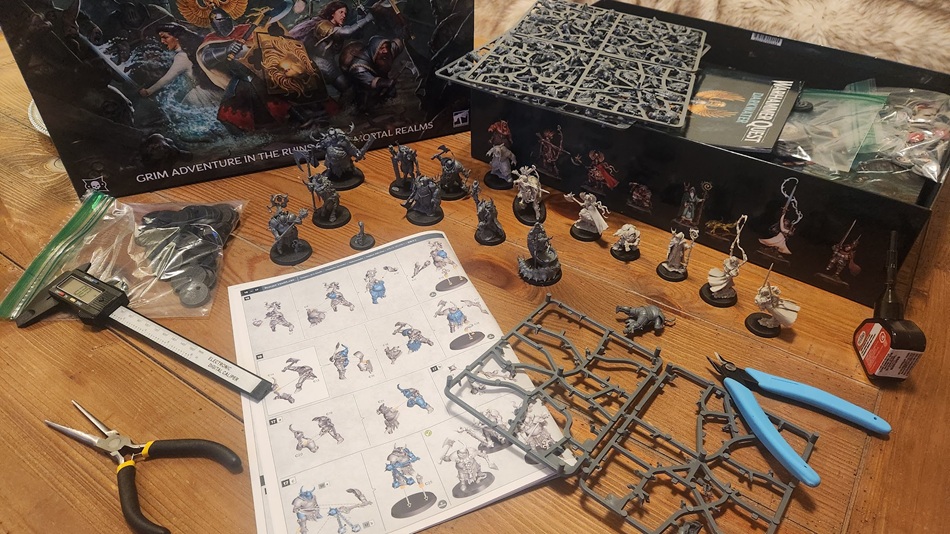
For this round of Dark Muse News, we’ll be seeking affirmations.
I’m older than the typical kid who plays with toy-soldier figurines (well, I’m over 50) and love to play with plastic figurines. If you are like me, and need affirmations on occasion that it is okay to be a kid still (and perhaps even okay to spend a load of hobby money on boutique board games), then this post is for you. We’ll highlight H.G. Wells, Peter Cushing, and delve into preparing for Warhammer Quest: Darkwater. This confesses my obsession with miniature board games that include miniatures; my collection includes shelves of asylum horror crawlers [yes, it’s a whole subgenre, and this blog will cover them] and traditional dungeon crawlers. The post overviews the evolution of some dungeon crawlers.
H.G. Wells and Peter Cushing Championed Miniature Games (Prior Plastic)
For younger folk, note that HG Wells (1866-1946) was one of the originators of science fiction for works like The Time Machine, The War of the Worlds, The Invisible Man, and The Island of Doctor Moreau. We can take solace or pride that he is also credited with writing some of the original instructions for miniature gaming (1913) Little Wars; A Game for Boys from Twelve Years of Age to One Hundred and Fifty.
HG Wells’ rules for war gaming are readily available online via Project Gutenberg “Little Wars; A Game for Boys from Twelve Years of Age to One Hundred and Fifty and plenty print options exist. Many include his associated companion volume Floor Games. The set is easy, splendid reads. They document the evolution of the game design, from tuning time per round, how to resolve conflicts between moving figures, how often guns can be deployed, the use of curtains and placement of terrain, and how introducing a point system worked to encourage bolder moves and retreats.
Renowned actor Peter Cushing was born the year Little Wars was published (1913-1994) and is now broadly known for key roles in Star Wars. He was controversially digitized after his death for a reprise as Grand Moff Tarkin (2016, in Rogue One: A Star Wars Story). Anyway, he was a big fan of Little Wars (check out this 1956 video spotlighting his miniature painting and play (1956). Plenty of images of Cushing painting and playing on the floor (i.e. this blog).

Little Wars; A Game for Boys from Twelve Years of Age to One Hundred and Fifty
[HG Wells introduction to Little Wars]
Little Wars is the game of kings — for players in an inferior social position. It can be played by boys of every age from twelve to one hundred and fifty–and even later if the limbs remain sufficiently supple–by girls of the better sort, and by a few rare and gifted women. This is to be a full History of Little Wars from its recorded and authenticated beginning until the present time, an account of how to make little warfare, and hints of the most priceless sort for the recumbent strategist….
But first let it be noted in passing that there were prehistoric “Little Wars.” This is no new thing, no crude novelty; but a thing tested by time, ancient and ripe in its essentials for all its perennial freshness–like spring. There was a Someone who fought Little Wars in the days of Queen Anne; a garden Napoleon. His game was inaccurately observed and insufficiently recorded by Laurence Sterne. It is clear that Uncle Toby and Corporal Trim were playing Little Wars on a scale and with an elaboration exceeding even the richness and beauty of the contemporary game. But the curtain is drawn back only to tantalise us. It is scarcely conceivable that anywhere now on earth the Shandean Rules remain on record. Perhaps they were never committed to paper….
And in all ages a certain barbaric warfare has been waged with soldiers of tin and lead and wood, with the weapons of the wild, with the catapult, the elastic circular garter, the peashooter, the rubber ball, and such-like appliances–a mere setting up and knocking down of men. Tin murder. The advance of civilisation has swept such rude contests altogether from the playroom. We know them no more….
Clandestine Gifting of Warhammer Quest: Dark Water
Skirmish and full-fledged miniature battles are not my preference, but with my latest acquisition, those game types merge. I managed to preorder and receive a copy of Warhammer Quest Dark Water (WQ:DW), picking it Mon. Dec 22nd, from a new board game store that opened down the street. This left me just enough time to wrap it, write “to my dear husband, love Heidi” and stow it under the Christmas Tree.
My wife is very accepting of my antics, so no harm done in misrepresenting her (there are rules for that sort of thing; for instance, if I gifted her the game, then that would be inappropriate).
Warhammer Quest: Dark Water Blurb
It’s time to take up your sword, unite with your friends, and battle against the foul forces of Nurgle, the Plague God, in Warhammer Quest: Darkwater, an all new co-operative dungeon crawler for one to four players set in the Mortal Realms.
Deep within the verdant wilds of Ghyran something evil is festering – the Daemon Prince Gelgus Pust, the Prince of Sores, has laid claim to the ruins of the Jade Abbey, within which lies the source of the Everspring – a bounteous well of life energy linked to Alarielle the Everqueen herself. Only a diverse band of heroes have skills and determination to journey into the labyrinth of the Jade Abbey and stop the corruption.
A thrilling cooperative dungeon-crawler for one to four players set within the Age of Sigmar, Warhammer Quest: Darkwater is a brand new boxed game designed to be replayable over and over. You’ll pick a hero, open the 38-page lay-flat map book to match your chosen scenario, and use miniatures, cards, and dice to battle for the fate of the Everspring.
This new Warhammer Quest game is quick to learn and easy to play, perfect for game night with your friends and family. Simply pick your heroes and jump into a 30-minute skirmish against the disgusting followers of Nurgle – a perfect bite-sized chunk of gaming for tempting friends into another session, and another, and… hey, why not play a whole campaign? If you want something meatier, you can play through the whole story in about 10-14 hours over multiple days – or one marathon session, if you bring plenty of snacks.
These campaigns are thrilling three-act adventures through the infested ruins of the Jade Abbey, where you’ll play through multiple scenarios, unlock new heroes and rewards, and eventually test yourselves against the loathsome might of Gelgus Pust. Victory isn’t certain, but you shouldn’t let loss put you off! Campaigns are designed to be replayed, and because you only use a portion of the cards on offer each time, every playthrough will be a unique combination of heroes played, encounters fought, events overcome, and rewards looted.
— Description from the publisher
Push-to-fit Models
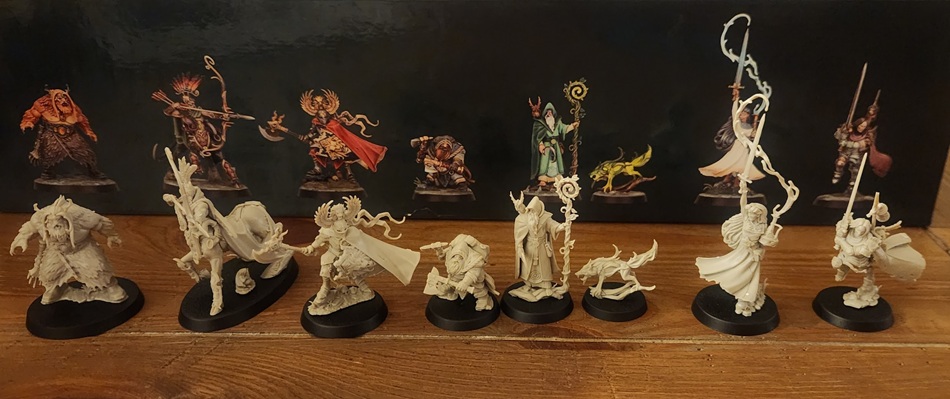
Part of the fun and mystique of miniature gaming is prepping the models. Most of the games I get from Gamefound or Kickstarter, and those usually offer single-piece/pre-assembled molded figures; each category of figure made with different colored plastics (heroes, villains, etc.). WQ:DW follows suit with the color scheme, in that the heroes are a creamy white and the plagued villains are dark gray.
In the days of old, for Warhammer, we had to cut the model pieces off the skeletal sprues, then clamp or hold them together as glue was applied and took hold. The push-to-fit approach mostly works and saves a lot of time. The designs are incredible at hiding seams. I still need glue to repair a few pieces.
Centipede Ouroborus
This is when it gets comical, and it motivated the need for affirmations. Besides having bifocals (a pain in the arse that never goes away, an unlocked achievement from 5-6 years ago), I was just blessed with a Posterior Vitreous Detachment (PVD), a mostly healable condition old folk get. In short, eyes can contract and pull cartilage into the jelly part, yielding wicked floaters, especially a continent-sized one in the shape of a centipede eating its tail. Think Ouroborus.
Anyway, that “Weiss Ring” is floating around my left eye. Thankfully, my flavor avoided a retinal tear or detachment. That said, trying to focus on the miniature fragments and line up prongs and pieces is challenging. It required some agility, patience, and vision…so it has been a humbling and comical affair getting the models together.
Rectangular Dungeons are Back!
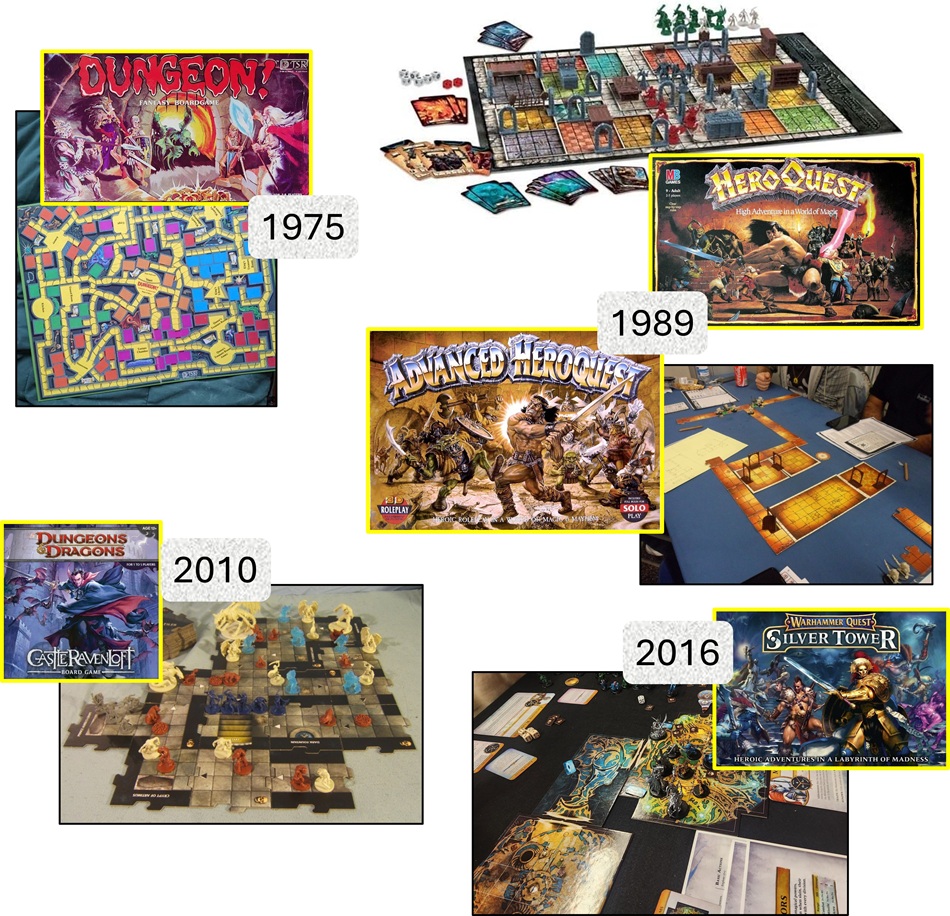
I was attracted to WQ:DW since it had different mechanics from what I already have. So some evolution is expected. Dungeon crawlers always promise a sense of exploration. Dungeon crawler aficionados expect tile flipping, a mechanic that is rampant across Warhammer Quest games to date (as well as for most Dungeon Crawler games since Advanced HeroQuest came out; image below).
Many pioneering games like 1975 Dungeon!‘s labyrinth of hallways or the 1989 HeroQuest’s Clue-like board did not have the board (or tiles) flip but they did have cards representing the rooms content to turn over. Other games had non-recantuglar, modular boards like the other 1989 Hero Quest (the Advanced version) or even modern variations like WoTC’s with its interlocking tiles for their D&D crawls (~2010, Ravenloft). Games Workshop stuck with the modular tile approach across their quest line-up (The 1995 Warhammer Quest, Silver Tower, Cursed City, etc.). In general, the “dungeon” was getting more-and-more irregular, and less-and-less limited to a rectangle. Until now!
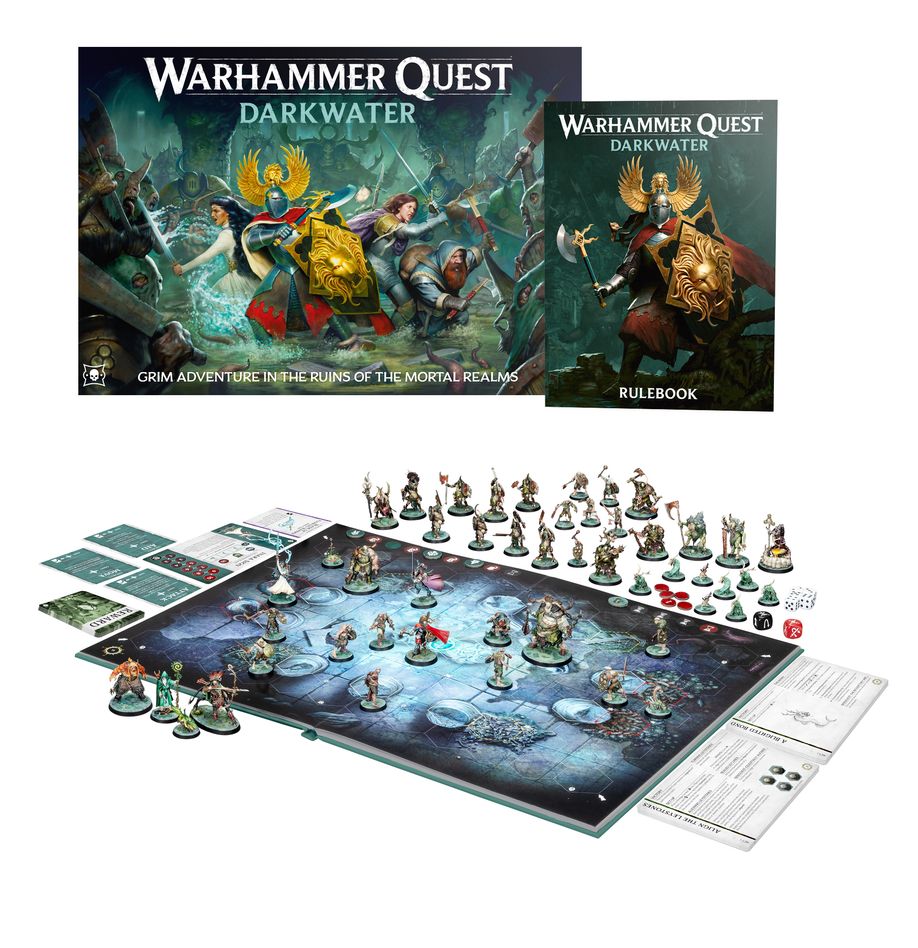
The WQ: Dark Water is not tiled! In fact, it’s a booklet that opens up, so each scenario in the campaign is just a turn of the page. This will save setup time for sure, but will it kill the feeling of exploration? That is TBD.
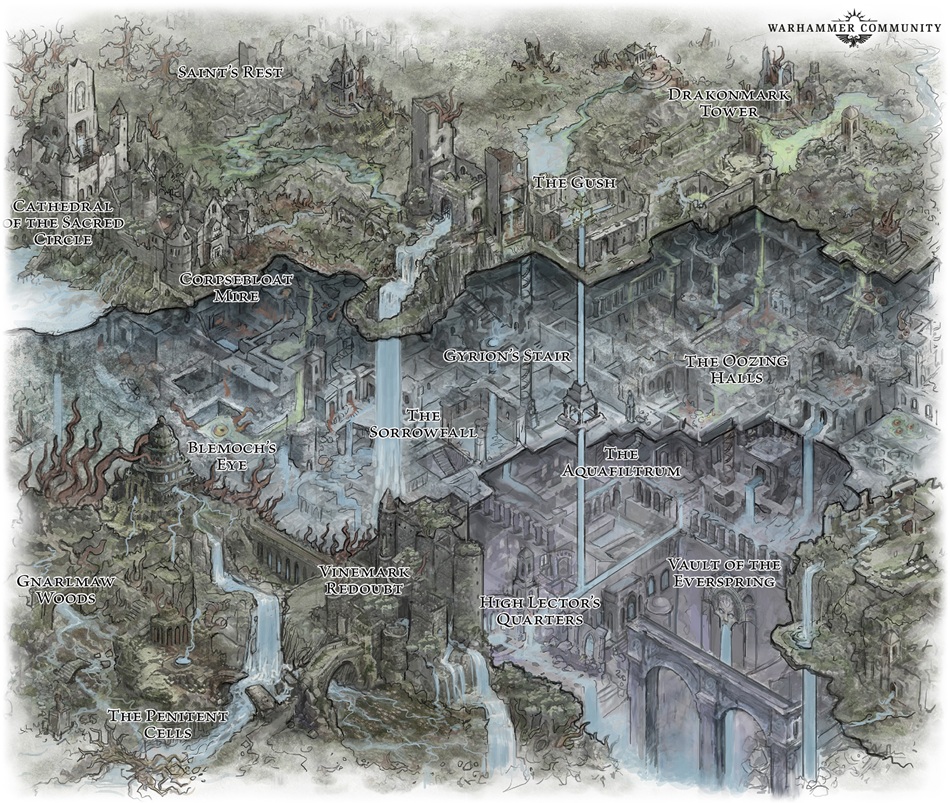
But wait, there is more! The map has hexes instead of squares. So it radiates a skirmish, tactic game-feel. Games Workshop provided a nice article on the milieu. The hope is to still provide a dungeon-crawling experience. A nicely printed map showcases how all the levels around the Jade Abbey fit together, so that may suffice.
A future blog post will cover Dark Water plays, but for now, rest assured, as Dungeon Crawlers evolve, we players still have mojo!
Jade Abbey
S.E. Lindberg is a Managing Editor at Black Gate, regularly reviewing books and interviewing authors on the topic of “Beauty & Art in Weird-Fantasy Fiction.” He has taken lead roles organizing the Gen Con Writers’ Symposium (chairing it in 2023), is the lead moderator of the Goodreads Sword & Sorcery Group, and was an intern for Tales from the Magician’s Skull magazine. As for crafting stories, he has contributed eight entries across Perseid Press’s Heroes in Hell and Heroika series, and has an entry in Weirdbook Annual #3: Zombies. He independently publishes novels under the banner Dyscrasia Fiction; short stories of Dyscrasia Fiction have appeared in Whetstone Amateur S&S Magazine, Swords & Sorcery online magazine, Rogues In the House Podcast’s A Book of Blades Vol I & II, DMR’s Terra Incognita, the 9th issue of Tales From the Magician’s Skull, Savage Realms Magazine, and Michael Stackpole’s S&S Chain Story 2 Project.