Tuesday, February 9th, 2010 | Posted by Ryan Harvey
Continuing from last week’s look at the weird tales of pulp suspense maestro Cornell Woolrich, today I’ll walk around another bleak urban corner of the midnight-hued world of my favorite pulp author.
“Dark Melody of Madness,” first published in the June 1935 issue of Dime Mystery and often reprinted under the less-chilling title of “Papa Benjamin,” is one the superb pulp horror stories, and one of Woolrich’s earliest classics, written during the first year of his career as professional magazine writer. In its use of race as an undercurrent, it has connections to some of the great horror works of Robert E. Howard, in particular “Pigeons from Hell,” which also uses the device of voodoo of the West Indies. Anyone interested in the American Weird should read it. Fortunately, it’s been reprinted in many anthologies.
Read More »
Tuesday, February 2nd, 2010 | Posted by Ryan Harvey
It might surprise regular readers of this website that Edgar Rice Burroughs and Robert E. Howard are not my favorite pulp writers. They rank among the authors who have influenced and inspired me the most—and they provide endless material to discuss and analyze. But my favorite pulper, perhaps my favorite writer of all time, is Cornell Woolrich.
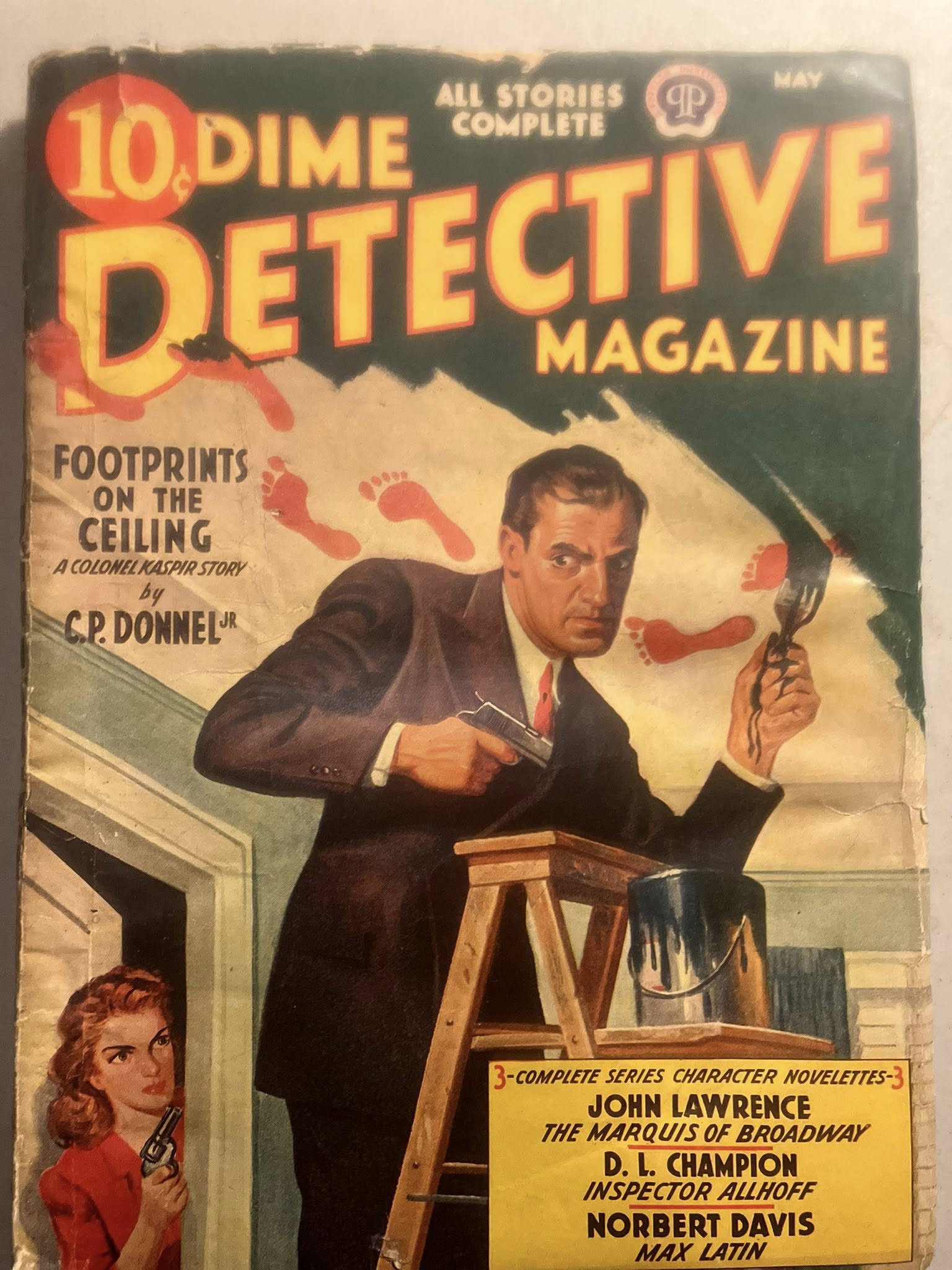
I haven’t written anything about Woolrich on Black Gate before because his genre doesn’t intersect with the dominant focus of the magazine, except maybe in the broad way that Black Gate readers are usually interested in the pulps in general. Woolrich wrote suspense and mystery stories, and the majority of his work appeared in crime magazines like Dime Detective, Detective Fiction Weekly, and the legendary Black Mask. His specialty was the “emotional thriller,” harrowing trips into fear and paranoia with suspense set pieces that no author has equaled. Often called by admirers and critics “the literary Hitchcock” and “the twentieth-century Edgar Allan Poe,” Woolrich could wring more palpitating dread out of everyday life than any writer I’ve encountered. His style is defining of noir, the existential crime tale. Eventually, Hitchcock and Woolrich did merge, when Hitchcock turned Woolrich’s short story “Rear Window” (originally published as “It Had to Be Murder”) into a film that you might have heard of.
But there is one part of Woolrich’s oeuvre that falls into the compass of Black Gate: he made occasional forays into stories of the fantastic. He was actually ideally suited for the horror story, but the market for such tales was not as strong as the crime fiction market (just ask anybody to whom Weird Tales owed money). Woolrich had a personally dismal view of existence—universe and fate are essentially hostile to humanity, and the inevitability of death made life pointless—that could transfer perfectly to the supernatural, where those malign forces of the universe manifest in the unnatural occurrences. The idea that the world doesn’t care for you is one also found in H. P. Lovecraft, although visualized in a different way. If the two men had ever met, there would have been a strange, strange discussion. (Woolrich, however, could rarely be budged from his hotel room in Manhattan. H. P. Lovecraft was a partying socialite in comparison.)
Read More »
Tuesday, January 26th, 2010 | Posted by Ryan Harvey
Last week, when I answered the call to a group celebration of Robert E. Howard’s birthday, I originally chose to write about his breakthrough short story, “Wolfshead.” Somehow, I got sidetracked and ended up typing out a personal reflection on the first Howard story that I ever read, “The Fire of Asshurbanipal.” But I still have my notes about re-reading “Wolfshead” (now easily available in The Horror Stories of Robert E. Howard from Del Rey) and it seems a shame to waste them. So here are some thoughts on this early and often reprinted work and how it helped set off the Great One’s career.
Plus, today is my birthday, and I get to do whatever I want. (Told you it was close to Howard’s. Please also wish Jason M. Waltz, Australia, and Paul Newman a happy birthday as well. A bit tough in Paul’s case . . . oh well.)
One reason that “Wolfshead” occurred to me as a topic is that a re-make of the classic Universal film The Wolf Man (elided into The Wolfman) comes out in theaters next month. The film has gone through enormous production and post-production hell and numerous delays, so I’m skeptical about its quality. I hope—fervently hope—that the film works beyond expectations, because right now werewolves need a boost. Vampires and zombies seem to run the horror world right now—they have always been far more budget-friendly than werewolves—but I would joyfully welcome a werewolf Renaissance. Of all the classic European monsters, the werewolf has always been my favorite. “Wolfshead” was a story that was ahead of its time in the way that Howard changes around the shapeshifter myth; in many ways, current werewolf stories haven’t quite caught up to him.
Read More »
Friday, January 22nd, 2010 | Posted by Ryan Harvey
Today’s is Robert E. Howard’s birthday—I’ve always felt pleased that it lies so close to mine, as January is a lonely month in which to have your birthday—and for my gesture to commemorate the Great Lord of Blood, Thunder, and Thick Mountain Accents, I’m going to take a short glance back at my first encounter with him, in the story “The Fire of Asshurbanipal.”
Okay, I lied. It’s not short . . .
Read More »
Tuesday, January 12th, 2010 | Posted by Ryan Harvey
The Ship of Ishtar
A. Merritt (Paizo Publishing, 2009)
I first read The Ship of Ishtar in a 1960s Avon paperback I found in a used bookstore in Phoenix. This copy is so brittle that I have to specially brace the book each time I open it or else the spine will separate like the San Andreas fault and the pages flutter down in a yellow autumn fall.
What I’m saying is . . . I’m extremely glad that Paizo Publishing has brought my favorite A. Merritt novel back into print in an edition that doesn’t make me afraid of the physical act of reading it. (Go buy it here.)
It’s strange that Abraham Merritt, one the biggest sellers in the history of speculative fiction, should need an introduction at all today, but sadly he does. Merritt was a journalist by vocation, the editor of The American Weekly, but his forays into writing ornate “scientific romances” starting with The Moon Pool in 1918–19 made him one of the most popular authors of the first half of the twentieth century. Today, he’s the realm of specialists, collectors, and his work is found in volumes from university publishers and small presses. In his introduction to Merritt’s breakthrough novel, The Moon Pool, Robert Silverberg pondered this turn of events that made Merritt obscure. What happened?
Silverberg offers up his own wonderings, ultimately finding the author’s eclipse inexplicable; but I think Merritt’s unusual mixture of two-fisted stalwart heroes in epic action with grandiose, mind-bending worlds of wonder painted in prose arabesques (and millions of exclamation marks!) makes him an author who doesn’t speak to mainstream genre readers today, even if he invented the clichés of countless contemporary fantasy authors. Clark Ashton Smith started as a specialty author and has remained there. Abraham Merritt was a mainstream writer who managed to Clark Ashton Smith himself after his death, ending up as a specialty author as well. Unfortunately, such is often the way of unusual talents. At least The Ship of Ishtar is now only a few clicks away for you to purchase and enjoy.
Read More »
Tuesday, December 29th, 2009 | Posted by Ryan Harvey
It’s strange that Robert E. Howard’s most famous female character is one he didn’t actually create: Red Sonja, the work of comic book writer Roy Thomas and artist Barry Windsor-Smith, based on the historic adventuress Red Sonya from the story “The Shadow of the Vulture.” Red Sonja has been erroneously credited to Howard for years; even the movie Red Sonja lists him as the creator on the main credits.
This accidental attribution might explain the scant attention given to a fierce, red-haired, sword-swinging woman that Howard did create: Dark Agnes of Chastillon, sometimes called Agnes de le Fere. She appears in two stories and a fragment, and if Howard had sold the stories during his lifetime he might have written far more about her. She’s much-neglected in discussions of the author, and none of her stories have been in print since Ace’s 1986 printing of Sword Woman, which was first published by Zebra in 1977 and then re-printed by Berkley in 1979.
Another reason for the general obscurity of the abbreviated Dark Agnes cycle is that the stories are lesser pieces that feel rough alongside Howard’s classics. But their content is worth examining to see the author exploring the first-person female point of view. Detractors who consider Robert E. Howard—and sword-and-sorcery in general—misogynistic will discover a genuine surprise in Dark Agnes.
Read More »
Tuesday, October 20th, 2009 | Posted by Ryan Harvey
The comic book superhero was born in the late 1930s, during the time when the dominant form of popular culture reading was the pulp magazine. During the next decade, the pulps would start their slow demise: wartime paper shortages that forced the publishers to cut back on the more risky material to focus on the steady sellers, the paperback influx competed on the genre scene and were popular with soldiers overseas, and the rise of the comic book took away much of the younger readers. That the comic book should play such a large part in the end of the pulp magazine industry is an ironic reversal, since the hero pulps fueled the creation of those first four-color superheroes. No Batman without the Shadow. No Superman without Doc Savage.
The comic book industry is now doing some payback to the long-vanished cheap paper fiction magazines. DC Entertainment Inc. has an upcoming project where they are going to let their characters revert back to the 1930s and turn into true pulp heroes once more. It’s an alternate universe version of the DC Universe with no super-powered characters, set firmly in the 1930s. And it will not only feature their own creations like Batman, but also genuine pulp stars Doc Savage and the Avenger, to whom DC owns the comic book rights. The first publication in the new setting is next month’s Batman/Doc Savage Special, written by Brian Azzarello and illustrated by Phil Noto.
That’s all you need to get my blood a’ rushing. I rarely buy DC or Marvel monthly comics, since I think their indulgence in crossover mega-events has reached a level of mania/boredom, but this… oh, I am all over this in so many ways. Just having Doc Savage back in comics is enough, but Batman is also going to get pulled back to the decade of his nativity. I love comic book superheroes (Batman in particular), but since my mid-twenties I’ve turned more toward the pulp characters (The Shadow in particular), and seeing them get a whole corner of the universe of one of the two big comic book publishers is like a five-Red Bull high. And behold the Bama-influenced Doc Savage on the cover!
Read More »
Tuesday, August 11th, 2009 | Posted by Ryan Harvey
When other genre-lovers find out I’m a fan of Robert E. Howard, they often ask me what my favorite of his stories is. They probably expect I’ll name one of the Conan yarns, or perhaps a Solomon Kane or Kull story. (Kull is, indeed, my favorite Howard character.) If they already know something of my background in history, they may think I’ll name one of the Crusader stories that appeared in Magic Carpet Magazine.
But instead I say, without hesitation, “Pigeons from Hell.” And, after an inevitable moment of surprise, they always answer back: “Oh, that’s a great story! I had almost forgotten about that one!”
The irony of my love for “Pigeons from Hell” isn’t lost on me: I praise Howard for his foundational contribution to sword-and-sorcery and historical action tales, and yet my personal favorite story he wrote is a contemporary America-set horror story. But “Pigeons from Hell” is quintessentially Robert E. Howard from first word to last; Howard was an author who knew how to transform naturalism into the “weird tale,” and who also took great inspiration from the folklore of his small world of rural central Texas.
Read More »
Sunday, June 7th, 2009 | Posted by Theo
Because I’ve sat on a few Nebula juries in the past or perhaps due to the fact that a few thousand people are bored enough to stop by my blog every day, publishers send me books from time to time. The vast majority of them aren’t just bad, but amazingly bad, and I usually attempt to do the kindest thing I can do for them, which is to say nothing at all about them. I don’t know what has gone wrong at some of the genre’s leading publishing houses, but someone needs to send them a very strong message to stop publishing novels where the central theme involves the importance of being true to oneself, features a strong, independent, sarcastic hero who don’t take no crap from nobody, concerns love triangles with the angst-laden but irresistible reader stand-in at the center, or incorporates sex scenes involving more than four different individuals and at least two different species. Weve been there, a lot. We’ve done that, a lot.
The nadir has got to be what I like to consider “were-seal porn” due to one unforgettable book about a lonely, but beautiful lighthouse keeper and her mysterious lover. You probably think I’m kidding, but I swear, not only did someone actually write that book, someone decided to publish it! So, my expectations were extremely low when I picked up a book out of the PR pile, mostly because I badly needed a break from the history of economic analysis. I was surprised, then delighted, and ended up blowing off the rest of the evening in order to finish what was really a very good fantasy novel.
The Warded Man isn’t exactly low fantasy, but it’s probably closer to low fantasy than high fantasy. More to the point, it’s original, it’s well-written, and it’s extremely absorbing. It’s a strange world, one of the weirdest post-apocalyptic worlds that I’ve encountered, as the greater part of both magic and science have been forgotten in the face of a plague of demonic forces that rise from the ground at night and can only be fended off by scripted or carved wards. The author does an excellent job of conveying the essential horror and helplessness of the common people, while portraying a realistic picture of the way in which no situation is so dire that petty human weaknesses can’t stir up unrelated conflicts of their own.
The book is one of the best debut novels I’ve ever encountered in the genre, and it wouldn’t surprise me in the slightest if it ended up claiming an award or two along the way. The author rewards the reader by seldom going for the obvious, and the character development tends to be a little deeper and more original than is the norm. If you feel that the fantasy field has been a bit barren of late, you should give The Warded Man a shot. I don’t think you’ll be disappointed.
Monday, June 1st, 2009 | Posted by Theo
I’m a day late on this one, my apologies. Given their interest in adventure fantasy and the fiction of the 1930s, I assume Black Gate readers are more inclined to frequent used bookstores than the average book buyer. One of the best resources online I have discovered is ViaLibri, a search engine devoted to used bookstore sites including Amazon and AbeBooks. At its site, one can discover everything from a 1932 copy of Oriental Stories Pulp Magazine, Spring 1932, Volume II, # 2, containing “Lord of Samarcand” by Robert E Howard, to the 2008 limited edition re-release of Howard’s Kull: Exile of Atlantis by Subterranean. Many of the books are a bit pricy, but bargains can occasionally be discovered; I found a complete set of the 8-volume, 1936 edition of the The Cambridge Medieval History in England for about a quarter the price I would have paid at my local used bookstore for a set missing a volume. It was an excellent deal even with the added shipping expense required. Whether you’re a serious collector or simply happen to be searching for a specific book you recall from your youth, ViaLibri is a nice resource that may be of some utility in your hunt.