Sunday, June 16th, 2013 | Posted by John ONeill
I recently stumbled across a copy of a gaming magazine I’d never encountered before: The Last Province, a bi-monthly British publication that apparently lasted five issues, from October 1992 to September 1993.
This doesn’t happen very often, so it was definitely worth investigating. And I’m glad I did, as it turned out to be a delight.
I think the cover — a Martin Lennon character study of three very different adventuring fellows striding confidently across a green and pleasant land — effectively communicates both the content and editorial attitude. If the art doesn’t do it, the tag words “Independent British Roleplaying” at the top should give you the idea.
Paz Newis’s page 4 editorial is a perfect mix of defensiveness towards gaming stereotypes, and contempt for what others consider ‘normal.’ Pretty much exactly how I remember gamers talking in the 90s.
To my mind ours is one pastime with a wealth to offer its participants. It is to those of you who wish to take roleplaying out of the ‘spotty adolescents’ stereotype that this magazine is aimed.
Recently… I thought it would be a good idea to sit in front of the television. I was appalled! It really was brain numbing. All of my higher brain functions seized up. If this is what the majority of ‘normal people’ spend their time doing I have no desire to be normal.
The news section is jammed with headlines on the big events of the day — including Steve Jackson’s quarter-million dollar judgment against the US Secret Service for seizing their computer equipment during an investigation of GURPS Cyberpunk, the report that a young employee at a Glasgow branch of a well known game store chain was apparently fired for being female, and the release of a major new RPG from FASA with the strange title Earthdawn.
Read More »
Friday, June 14th, 2013 | Posted by John ONeill
Gary Gygax’s famous Appendix N, the list of titles he considered essential reading for Dungeon Masters hoping to create authentic adventures for their players, is perhaps the purest distillation of the literary recipe at the heart of modern adventure gaming.
Gygax put Appendix N in the back of his Dungeon Master’s Guide in 1979. Read all the writers on that list and you’ll understand the creative gestalt underlying 20th Century fantasy that eventually exploded into Dungeons & Dragons in 1974.
That’s the theory, anyway. Plenty of people have tried it. It’s sort of the gamer’s version of going walkabout. Immerse yourself in Appendix N and spiritual understanding will be yours. Plus, as a bonus, you end up with a rockin’ library.
Tim Callahan and Mordicai Knode are attempting this spiritual journey together, and they’re chronicling it at Tor.com. They begin with a look at Robert E. Howard’s Conan story “Red Nails,” originally published in the July 1936 issue of Weird Tales:
There is a giant mega-dungeon; it hardly gets more D&D than that. The two elements that really strike home here in terms of inspiration are the populated dungeons as its own character of rivalry and strife, and black magic. The city as one massive labyrinth is great, as is the characterization of its architecture & embellishment — gleaming corridors of jade set with luminescent jewels, friezes of Babylonianesque or Aztecish builders — but it is the logic of the city that shines brightest to me. “Why don’t the people leave?” There are dragons in the forest. “What do the people eat?” They have fruit that grows just off the air. “Where do all these monsters come from?” There are crypts of forgotten wizard-kings. There is a meaningful cohesion to the place; Howard manages to stitch dinosaurs, radioactive skulls, Hatfields and McCoys, and ageless princesses into something cogent.
The two have promised to “look at Gygax’s favorite authors and reread one per week, in an effort to explore the origins of Dungeons & Dragons and see which of these sometimes-famous, sometimes-obscure authors are worth rereading today.”
Well worth a look. Check out the first installment here.
Friday, June 7th, 2013 | Posted by John ONeill
Jean Rabe, editor of the Bulletin of the Science Fiction Writers of America, has stepped down following a series of controversies in recent issues.
The problems began with the now-infamous issue #200, pictured at right, featuring a Jeff Easley Red Sonja cover. Mike Resnick and Barry N. Malzberg, in their long-running column, wrote about “lady editor” Bea Mahaffey (among others), glossing over her significant accomplishments in the field to focus on her looks. In issue 201, CJ Henderson praised Barbie for maintaining “quiet dignity the way a woman should.” But things really blew up with issue 202, in which Resnick and Malzberg responded to mounting criticism by crying about censorship.
There’s been a great deal written about this in the blogosphere and fan press in the past month (Charlie Jane Anders at io9 has an excellent round-up), but I think Benjamin Rosenbaum put it best in his June 3 open letter ”Dear Barry & Mike“:
It takes a certain kind of willful blindness not to get that slathering wolf whistles all over your tribute to women editors of years past might piss off… well, pretty much anyone born after 1960.
It’s not that we don’t know how it was when you guys came up. We know that back in the day, talking loudly about Andre Norton looking good in a bathing suit was supposed to be a gracious compliment about which she should be merrily grateful… We know this. We get it. We can make the imaginative leap to your context.
What upsets me, though, is that you apparently can’t make the imaginative leap to our context. You apparently don’t get that talking about how hot an editor is in a skirt — not in a love letter or a roast or an autobiographical reminiscence, mind you, but… in the central house organ of her writers’ organization — is, for us, kind of disgusting…
And then, honestly guys, the confused ramble about censorship?… That’s just painful. Like, if you say something that sucks, and we tell you it sucks, that’s… censorship? Stalinism?
SFWA President John Scalzi issued an apology to readers of the SFWA Bulletin on June 2.
Thursday, June 6th, 2013 | Posted by John ONeill
I’m not used to seeing the latest D&D publishing news in Forbes magazine.
I’m not crazy, right? Forbes, the house organ of American capitalism, usually reports on panic-inducing Rolex shortages, fashion trends at Goldman Sachs, and how bubbly can boost brain power. Last time I read an article about role playing in Forbes was way back in… what am I saying. I’ve never read a gaming article in Forbes.
Well, last week there were two of them. Breaking news stories, even. Stuff I didn’t know about the first D&D Next release scheduled to appear at GenCon. Here, look:
A year ago today, Dungeons & Dragons publisher Wizards of the Coast launched a public playtest of a new edition of the classic fantasy role-playing game. Codenamed D&D Next, the rules are an ambitious redesign meant to unify four decades and five editions’ worth of players under one single system – and now fans will get to see them in print for the very first time.
To celebrate the playtest’s anniversary, Wizards of the Coast announced today that it will release a limited-edition commemorative book containing the most up-to-date D&D Next rules. Ghosts of Dragonspear Castle will be available exclusively at Gen Con 2013…
Wizards of the Coast will not say when it plans to will close the playtest and release a final version of the new rules, but many fans expect the game to be released in early to mid 2014, to coincide with the game’s 40th anniversary.
That reads like gaming journalism to me. What’s going on? Wait — the author is Forbes staffer David M. Ewalt, author of the upcoming book Of Dice and Men: The Story of Dungeons & Dragons and the People Who Play It. Is this Ewalt sneaking articles onto the Forbes website while his boss is on vacation? God, I hope so. That would be so cool.
As for Ghosts of Dragonspear Castle itself, it’s real news. Although you have to pre-order it to get a copy — and go to GenCon to pick it up — which probably means I won’t be getting one. It’s being described as more of a keepsake than a core publication (and even has places for owners to sign their copy), so it’s not a must-have. Still, it contains a big four-part adventure and the first publication of the D&D Next playtest rules, which is sure to make it a hot commodity.
Read Ewalt’s complete article here (and his second, “After A Year Playtesting A New Dungeons & Dragons, What’s Next?“), before his boss gets back from Maui and forces him to take them down.
Tuesday, June 4th, 2013 | Posted by John ONeill
As we first reported on April 4th, Skyhorse Publishing and Start Publishing have been in negotiations to acquire the assets of Night Shade Books. As co-owner Jeremy Lassen explained in an Open Letter on April 5th, the sale would allow Night Shade to avoid bankruptcy and keep it operating as an ongoing concern.
After several authors expressed concern over the terms of the buyout, Skyhorse and Start sweetened the deal with a more generous royalty rate. Now the publishers have announced that they have completed the acquisition of Night Shade, and that the first post-sale book to be published will be Michael J. Martinez’s The Daedalus Incident on July 9th. Here’s part of the official press release:
Founded by Jason Williams in 1997, who was joined by partner Jeremy Lassen shortly after, Night Shade Books has over 250 titles in its catalog, including some renowned genre fiction — written by multiple nominees and winners of Shirley Jackson, Bram Stoker, World Fantasy, Nebula, and Hugo awards. In 2003, Night Shade Books won the World Fantasy Special Award for Professional Achievement. Both Williams and Lassen will continue to be with Night Shade in a consulting capacity.
The agreement was reached following a spirited and public debate among authors, agents, fans, and publishers, which resulted in a deal approved by Night Shade’s authors….
“I am very excited to have found a buyer that is such a good fit for Night Shade, one that will be able to take us further than I was able to on my own. I look forward to building up Night Shade into the powerhouse of science fiction and fantasy for years to come,” said Night Shade founder Jason Williams. Night Shade had net sales of roughly $1.5 million for the 2012 calendar year.
Here at Black Gate, we’re very pleased to see that one of our favorite small press publishers will continue publishing great books.
Read the complete press release at io9.
Monday, June 3rd, 2013 | Posted by John ONeill

Summer Knight first edition (2002, Roc Books). Cover by Lee MacLeod
Paperback collecting is an odd hobby. For one thing, unlike stamps or coins, virtually no paperback is out of reach for the determined collector.
Want examples? As I mentioned in Jack Vance’s obituary last week, the first edition of The Dying Earth is one of the rarest and most sought-after genre paperbacks — it had a tiny print run, and no one knew who Jack Vance was when it first appeared in 1950.
What does that mean to your pocketbook? I paid just under $20 for a copy in mint condition a few years ago. As of today, around half a dozen are available at Amazon.com, with Very Good copies starting at $10.
Think about that. A first edition of one of the rarest science fiction books, by one of the top authors in the field, a full six decades after it went out of print, will set you back… around the same price as a brand new paperback today.
Perhaps that’s just our genre, you think. Let’s face it, half of the folks who read science fiction and fantasy are anal-retentive fanboys. Probably 50% of the print run of The Dying Earth ended up in protective mylar bags by 1955.
Maybe that’s an exaggeration. Still, the situation for mystery and western fans is pretty much the same. If you’re a paperback collector, it’s a buyer’s market. Walk into the Dealer’s Room at the Windy City Pulp and Paper show (or virtually any paperback show in America) with a crisp $20 bill, and you can walk out with a heavy bag of paperbacks published before you were born.
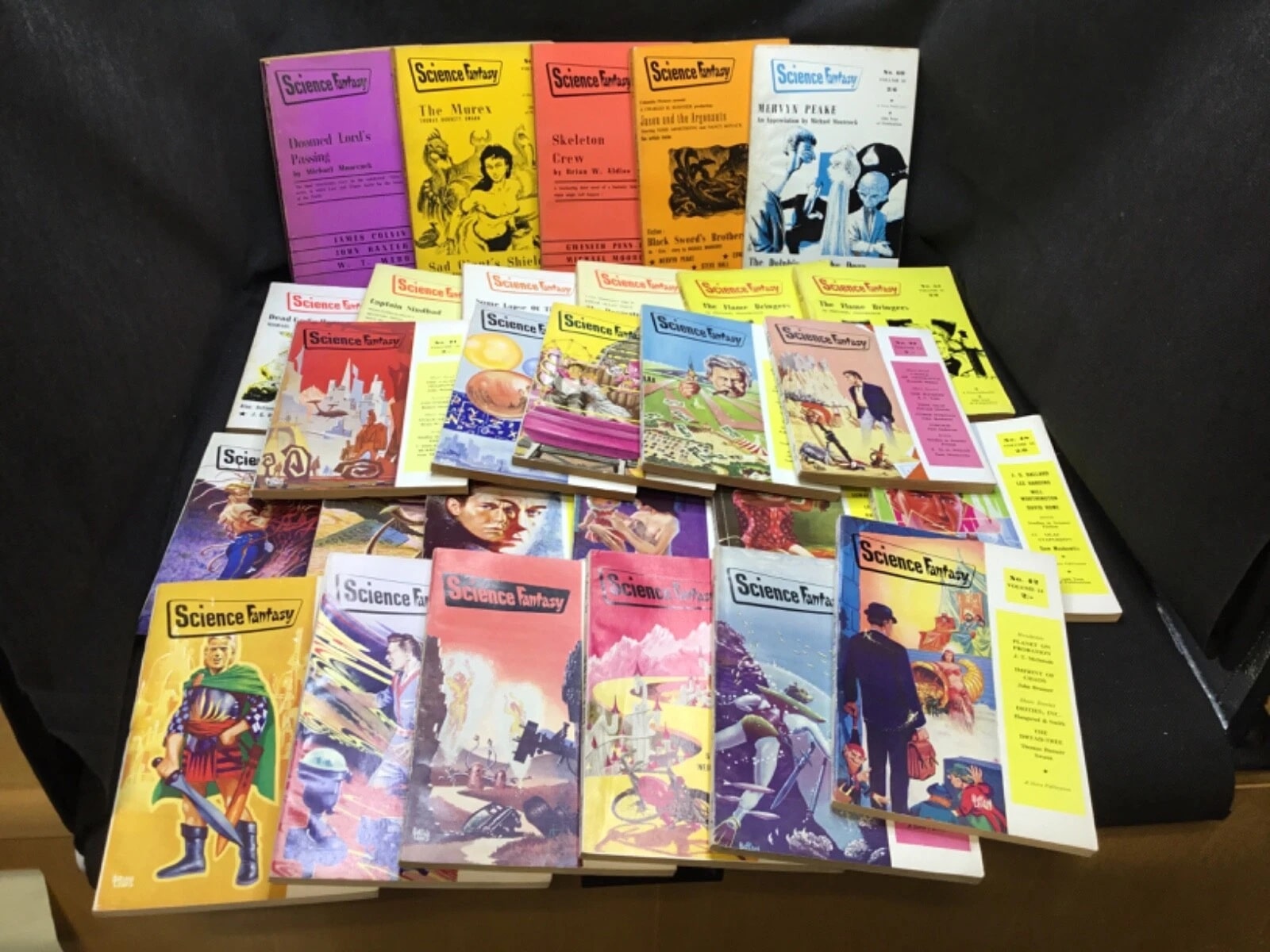
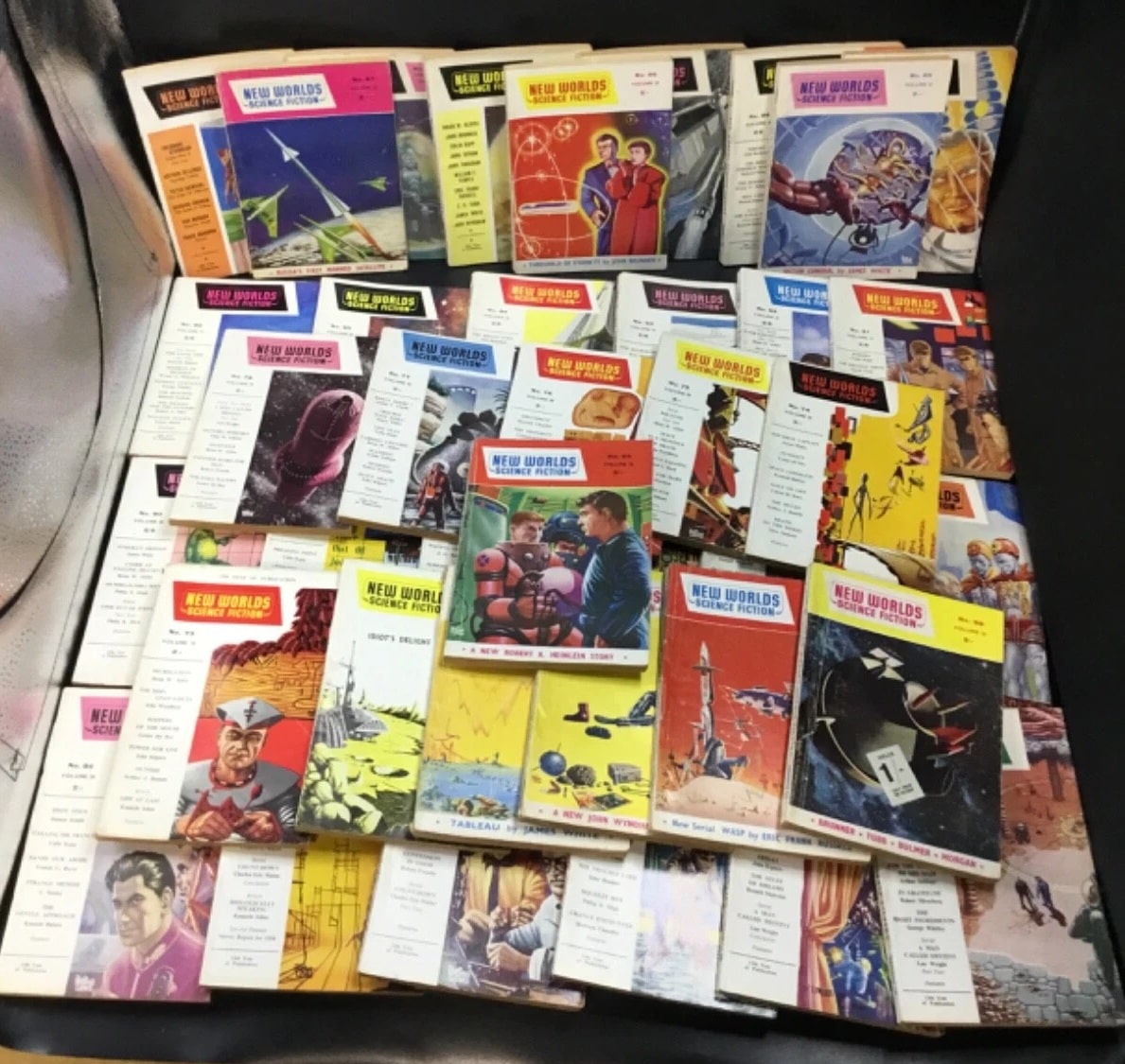
Hard to believe? Just have a look at the gorgeous assortment of 103 vintage titles I bought for around $50 at Windy City just last year.
Perhaps it’s different if we look outside genre fiction entirely. What’s the rarest and most expensive paperback known?
Read More »
Sunday, June 2nd, 2013 | Posted by John ONeill
The School for Good and Evil
By Soman Chainani
HarperCollins (488 pages, May 14, $16.99 hardcover/$10.99 digital)
The School for Good and Evil is a major summer release from HarperCollins, with a national marketing campaign and lot of pre-release buzz, and it’s already getting a lot of attention.
We know what to do with young adult books getting a lot of attention here at Black Gate – we give them to Tabitha, the thirteen year-old reviewer who covered The House of Dead Maids and All the Lovely Bad Ones for us, among others. We’re glad to have her join us again, even though she makes us feel old and out of touch.
Black Gate: Tabitha, welcome back to the Black Gate offices!
Tabitha: Thanks, I guess.
Before we get started, why don’t you tell us a little about yourself.
Didn’t we do that last time?
Yes but that was like a hundred years ago. All the people who read your last reviews probably got old and died.
Wow. Okay, in that case, I turn 114 this year. I’m going to high school next year. On the introvert scale, I’m beyond “vampire.”
“Beyond vampire.” What does that mean? Explain it for old people.
I scream in agony whenever I set foot outside my house.
Read More »
Friday, May 31st, 2013 | Posted by John ONeill
Black Gate is very proud to announce that we will be presenting the complete fantasy novel The Death of the Necromancer, by Martha Wells, as part of our Online Fiction series, starting this Sunday, June 2.
The Death of the Necromancer is one of the most important fantasy novels of the past 20 years. When I ran SF Site, we received an advance proof in 1998, and it electrified our entire office. In his review, senior editor Wayne MacLaurin wrote:
Take a great Sherlock Holmes novel, mix in a heavy dose of Steven Brust’s Jhereg, and you’ll have some idea of what you can expect… Martha Wells’ first two novels, The Element of Fire and City of Bones, were praised for their rich detail and original concepts. The Death of the Necromancer raises those two points to new levels… It’s a stunning achievement.
When we polled all 40 regular reviewers for our “Best of the Year” awards, The Death of the Necromancer topped more ballots than any other book, and to no one’s surprise it was nominated for a Nebula Award.
Martha Wells has a long history with Black Gate. We published three long novellas featuring her heroes Giliead & Ilias, starting with “Reflections” in Black Gate 10; followed by “Holy Places” (BG 11), and “Houses of the Dead“ (BG 12). Her stories are fast-paced mysteries, filled with deeply human characters on a splendidly realized stage, and her appearance in BG brought us a whole new audience. Her most recent article for us was “How Well Does The Cloud Roads Fit as Sword and Sorcery?,” which appeared here March 13.
Martha Wells is the author of fourteen fantasy novels, including City of Bones, The Element of Fire, The Cloud Roads, and The Serpent Sea. Her most recent novel is the YA fantasy Emilie and the Hollow World, published by Strange Chemistry Books in April. Her web site is www.marthawells.com.
The Death of the Necromancer was originally published in hardcover by Avon EOS in 1998. The complete, unedited text will be serialized as part of our Black Gate Online Fiction line, starting this Sunday, June 2.
Thursday, May 30th, 2013 | Posted by John ONeill
Jack Vance, one of the greatest fantasists of the 20th Century and one of the last living links to the pulp era, died Sunday at the age of 96.
Vance was an electrician in the naval shipyards at Pearl Harbor in 1941, working for 56 cents an hour. He left a month before the Japanese attack; during World War II, he was in the Merchant Marines.
His first published story, “The World-Thinker” in the Summer 1945 issue of Thrilling Wonder Stories, was written at sea. Over the next six decades, he wrote more than 60 books (and perhaps as many as 90).
Vance was a prolific contributor to the pulp magazines in the 40s and 50s, especially Startling Stories and Thrilling Wonder. Some of his most famous work during this period included “The Five Gold Bands” (Startling Stories, 1950), “Son of the Tree” (Thrilling Wonder, 1951), “Telek” (Astounding Science Fiction, 1952), “The Houses of Iszm” (Startling Stories, 1954), and “The Moon Moth” (Galaxy, 1961).
Vance won his first Hugo Award for the brilliant novella “The Dragon Masters” (Galaxy, 1962); “The Last Castle” (Galaxy, 1966) won both the Hugo and Nebula Award.
During this period, he also wrote most of the stories that were collected as The Dying Earth in 1950. Famously, Vance was unable to sell his collection to genre publishers, as a result one of the most important works of American fantasy was published by tiny Hillman Periodicals, who chiefly published comics.
Read More »
Thursday, May 30th, 2013 | Posted by John ONeill
We presented nearly 100 new articles on the Black Gate blog last month, covering virtually every aspect of fantasy — from Kickstarter to Red Sonja , Space: 1999 to exotic food.
Why do we do it? Here’s a clue: it’s not the great pay, or the breezy offices of our rooftop headquarters here in downtown Chicago. It’s not the allure of maverick journalism, and the way publishers tremble when we walk into a room. It’s not the travel, or the lousy expense accounts, or the drunken nights playing poker with George R.R. Martin and Gordon van Gelder (man, that guy can bluff). It’s not the endless review copies of the latest fantasy releases, or the –
Hold up there, Sparky. Review copies? Ummm, those are pretty cool. Yeah, free books never get old. Forget what I just said. We pretty much do it for the freebies.
Plus, we do it for you, our fans. For the great letters to send us, and the thoughtful comments, and those books you mail us with sticky notes that say, “Just thought you’d like this!” Seriously, you guys rock. Also, free books. Those are great too.
Here’s what the Black Gate supercomputer tells us were the 50 most popular articles we published last month. Enjoy. And keep those comments and mail coming!
- Art of the Genre: The Joy and Pain of Kickstarter [and How Backed Projects Still Fail]
- An Open Letter from Jeremy Lassen at Night Shade Books
- Vintage Treasures: Chaosium’s Thieves World
- Red Sonja: The Novels
- Teaching and Fantasy Literature: Writing Fantasy Heroes
- Night Shade Attempts to Avoid Bankruptcy with a Sale to Skyhorse Publishing
- The Company That Time Will Never Forget: A Visit to Edgar Rice Burroughs, Incorporated
- Red Sonja: The Movie
- Are You Going to Eat That?
- Vintage Treasures: The People of the Black Circle by Robert E. Howard
Read More »