Quatro-Decadal Review: Weird Tales, November 1989, edited by John Betancourt, George H. Scithers, and Darrell Schweitzer
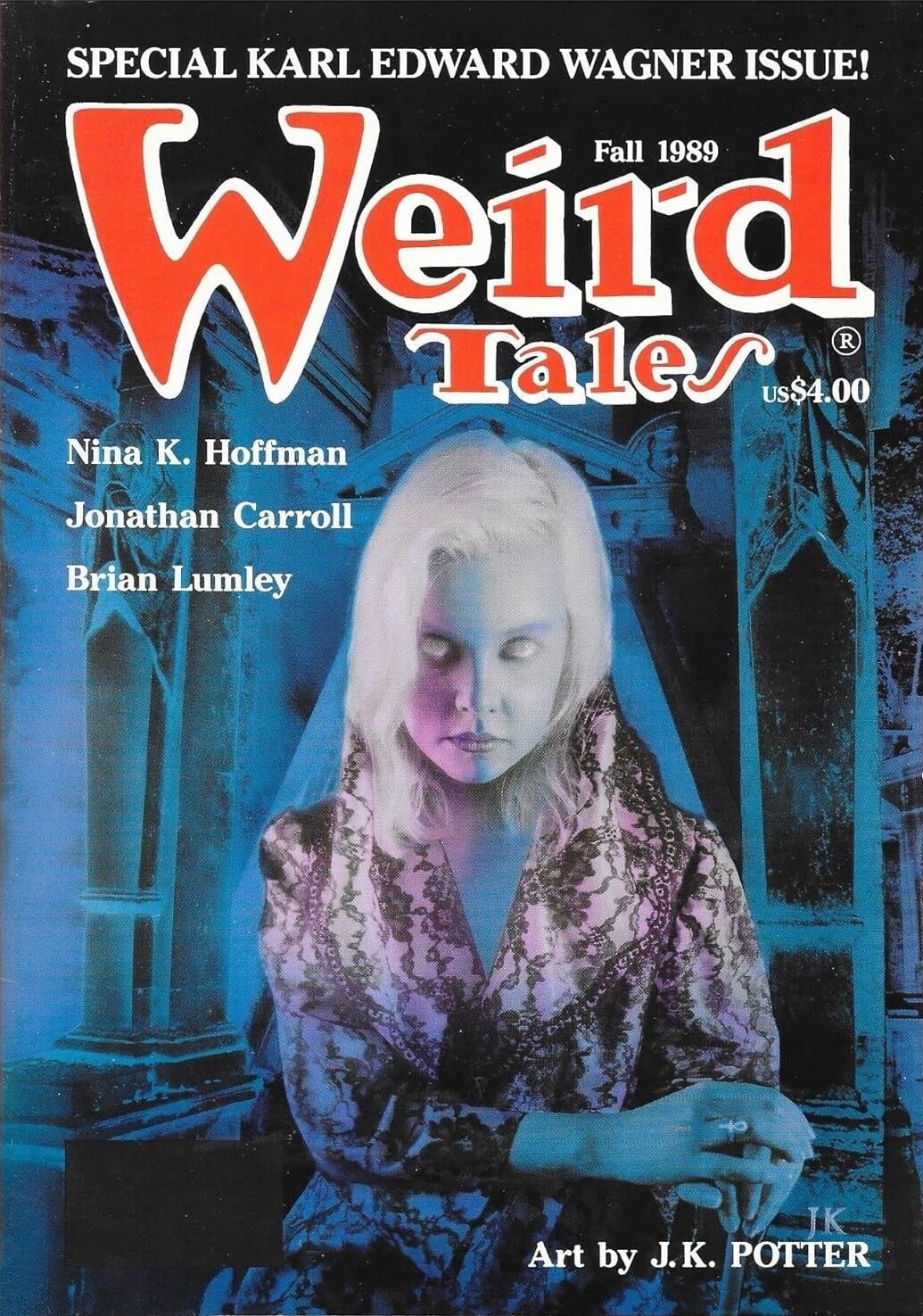
Weird Tales, Fall 1989 (Terminus Publishing). Cover by J.K. Potter
There has been quite the gap in my reviews. I’ve been high-centered on Weird Tales. Many factors played a role in this — mostly that it is not a small magazine by any stretch. Then there is the fact that I read it in early 2023, got distracted by other things, and had to re-read it to write about it.
As readers of these reviews know, I don’t hold back re: spoilers for 35-year old stories. New readers, be warned!
Frequent readers will also recall that I often hypothesize on the thoughts and drives of the editors, but in this case I don’t have to hypothesize — my friends, we live in the future and I was able to get the straight dope right from The Grey Eminence himself: Darrell Schweitzer.

Darrell Schweitzer reading at the World Fantasy Convention 2019
You’ll be getting my views, my 20 year-old self’s views, a bit of 1989 Schweitzer’s views, and 2024 Schweitzer’s take on it all. Buckle up!
The physical copy itself was in remarkably good shape, and at first I thought I had just gotten lucky in the eBay department, but 2024 Darrell Schweitzer points out that these issues were built to survive.
In those days WT had a circulation of about 10,000 and actually was in bookstores and newsstands, so it was reaching beyond the core, convention-going crowd. It is something of a point of pride with me that these issues are NOT rare and never will be, because we put out a (relatively) large number of copies, on book paper. Copies should last for centuries.
Those book-paper issues were the Terminus WT at its zenith. It looked like the real thing, in a format and size based on the issues of about 1940, but it was on book paper and so a lot more permanent, and the content was modern — Karl Edward Wagner, Jonathan Carroll — and the artwork was also cutting edge. Work like Potter’s would not have been possible in 1940. Maybe some people didn’t like it but I don’t apologize. Potter is very good at what he does.

The Eyrie — Editorial and Letters
Right out front, a lot of these letters deal with the fact that Weird Tales has recently been re-launched (in fact, the Fall 1989 issue is the 5th issue of the relaunch). There is quite a bit of discussion about attempts to not skip an issue. The new distributor wanted things dated earlier — so it all starts off with a word of explanation for all the collectors out there.
Robert Bloch writes in to tip his hat to the pulp giant E. Hoffman Price, who passed away June 18, 1988, while writing at his computer (not a typewriter) — a writer to the very end!
An odd thing about these old letter columns, sometimes they have a fan-seeking-fan angle or invitation to start correspondence. As an example, one Bruce Moffitt ends his letter with an address and “I’d welcome correspondence from WT Fans.” Did anyone ever send a missive to PO Box 350, Brookfield MO, 64628? I don’t know, but various science fiction archives record that he wrote a decent number of letters to magazines in the 70s and 80s.
Bret Berman of Monticello, NY, isn’t looking for pen pals, he’s looking for a fight, deriding, the previous issue.
Your Fall ’88 issue was a batch of period pieces that belong in some “Fantasy Warrior Homo-History” type magazine.
Because talk is cheap Berman offers a solution.
I think you should read more unsolicited manuscripts, regardless of the method of presentation, your hoity-toity attitude about “proper formats” turns my stomach, which is more than I can say about your choice of materials.
Editor Darrell Schweitzer doesn’t take such criticisms lying down!
You leave us several openings, coming off as decidedly retrogressive in your social attitudes… which is a polite way of saying bigoted. And your sarcasm about proper manuscript format suggests that you are a determined amateur, the sort who won’t do the right thing even when he’s told.
Dayum!
The Den — Book Reviews, by John Gregory Betancourt
Betancourt begins with highlighting the inexplicable cattiness between SF/F fans and Horror fans, noting that most SF/F writers dabble in horror and vice versa. The man then delves into FIFTEEN different books and a shoutout to some ‘zines, and soon-to-be-released projects (including Weird Tales own Another Round at the Spaceport Bar anthology). Standouts include:
Vampires!
Those Who Hunt by Night, by Barbara Hambly, “A first class piece of fiction from start to end, with gripping action, characters you believe in and care about, and a completely convincing depiction of turn-of-the-century London.”
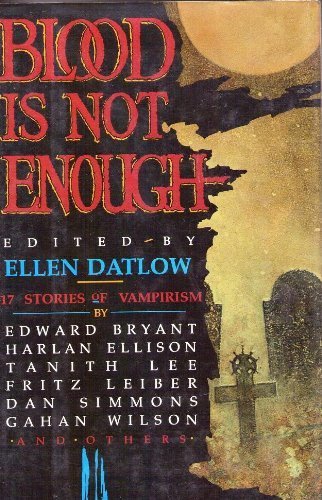
Blood is Not Enough, edited by Ellen Datlow, “The collection provides a good overview of what contemporary writers think of the vampire myth.”
And with so many posthumous publications, Phillip K. Dick might be a creature of the night himself. The Dark Haired Girl, by Phillip K. Dick “when I read Dick’s non-fiction, a line from an old song runs through my head: Paranoia runs deep.”
20-Year-old-me (20YOM) was not that into vampires — I liked the occasional vampire movie (Near Dark being at the top of the list back in the day — and even in the day now! And it would be another year before I stumbled onto Vampire: The Masquerade game and all its offspring).
Interview — Weird Tales Talks with Harry Turtledove
Darrell Schweitzer gives Harry Turtledove the interview treatment. An interesting aside on the business of writing; Harry Turtledove took about 13 years to break into print, including a five-year break for graduate school.
Harry Turtledove writes (at the time) about the Byzantine empire and the discussion wanders from his initial interest and study. An interesting point Turtledove brings up about ancient writers is their desire focus on copying, not improving.
The Byzantines did not view themselves as improving on the ancients. They modeled themselves on the ancients. […] in the West the ancient models were so thoroughly lost that people were creating new things. In the East the shadow of the greatness of both the Roman Empire at its height, and also of classical Athens, was something that Byzantine authors were so conscious of that they felt that imitating these things rather than doing something different was the best way to go.
I don’t know a lot about the genre of alternate history, but Harry Turtledove swings a mallet — Islam never existed, Mars is twice the size, Homo Erectus settle north and south America, that sort of thing. He owns up to it.
The rule that I use is to change one thing, make it a big change, and then try to follow as logically as possible the developments from that one single change.
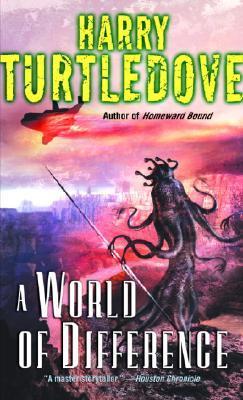
His alternate Mars book A World of Difference was coming out in 1989 and it did in 1990. It seems to have found a receptive audience having 3.58/5 stars on Goodreads. It also looks like it has a bit of a nod to H.P. Lovecraft’s Elder Things.
Poem — “Universe” by Robert E. Howard
This issue of Weird Tales is the first publication of this Howard poem.
I writhe the cosmic expands of my lips
And earthquakes shake the nations and men die.
I clench my jaws and the muscles bulge —
Like Atlantis above the smooth oceans of my skin.
20YOM was not quite aware that REH was a poet and might have found this work a bit odd, or perhaps a bit of a re-imagining of the cataclysms that bookend his Hyborian Age.

Artwork by J.K. Potter
Fiction — “Dragons” by Michal F. Flynn
A classic setup — Verrill hosts his friend Bennet Long at his sumptuous 19th century manor. Dinner has been eaten, cigars have come out of the humidor and the conversation turns to the supernatural. A conversational turn that Verrill has been dreading.
But Bennet was a changed man since his field trip into the Naga country some five years before. Something had happened to him there, something he never spoke of; yet, something that seemed to have changed his life… he began to delve into what I can most kindly characterize as “esoterica.”
These are men of science! And when Bennett goes to crazy town talking about dragons not being myth but real and hidden, Verrill pushes back with the mass ratios of predator to prey studies.
Humans have culled the great cats to the point that they can no longer sustain the dragons.
I’m not sure if Flynn-the-author or Verrill-the-character doesn’t understand that predators don’t primarily eat other predators. 20YOM, with an interest in ecology and environmental matters, would have noted the same thing.
All of this is prologue to Bennet telling the tale of his trip to the Naga Country of Burma. Fourteen days in, they come upon the corpse of a Bengal tiger, throat torn out and seemingly covered with acid burns. Having good sense, the group turns back to civilization only to find one of their number missing — snatched away from their midst. Panic ensues and the group splits up (rarely a good idea). Gunshots ring out! Screams are heard!
Back in the drawing room, Verrill still tries to argue about thermodynamics and the rarity of non-Eltonian hunters, but Bennet won’t back down. In fact, he’s done some research and now believes that the truly alarming numbers of missing persons, especially in big cities like London, is proof that a super-predator in human form is running quietly amok in the modern world.
Confronted with such powerful belief and numbers, Verrill has no choice but to drop the mask and messily devour Bennit.
2024 Darrell Schweitzer adds,
The Michael Flynn story was the result of a bet between George Scithers and Ben Bova. The idea was to find a story that could be published in either Analog or Weird Tales. If one found it, the other had to buy it. Bova found it, so it appeared in Weird Tales.
Poem — “Sighing” by Phil Emery
A short piece about the passing of magic in the world. Phil Emery is writing to this day, and has been in my own ezine, Heroic Fantasy Quarterly, twice! The Rider in Darkness and Jack O’ Wraiths.

Karolína Wellartová’s Artwork for “Jack O’ Wraiths”
Fiction — “Courting Disasters” by Nina Kiriki Hoffman
Main Character Simon is recovering from a particularly bad car accident, having wrapped his Ferrari around a redwood tree. As he recovers there is a realization that some aspect of the car has impressed itself into his psyche, and even deeper beneath the surface, some aspect of the redwood has, too.
He shares a hospital room with a young terminal cancer patient named Chris. The only contact information the hospital could find for Simon is Rachel, his recent ex-girlfriend; in fact it is that breakup that led to a night of drinking and speeding and that ride ended here in the hospital.
The two patients, Chris and Simon, are well aware they are both being somewhat cruel to the people around them—Chris because he won’t come clean with his mother that he knows he’s going to die, and Simon is still being a dick to Rachel, the only person who seems to care about him.
That’s not 100% true the car and the tree care for their own reasons.
<<But now I am part of something that lives wile it moves,>> said the tree.
<<But now I am part of something that lives while it is still,>> said the car.
Of course, Simon has already been damaged by an abusive father and the fear that he will become that kind of man is what drove him away from Rachel and into the arms of the redwood.
It is a lot of plates to spin, but Hoffman does a masterful job of it all, managing 5-way conversations when Rachel and Chris finally realize what is going on within Simon.
The story ends not with Simon and Rachel getting back together, but going their sperate ways, with the question of if Simon was, even against his own efforts, falling into the controlling patters of his father an open questions, but is 3-part psyche is free to explore the future and whatever new paths they find.
Fiction — “Racing the Horseman” by Rayson Lorrey
A short story with a classic feel. Dexter is a runner — it keeps him in shape and gives him the stamina all the ladies love! This morning’s run is a bit odd in that another runner is out in front of him, but that runner seems so old and decrepit he should barely be standing, much less running, much less outpacing Dexter.
Turns out the old man is death himself and Dexter catches him. On the one hand it was pretty predictable what with the name and all, but well done with it being centered on about three minutes of 30-something competitiveness. Could easily have been a Twilight Zone episode.

Fiction — “Florian” by Jonathan Carroll
A story within a story. An Austrian couple losses their young son and the father keeps writing stories about him and making his grieving wife proofread them. Or perhaps it is a story of a couple with a perfectly healthy son who writes a story about a father, broken by the death of his son, who writes stories about him and forces his wife to proofread them. It could go either way! The tale is a perfect length for the ideas it puts forth.
This tale turned out to be quite the coup for Weird Tales, as per 2024 Darrell Schweitzer.
One triumph of this issue was to actually get a Jonathan Carroll story, as he was in the first flush of his fame then.

Fiction — “The Pit Yakker” by Brian Lumley
Josh Peters is a man with a past, a past that he bluntly narrates in this excellent little horror tale. Young Josh has one good friend, Raymond Maddison, but he’s also finally got a girlfriend, Moria. Problem is Raymond is,
Like a big scruffy dog who sits at the corner of the street grinning at everyone going by and wagging his tail, who nobody ever pats for fear of fleas or mange or whatever…
Raymond is the kind of kid who is destined to be a pit yakker — meaning that he’s going to be working at the old coal mine on the edge of their run-down 1950s British coastal town. Being a bit of a clod, Ray is too dumb to get the hint to beat it when Josh and Moria go out for a walk — a walk to the quiet secluded spot out past the mine waste and houses to finally, maybe, hopefully, have sex. Josh sends Ray on a cigarette run and he and Moria slip off.
Things get hot and heavy and then Moria calls it off ‘cause she catches Ray watching them. Josh, in a righteous horny fury, rushes off to give him a solid beating; but can’t find him in the woods, and then when he returns he can’t find Moria. Dejected and heading back to town he catches site of Ray, chases him and is about to come to blows when Raymond, the big damn oaf, falls into some of the coke sludge and begins slowly sinking. Bloody noses are one thing, but drowning in coal-waste quicksand is another, and Josh goes to get some old cable and as he searches for it he finds Moria; dead; mutilated at Raymond’s hands.
And I stood looking at him. He saw me, saw the cable in my limp hands, looked into my eyes. And he knew… Instead I gave him back his terrible knife with all its terrible attachments.
What Lumley does so well is bring up layers of… maybe not horror, but distaste. The distaste of realizing exactly where you sit on the social hierarchy, the horror of knowing that to ever have a hope of moving up that scale (not to mention getting laid) you will have to abandon your only friend. He adds on to this a layer of very understated distaste of looking back from adulthood and realizing with horror that yes, beatings were routine at school, and mining waste and coal were just dumped on the beach, and no, your friend Ray wasn’t as bad as everyone thought, he was much worse. A horror of years of kicking yourself because you didn’t see the signs, forever wondering what would have happened if you had gone back sooner and the horror that you, too, were capable of, maybe not great violence, but great cruelty.
20YOM was also dealing with some of that distaste himself, attempting to juggle two non-overlapping cadres of high-school friends, and a handful of new college friends, AND realizing that the mid-level students in taekwondo class were the ones you had to practice your more advanced moves upon.

Artwork by J.K. Potter
Fiction — “Why Miracles Don’t Happen Anymore” by Mark S. Painter, Sr.
A low-key work, just what you need following “Pit Yakker.” God needs to find a person to speak through in these troubled times, but all the actual religious people are far too hypocritical to actually want to work directly with the god they claim to love and worship.
The TV Evangelist Right Reverand Billy-Joe Murphy doesn’t want the loss of status and income.
Iranian Mullah Hoijatoselslam Hashemi Farajzadeh doesn’t want anything to do with it because it doesn’t include violently purging the faith.
Professor Rachel Garvey passes because the message is not in her field of Women’s Religious Interpretive Studies.
Finally, Al Kurtz just wants to be left alone to watch TV.
It was a fun enough story, but in its way there is a very somber vibe — Billy Joe Murphy is right that people will just change the channel — he knows how TV and people work. Mullah Farajzadeh knows full well that his world is full of very violent men and regimes intent on purifying the faith. Professor Garvey is so hung up on making the message palatable to the first world women because she knows otherwise it just won’t stick, and poor Al Kurtz, he just wants to watch some TV after a hard day.
20YOM had already had 20 years of dealing with religious types and would have found their non-interest in assisting their god to be pretty funny. 54YOM would wonder why god would need so much help to begin with.
2024 Darrell Schweitzer.
I supplied the punchline for “Why Miracles Don’t Happen Anymore.” This tied the various parts of the story together. Painter showed great promise but I don’t think he ever sold anything else. Too bad.
Fiction — “How Sweet, How Silently She Sleeps” by Reginald Bretnor
A tale of cold Eastern-European brutality: Young Vlad hangs upon his grandfather Radu’s every word as he retells the day of murder and rapine and pillage when he stormed the local Count’s city. Ah, but the count’s beautiful young wife took poison before Radu could get his mailed hands on her.
Finally, in his 28th year, Vlad steps into his grandfather’s footsteps to raid the town, only they find nothing — fallow pastures, empty huts, cottages, and an abandoned silent city. Vlad stalks off to the Baron’s castle and into the chapel, and from there into the tomb of the princess who got away — and one other thing, the ancient crone ho tends Lady Naliyana’s tomb — and she assures him that the lady is not dead, and oh yes, she can give him the key.
Vlad goes in, finds the Lady Naliyana alive and sleeping and proceeds to raper her, only from one moment to the next his living struggling victim is just bones and dust.
“The last sound that he heard was the key turning in the lock of the brazen door.”
Boom!

Fiction — “Upstairs” by John Accursi
A severed hand, reanimated by a fathomless desire for revenge, crawls through a suburban home and tells the rest is backstory. A backstory of a mentally retarded child locked in a closet, escaping to see, joust once, the family gathered at Thanksgiving and is murdered and dismembered for it. The story is only so-so, although it is the perfect length for what it is. It suffers a bit from being the second vengeance-from-beyond-the-grave tale in a row.
Poem — “Improbably Bestiary: The Nightmare” by F. Gwynplaine MacIntyre
A decent poem about being possessed by a nightmare, or possessing one, or being quite mad and blaming your actions on one.
It unbuckles my flesh, and it swallows me whole,
Then it tries on my body for size.
And the man people see, whom they fancy is me,
Is the Nightmare in human disguise.

Artwork by J.K. Potter
Fiction — “Three Heads for the High King” by R. Garcia Y Robertson
Caer is the youngest daughter of a witch/wise-woman/priestess/lawgiver of a nameless dark-age village on the isle of Ultima Thule — a place where Mother Earth ‘gives birth: heaving her thighs, throwing molten stone from her mountain flanks, and gnashing her rocky teeth.”
One day a young handsome British/Irish man is dropped off — clearly an exile. He only gives his name as “hands’ because he has no other wealth or trade. The local girls instantly rename him ‘Fair-Hands” ‘cause he’s clearly never done a day of farmwork in his life.
Ultima Thule is a terrifyingly pagan place, with polygamy, incest, and hints of (sacred) cannibalism. Also boning. Lots of boning going on. But Fair Hands is uninterested in sex with Caer’s older sister — turns out he’s too busy working and looking for rocks. Rocks are a particular hobby of Caer’s and soon enough she finds the crystal he’s looking for and learns it is a ‘sunstone,’ and Fair Hands needs them to find his way to Avalon.
She’s really hoping to get a little Fair-Hands dick but instead gets a story about Britain instead.
This is a long, glorious tale; Arthurian, but I won’t hold that against it. In short, Modred, in disguise, is fleeing Brittain and hoping to get to Avalon where his mother is High-Queen. It mashes and re-mixes the fundamental tales, with Modred also being a lover of Gwynyfar and hounded by Authur’s knights and hunters. Specifically, Sir Cei (Kay), shows up with three Pictish headhunters and a Moor hell-bent on vengeance.
It is the Law of Ultima Thule “The Stranger is Sacred” that saves Hands’ life, and Caer is sent out to spirit him away before the hunting party can find him. They flee to one of the holy openings to the underworld. Adventure ensures as the two unravel the secrets of the sacred caves and make their escape and journey to the Sacred Queen (not to be confused with the High-Queen) Summer Sanctuary, one step ahead of the head-hunters.
There is lot going on in the story and an interesting aside is that over a few days of travel the environment of Ultima Thule is the greatest challenge to all involved, and but for a little sacred paganistic cannibalism they near die of starvation.
[Hands] insisted on having his headhunter cooked, though he was too famished to ask what meat it was. Which was just as well, considering his Christian stomach.
Caer, her sisters, and Hands manage to get to the Sacred Queen’s Sanctuary where a penultimate climax of legal wrangling leads to a climax of a duel between Hands and Cei, which Hands wins… well… handily, followed then by an anti-climax of Cei, for all his antagonistic place in the story, being a man of honor and it is that honor that keeps the Moor from killing Hands outright, and thus Hands gets away.
The story just drips with a late 80s/early 90s matriarchy vs. patriarchy vibe, and cleverly mashes together shadowy iron-age settings and twists the Arthurian myths. AND by not hewing too closely to either, makes it all work.
20YOM was about six months away from discovering Simon Bisley’s “Slaine the Horned God” in a special 3-issue run of Heavy Metal magazine — something that took the spirit and feel of “Three Heads for the High King” and placed it in a mythical ancient Ireland. 54YOM has yet to fully recover.
Art: J.K. Potter Portfolio
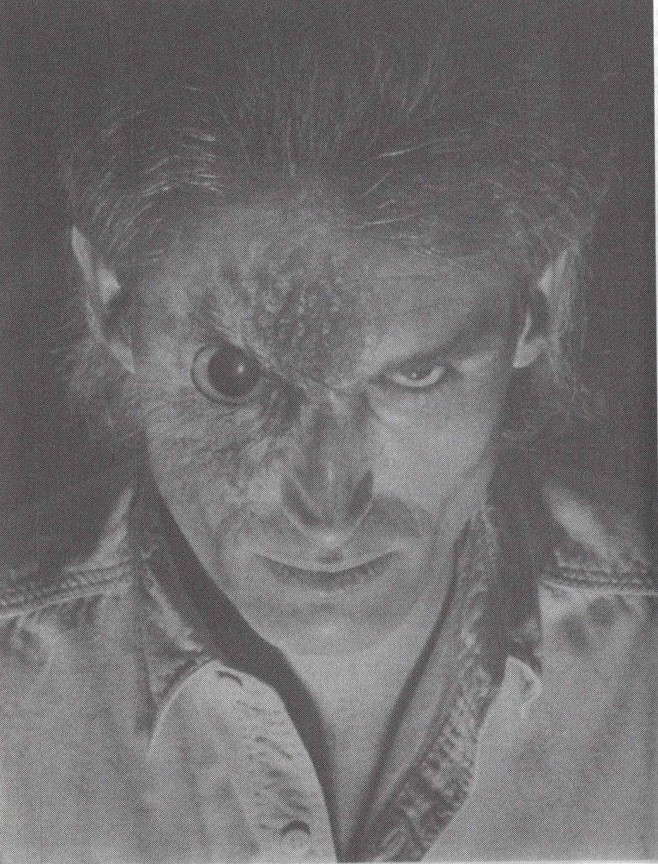
Artwork by J.K. Potter
All the artwork in the issue is by Mr. Potter — I’m not sure if he used traditional photo developing or maybe had access to early CGI/photoshop. So a photoreal/ photosurreal angle — which is pretty standard of the late 80s and early 90s. While it is all quite good, I’m not sure how much his pieces really match the stories. According to this 2014 interview, from 1977-2005 he was a ‘camera, darkroom, and airbrush guy.’

Artwork by J.K. Potter
Mr. Potter’s artwork did not match with everyone’s expectations. 2024 Darrell Schweitzer elucidates.
Surprisingly, the JK Potter artwork, which was so popular in weird fiction fandom, was not well received by some of the general public. We got letters complaining, “Photographs? Can’t you do better than that?” He was using photo-developing techniques, not Photoshop, which, if it existed at all in 1989, was in a very crude state of development. You can see this in his work from the ’80s, in various books and in Nyctalops magazine, where he got his start.
Fiction — “The Highwayman” by Lois Tilton
Walter Rowland, a bold highwayman, has been ratted out the very night he was to spirit away his beloved Bess. He faces his inevitable doom with a swallow of raw gin and the desperate hope that the old woman who visited the prison the day before and gave him a twisted strand of thread and promise of resurrection.
Desperate times call for desperate measures and it works! Wat Rowland returns to the land of the living with an incredibly sore-throat and owing the witch Nan Jenkens a favor. Worse yet, with a twist of the strand Nan can re-hang him if he steps out of line. And he’s desperate enough to step out of line, desperate to get back to Bess, and all the murders and thievery and grave-robbing really make his new life hell. He tries twice to get away, fails both times, and with the news that Bess was actually shot dead trying to warn him of the ambush the night he was capture. With nothing left to lose, he lunges to get the strand and pits his dying strength against Nan’s. In the struggle he drops the fetish into a burning candle.
“You fool!” she screeched, as Walter Feel to the floor, strangling.
But this would be the last time… Or so he prayed, through every endless moment of his dying.”
This was a good punchy story, and I felt a bit of perverse schadenfreude with a crackin’-wise overly confident thief getting savagely roughed up and making a final desperate gamble.
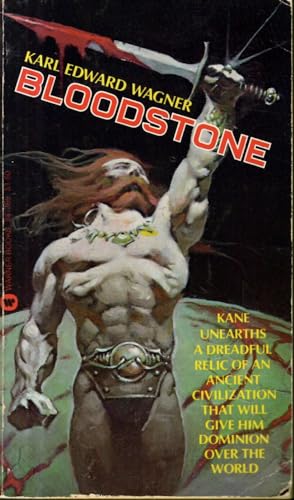
Essay — “A Brief Introduction to Karl Edward Wagner” by David Drake
Ah! This one is bittersweet, as Karl Edward Wagner (KEW) died October 4, 1994, and we lost David Drake on December 10, 2023. Two greats gone… And as I wrote this, the SFF world is rocked back on its heels with the loss of Brian Lumley on January 2, 2024, Howard Waldrop, January 14, 2024, and Christopher Priest, February 2, 2024.
I must confess that as an S&S editor and reader, I have a conspicuous lack of knowledge about Karl Edward Wagner.
Ironically, the interview starts off talking about death, about KEW’s friendship with Manly Wade Wellman until his death just three years before this Weird Tale’s publication.
In many ways, these interviews are by their nature very sobering because the world of writing and publishing always seems to get worse, to get in seems to always be getting harder.
“And in an off-campus soda shop, nestled among the westerns and the porn, Karl found a new line of heroic fantasy, put out by a California firm called Powell Publications. Powell looked open to innovation.” And they bought Karl’s book Darkness Weaves in 1969.
Funny how the pre-internet world isn’t that much different, with KEW eventually starting his own publishing venture, Carcosa, to publish S&S and weird fiction.
Overall, an excellent essay, some items I found quite interesting: one — a collapse of the heroic fantasy market in the early 70s, and then it managed to come back in the mid-70s. KEW, like so many others, made most of his early sales work on pastiches and editing with only a few of his own stories selling.
Two — KEW’s first love, heroic fantasy, was so tarnished by a reputation that
Reviewers were going to treat heroic fantasy as a lowest-common-denominator dreck without bothering to read it: and for most of each year’s new crop of thirteen-year olds, the lowest common denominator was plenty good enough. Modern horror, on the other hand, had a chance of being taken seriously as literature.
I’m going to go on an aside here. Help me get these soap boxes set up while I fetch the high horse.

While I believe that KEW’s view of the ghettoization of heroic fantasy is completely accurate, I also find it somewhat… ironic? Enraging? I’ve heard this dig at 13-year olds many, many times, but as a former 13-year old, I feel the need to punch back.
Friends, Romans, hordes of Mordor, 13-year-olds built most of this, built most of the sf/f fiction world, a world that even limping along as it does today is still a world people are willing to give their left testicle/boob to get a shot at getting into. And as movies and video games have drained away those 13-year-olds, SFF publishers would give their left testicle/boob to get them back. To get a tenth of them back. They have tried, tried mightily, to find a replacement for that cadre, and that has been generally unsuccessful. One could argue that the boom in YA is yet another attempt to get those 13-year-olds back, and the various sparkly vampires and animal companion books are an attempt to mine the next vein of 13-year-olds.
While I get off this high horse, you guys put these soap boxes up.

Artwork by J.K. Potter
Fiction — “At First Just Ghostly” by Karl Edward Wagner
2024 Darrell Schweitzer recalls,
One of Karl’s last stories. I remember that John Betancourt had to hang out with him in bars at a World Fantasy Con to get the manuscript away from him, as Karl kept making little handwritten changes.
After the essay and my previously stated lack of KEW knowledge, I was eager to get into the story… sadly, I found it to be a letdown.
Cody Lennox is a Fantasy/Horror writer in London for a conference (coinciding with the great conjunction of the planets) and mysterious events plague him every stage of the way. He has also drifted further and further into alcoholism after the death of his wife, Cathy.
There is a lot of insider baseball in the tall weeds about writing; and he finds a hottie way above his league naked in his hotel room, until a big dud with red hair drives her out; then his dead wife shows up hale and hardy and strangely silent about their past but she sure wants to have sex until another strange hottie named Klest drives her away; then Kane (red-haired guy ) shows up as the demons attack; then Kane reveals Forces are after Cody, ‘cause he has powers to shift between different worlds; and that power is magnified by the conjunction of the planets; and team evil wants to use that skill to open the gates o’ hell. Kane’s badassery and Cody’s desire to get back to the life he knows diffuses the situation and it all ends with Kane buying a publishing house to keep Cody safe and sound.
Like I said, I was not overly impressed with it. Writers writing about writers is frowned up on for a reason, and the plot often jerks along because Kane never bothers to leave a message of any kind to try to ensure that he and Cody can meet to talk. But in truth, the character of Cody Lennox is the most detrimental part of the story. He’s always got a clever quip (and if I haven’t said it before, witty banter rarely is) and Cody is often having one-sided witty banter with himself. Wagner relies way too much on Cody Lennox constantly thinking “this must be a dream,” and “Didja slip something into my drink?” An example — which also includes the delightfully 80s-ness of the tale follows:
The man was not as tall as Lennox, but he was built like an all-pro NFL lineman. He was wearing kicker boots, punker black leathers, and a lot of chains and badges and things. His combed-back red hair and short beard were like rust surrounding a brutal face, and his eyes were cold blue and malevolent. Lennox quickly looked away. It was time to try pinching himself. He tried. It hurt.
Cody Lennox quips and refuses to believe what’s going on, because if he didn’t do that he would do, well… nothing. Just get hammered and wait for Kaine/Kesset/Team Evil to do something.
In that light, Cody’s various friends and associates who are trying to make sure he doesn’t drink himself to death are more active participants and more interesting. And it is darkly hilarious that, on the one hand, they are shocked at Cody’s drinking before noon. But after noon? The sky’s the limit, baby!
I suspect that KEW’s “Kane” stories were quite well established by this point, and maybe this was written with a more in-the-know fan in mind. So “At First Just Ghostly” is like A Sherlock Holmes story written from the POV of someone encountering Holmes and Watson for the first time. I haven’t made my mind up on Karl Edward Wagner yet, but as an introduction this particular story didn’t serve him very well.
20YOM might have been a bit more sympathetic to it, thinking the intrusion of the supernatural into the mundane would be a very cool idea—which it was (and still is), although I would have been much more interested in Kane than in Cody Lennox. 54YOM wonders if that was the main point of the story.
2024 Darrell Schweitzer adds some important, and sobering, backstory.
That story (which I do not remember clearly) seems in your description of it poignantly autobiographical as KEW finished his downward spiral into death. I recall that John Betancourt had to follow KEW around at a convention (might have been the World Fantasy Con in Nashville) to get the manuscript away from him. He was still making scribbled revisions while drinking heavily. It was about the last thing he wrote. His wife had not died but had left him because of his self-destructive behavior. Wagner’s Carcosa imprint was devoted to omnibus editions of pulp fiction by living authors, who were still around to appreciate it. It was not devoted to S&S or any new fiction. It published 4 volumes, two by Wellman, one by E. Hoffmann Price, one by Hugh B. Cave. It was a very idealistic venture. I believe KEW’s partner in all this was the late David Drake.
That (finally!) wraps up Weird Tales, November 1989. Overall, I was quite impressed with its offerings. 146 pages of offerings, so this quatro-decadal-review was not a small endeavor! I’ll leave the final word to 2024 Darrell Schweitzer.
One thing I (and John Betancourt) can be proud of about WT of this period is that these issues will never be rare. We were putting out close to 10,000 copies, well bound, on book paper. Copies should be around for centuries.
The WT of this period was intended to be what would have happened if WT had survived to the present day uninterrupted, but also, you might say, if it had been raised from the dead and went to Heaven. It retained its essence and form. The layout and design is based on the very attractive issues of the early 1940s. (To be fair, WT in the golden years of Farnsworth Wright was usually a fairly ugly magazine. The design and appearance improved enormously in the late ’30s, particularly after it was taken over by Short Stories Inc. and had a professional design department.) It’s on book paper. No “crumbling pulp pages.”
All this was way too idealistic. It lost a lot of money. You can see my memoir of this period in the revised/expanded version of The Weird Tales Story, including the tale of how WT escaped a lawsuit by abandoning a warehouse full of back issues in the manner of the proverbial adventurer who must occasionally abandon his luggage.
Previous entries the Quatro-Decadal Reviews include:
November 1969
Amazing Stories
Galaxy Science Fiction,
The Magazine of Fantasy & Science Fiction
Worlds of If
Analog Science Fiction/Science Fact
Venture Science Fiction
A Decadal Review of Science Fiction from November 1969: Wrap-up
November 1979
Quatro-Decadal Review, November 1979: A Brief Look Back
The Magazine of Fantasy & Science Fiction
Galileo Magazine of Science & Fiction
Analog Science Fiction Science Fact
Isaac Asimov’s Science Fiction
Amazing Stories
Omni
A Decadal Review of Science Fiction from 1979: Wrap-up
November 1989
Jump Back! Quatro-Decadal Review, Looking Ahead to November, 1989
Amazing Stories
Analog
Asimov’s
Magazine of Fantasy and Science Fiction
Adrian Simmons is an editor for Heroic Fantasy Quarterly, check out their Best-of Volume 4 Anthology, or support them on Patreon!
I had my hands on this one as soon as it came out (I was a subscriber, in fact), and I especially love the J.K. Potter pics. I first saw his work in the Arkham House “best of” Clark Ashton Smith volume, A Rendevous in Averoigne, and immediately fell in love with it.
Excellent! 20YOM was not in the know about such things. I will have to look up Potter’s CAS work.
I do have the complete Terminus digest run (and I think a relatively complete Terminus magazine-sized run? but I’d need to dig out the issues to confirm that), although I came to it a bit later (with the Gene Wolfe issue being first) and had to track down copies of earlier issues once I discovered it existed. I think it’s the only fiction magazine I ever consistently read cover-to-cover.
As I recall, this particular issue was the hardest to source — Terminus was selling copies of most of the earlier ones, but the KEW issue had to wait until I discovered Uncle Hugo’s Science Fiction Bookstore in the Twin Cities back in 1990.
Love J.K. Potter’s artwork, which I also first encountered in A Rendezvous in Averoigne.
Ah, the intricacies of magazine collecting back in the day! You make me feel kind of guilty that I just ordered mine off of Ebay. It sounds like Schweitzer and Betancourt were really swinging for the fences with their run of Weird Tales.
I mean, it was 34 years ago (and I was a senior in college), but I’m pretty sure I was able to get all of the back issues other than the KEW one directly from Terminus?
(Also, I’m pretty sure that I discovered that Weird Tales had been resurrected because of an ad in an issue of F&SF.)
And yeah, all of those digest issues were outstanding. The Tanith Lee issue might be my favorite of the bunch.
Did you fill in a card, an insert, in F&SF? Envelopes? Stamps!? Old School! I miss those days.
I’m guessing I actually had to take a scissors and clip the subscription form out of a page of the F&SF issue (which is, needless to say, long gone); then put it in an envelope along with a check, put it in the mail and be patient.
Those were days, weren’t they?
This was also around the time I joined the SFBC, as I recall.
Ah, from 2024’s perspective, this almost seems like some kind of Shinto paper ritual. Arcane!
(Also, just looking at my stack of issues again, I’m pretty sure the first issue I received was the David Schow one — the Gene Wolfe issue was actually the first of the Terminus run, so I must’ve gotten it as a back issue.
I might have to get back on ebay and find thid Gene Wolfe issue. I loved his “Soldier in the Mist” and it sequel. Do you happen to know what issue number it is?
Issue 290. Because it was a Gene Wolfe special issue, it had some fiction by him and also a nice, meaty interview that I’m sure was conducted by Darrell Schweitzer.
Thanks!
I recognize that cover. Not from ever having seen the magazine but from the cover of a music CD I have.
https://www.discogs.com/release/784622-Various-Beauty-In-Darkness-Vol-4
German stoner rock nodding to artwork of the 80s? Typical!
[…] (Black Gate): Two — KEW’s first love, heroic fantasy, was so tarnished by a reputation […]