Cover for The Graveyard Heart and Elegy for Angels and Dogs by Bob Eggleton
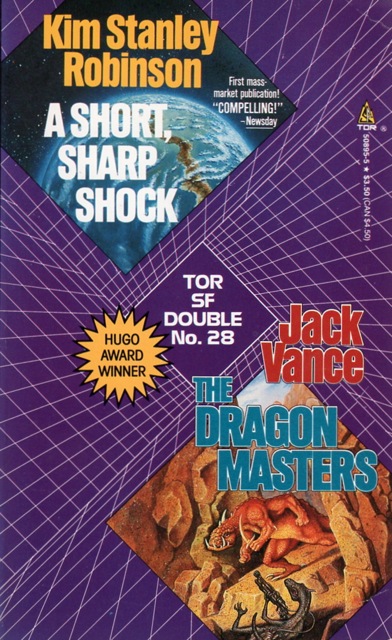
Originally published in December 1990, Tor Double #28 contains the fourth story (but third headlining story) by Kim Stanley Robinson, who first appeared in Tor Double #1, and the second, and final story by Jack Vance.
The Dragon Masterswas originally published in Galaxy in August 1962. It was previously published as part of an Ace Double (with Vance’s The Five Gold Bands) by Ace Books in 1963. It won the Hugo Award and the Seiun Award.
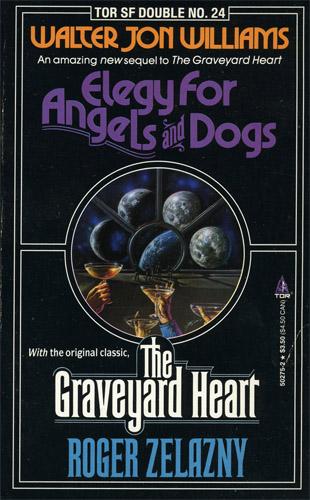
Cover for The Graveyard Heart and Elegy for Angels and Dogs by Bob Eggleton
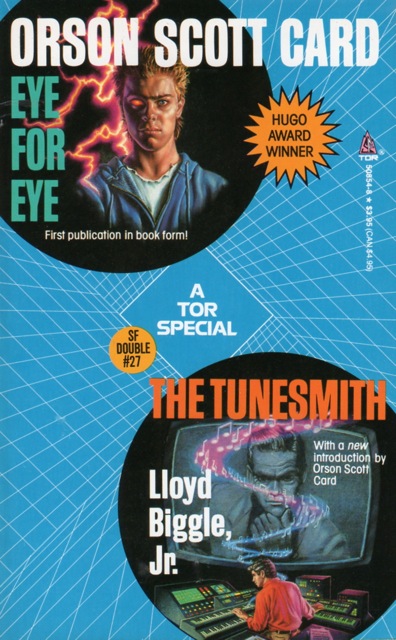
Originally published in November 1990. In addition to the stories, Orson Scott Card provided two essays entitled “Foreword: How Lloyd Biggle, Jr., Changed My Life, Part I (The Tunesmith)” and “Afterword: How Lloyd Biggle, Jr., Changed My Life, Part II (The Tunesmith),” both original to this volume.
The Tunesmith was originally published in Worlds of If in August 1957. Erlin Bacue is a composer in a world which has turned a deaf ear to traditional music. The only music that is composed are Coms, short for commercials. What sets Baque apart from his fellow composers is that, while he makes use of the multichord for his compositions, he does all his composing himself, unlike most other composers who make heavy use of what we would now recognize as artificial intelligence. This hive his Coms a depth that others don’t have, but it also means that he takes longer to compose his Coms than other composers do.
Cover for Fugue State by Wayne Barlowe Cover for The Death of Doctor Island by Ron Walotsky
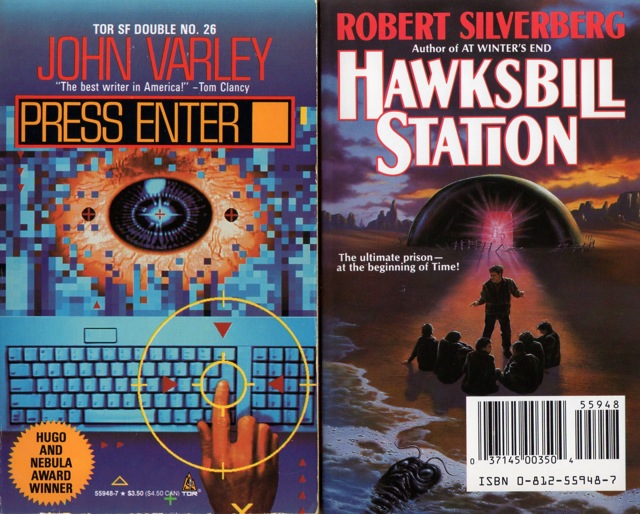
Tor Double #26, originally published in October 1990, contains the fifth and final story by Robert Silverberg. It also contains the second of three stories by John Varley.
Hawksbill Station was originally published in Galaxy in August, 1967. It was nominated for the Hugo Award and the Nebula Award. Set in the Cambrian period, before land animals or plants have evolved, it focuses on the titular prison, sent back in time from the twenty-first century to house political dissidents.
Cover for Fugue State by Wayne Barlowe Cover for The Death of Doctor Island by Ron Walotsky
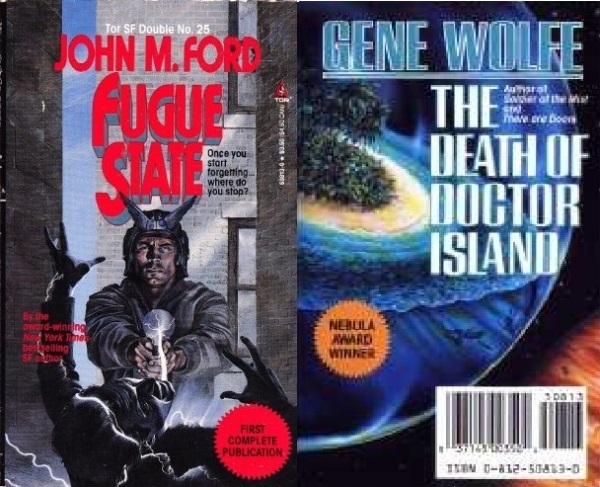
Tor Double #25 was originally published in September 1990 and collects Gene Wolfe’s The Death of Doctor Island and an expanded version of John M. Ford’s Fugue State. Both stories have settings which question the nature of reality, although in very different ways.
The Death of Doctor Island was originally published in Universe 3, edited by Terry Carr and published by Random House in October, 1973. It was nominated for the Hugo Award and the Nebula Award, winning the latter. It also won the Locus poll.
Wolfe’s story focuses on Nicholas de Vore, who rescues himself from a sandy pit to discover he is living on a nearly deserted island. He eventually learns that there are two other people living on the island, Ignacio, an older man who attacks Nick upon first meeting him, and Diana Phillips, a young woman who provides him with advice and assistance in surviving on the island. The most important “person” he meets, however, is the disembodied voice of “Doctor Island,” who is Nicky’s primary source of communication on the island.
Cover for The Graveyard Heart and Elegy for Angels and Dogs by Bob Eggleton
Tor Double #24 was originally published in August 1990 and is the final volume in the series which compiled a classic story along with a sequel (or prequel) written by another author. Walter Jon Williams used the world Zelazny created with an overlap of only a few characters to expand Zelazny’s story. Not original to the Tor Doubles series, Elegy for Angels and Dogs was originally published in Asimov’s Science Fiction Magazine 26 years after The Graveyard Heart appeared.
The Graveyard Heart was originally published in Fantastic Stories of the Imagination in March, 1964. Opening at New Year’s Eve 2000, Zelazny offers a decadent society of the Set, who live to attend flamboyant parties and be seen, going into cryosleep between the parties to prolong their lives. Alvin Moore has managed to get an invitation to the “Party of Parties,” where he promptly falls in love with Leota, one of the Set.
Since the Set only come out of hibernation every few years to attend elaborate parties, there can be no relationship between Moore and Leota. Unable to accept this, Moore decides he must be admitted to the Set and goes about figuring out how to improve his chances of achieving his goal.
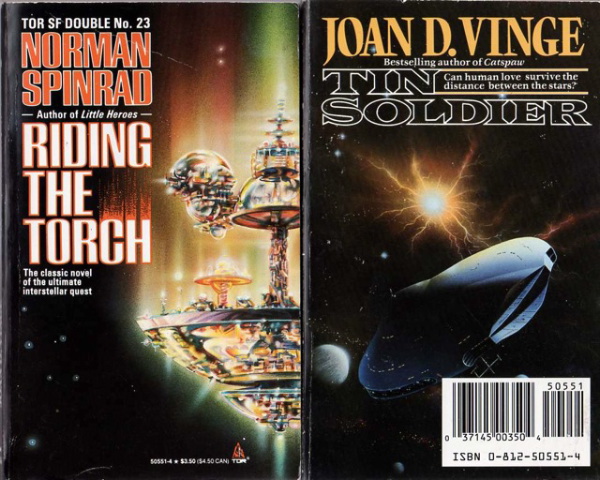
Cover for Riding the Torch by Wayne Barlowe Cover for Tin Soldier by Ron Walotsky
Both stories published in this volume originally appeared in 1974, with Joan D. Vinge’s Tin Soldierappearing in April and Norman Spinrad’s Riding the Torch appearing four months later.
Tin Soldier was originally published in Orbit 14, edited by Damon Knight and published by Harper and Row. The story was also Vinge’s debut story.
Among Vinge’s best known works is her Hugo and Locus Award winning novel The Snow Queen, which was also nominated for the Nebula, the Ditmar, and the coveted Balrog. That novel took its inspiration from the fairy tales of Hans Christian Andersen. Vinge’s first story, The Tin Soldier, looks to the same source, taking its title from Andersen’s “The Steadfast Tin Soldier,” a fact referenced in the story.
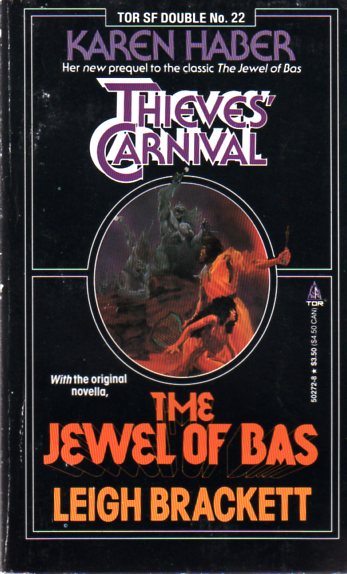
Cover for The Jewel of Bas and Thieves’ Carnival by Luis Perez
This volume represents the third collection of linked stories. While Robert Silverberg wrote In Another Country to take place at the same time as C.L. Moore’s Vintage Season and Harry Turtledove’s The Pugnacious Peacekeeper was a more traditional sequel to L. Sprague de Camp’s The Wheels of If, Karen Haber provided a prequel to Leigh Brackett’s The Jewel of Bas. Although Haber’s Thieves’ Carnivalappears first in this volume, I’m going to stick with my norm of reviewing the earlier published story first.
The Jewel of Bas was originally published in Planet Stories in Spring 1944. It is the final of three stories by Leigh Brackett in the Tor Double series. The story opens with Ciaran and Mouse, a raggedy couple who has recently gotten married. Leaving the city they have known for their entire lives, Ciaran convinces Mouse that they should take a shortcut he has heard of across the Forbidden Plains, despite its foreboding name and its reputation for causing people to disappear.
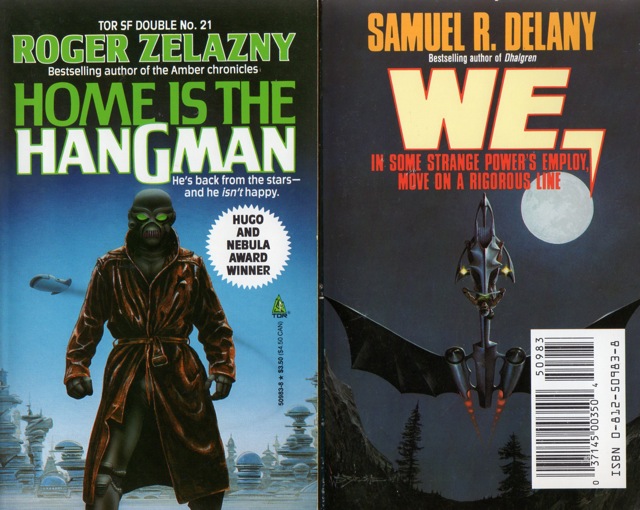
Cover for Home Is the Hangman by Martin Andrews Cover for We, in Some Strange Power’s Employ, Move on a Rigorous Line by Wayne Barlowe
The twenty-first Tor Double is the first time both of the authors in a collection are repeats. It includes the second (and final) Samuel R. Delany story, We, in Some Strange Power’s Employ, and the second of three Roger Zelazny story, Home is the Hangman. Delany first appeared in Tor Double #4 and Zelazny in #12. It is also unique in that it is the first time one of the stories (Delany’s) includes a dedication to the other author (Zelazny).
We, in Some Strange Power’s Employ, Move on a Rigorous Linewas originally published as “Lines of Power” in Fantasy & Science Fiction in May, 1968. It was nominated for the Hugo Award and Nebula Award.
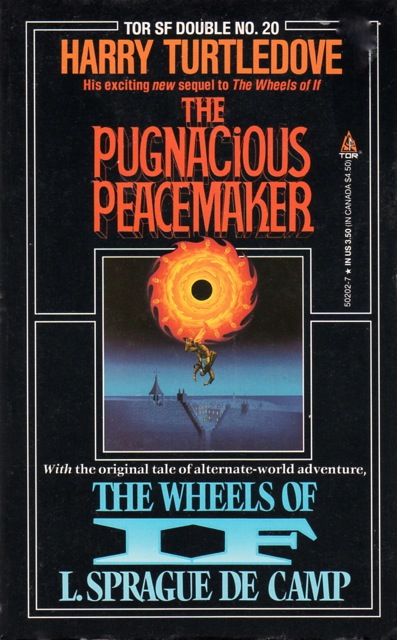
Cover for The Pugnacious Peacekeeper and The Wheels of If by Joe Burleson
While the eighteenth volume of the series included C.L. Moore’s Vintage Season and Robert Silverberg’s In Another Country, which takes place at the same time, this volume includes a story and an actual sequel. It also includes the first original story in the series (Silverberg’s story appeared in IASFM nearly a year before appearing in this story). From a production point of view, this is also the first volume that does not have an embossed cover.
The Wheels of If was originally published in Unknown Fantasy Fiction in October, 1940. The story is an alternate history tale that follows Allister Park. Park is a prosecutor in a world which seems to be our own. His current goal is to successfully prosecute the Antonini gang. He sees the successful prosecution as a stepping stone to being nominated for the position of District Attorney for the County of New York. However, when he awoke on Monday, April 11, it was clear that something was different. Park suddenly had a moustache and the New York in which he found himself was not the New York in which he was familiar.
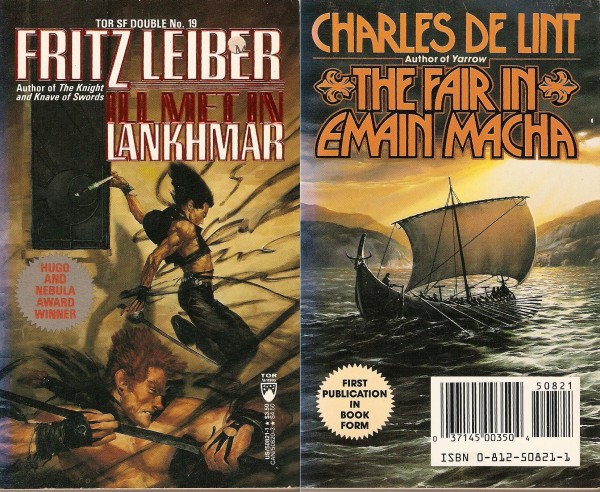
Cover for Ill Met in Lankhmar by Sam Rakeland Cover for The Fair at Emain Macha by Mel Grant
This volume of the Tor Double series offers something it hasn’t offered before. Although several of the novellas previously published in the series have played with the tropes of fantasy novels, such as Jack Vance’s The Last Castle or Joanna Russ’s Souls, all of the stories published to this point have been science fiction. With Volume 19, the series offers two novellas which are unabashedly fantasy, Fritz Leiber’s Ill Met in Lankhmar and Charles de Lint’s The Fair in Emain Macha. Not only are both fantasy stories, but both of them are parts of series exploring the characters who feature in them.
Fritz Leiber introduced the world to Lankhmar and his characters of Fafhrd and the Grey Mouser in August of 1939 in the story “Two Sought Adventure,” which appeared in Unknown. By 1969, he had published an additional eighteen stories about the adventurers, including one story which told of the Grey Mouser’s life before he met Fafhrd.
Ill Met in Lankhmar was originally published in F&SF in April, 1970. It won the Hugo Award and the Nebula Award. Ill Met in Lankhmar is the second of four Leiber stories to be published in the Tor Doubles series. A prequel to all of the previously published Lankhmar stories with the exception of “The Unholy Grail,” this novella tells how his two characters meet for the first time. …