The Lost History of a Strange Planet Earth: Erich von Däniken’s Chariots of the Gods? and the Pseudoscience Bestsellers of the 1970s
 |
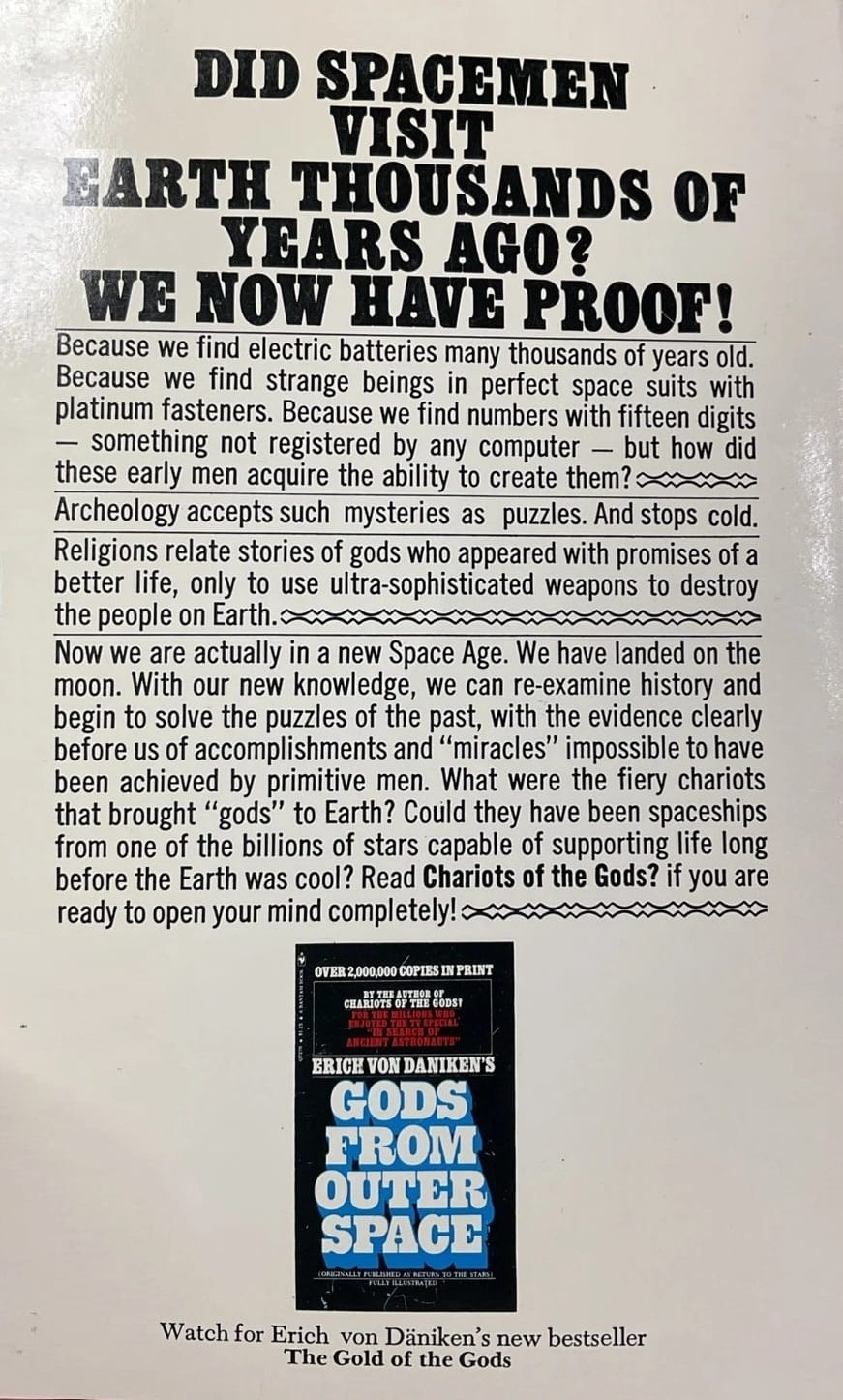 |
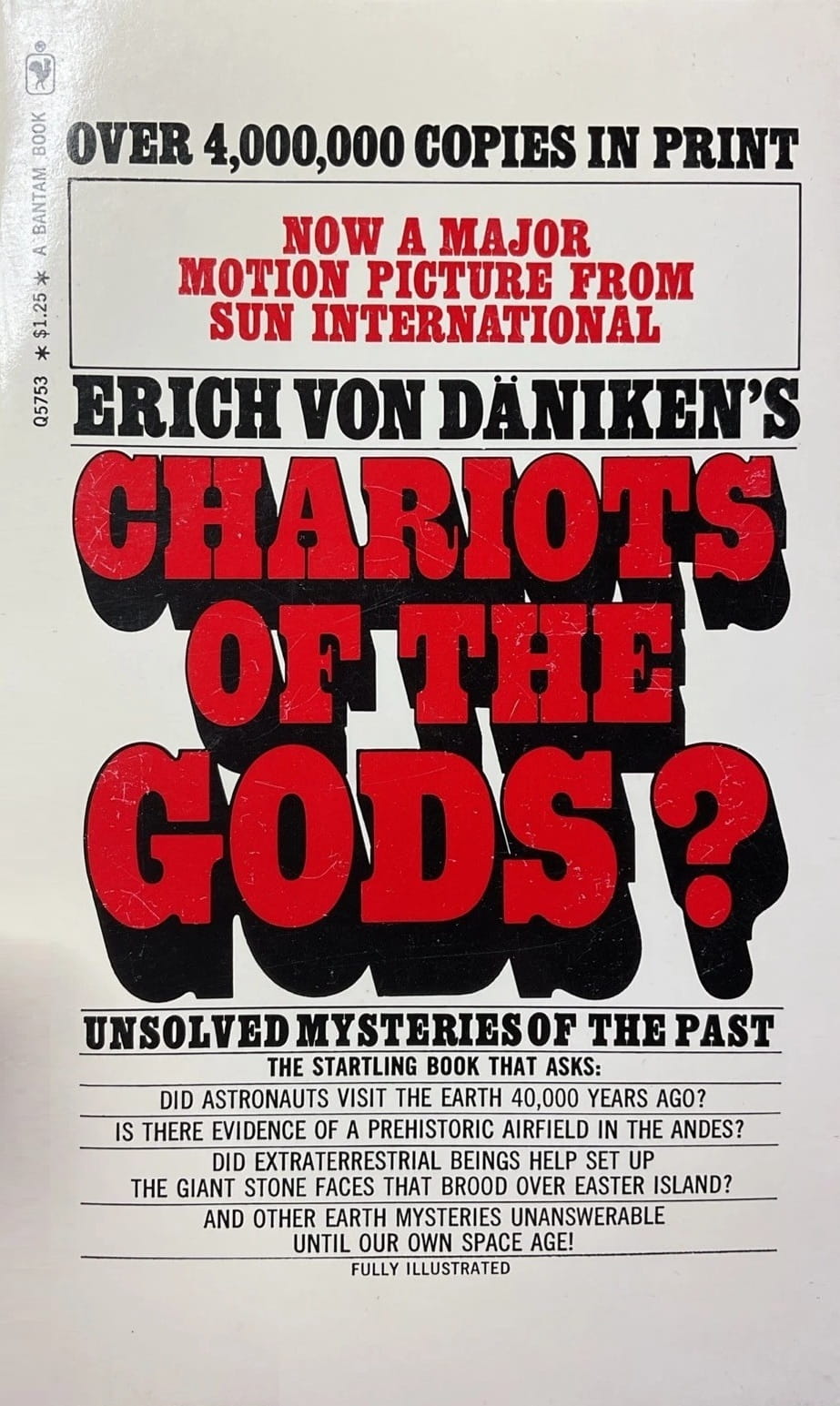
Chariots of the Gods? by Erich von Däniken (Bantam Books, 1971)
In my last post, I mentioned Erich von Däniken’s Chariots of the Gods? to introduce a Ken Bulmer (as Manning Norvil) heroic fantasy trilogy. When I first read Chariots, as an imaginative young lad of 13 or so, I believed he was on to something, and I went looking for more “exposes” of hidden history.
Boy did I find them. The book’s success, which appeared in German in 1968 and in English in 1971, spawned a TV movie In Search of Ancient Astronauts (1973), which was hosted by Rod Serling. And almost immediately other and related books and films began to appear.
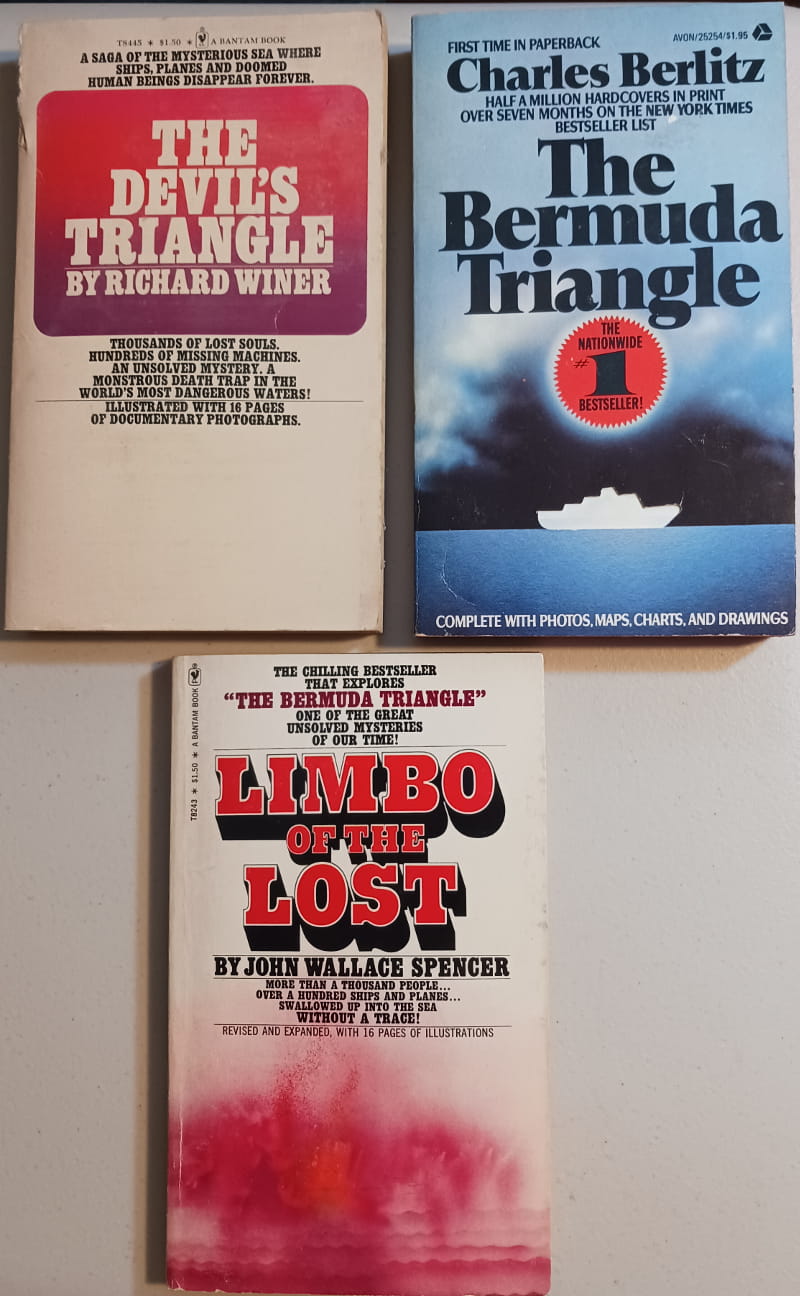
Older books written about similar “lost history” and about UFOs got new life and were republished in new formats. And new works on the theme continued to be published all the way to… now. Von Däniken continued to write them himself, until his death on January 10 of this year.
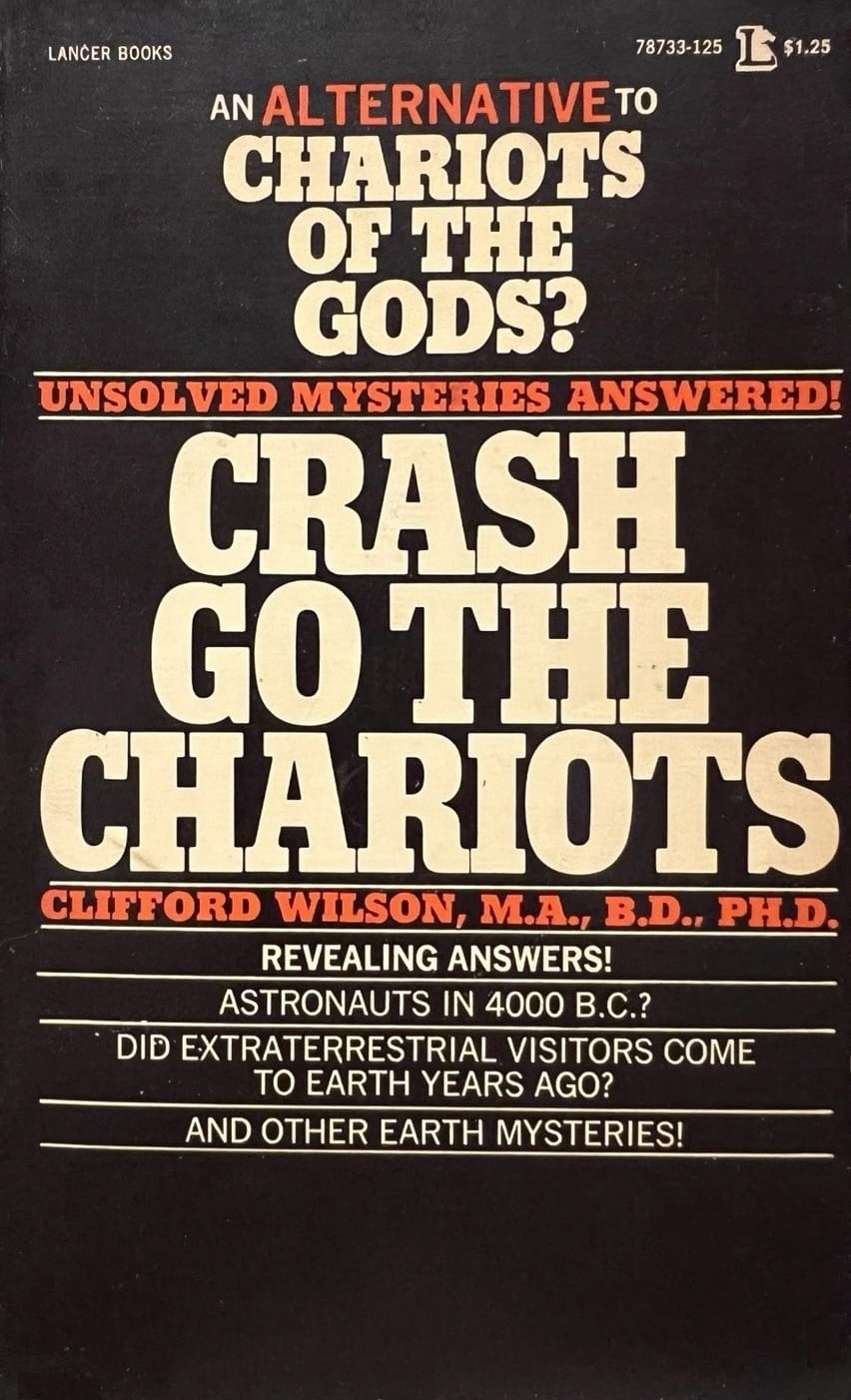
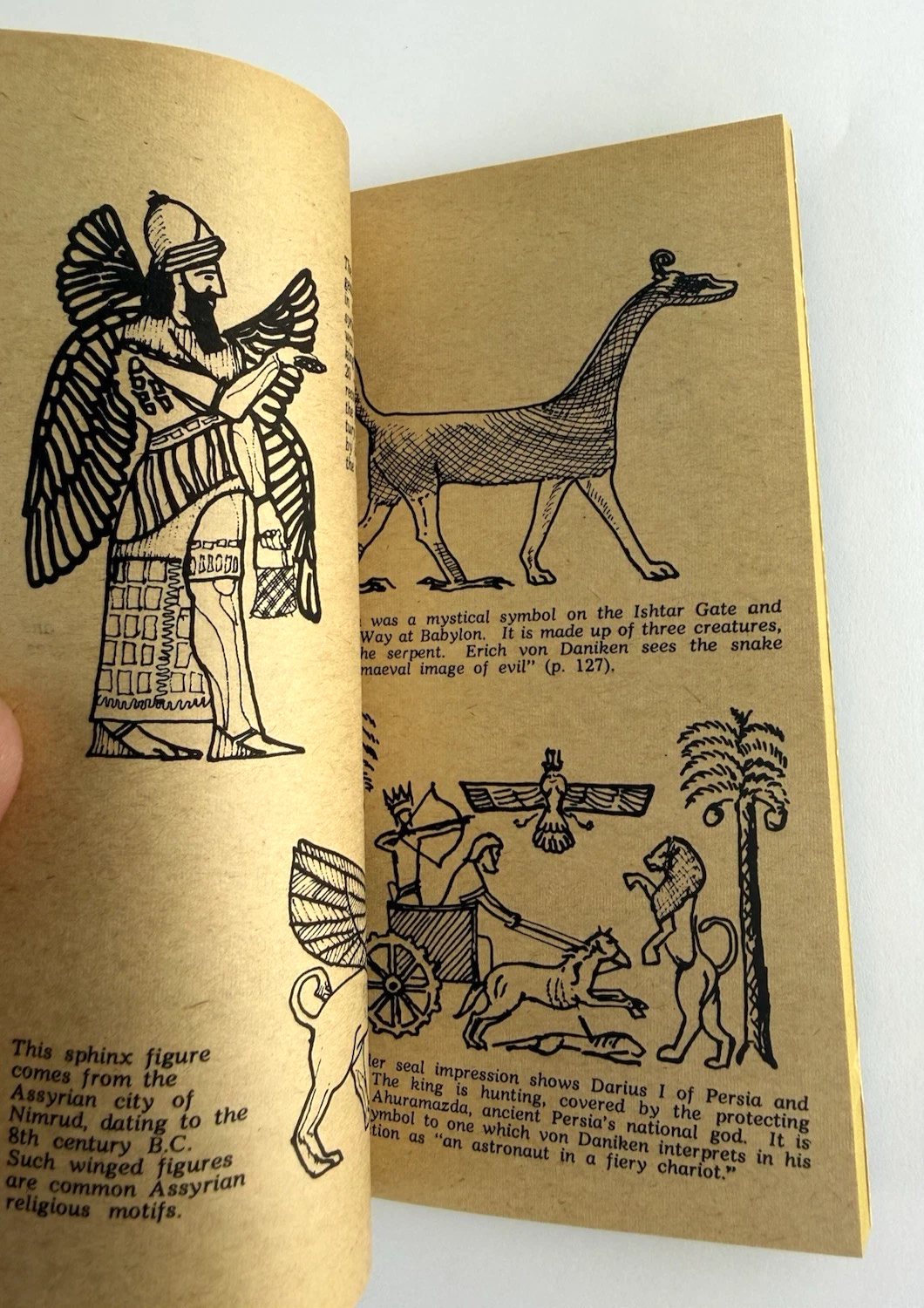
For about three years as a young teen I read quite a few of these kinds of books, with growing skepticism, and finally with a bit of ire at people writing fictions as nonfiction. I also began reading books that looked behind the scenes of such fare, like Crash Go the Chariots.
 |
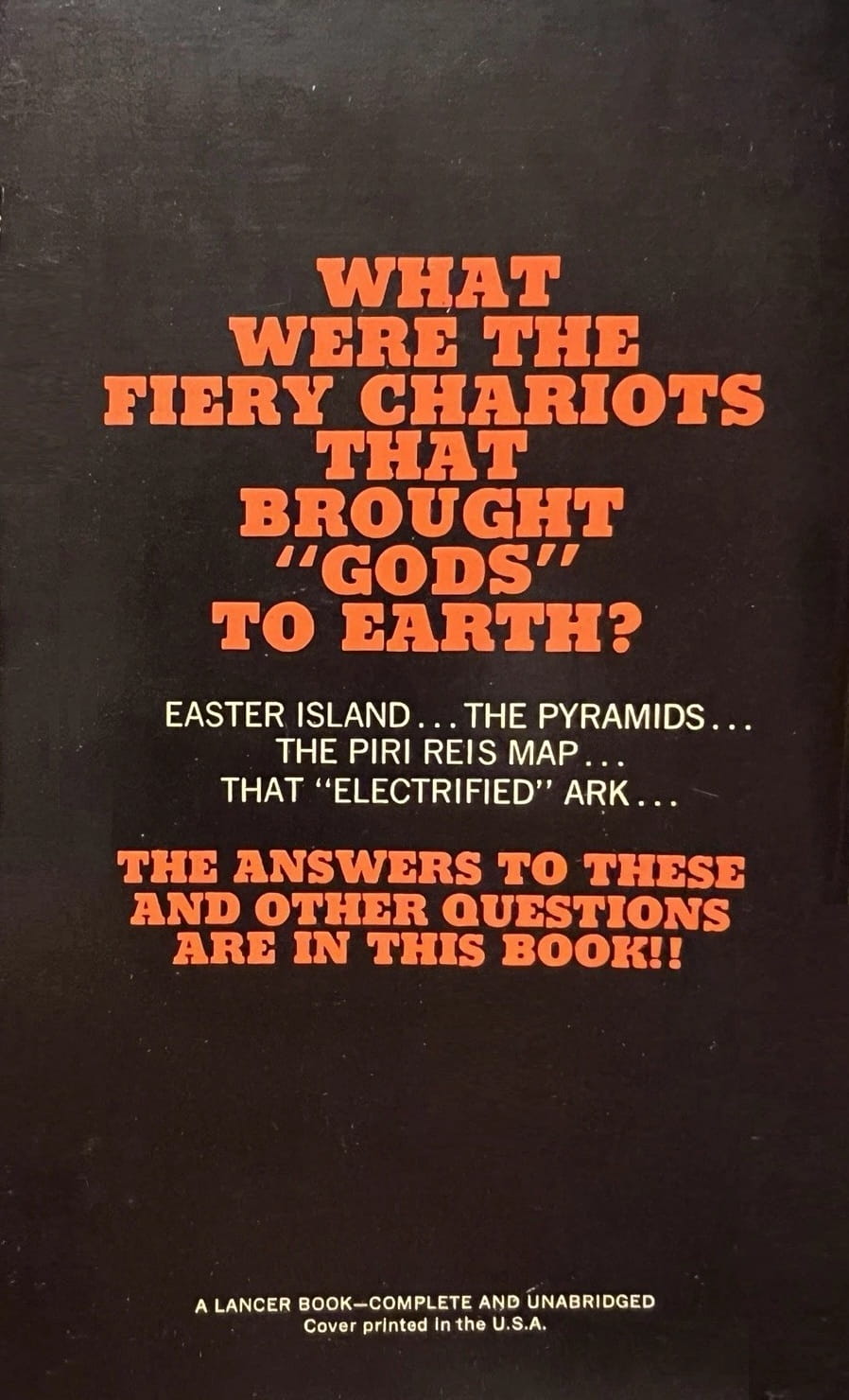 |
Crash Go the Chariots by Clifford Wilson (Lancer Books, 1972)
Note that I’m not advocating for anyone to read Chariots of the Gods? or any of the follow ups or even the “precursors.” I’m just showing you the ones I read. I don’t deny that the universe is a mysterious place and things happen that science does not understand, but I’ve been trained in the scientific method and the arguments made in these books are not compelling as real history.
I have, however, used these books in my college classes to teach students about skepticism and how to recognize science versus pseudoscience. Pseudoscience is often wrapped in exciting packages, and a characteristic of humans is that we love a mystery and love to “know” things others don’t. These kinds of books feed those needs, but — when treated as nonfiction — they actually retard our development of an understanding of the universe.
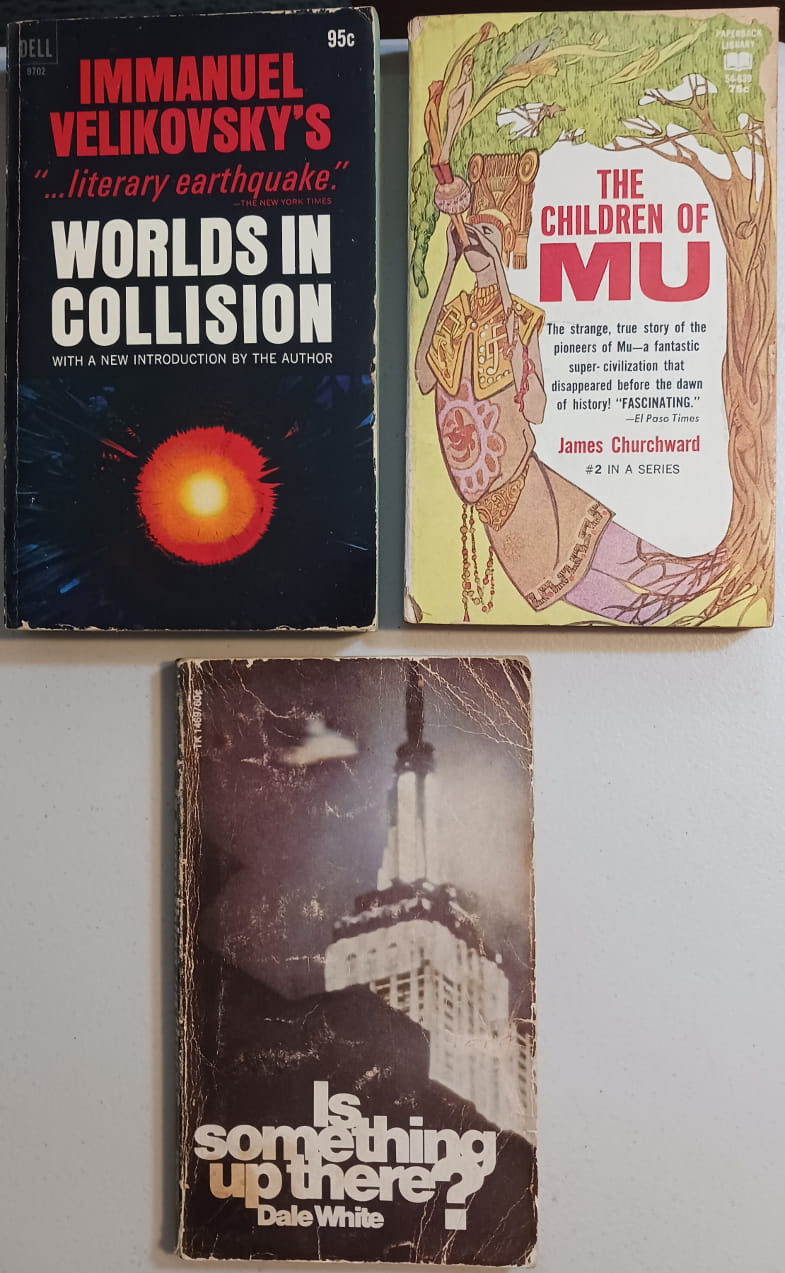
As I first explored these lost history books myself, I found there’d been a long thread of them before von Däniken, dating back — perhaps — to Plato and his writings about the lost land of Atlantis. In 1926 a British author named James Churchward wrote a book called The Lost Continent of Mu, and a sequel called The Children of Mu (1931), which I read in much later editions. A third Mu book (Sacred Symbols) was published just before Churchward died but reissued in 1972 on the heels of Chariots of the Gods. Mu had supposedly existed in the Pacific Ocean.
I also read Immanuel Velikovsky’s Worlds in Collision, which was first published in 1950, where he advocated for a catastrophic history of our Solar System. Specifically, he argued that Venus had once been part of Jupiter, was expelled by the gas giant and sent on a course to its present location right through the orbits of Earth and other inner planets to cause great disruptions.
Although all these ideas have been rejected by science, they have inspired numerous fictions. I already discussed Ken Bulmer’s Odan series. Churchward is mentioned in some of Lovecraft’s short stories. Philip Wylie’s When Worlds Collide and After Worlds Collide owe a debt to Velikovsky, and quite a few of Lin Carter’s works, including his Thongor and Zanthodon series are based on these sorts of ideas.
When taken with the proverbial grain of salt, they can be great fun.
Charles Gramlich administers The Swords & Planet League group on Facebook, where this post first appeared. See all of his recent posts for Black Gate here.
There’s also Charles Fort, whose books inspired several science fiction writers (Eric Frank Russell is the only one whose name I can remember now). The chain of logic in books like this is: Chapter 1 – isn’t it at least possible that X is true? Chapter 2 – as we saw in the last chapter, X is true, which means that maybe Y might also be true, Chapter 3 – now that we’ve shown that Y is true…etc. But then I’ve seen reasoning like this in philosophy, religion, economics, and popular science books too.
I’ve only read a little bit of Fort but I know he was popular in this kind of thing.
I remember my uncle taking me to see the Chariots of the Gods (I think it had the same title as the book) movie, and being so blown away. I was probably 10 or 11, and the UFO craze was in full swing.
Big Foot and UFO’s; we just couldn’t get enough of that stuff back then.
I read a bunch of UFO books and the “MU” books by Churchward and lots of other stuff
I’m sure you’ve watched those Graham Hancock Ancient Apocalypse documentaries, haven’t you? ( I know they’re not accepted and are probably so much BS, but I can’t help but think he might be right about some things… well probably not, but it sounds plausible.)
He references these books.
I know the basic gist of the ancient apocalypse stuff but I’ve never watched those documentaries. I don’t get a lot of time to watch stuff these days.
I realize they are mostly BS but he does make you think. Of course it makes needs like me thinknof the Hyborian age.
Thumbs up
I was wild about Von Daniken’s works all my life. Ever since I was a tiny kid watching TV in the late 70s with a black and white TV in a small house my parents had before they split up. I had these cool “Tiger Salamanders” that I’d kept as pets when I found them after the basement flooded and fed them bits of meat, eggs and mealworms. They were vicious tough little things but I’d hold them expertly in my small hands and they’d open their mouths with cartildge teeth for the worms eagerly. And I’d sit in times late in the middle of the night and early in the morning turning on a tiny B&W TV that was a hand down from my Grandmother.
The TV showed well a lot of stuff but the “In Search of” shows stuck in my mind. Mr Spock’s wise voice educating me about Bigfoot and the Bermuda Triangle. I wondered why Captain Kirk had to be a Cop. IMO it was a strong step down for him… Regardless I was captivated every time it was on and re-re-rewatched it. Of course I found the books and lots of other unexplained, paranormal, occult subjects. The libraries at the time, school and public, had tons of such books as aftershocks of the 1960s I presume.
So, I’ve loved the concept of Space Gods and other Unexplained stuff all my life. Someday I’d love to get control of funding for a big public museam and force them to include a Landsburg/Nimoy exhibit showing In Search Of and the movies and probably (for History channel funding) Ancient Aliens along with cool toys and science exhibits. Stuff like a prehistoric playset like a DFC set but including larger human figures for Nephilhim and aliens and ancient structures. Also Pyramid power sets for kids science fair kits. Maybe include an Astrology room and Alchemy lab also. AND all the proper NINE original planets… We’d do “Natural Energy” of whenever Freeman Dyson comes over to visit we’d give him a tube with a fan to shout into and his screaming would power a smal LED light I think…
A museum of that kind of stuff would be a lot of fun to visit. I’m surprised I guess that there aren’t more of those out there. We have a small local “museum” called the mystery house, which is really a touristy thing but fun. they have a faked crashed UFO and various kinds of supermonsters like a alligator/giant snapping turtle mix that they built. It’s fun.
The fundamentalists have “museums” like that, though they just pander to their peculiar fixation on Biblical literalism.
As opposed to pandering to the assumption that the state of the world as science currently sees it is correct? I can’t count the number of times I’ve visited a natural history museum and read a placard on a fossil that dates it to a certain time frame, only to visit a decade later to find the time frame on that fossil has been silently altered to well outside of the original dates. What is there to be derived from that, except to trust that whatever the museum is telling us now is wrong, and will be shown to be so as soon as someone devises a test he or she has more faith in than the old test?
It is fully within your rights to dislike the foundational documents a museum cites because you see problems with them. But unless the foundational documents that the museum you prefer cites have no problems at all, denigration of the people evaluating and choosing one source or another is an unworthy response.
Tl;dr: It’s not like traditional museums’ fecal material doesn’t stink.
Seems I struck a nerve.
No, I don’t assume the state of the world as science currently sees it is correct. Just that it’s as close as we can get to correct at the moment. Revision of scientific knowledge is a feature, not a bug. Basing one’s worldview on an “foundational document” held to be inerrant, regardless of the accumulation of contrary evidence, appears a lot more problematic.
That said, I don’t necessarily dislike such foundational documents. Even if problematic, they can be entertaining. Nor do I necessarily dislike people who base their worldview on them. That would depend on their behavior.
I do regard my above statement that so provoked your ire to be reasonable and defensible.
There may be traditional museums that for valid reasons. possess fecal matter that stinks. Most samples I have seen displayed, however, are coprolites, the odor of which I find generally inoffensive, as I do that of fossils in general.
My regards.
like the Noah’s ark park
I’ve seen videos about that – love the Gladiator DInosaur. The Creationists would really rake in followers if they weren’t too addicted to “Counting the Begats” and have that 6K year thing. I mean go through Churchward, Donnely, tons of cultures all over the world tell of a Great Flood aka 12,000 BC when the Ice Age ended and water levels rose very quickly. And giants and visitors from the stars… These are cultures that had ZERO connection to any Abrahamic based faith or any classic “Western” one.
As it is real “Scientists” destroyed fossils of (at least) dinosaurs to confound rivals in competition for whose theories would hold out best. Allegedly they’ve dynamited underground cities and destroyed the skeletons of giant humans they found lest the creationists get an inch. Mentioning that JIC things like the “Piltdown man” were considered “One Bad Apple”…
I’d do some other stuff – like I’d have REAL Native Americans stories both about the Giants and earlier world but also some de-bunking. There are some pyramid like mounds of dirt with flat tops and stonehenge but with logs type monuments they made. Well like they said “We understand how white man think Aliens made the Pyramids. We couldn’t and until recently they couldn’t. But these mounds? We shovel DIRT. For when floods come, and poles are to tell seasons…!” so some things would be “De-Bunked” and I’d have native crafts with sales % going to the tribes legit, donation boxes. Right in with the Pyramid Power and “Prehistory” (with Nephilhim, Aliens, etc.) gift shop! Hmm Biorythyms…remember THAT? It’d be cool to bring back some merchandise (books, calculators, cards) for that stuff also!
I bet some of that old stuff is collectible, although it seems like new fads are the biggest thing in these circles. I do remember biorithyms. I remember my girlfriend and I buying each other “mood” rings. Don’t know where mine is now, though. Long since lost
I’ve looked – Biorythyms aren’t scalper price on ebay, pretty affordable to buy it since it was overproduced when it was a fad. And it’d probably be pretty easy to get the rights to republish/remake the stuff. Mood rings are still made, you can go to Temu and real cheap get a tray full of them for $20-$30 range and I’ve seen these on gas station and arcade counters as impulse sales/prizes. They work good since that stuff is easy to make though they all wear out over time.
Personally, I miss “Starscroll”. Remember those things in impulse boxes at store counters and that neat vending machine with lighted display and a dial twist for hororscope sign then insert coin(s) to get it ? I’ve even seen some of them on ebay, the machines… I’d love to see these return!
Also “Geoglyphs” could make a neat return and be marketed as an arts and crafts thing… You know, Ica stones. And in deluxe sets with Dremel tool and with glasses + safety glass or just the stone and/or templates. Pictures of cavemen fighting dinosaurs, riding pterodactyls, meeting with Aliens, alien ‘gods’…etc. And you spray one side of the plastic with water, press it on the rock a while, the image is transferred then you let it dry and dremel the carvings into it. “Uncover the ancient hidden history past which has been recorded in stone!” And, yes, I know, Carl Sagan is probably spinning in his grave since his warning in “The Demon Haunted World” is coming too true, but might as well ride it…
I read The Demon Haunted world” and still have my copy. Was looking at it the other day in fact. I remember the stones too, I think. Been a long time.
If you enjoy the Native American take on things, check out Vine Deloria’s Red Earth – White Lies. He shows how a lot of earth science, in particular, is educated guesses presented as absolute truth.
In this same line of alternative history/science, Zeccharia Sitchin is great fun. I think there’s an element of truth in what he presents, it makes too much sense to be all made up. But it is probably exaggerated and misinterpreted in certain points.
Another fun read is Ralph Ellis. He treats the Bible and Hieroglyphics as history, and shows that they were written by people with a sense of humor and sarcasm. He claims to be able to match them to historical events, if you recognize the nicknames by which personalities are referred. For example, King David gets matched to the Pharoah Psussanes (sp?), whose symbol was a pyramid with a down-facing pyramid superimposed over it. This was like a six-pointed star, so the Pharoah was known to his followers as “King/Ruler Star” or King Dauwud, which came down to us as King David. This is similar to how future generations will be confused by Dwight David Eisenhower also being President Ike.
If nothing else, all these books are good for provoking thought and further investigation.
that sounds interesting but I think there are so many books that it really becomes impossible to sample all of it. I’m reading a lot of novels these days as I try to write it, and most of my nonfiction reading has to be about science and the stuff that I teach. After I retire I may be able to try more esoteric stuff
I don’t think I ever actually READ Von Daniken but, as sounds pretty common, I went through a phase when I was lapping up the “ancient astronauts”/”lost continent” stuff with a spoon. And I still think it’s kind of cool as an inspiration for fiction, at least.
I agree. I tell my students that fiction is the place for this kind of thing and it can be a lot of fun just as long as you hold any such claims up to scientific light in the real world.
Any relation of these books to Zecharia Sitchin’s 12th planet books? I haven’t read them but a friend was mad about them and pretty much paraphrased them to me during the occasional pub lunch.
I haven’t read any of Sitchin’s work. After the Von Daniken era I pretty much moved away from all that kind of stuff.
I burned through “Chariots-” and a whole bunch of the other titles here in elementary school. I thought it was all a crock even then (along with flying saucers, Nessie, bigfoot, etc.) but for some reason I got a kick out of fantasizing about it and in a roundabout way thinking about this stuff led to little Catholic school boy me becoming an atheist by the age of ten. I remember the televidion ads for all of the Sun International pictures, especially the Noah’s ark one, but have never seen one.
I bought into the stuff for a few years and really wanted to believe, but eventually the holes and the lack of evidence showed me the falsity. It really trained me in skepticism, though.
Nobody said it better than the Firesign Theater, in Everything You Know Is Wrong – “There’s a seeker born every minute.”
I would consider myself a seeker, although what I look for as evidence has changed over time.
I used to find all that stuff fun, but when QAnon and the anti-vax movement brought absurd pseudo-science conspiracy into the mainstream the fun ended for me.
that’s why we need good science education.
I know that they are not true, but I kind of wish they were. I enjoy reading them and think that it would be so cool if it were real. Oh well. Back to boring reality.
I often tell my students, I wish bigfoot and the loch ness monster and ufos were real, but the evidence is just against it.