Poison Pen and Poltergeist: Gaudy Night by Dorothy Sayers
“Do you know the Guest Room, miss? That would be after your time, perhaps. Well, it’s on the New Bridge, miss, between Tudor Building and the North Annexe where the Cottage used to be, miss, only of course that’s all done away with now and you has to go up by the main staircase past the West Lecture Room, miss, what used to be the Junior Common Room, miss, before they made the new entrance and moved the stairs, and then turn right and it’s half-way along the corridor. You can’t mistake it, miss.”
In Gaudy Night, Sayers returns to Harriet Vane, after showing Peter Wimsey on his own again in Murder Must Advertise and The Nine Tailors. In fact, a large part of Gaudy Night focuses on Vane on her own, while Wimsey is away doing something for the foreign service. The chronology is a little odd; at one point the events of The Nine Tailors, published just the year before, are referred to as three years in the past. Perhaps Sayers wants to make a point of how long Wimsey’s courtship of Vane has been at a standstill. In any case, Gaudy Night finally resolves that issue.
But though this novel portrays love and its tribulations, it’s still a mystery novel — but with a different kind of mystery. Vane is invited back to Oxford for a Gaudy (a reunion of alumnae held in the summer, between terms). While there, she encounters some ugly and hostile messages, including one directed to her that reads YOU DIRTY MURDERESS. AREN’T YOU ASHAMED TO SHOW YOUR FACE? which evokes her continuing conflict over her own trial for murder five years before.
Most of a year later, shortly before the end of the Easter term (which runs from April to June), she receives a letter from Letitia Martin, the dean of her college, asking for her advice or help with a series of such incidents affecting other faculty and students. And so she returns to the college as a guest, with a cover story about doing research for a book on Sheridan Le Fanu.
Rather than have the story take place at a real women’s college, Sayers invents one for Vane to have attended, called Shrewsbury. This sounds like a wry joke about the women who attend it, but Sayers provides it with a plausible history: named for the countess of Shrewsbury, a historic figure of the time of Elizabeth I, Shrewsbury being a major town in the county of Shropshire or Salop (thanks to the vagaries of English pronunciation, all three names have the same etymology). However, doubts about the character and temperament of academic women are a major theme of the story.
Shrewsbury has a number of distinctive features that need to be understood to make sense of the story. To begin with, like all Oxford and Cambridge colleges, it’s a residential institution, providing accommodations for 150 young women students. It also houses their principal instructors, tutors who supervise their work closely; Shrewsbury has, for example, a history tutor, a modern languages tutor, a science tutor, and two English tutors. Its students’ graduation depends on their being able to pass comprehensive examinations in their subjects, which is a major source of stress for some of them.
 |
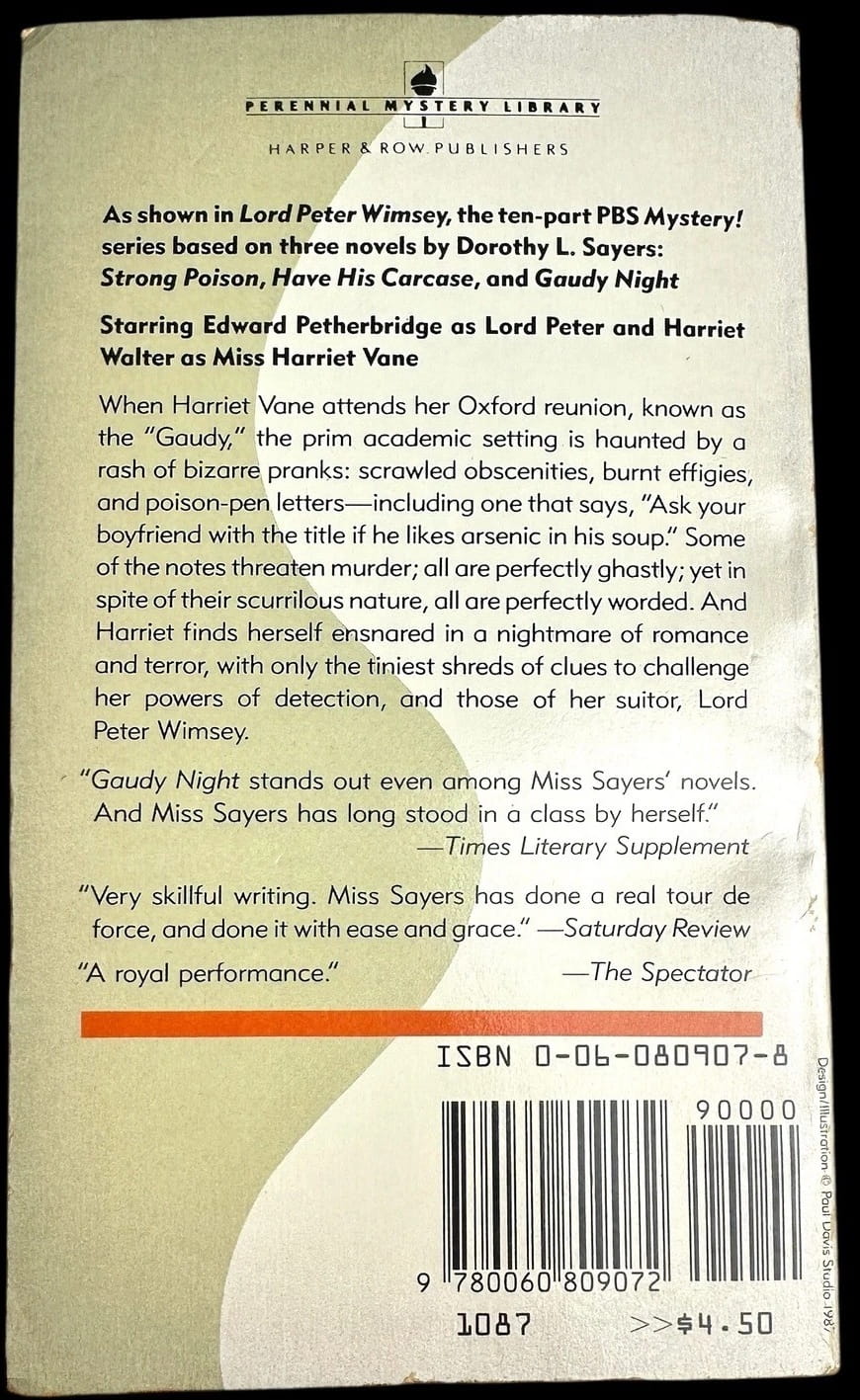 |
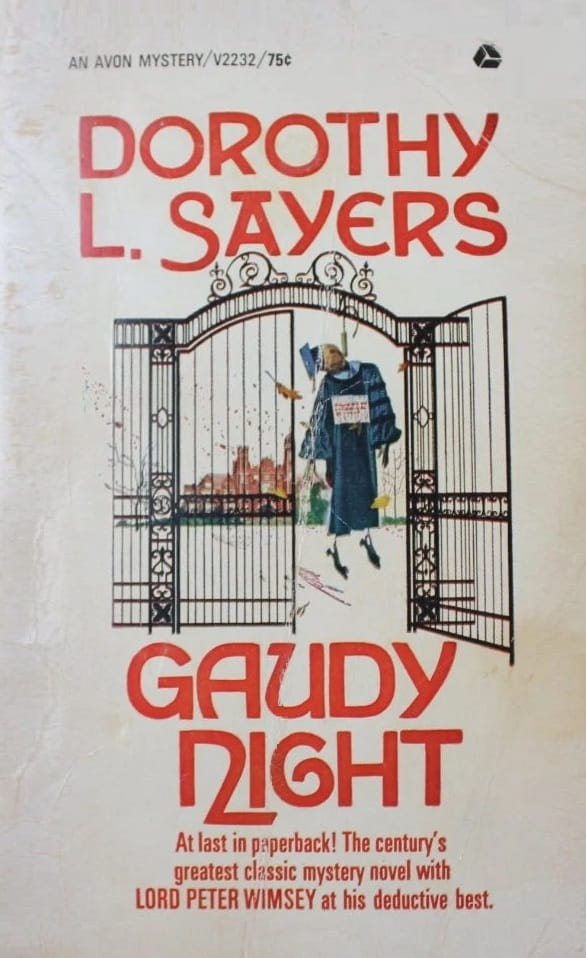
Gaudy Night (Perennial Library)
The instructors, and key administrators such as the Dean and the Warden, also have rooms in the college. The college also has women servants, “scouts,” either single women or widows, who are responsible for its housekeeping, and a few men for specialized jobs such as gatekeeping.
Shrewsbury comes to life with all the complexities of a real institution with a real history. Sayers makes a small point of differences from American higher education by showing several meetings with Miss Schuster-Slatt, an American visitor who finds some English attitudes unexpected (“‘But English people won’t fill up questionnaires,’ said Harriet”). It’s taken for granted that women instructors will be unmarried and celibate, and a persistent question in Gaudy Night is whether celibate and childless women may not be susceptible to mental disturbances that would account for disruptive behavior.
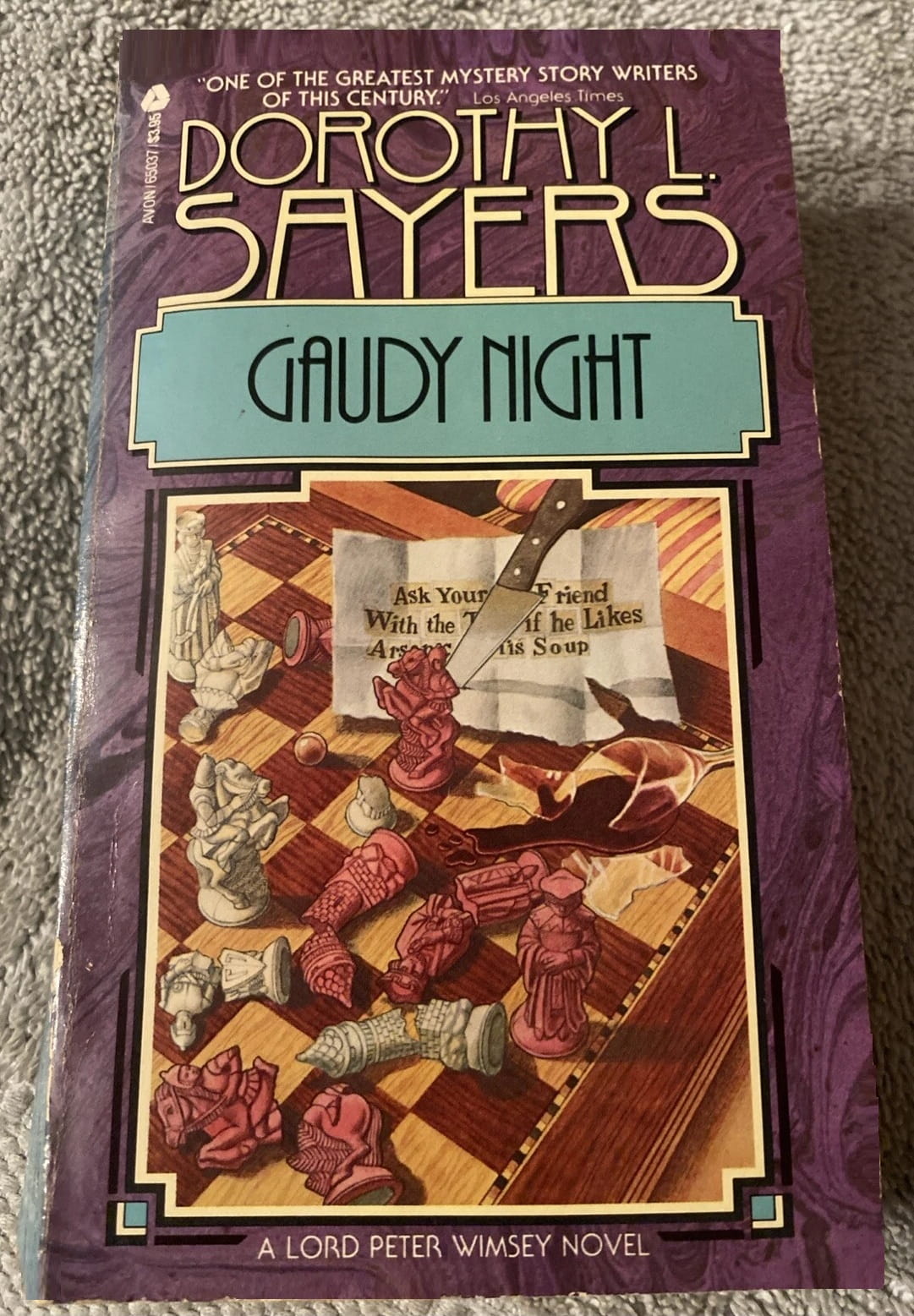 |
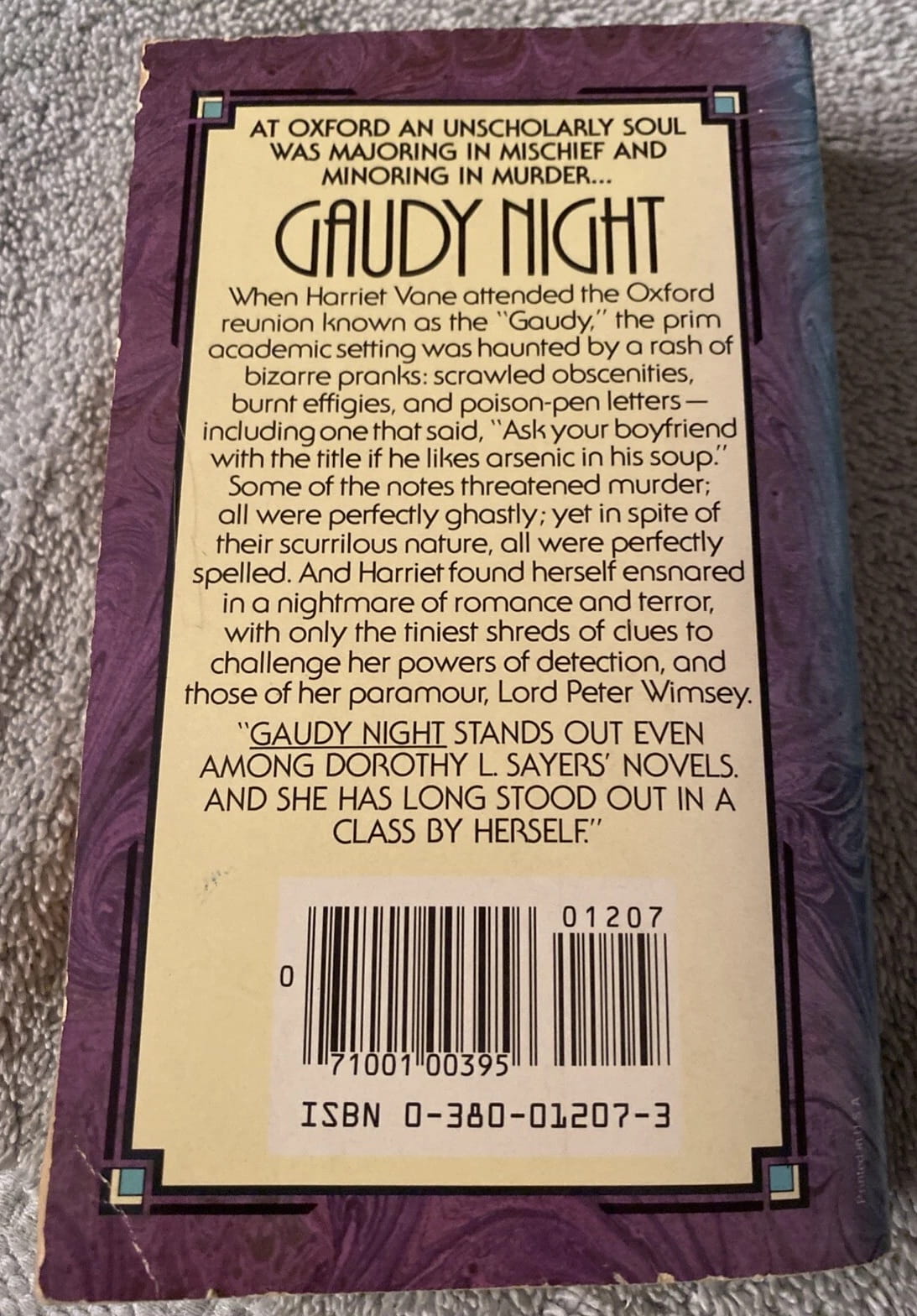 |
Gaudy Night (Avon Books)
There certainly is disruptive behavior enough: not only hostile messages created by pasting newspaper letters onto paper, but similar messages painted onto the walls; an effigy hanging in the college chapel; destruction of property; and by the end, physical violence toward some of the women, including Vane. There is also a subplot about an emotionally vulnerable woman student who is driven to attempted suicide by a long series of hostile messages, exactly in the style of present-day cyberbullying, though with a more primitive medium. This is a classic “locked room” story, though Shrewsbury is an unusually large “room.”
Vane initially recommends calling in the assistance of Wimsey’s ally Miss Climpson and her agency, who, as women, might be able to investigate the problem less disruptively than the police or conventional male detectives — only to find that Miss Climpson is unavailable. After the situation has grown really tense, she takes the step of writing to Wimsey through his friend Freddy Arbuthnot, and he reappears and steps in to suggest a further course for the investigation, after close review of Vane’s notes.
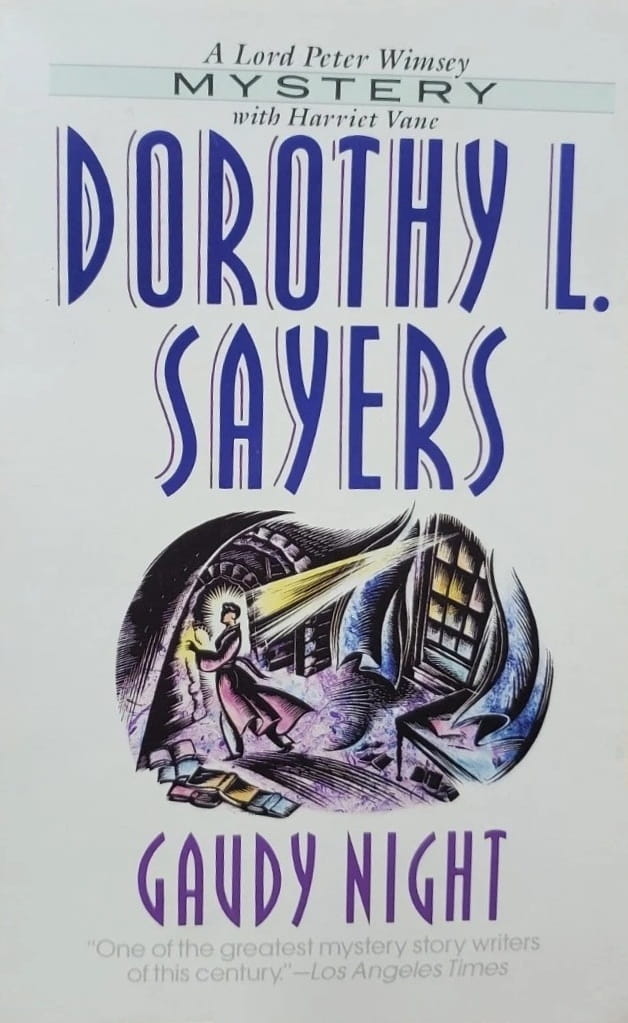 |
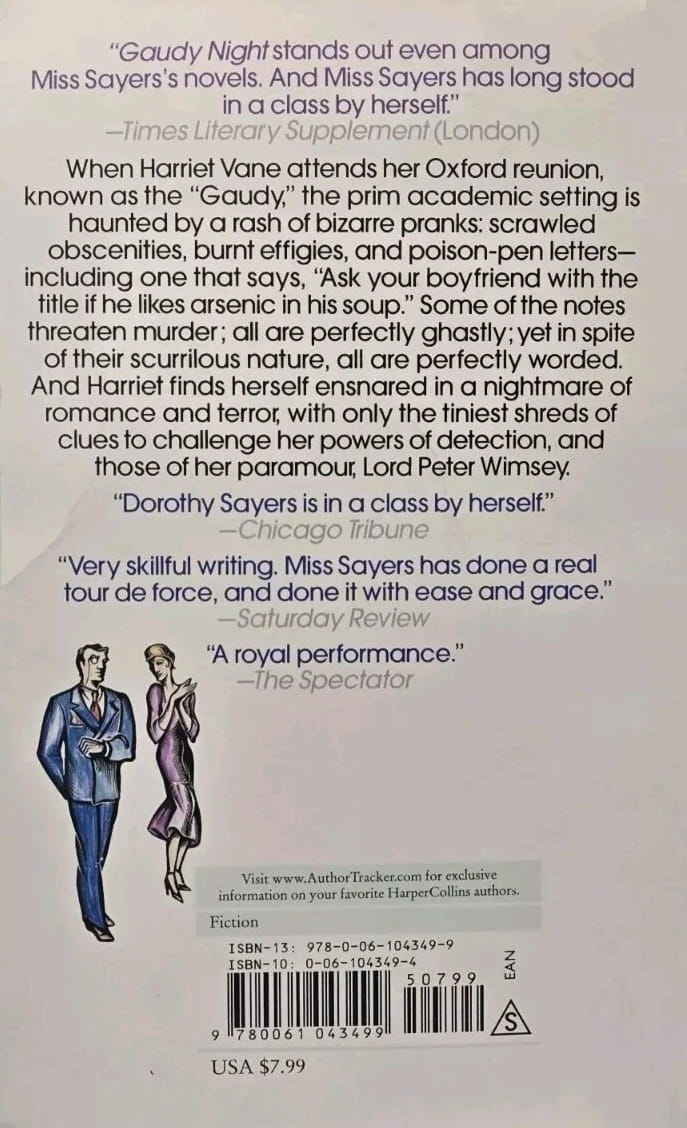 |
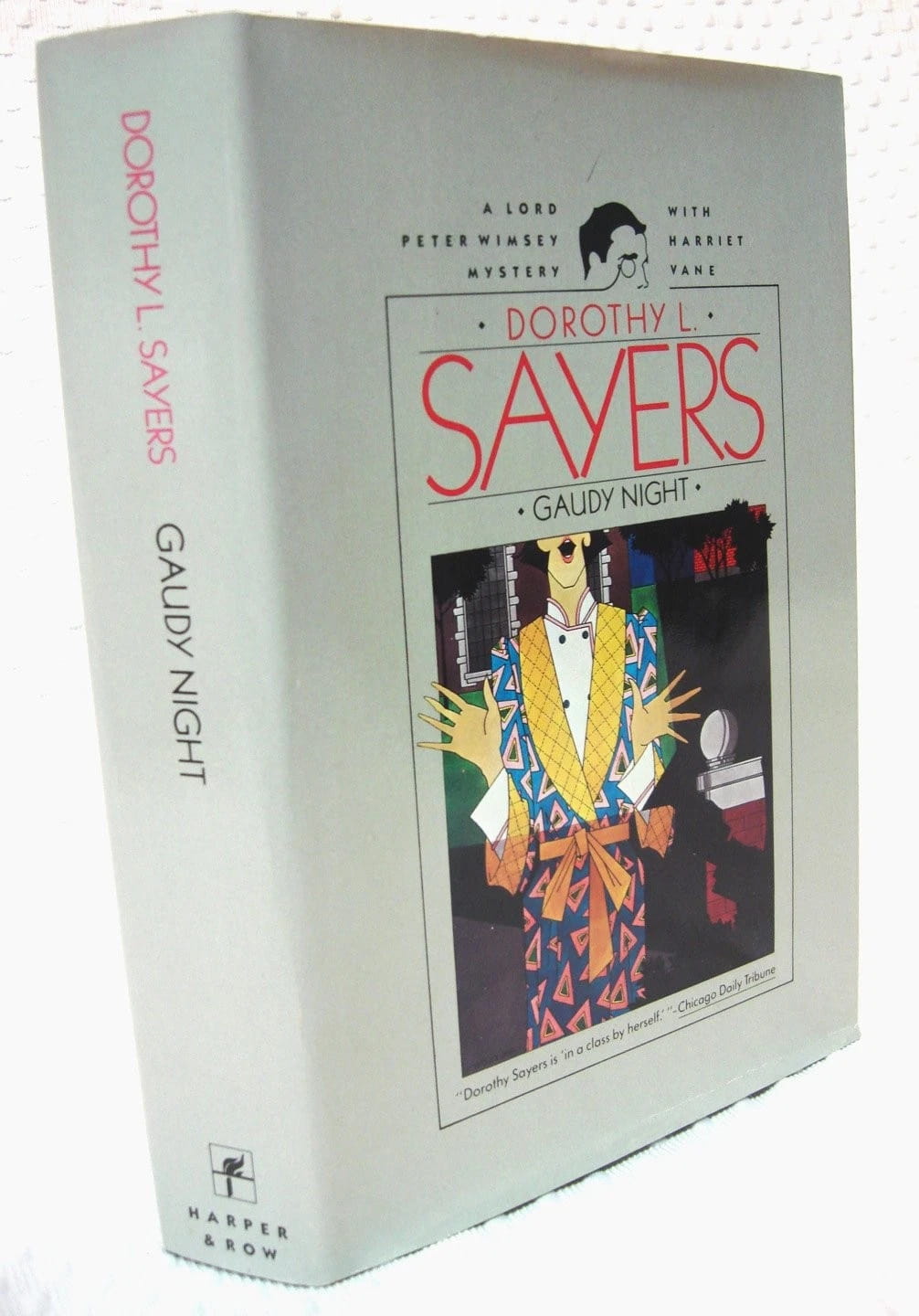
Gaudy Night (Harper & Row, 2006)
He also provides Vane with training in how to fight off a strangulation attack — and buys her a spiked dog collar to wear during nighttime investigations:
‘The man was very much interested,’ he observed, ‘in my bull-terrier bitch. Extremely plucky animal, but reckless and obstinate fighter.’
During his visits to Oxford, we see Vane realize how much at home he is there, as much as she is, and learn that he actually took a first in history, something she had never taken the time to learn, though apparently it’s well known, for example, to the Dean. During the course of her stay, Vane also becomes acquainted with Wimsey’s nephew, Lord Saint-George, and learns more about Wimsey from him — both from what he says and from how he behaves.
 |
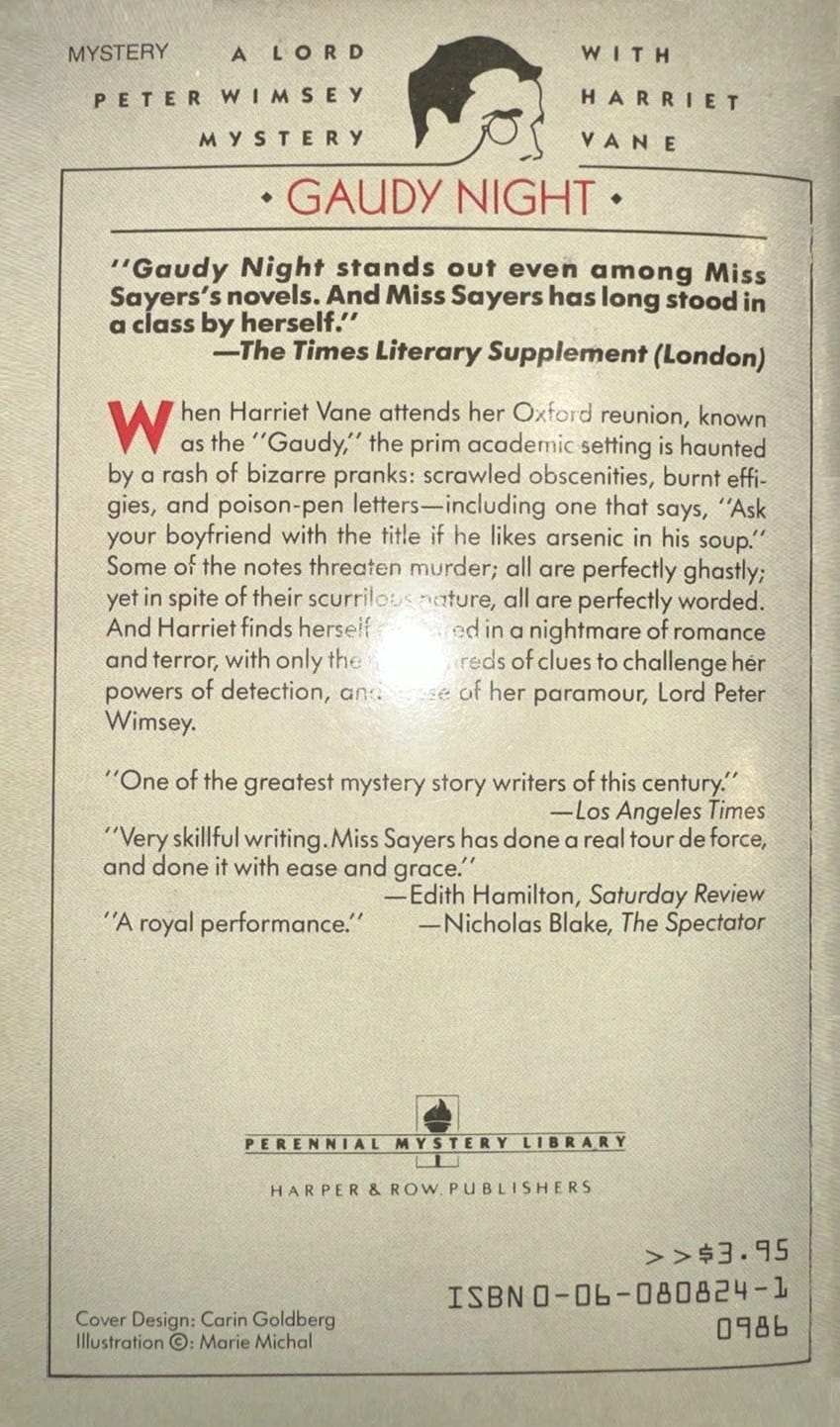 |
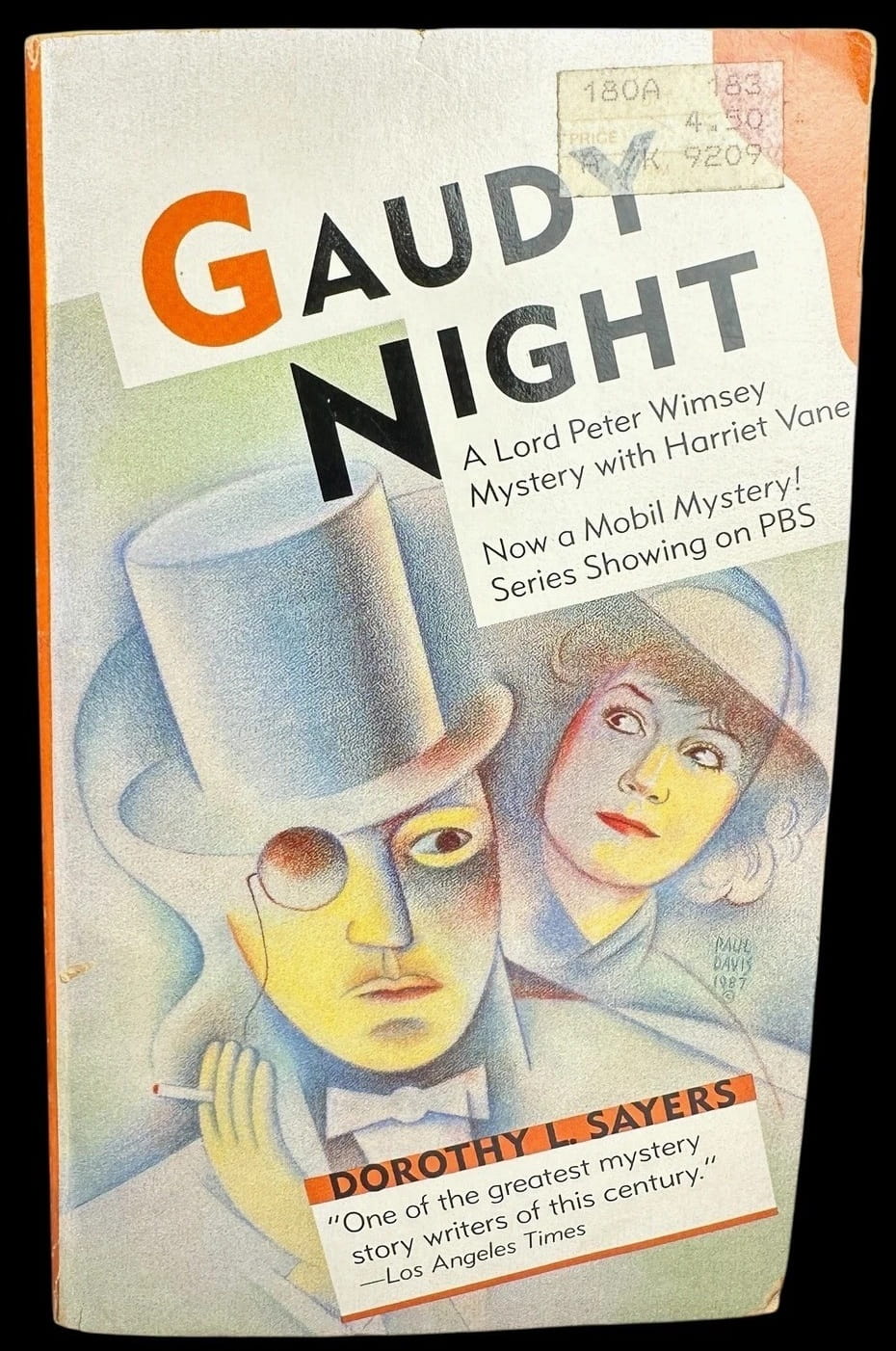
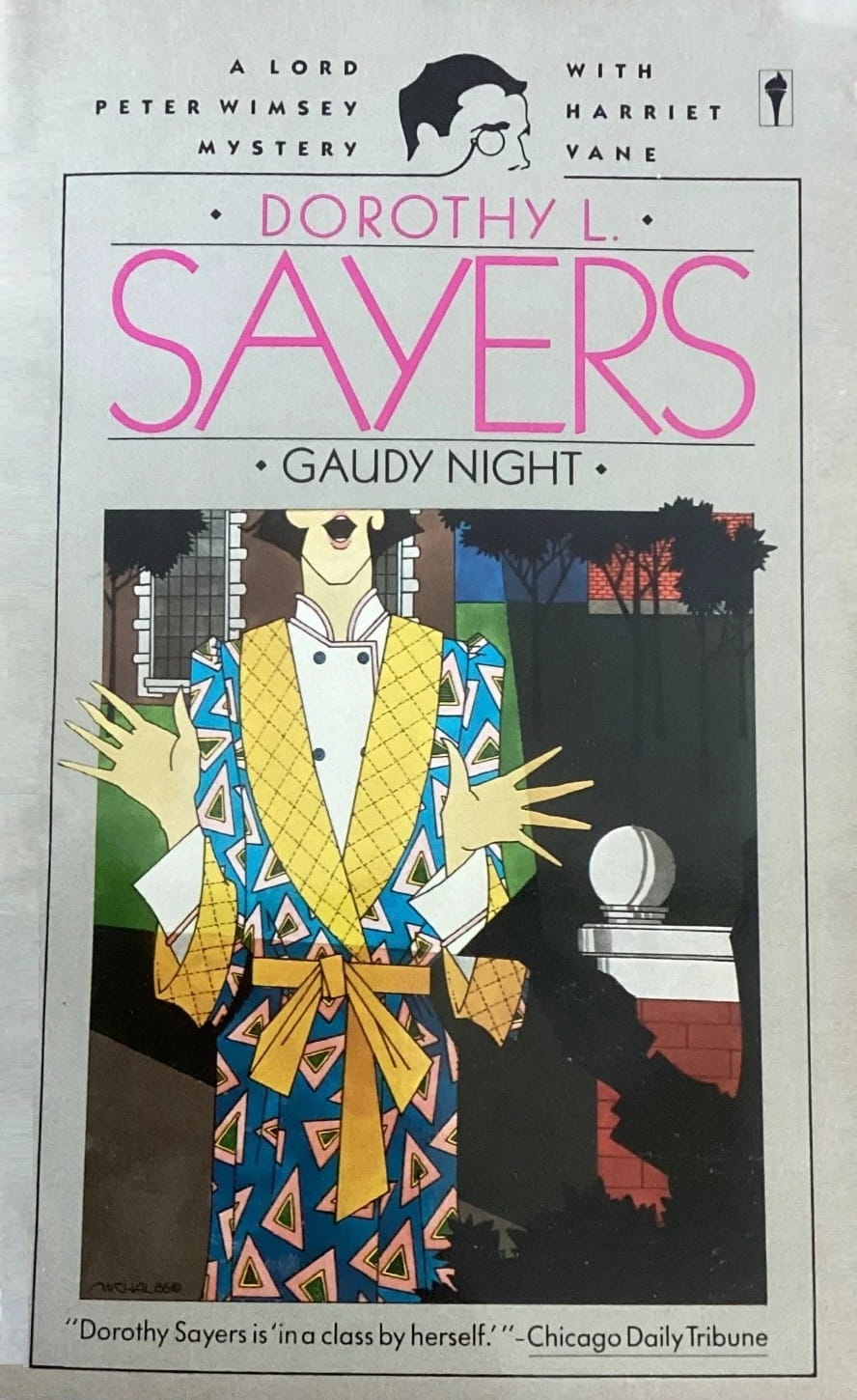
Gaudy Night (Perennial Library)
The environment of the college, both personal and intellectual, is shown in rich detail. Notably, early on, several of the faculty women ask questions about Vane’s own experience as both an accused criminal and an investigator. We see discussions of whether criminals should be viewed as mentally disturbed and treated rather than punished; whether perhaps it would be better to make use of them as experimental animals; whether there should be a general policy of eugenic sterilization of the unfit; and also whether it’s ethically appropriate for Wimsey to investigate crimes as a hobby.
We see unexplained hostility on the part of Miss Hillyard, the history tutor, and learn about the involvement of Miss de Vine, a research fellow, with a question of scholarly integrity — one that Wimsey later makes a point of inducing her to discuss at length, and the other faculty to comment on. All of this leads up to his climactic presentation of the evidence and to a perfect Aristotelian recognition scene — followed by a final confrontation between Vane and Wimsey that also resolves the romantic storyline.
 |
 |
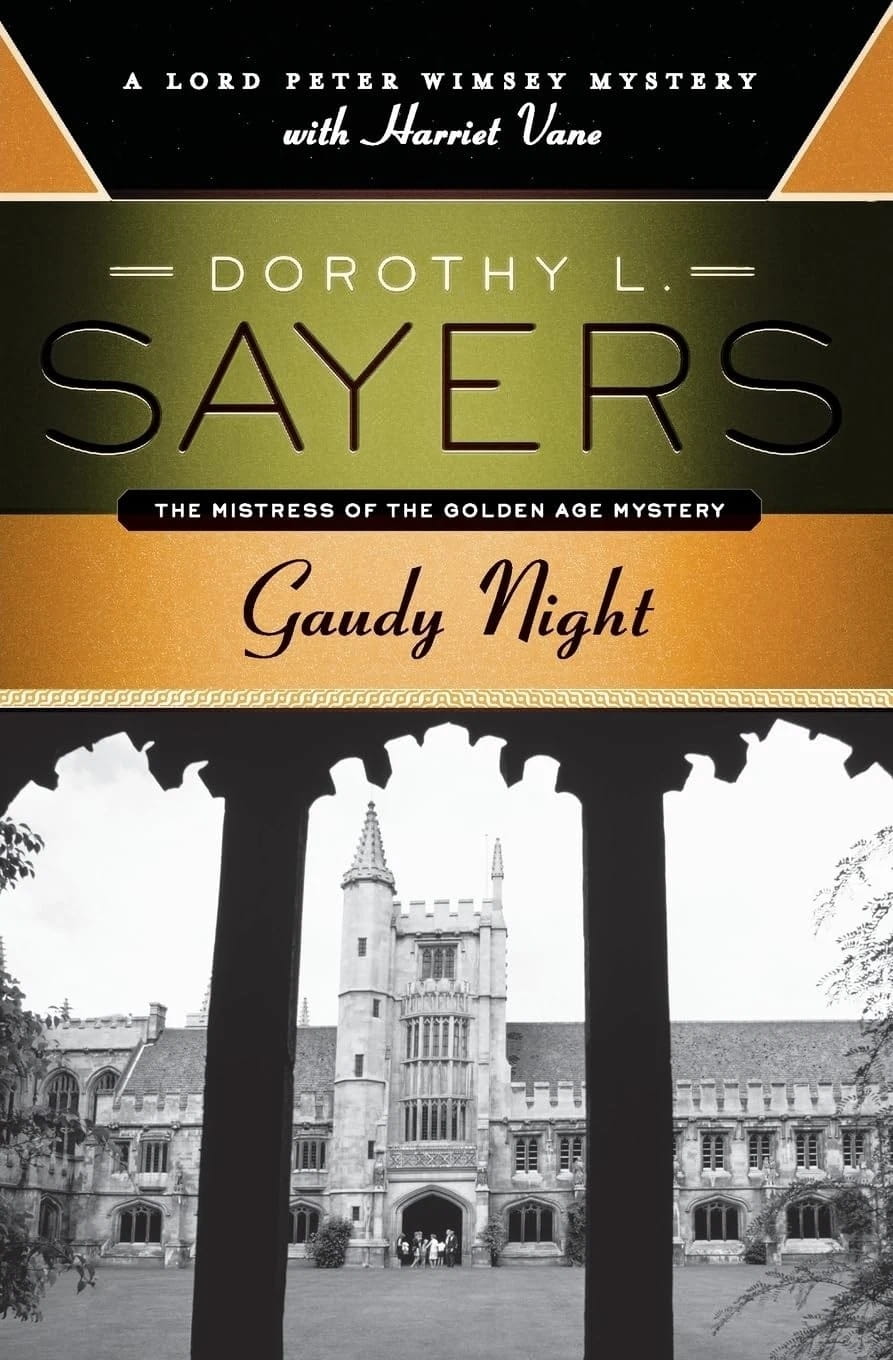
Gaudy Night (Bourbon Street Books, 2012)
I have to say that to my taste, Gaudy Night seems the best of the Wimsey novels. It’s not only a well told mystery, with all the essential clues carefully presented, though some of them are misread by Vane and likely enough by many readers. It’s also a love story, of course. But more fundamentally than that, it’s an academic novel — and Sayers makes a point of having another such novel, C.P. Snow’s The Search (published not long before), be a clue and a topic of discussion.
What Sayers is writing about here is the theme of vocation, both as it applies to Wimsey himself and as it applies to Shrewsbury’s women; and the working out of that theme is the key both to the love story and to the mystery. I’ve remarked on how Sayers regularly varies her approach to writing mysteries by taking up different genres; here she goes the distance by writing a realistic novel on a serious theme that also happens to be a mystery, one that addresses a serious theme and has something to say about it — even for us in our very much transformed academic environment.
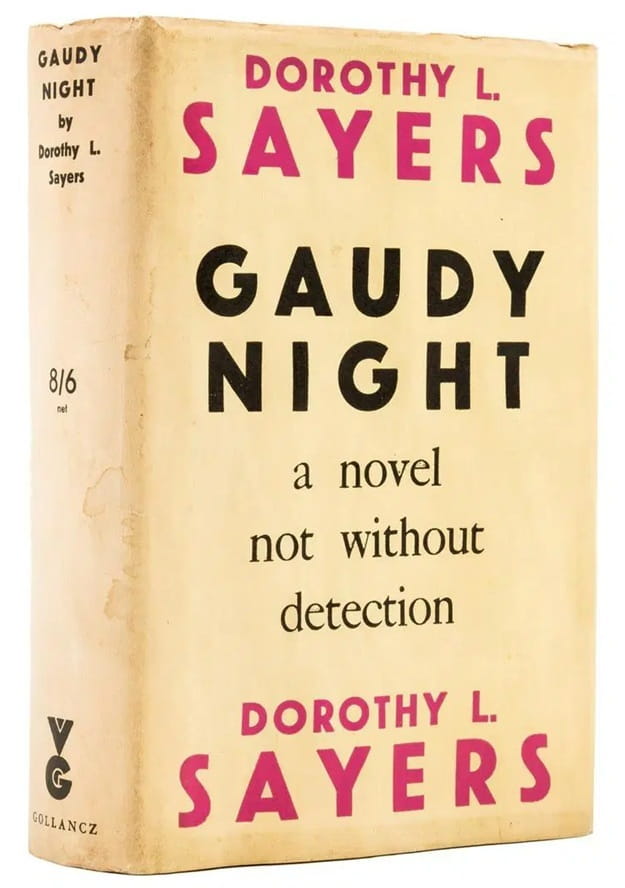
Sayers started out by making Wimsey a little more human, with a few more personal conflicts, than other heroes of detective fiction, and this novel completes the process. (I find it striking that the cover of the first edition describes it as “a novel — not without detection.”)
It also shows Wimsey realizing how he went wrong in his first encounters with Vane, which I remarked on in my review of Strong Poison. In fact I think that Sayers has achieved the exact task she has Wimsey propose to Vane for one of her own novels in progress:
‘But if I give Wilfrid all those violent and lifelike feelings, he’ll throw the whole book out of joint.’
‘You would have to abandon the jig-saw kind of story and write a book about human beings for a change.’
William H. Stoddard is a professional copy editor specializing in scholarly and scientific publications. As a secondary career, he has written more than two dozen books for Steve Jackson Games, starting in 2000 with GURPS Steampunk. He lives in Lawrence, Kansas with his wife, their cat (a ginger tabby), and a hundred shelf feet of books, including large amounts of science fiction, fantasy, and graphic novels.