Whales of a Tale: Hell’s Heart by Alexis Hall and Whalefall by Daniel Krauss
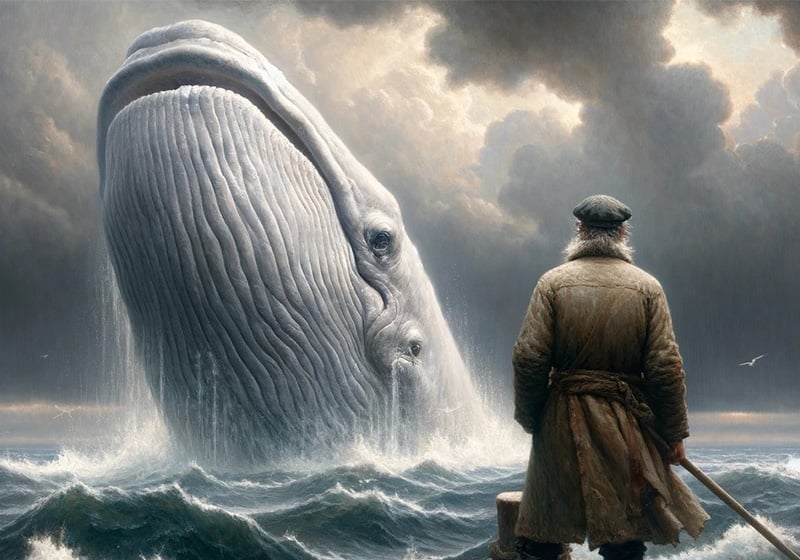
A lasting memory from Moby Dick still vivid for me after reading it decades ago is the description of the Pequod crew processing a whale’s body.
The peeled white body of the beheaded whale flashes like a marble sepulchre; though changed in hue, it has not perceptibly lost anything in bulk. It is still colossal. Slowly it floats more and more away, the water round it torn and splashed by the insatiate sharks, and the air above vexed with rapacious flights of screaming fowls, whose beaks are like so many insulting poniards in the whale. The vast white headless phantom floats further and further from the ship, and every rod that it so floats, what seem square roods of sharks and cubic roods of fowls, augment the murderous din. For hours and hours from the almost stationary ship that hideous sight is seen. Beneath the unclouded and mild azure sky, upon the fair face of the pleasant sea, wafted by the joyous breezes, that great mass of death floats on and on, till lost in infinite perspectives.
There’s a most doleful and most mocking funeral! The sea-vultures all in pious mourning, the air-sharks all punctiliously in black or speckled. In life but few of them would have helped the whale, I ween, if peradventure he had needed it; but upon the banquet of his funeral they most piously do pounce. Oh, horrible vultureism of earth! from which not the mightiest whale is free.
Critics assert the religious symbolism of various figures and plot lines in Herman Melville’s seafaring opus, but there is perhaps no better disavowal of the notion of Godly compassion than the depiction of nature’s inherent cruelty compounded by human avarice.
Of course, the novel’s theme is that and a hundred other things in Ishmael’s recounting of Ahab’s quest for the great rare white whale that ends, not surpassingly, in tragedy for just about everyone involved. Besides that, it is also an epic adventure story.
But as a canonical Great America Novel (a reputation gained some 20 years after Melville’s death and when the book had gone out of print), like Shakespeare (a major influence on Moby Dick) it serves as inspiration for numerous retellings and recastings, c.f., Railsea by China Miéville, Ahab’s Wife by Sena Jeter Nasaland, The Wind Whales of Ishmael by Philip José Farmer, and Jeffrey Ford’s Ahab’s Return to name a few.
A worthy addition to this list is Hell’s Heart by Alexis Hall. (The title refers to Captain Ahab’s final confrontation with Moby Dick — “From hell’s heart I stab at thee” — as well as the self-destructiveness of some of the characters.)
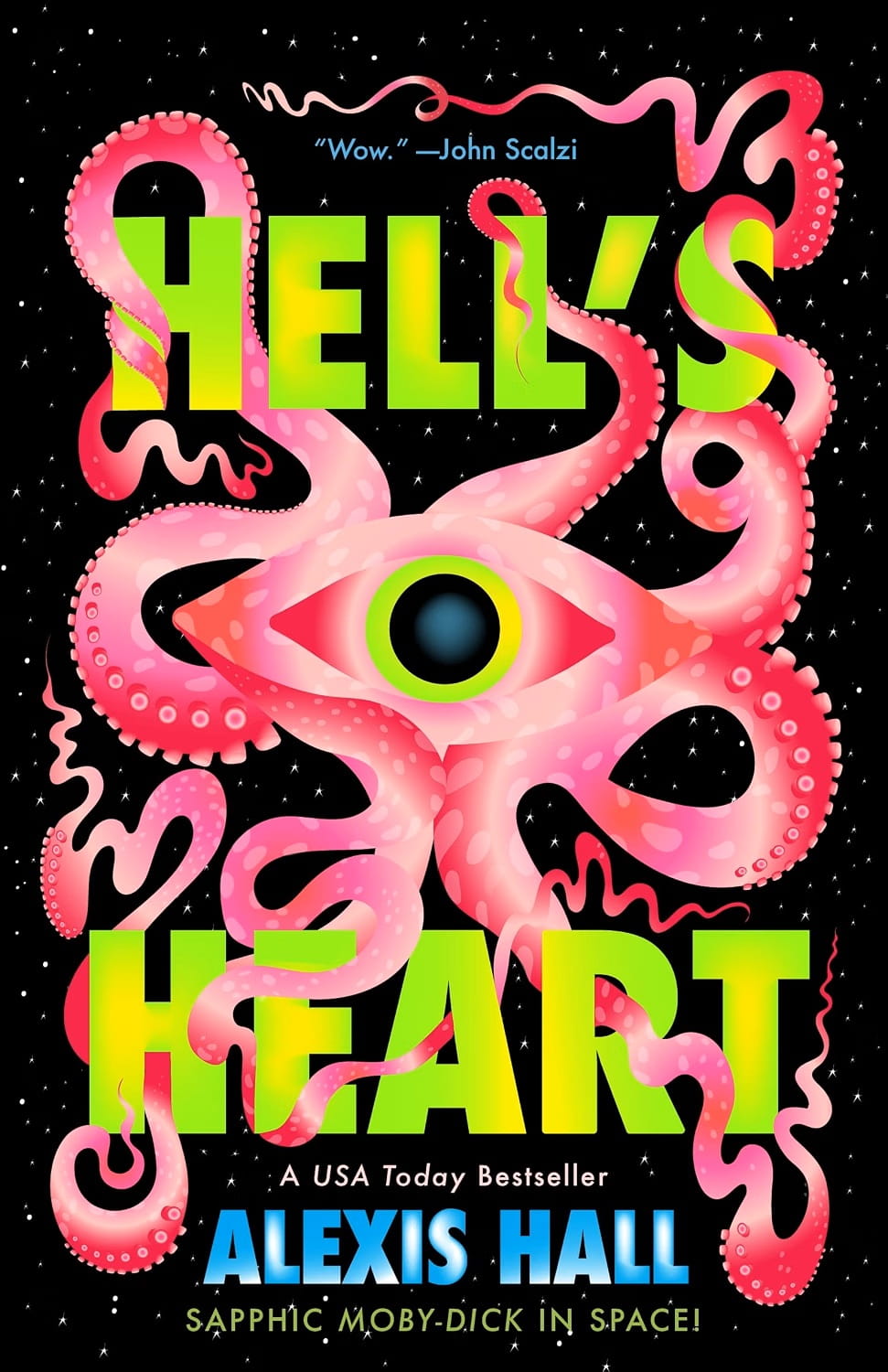
The book cover describes this as “Sapphic Moby Dick in Space” which, while somewhat accurate, makes it seem a little less weighty than it actually is. It does deal with the same theological and moral topics as its inspiration, albeit in a contemporary snarkier way.
Believe it or not, Moby Dick contains considerable slapstick comedy and dark satire. However, since it is expressed in a convoluted 19th century kind of way, the humor can easily escape a modern reader.
Cannibals? Who is not a cannibal? I tell you it will be more tolerable for the Fejee that salted down a lean missionary in his cellar against a coming famine; it will be more tolerable for that provident Fejee, I say, in the day of judgment, than for thee, civilized and enlightened gourmand, who nailest geese to the ground and feastest on their bloated livers in thy paté-de-foie-gras…what do you pick your teeth with, after devouring that fat goose? With a feather of the same fowl. And with what quill did the Secretary of the Society for the Suppression of Cruelty to Ganders formally indite his circulars?
Hall is not so allegorical. Her take on the canonical opening lines of “Call me Ishmael” (itself a bit of comical narrative commentary) goes:
Call me… call me whatever the fuck you like. Isha. Or Isobel. Io. Imogen. If there’s a point to all this–or any of this cacophonous bullshit in my head — is that I don’t think I’ve ever been sure what the I in I am stands for.
Jokes aside, the “I” here is a reference to God (in Exodus, Moses asks God his name, and the reply is “I am who I am.” In the New Testament, Jesus says, “before Abraham was born, I am,” implying incarnate godhood). The narrator is unsure that there might be a god, but her own existential anxieties prompt her to go voyaging.
Note the gender reversal. In addition to our narrator, both the ship captain (only referred to as “A” for guess who, dressed in scarlet with a modern chrome prosthetic leg rather than the black mourning garb and ivory peg of the original) and the narrator’s roommate Q (again, guess who, a native of an exotic but largely abandoned Old Earth) present as women, which explains the Sapphic description, although the narrator an equal opportunity sex addict.
Besides the sex and the jokes (some of which grow tiresome, particularly the sniggering every time sperm is mentioned, which even the author seems to realize is tediously sophomoric, eventually dropping this particular schtick by the middle of the story), Hell’s Heart more or less follows the original, even including a dedication to Nathaniel Hawthorne, but with a futuristic, space operatic setting.
Humanity has migrated from Old Earth to live in atmospheric domes of other planets and moons in the solar system, a time when the narrator’s generation was “born too late for tall ships, but too soon for star ships.” The voyage here takes place not on the oceans of Earth, but the atmosphere of Jupiter in search of Leviathan creatures that look less like whales than gigantic blobs of tentacles, yet contain spermaceti to produce energy as well as other byproducts necessary for human survival in space. Hence, the hunt, just another example of human cruelty to other creatures in pursuit of economic gain.

But the overriding pursuit, of course, is A’s obsession with the Möbius Beast (besides a play on Moby, Möbius is a mathematical concept denoting a geometric surface where you cannot distinguish orientation, also a description of the beast as well as the ship’s actual mission).
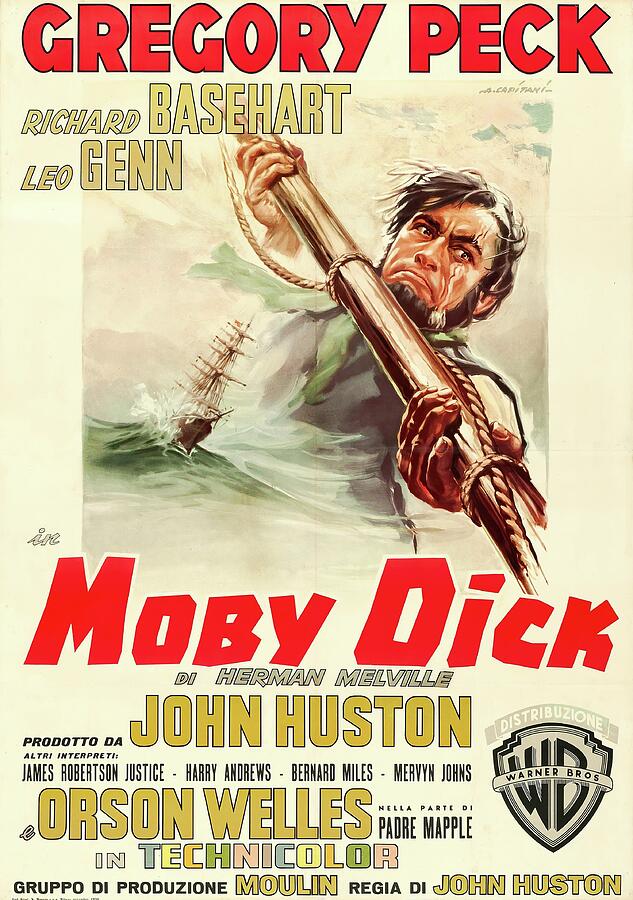
In an author’s note, Hall attributes the inspiration for Hell’s Heart to a group chapter a day reading of Moby Dick during the Covid lockdown. I imagine most people have some notion of Ahab and the White Whale without having read the book (and even if not having seen the multiple movies; fun fact, Ray Bradbury was a scriptwriter for the John Huston version). If you’re one of those, it probably doesn’t matter much if you read Hell’s Heart first. But do get to the source material.
Also now a major motion picture is Whalefall, a tale from Daniel Krauss (he of the Pulitzer winning Angel Down) that is less about the hunt for Moby Dick than one of its thematic inspirations, namely the biblical Jonah and the Whale.
Actually, Jonah was never swallowed by a whale; the literal translation of the Hebrew and Greek is a “great fish” or “huge fish,” which in the King James version became “whale.” The story is sometimes considered an allegoric prophecy for the resurrection of Jesus and, for Trinitarians, the reconciliation of father and son aspects.
Which is what Whalefall is about. Just as Jonah flees the demands of God (and winds up in the storm that results in the big swallow), teenager Jay Gardener leaves home to avoid the emotional abuse of his father Mitt, a professional scuba diver who can’t hold onto a job due to his dogged stubbornness, or uncompromising ethical standards, depending on how you want to look at it. The relationship has deteriorated to the point where, despite many pleas from his mother and sisters, Jay refuses to visit his dying father. Rather than endure the indignities of advanced melanoma plaguing his body, Mitt drowns himself off the coast of Monastery Beach, near Monterey, California. Burdened by his diving weights, his body is not found.
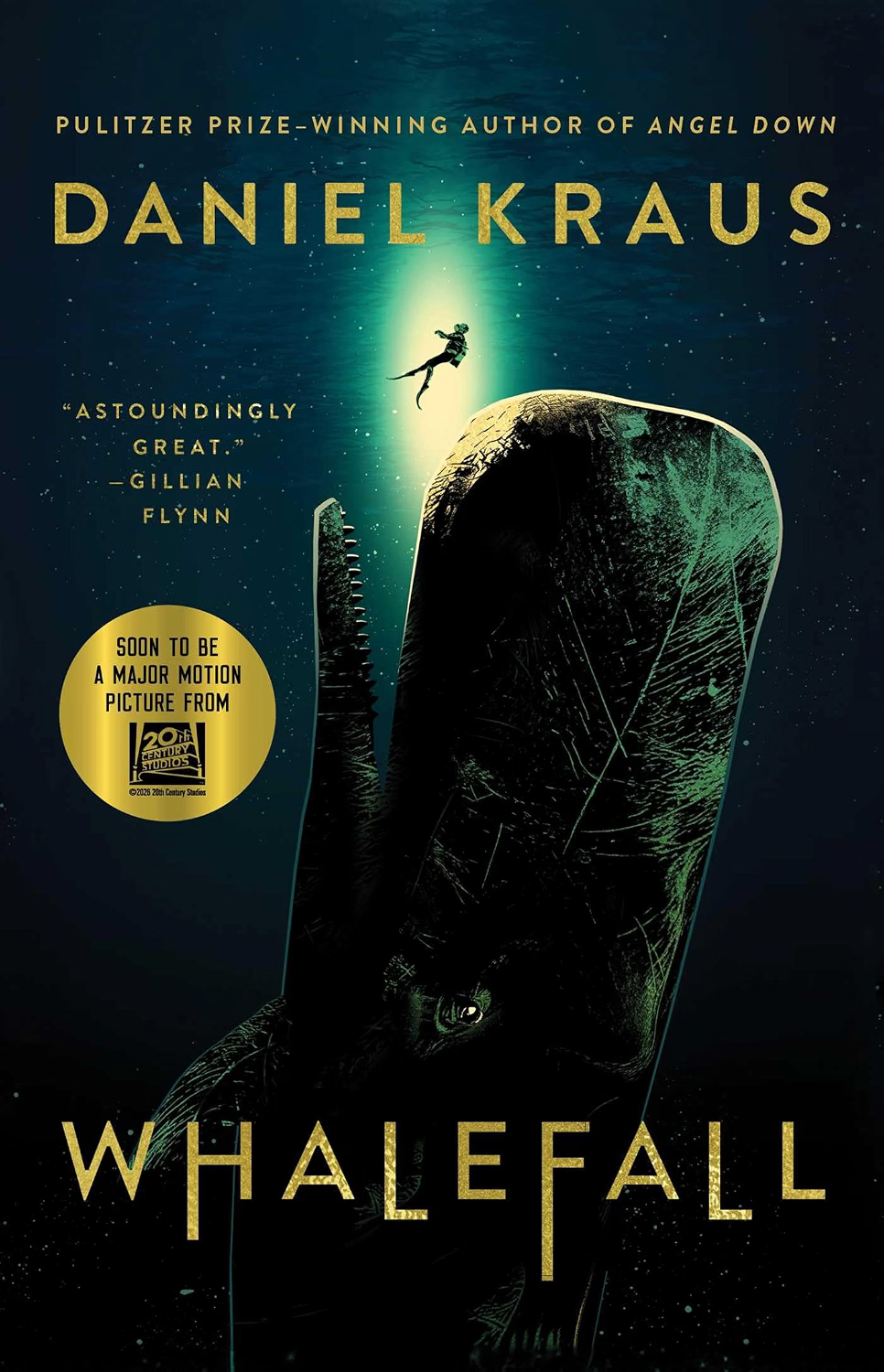
Out of guilt, Jay decides that recovering Mitt’s remains will provide some kind of redemption in the eyes of Mitt’s cronies and his family. Moreover, it will prove he has the same right stuff as his father. It turns out he does, but only because of various lessons Mitt had unmercilessly drilled into Jay’s consciousness. Getting sallowed by a sperm whale is how Jay finally understands what his father was trying to teach him, and by extension experience his father’s awkwardly expressed love, without which he could not survive the ordeal of being in the (sort of) belly of the beast.
A whalefall is a dying whale; the carcass eventually sinks to the ocean floor and becomes a source of nutrients for other deep sea organisms. In addition to helping to somewhat explain how Jay can exist inside the whale, it is a metaphor for Jay’s perceptual — and by extension Mitt’s as well — transformation.
Aside from its allegorical role, could a sperm whale actually swallow a scuba diver who could escape to tell the tale? It’s not totally impossible, but as this biologist explains, it’s more like the whale would just spit out a human that it couldn’t actually chew or digest. And it that person were somehow trapped in the first of whale’s four stomachs, survivability is highly unlikely.
Though Kraus says in an author’s note that his novel’s inspiration came from a video of two kayakers nearly ending up in a whale’s mouth whale and a subsequent investigation into the possibility of a Jonah-like ordeal, ultimately this is a novel, not a marine biology text. While there are some interesting factoids about whales, like Moby Dick and Hell’s Heart, the human condition is the ultimate tale told.
David Soyka is one of the founding bloggers at Black Gate. He’s written over 200 articles for us since 2008. See them all here.