Murder and Courtship: Strong Poison by Dorothy Sayers
In Strong Poison, Sayers gives Peter Wimsey a love interest, and makes this central to the story. Traditional mystery writers had avoided this kind of plot (Irene Adler, for example, was clearly not romantically involved with Sherlock Holmes, however profound an impression she made on him).
Not all of her readers welcomed the innovation. In particular, Harriet Vane, a successful author of detective stories, was sometimes looked at as what fan fiction readers now call a “self-insertion” by Sayers — a view that gains plausibility from Vane’s involvement in a love affair, given what we know now about Sayers’s life story.
We first meet Vane in a courtroom, where she is being tried for the murder of her former lover, Philip Boyes, a less successful but more artistically pretentious novelist (what little is said of his books suggests Aldous Huxley’s early novels, before Brave New World made him immortal).
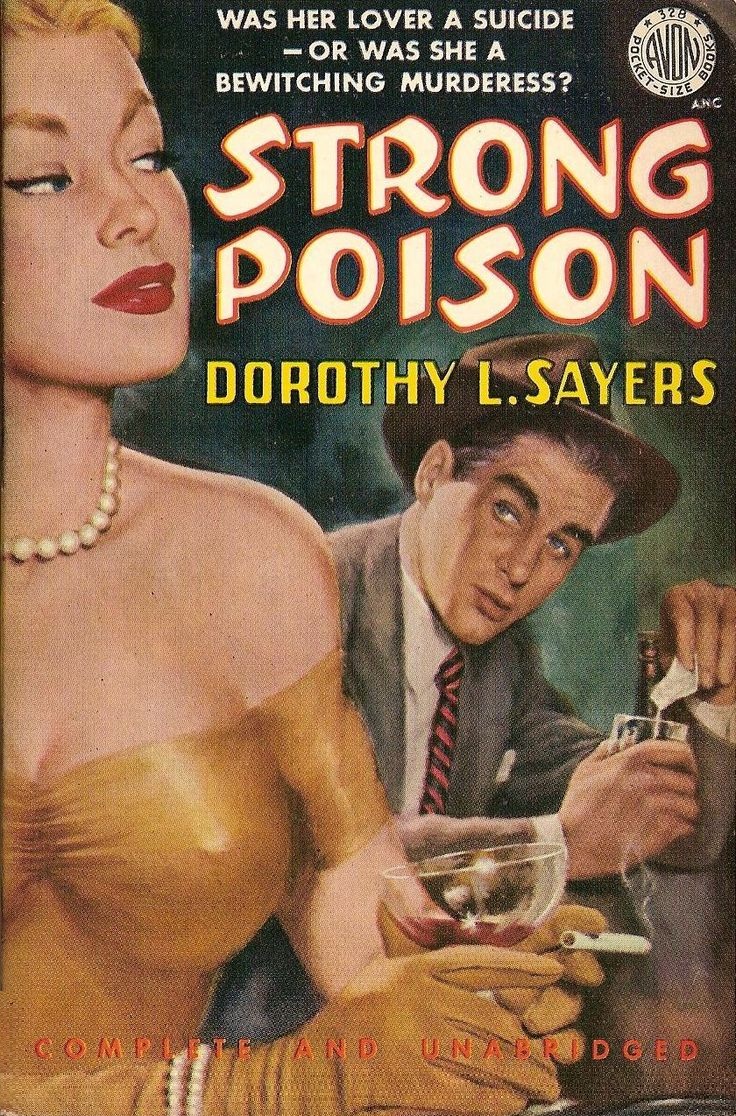
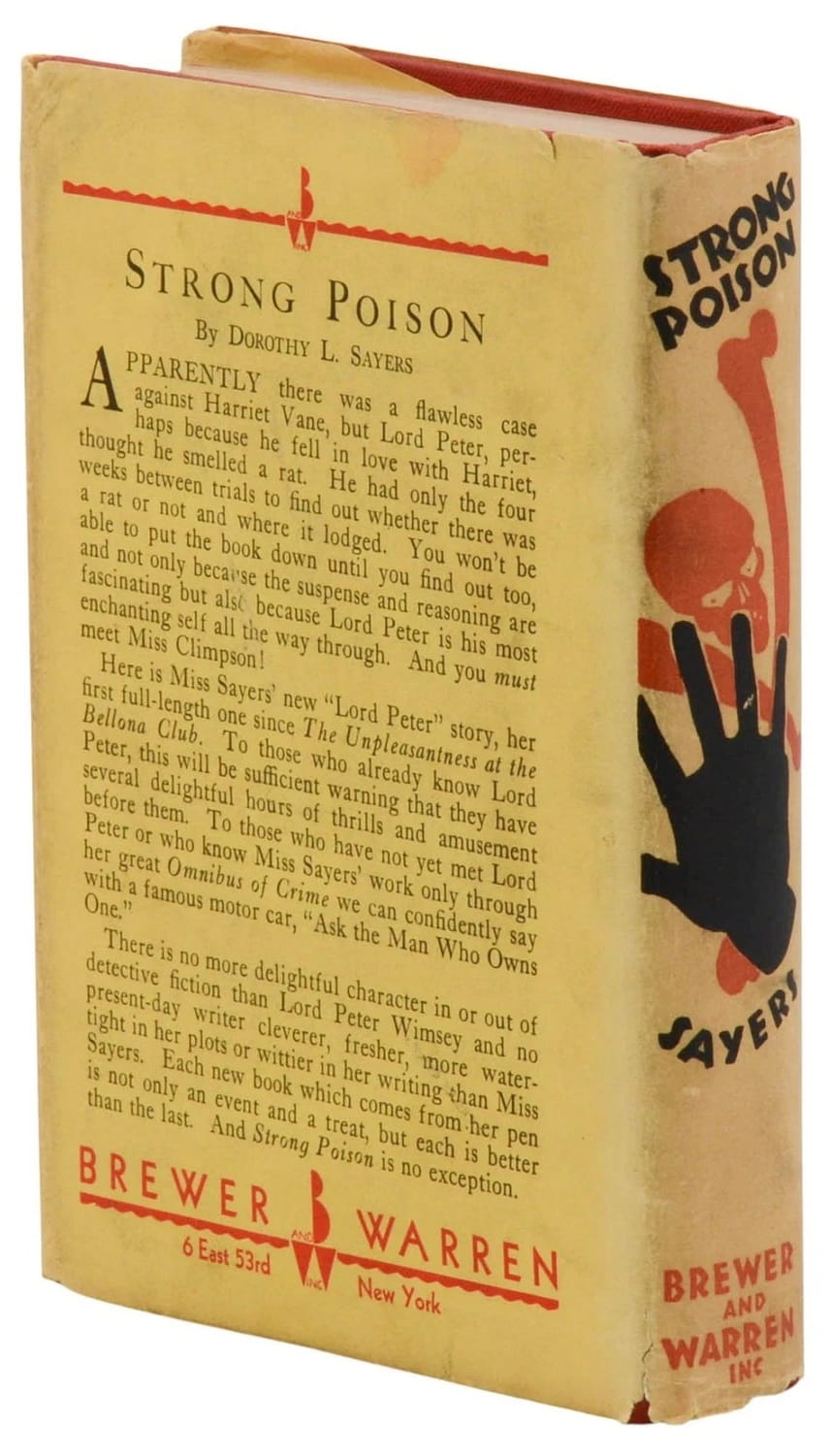
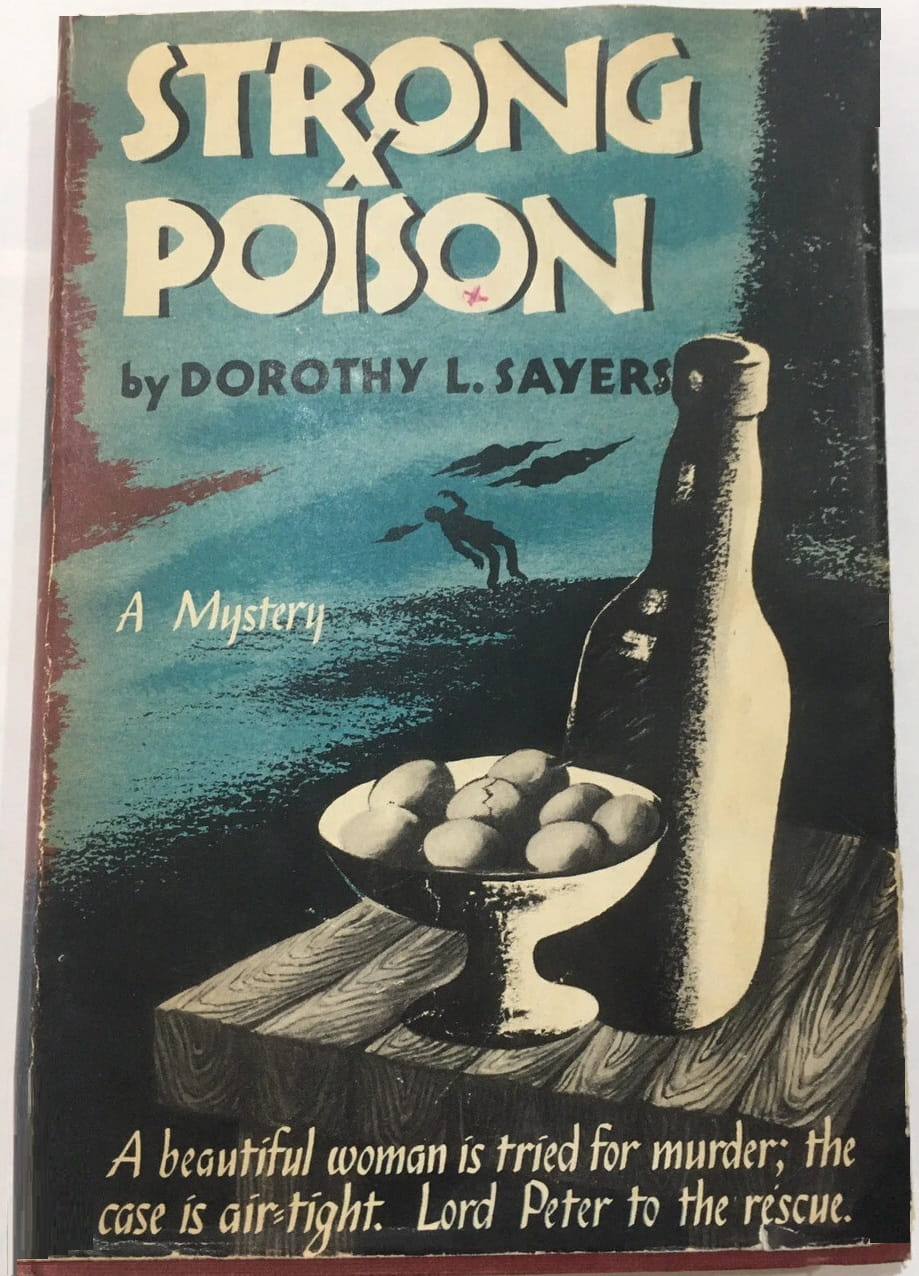
[Click the images for stronger versions.]
 |
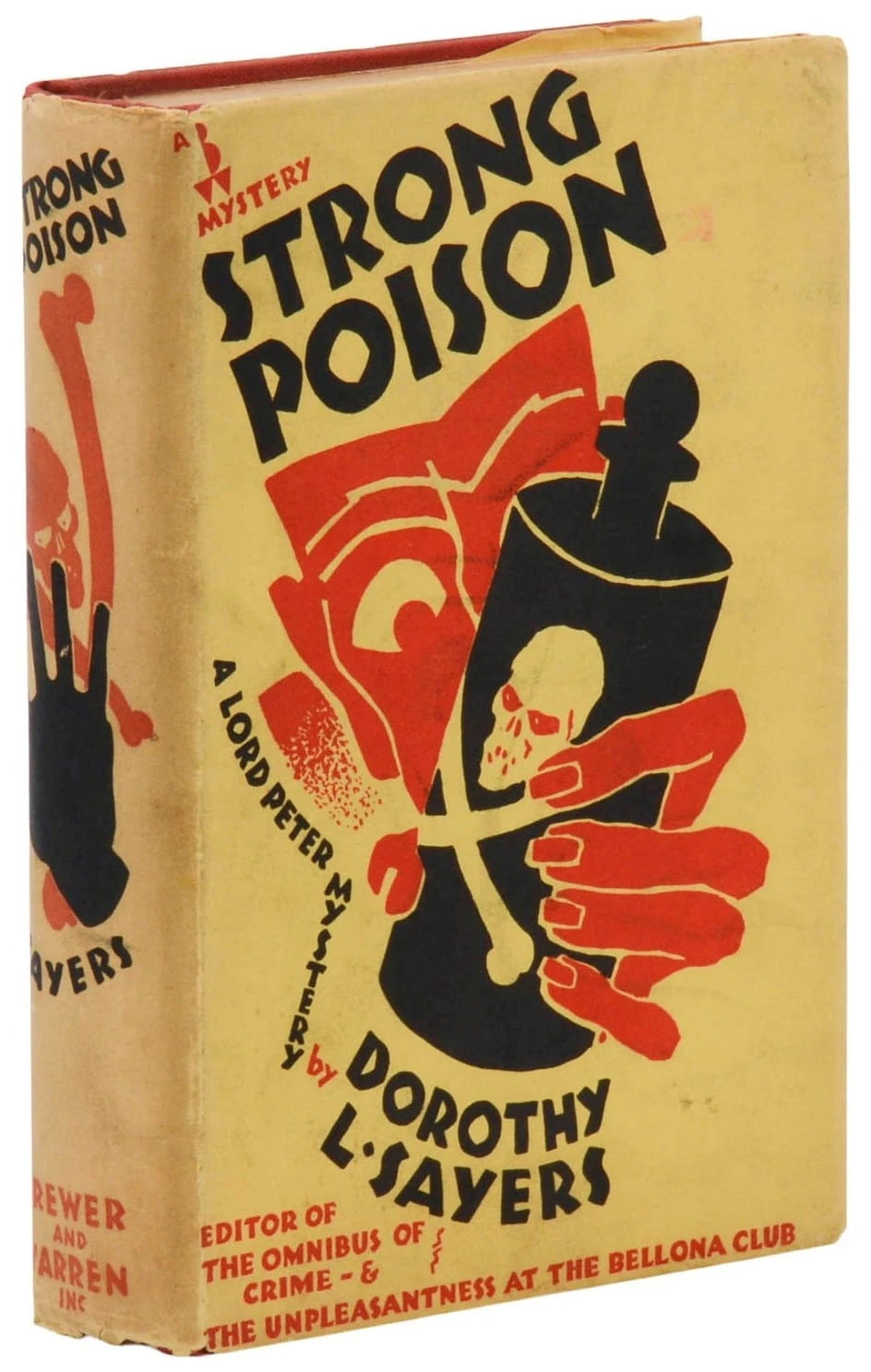 |
Strong Poison (Brewer and Warren, 1930)
Boyes died of arsenic poisoning, and Vane had bought arsenic twice in the time leading up to his death, and had seen him the night he died, so the circumstantial evidence looks damning.
Sayers has the judge sum up the testimony for the jury and advise them as to what points they need to decide, a handy device for exposition. The jury is out for a long time, from just after lunch till well into the evening, and finally ends up hung, nine to three.
One of the three is Wimsey’s ally Miss Climpson (introduced in Unnatural Death), who holds out against a lot of pressure from the foreman and most of the other jurors, saying that the prisoner’s demeanor is part of the evidence and Vane’s demeanor isn’t that of a murderer.
 |
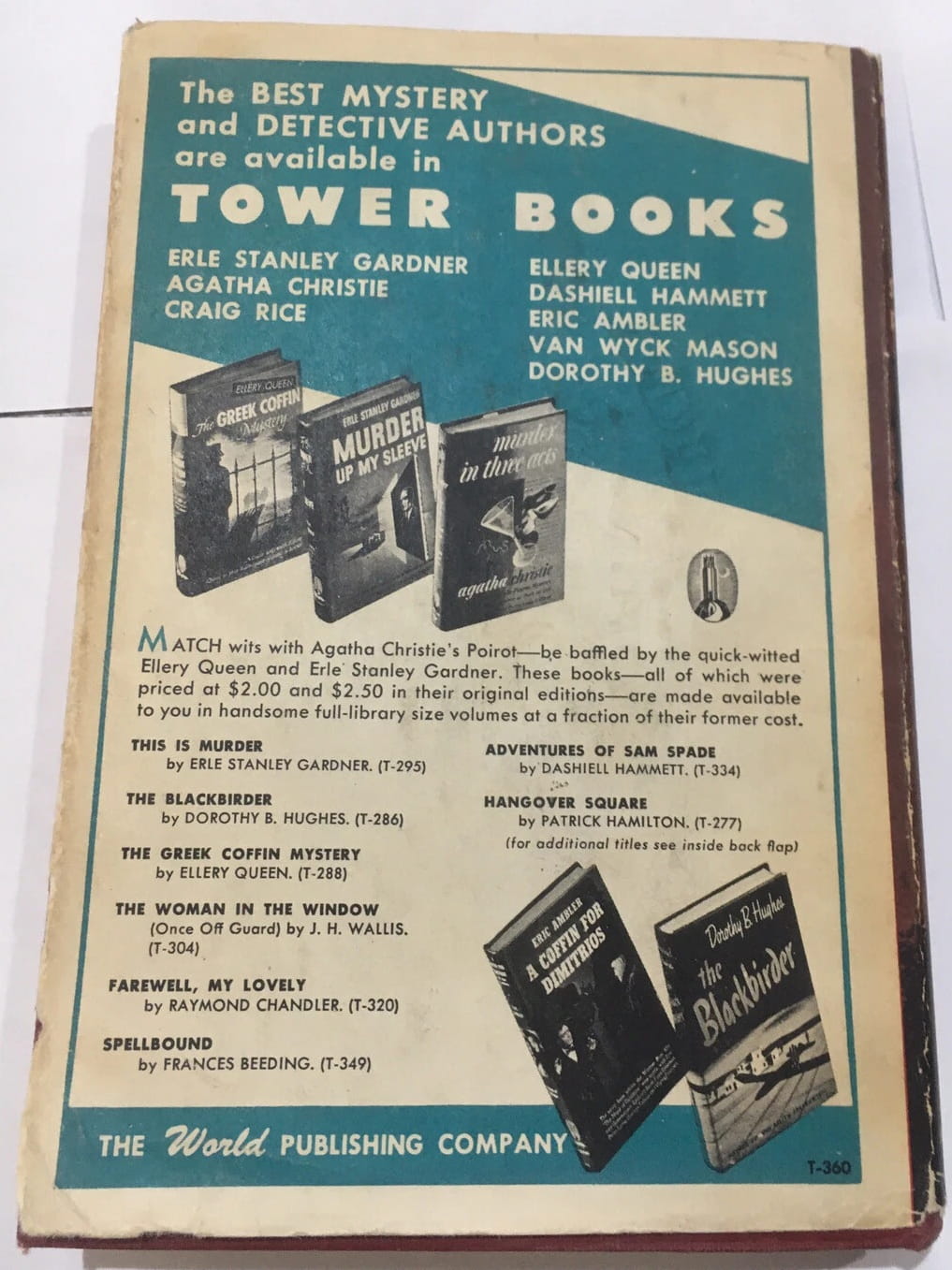 |
Strong Poison (Tower, 1945)
Wimsey himself, who apparently has been in the audience throughout the trial, seems to have reached the same conclusion; he’s convinced enough of Vane’s innocence to criticize her solicitor for treating this as a job of casting doubt on her guilt. But at the same time, he has decided to marry Vane, having fallen in love with her. He says as much to her when he first interviews her in prison, and is taken aback when she says, “Oh, are you another of them? That makes forty-seven.”
Wimsey’s closest friend, Charles Parker, makes an appearance, in two roles. On one hand, he’s initially convinced that Vane is guilty, though he provides Wimsey with help in looking for evidence to the contrary.
 |
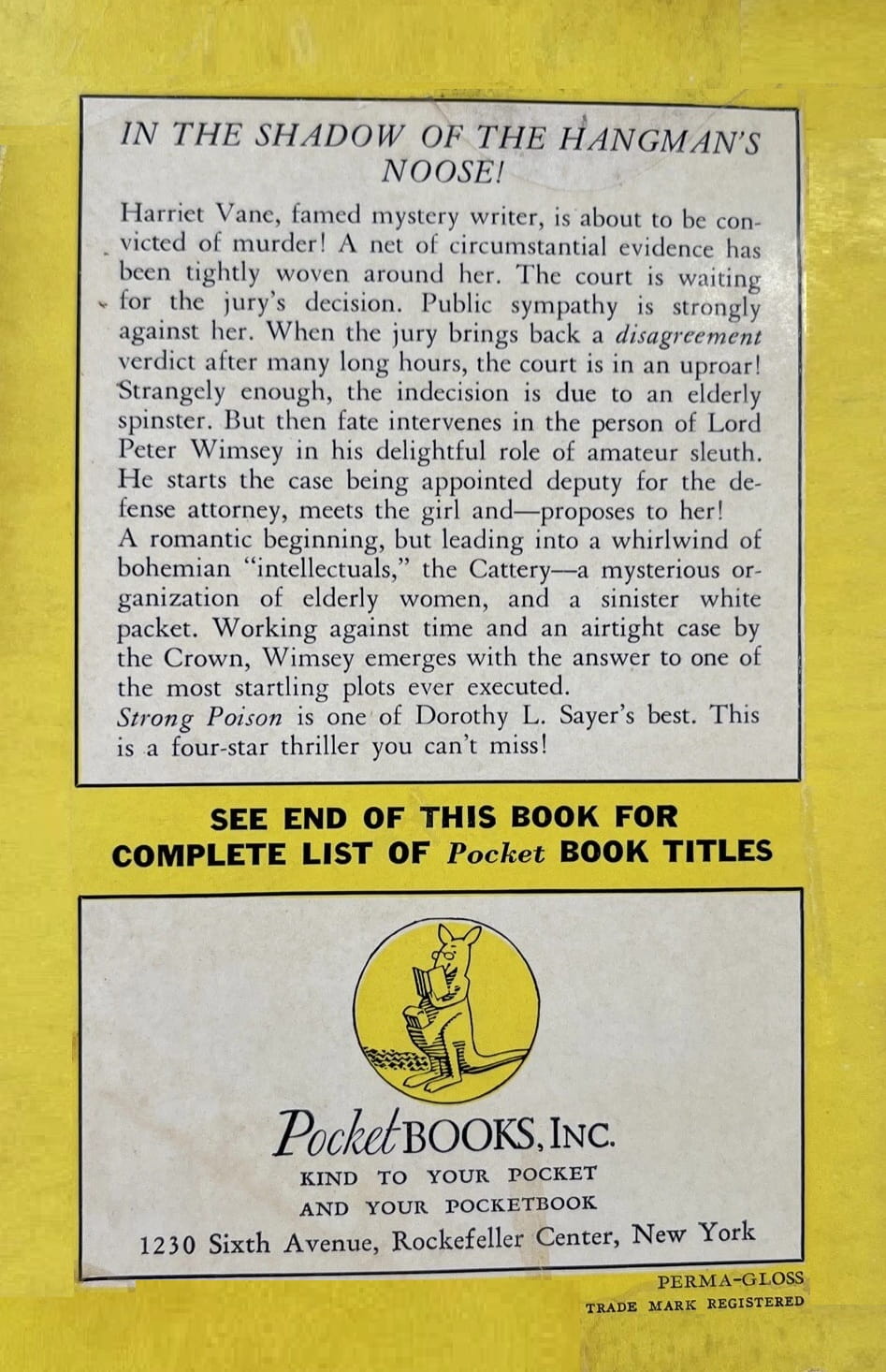 |
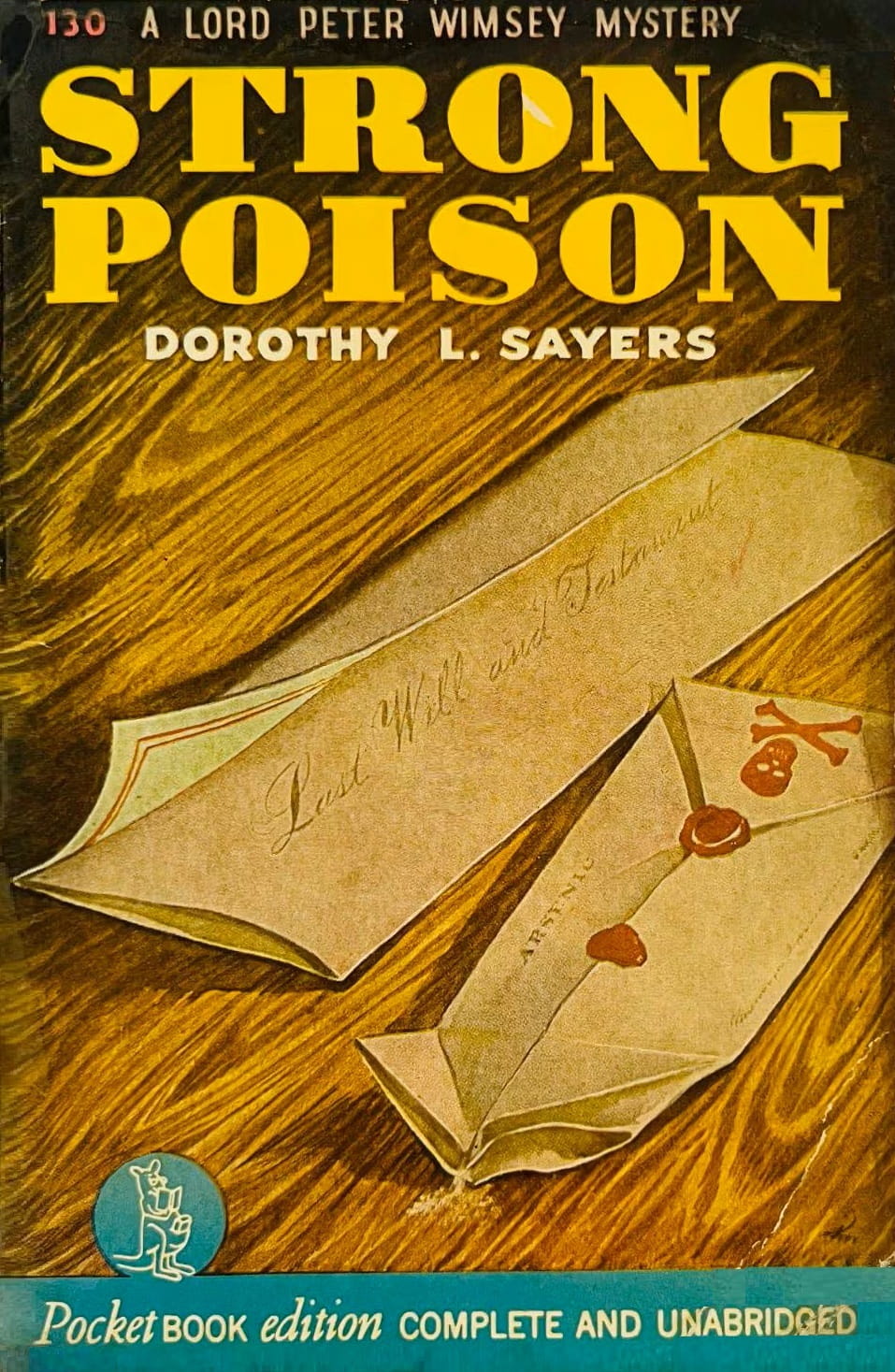
Strong Poison (Pocket Books, 1945)
On the other, he and Wimsey’s sister Mary have fallen in love with each other, and the issues of social class this raises parallel those between Wimsey and Vane neatly; their older brother, the Duke of Denver, is horrified at both prospects.
The use of arsenic makes this another mystery that turns on medical knowledge — or, in this case, on medical folklore. Once again, Sayers focuses less on who than on how.
 |
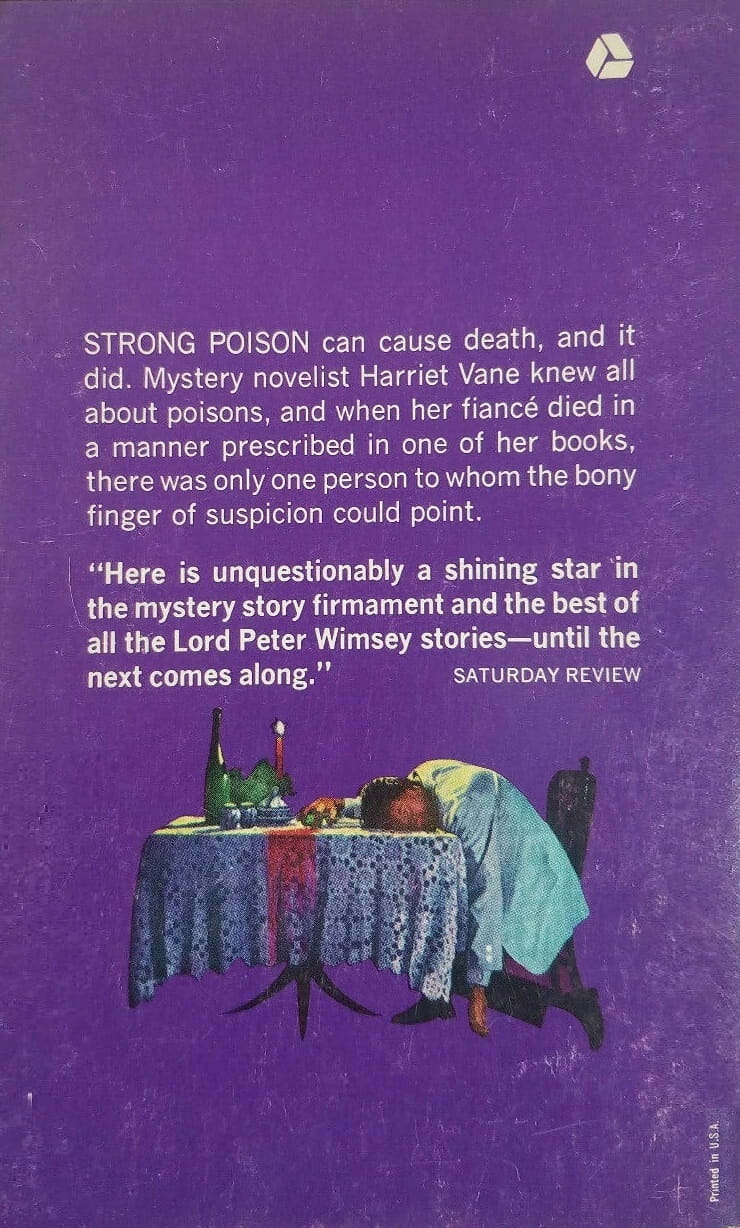 |
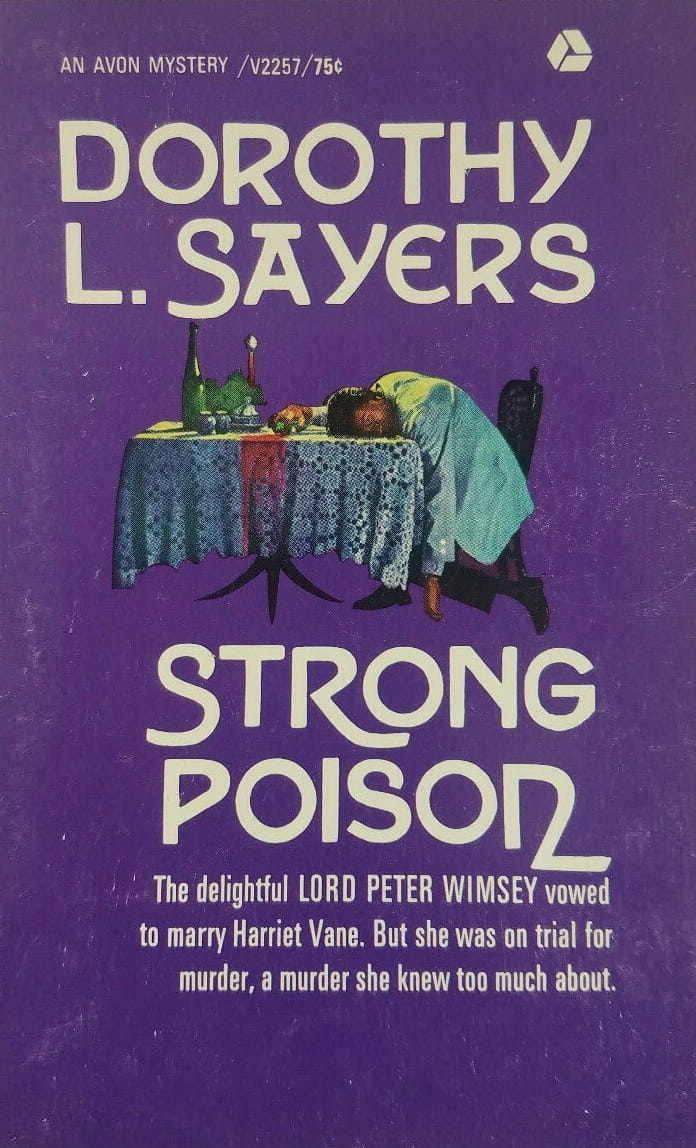
Strong Poison (Avon Books, 1969)
When Wimsey has his manservant Bunter put away some books he’s been consulting, one of which is A Shropshire Lad, I recognized, and so (to his credit) did Bunter, that this was a reference to the poem “Epilogue” (or “Terence, This Is Stupid Stuff”), which ends with the legend of Mithridates:
There was a king reigned in the East.
There, when kings will sit to feast,
They get their fill before they think
With poisoned meat and poisoned drink . . .
 |
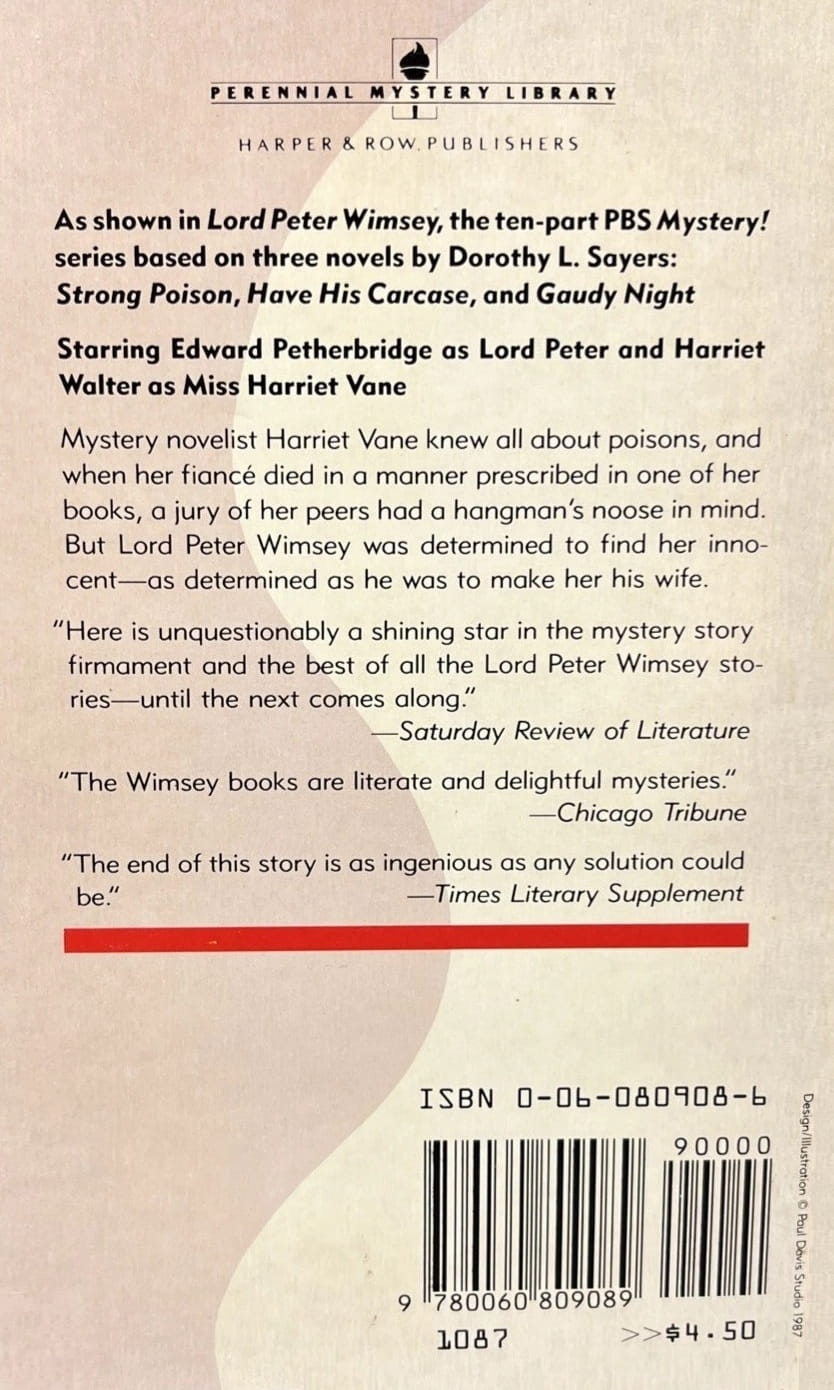 |
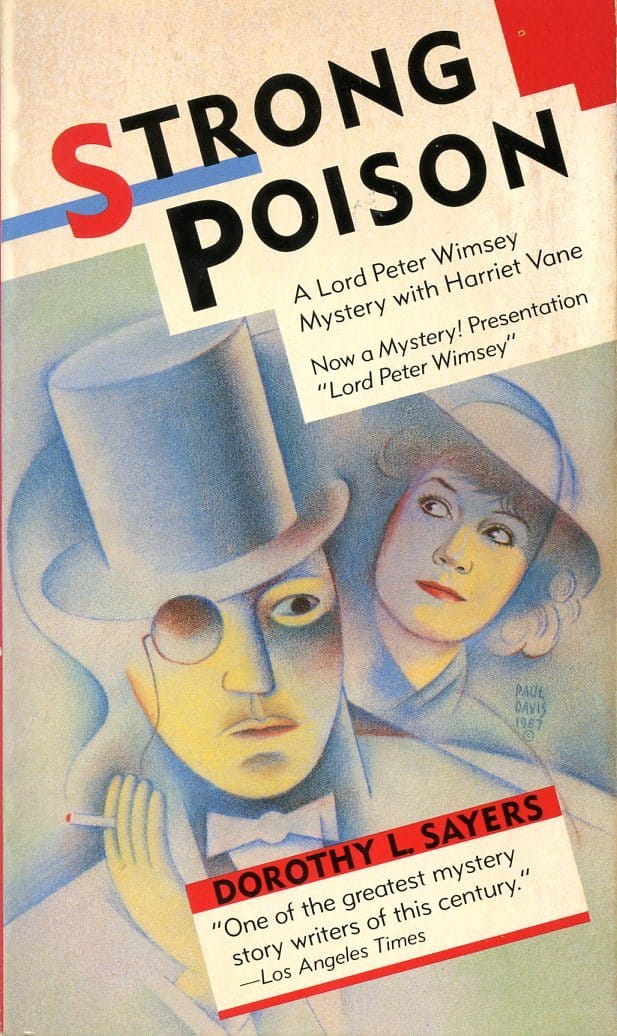
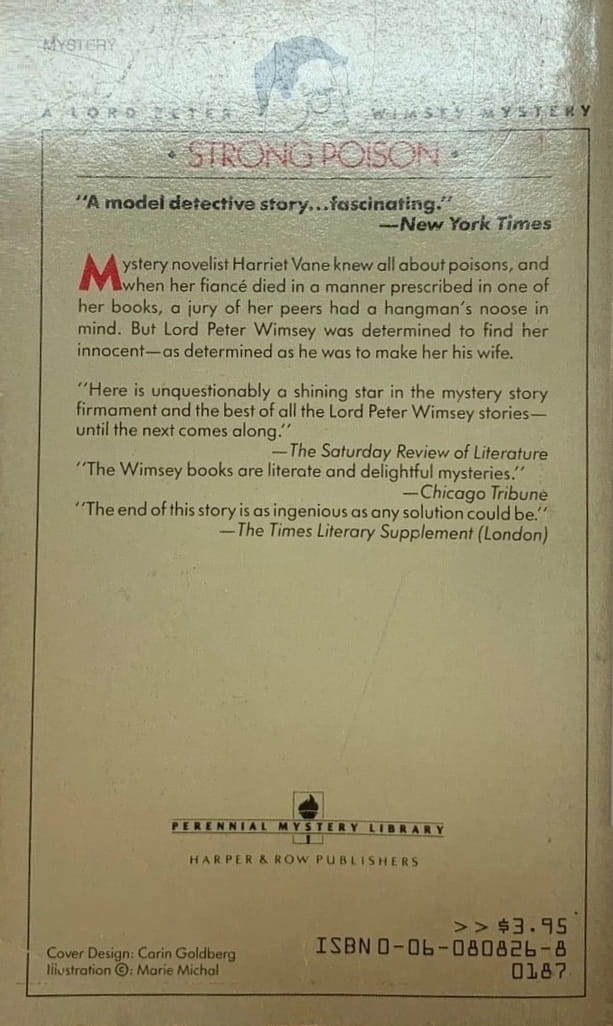
Strong Poison (Harper & Row paperback edition)
In fact, this is a book filled with quotations and allusions; and the exchange of both between Wimsey and Vane is one of the first signs that they might actually belong together. The poem neatly hints at the method (which is one that is no longer thought to be workable) and at how Wimsey proves his case.
Beyond how, there’s also why: the motive for the crime. And here, as in Unnatural Death (and An Unpleasantness at the Bellona Club, which came in between), family history and financial assets come into the story.
 |
 |
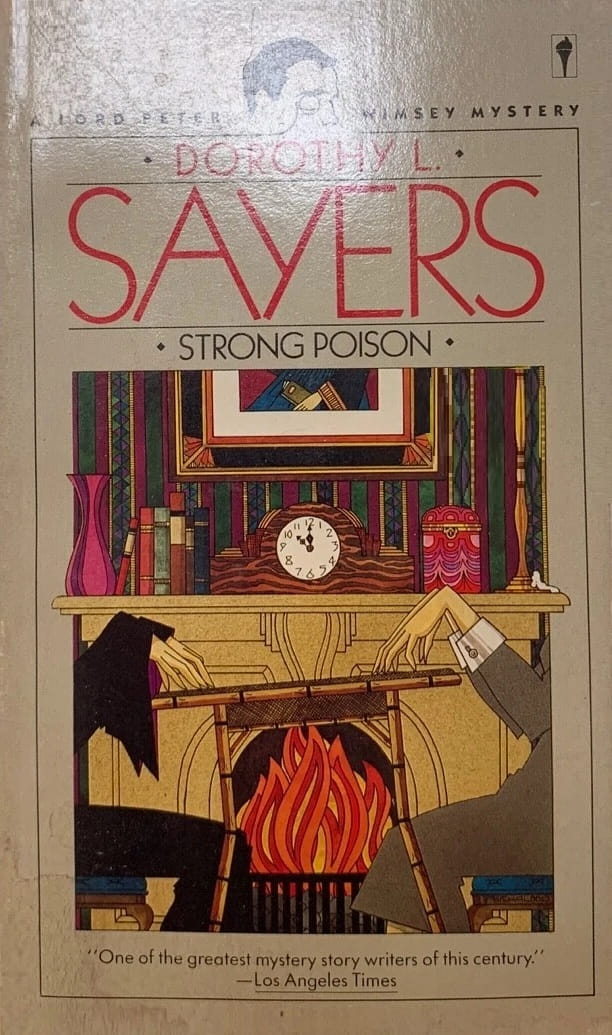
Strong Poison (HarperCollins, 1987)
Both Boyes and his cousin Norman Urquhardt, a solicitor, with whom he dined on the night of his death, have family connections to Rosanna Wrayburn (née Hubbard), a famous actress of the 1860s who led a scandalous life, under the stage name of Cremorna Garden, and invested the many gifts it brought her, making her wealthy in her old age. Sayers seems to like stories about women who rebelled against Victorian expectations in various ways!
Wimsey gets together with Miss Climpson early in the investigation and discusses possible motives with her; and later he calls on both her and another woman in his agency, Miss Murchison, to investigate various aspects of the case. In Miss Climpson’s case that involves her playing the role of a spirit medium for Mrs. Wrayburn’s credulous nurse (a great bit of comic relief!); Miss Murchison gets lessons in lockpicking from a former burglar, Bill Rumm, who reformed and got religion after an earlier encounter with Wimsey.
 |
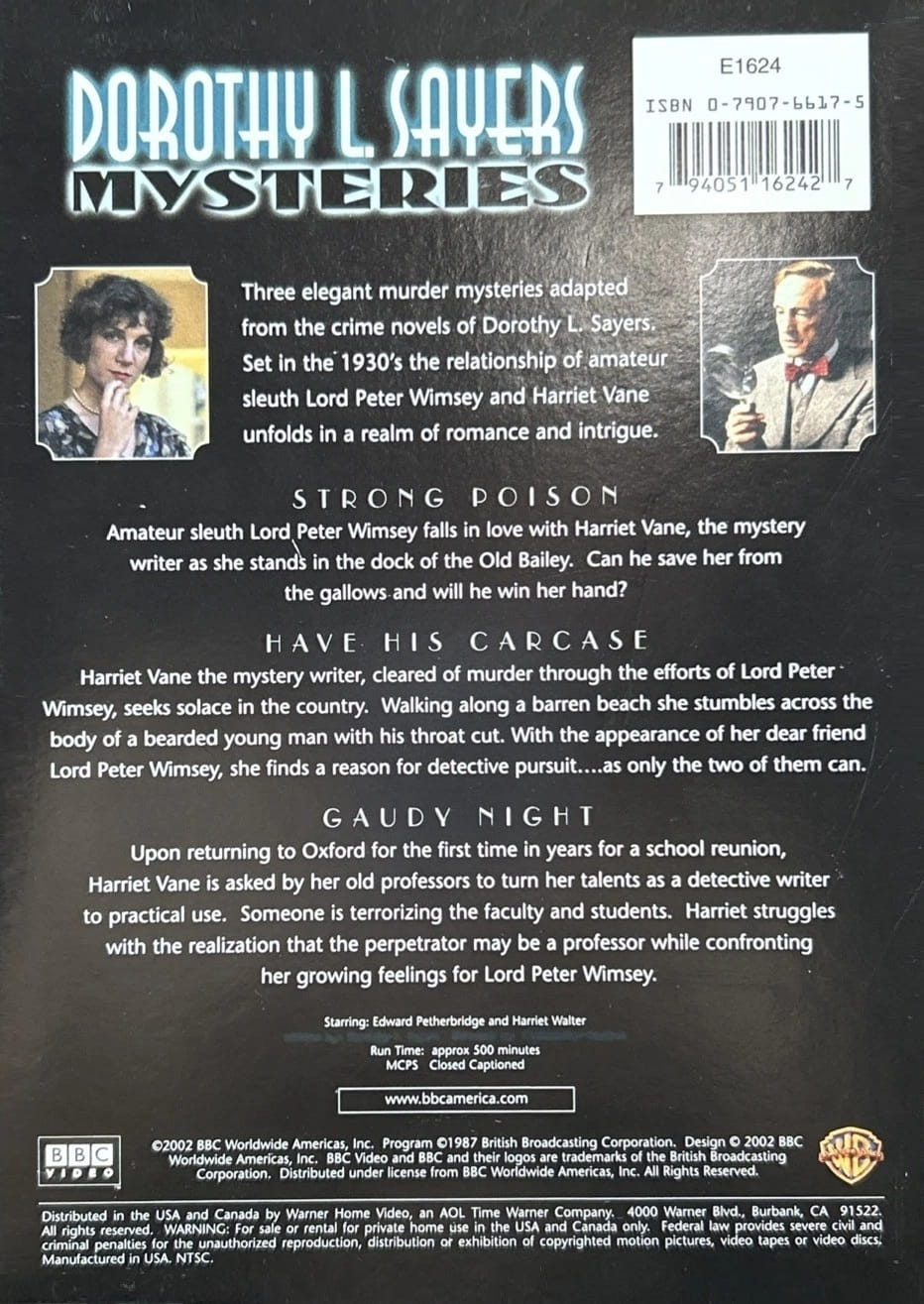 |
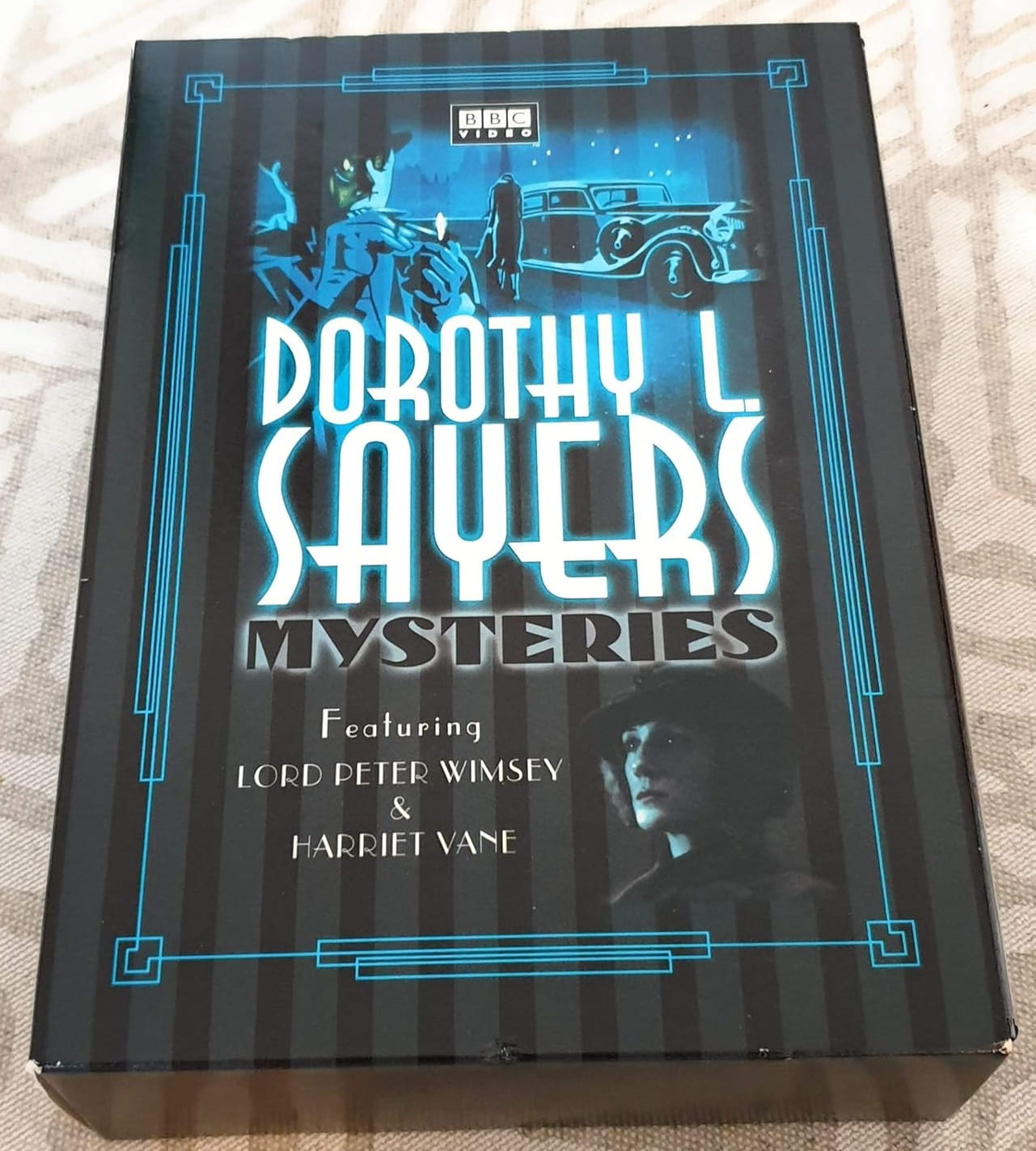
Dorothy L. Sayers Mysteries adaptations featuring Lord Peter Wimsey and Harriet Vane:
Strong Poison, Have His Carcase, and Gaudy Night (BBC Video, 2002)
Knowing why gives Wimsey confirmation of who. There are also connections with the Megatherium Trust (named for the giant ground sloth!), on which Wimsey gets helpful advice from his friend Freddy Arbuthnot — who has just become engaged to Rachel Levy, the daughter of the murder victim in Whose Body?, another matrimonial crossing of established social boundaries.
We also see Wimsey consulting with Marjorie Phelps, an artist who makes porcelain figures, for a better understanding of Vane’s cultural milieu. In particular, she introduces him to Vane’s friends Sylvia Marriott and Eiluned Price, who give him more background on Vane’s relationship with Boyes.
 |
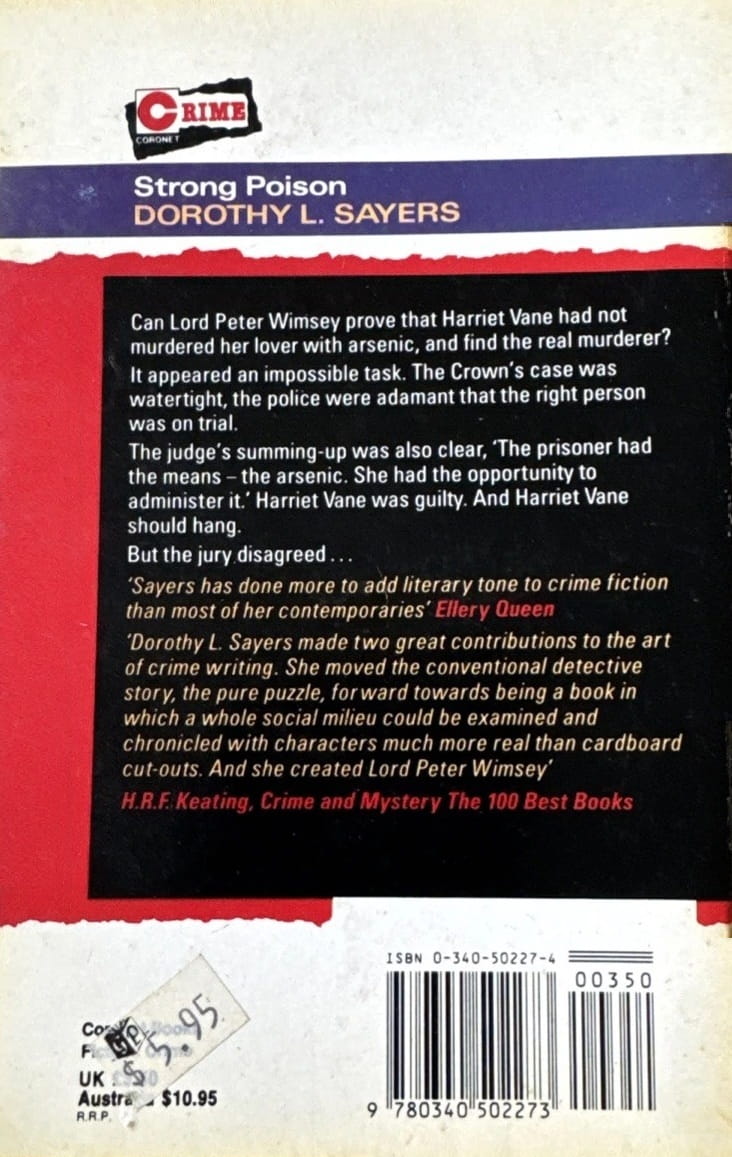 |
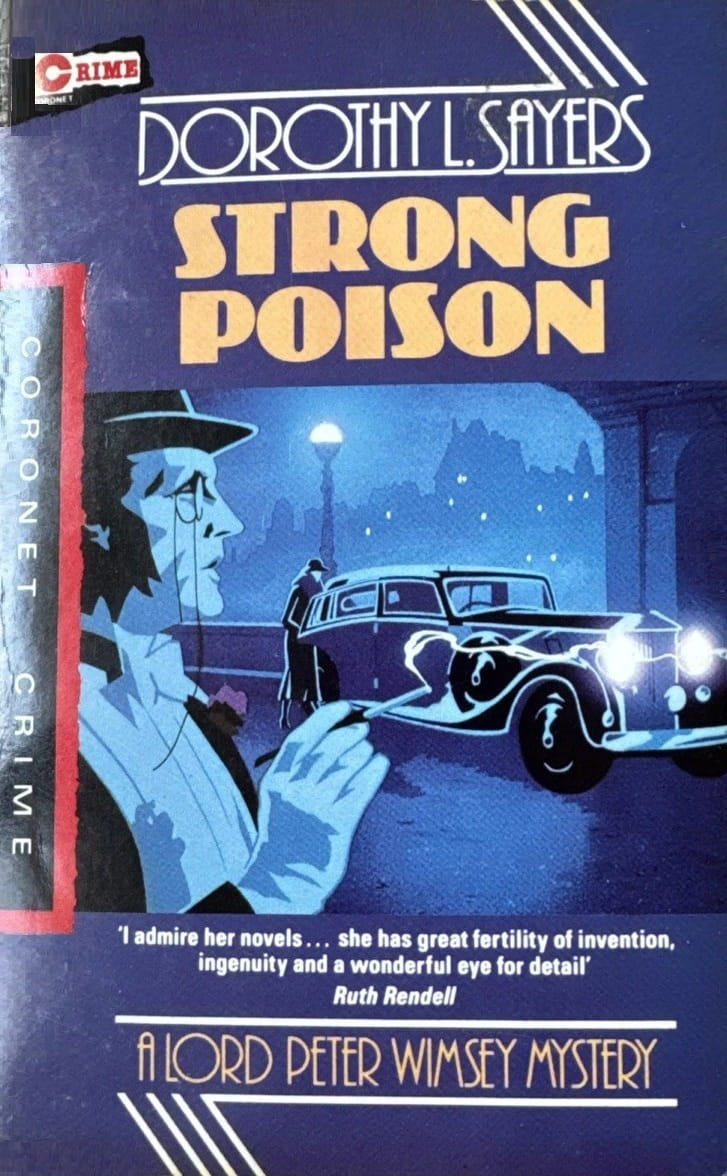
Strong Poison (Hodder & Stoughton/Coronet Crime trade paperback, 1993)
Price is characterized as generally disliking men, which might or might not be a hint about her sexuality, but at the end of the novel she tells Vane that Wimsey is too decent to be importunate in his courtship, so it seems he managed to make a good impression on her.
The chapter where Wimsey talks with the three women doesn’t seem to advance his investigation much; its function seems to be more one of characterization — notably Phelps’s silent unhappiness at the end, which hints at something unspoken between her and Wimsey.
 |
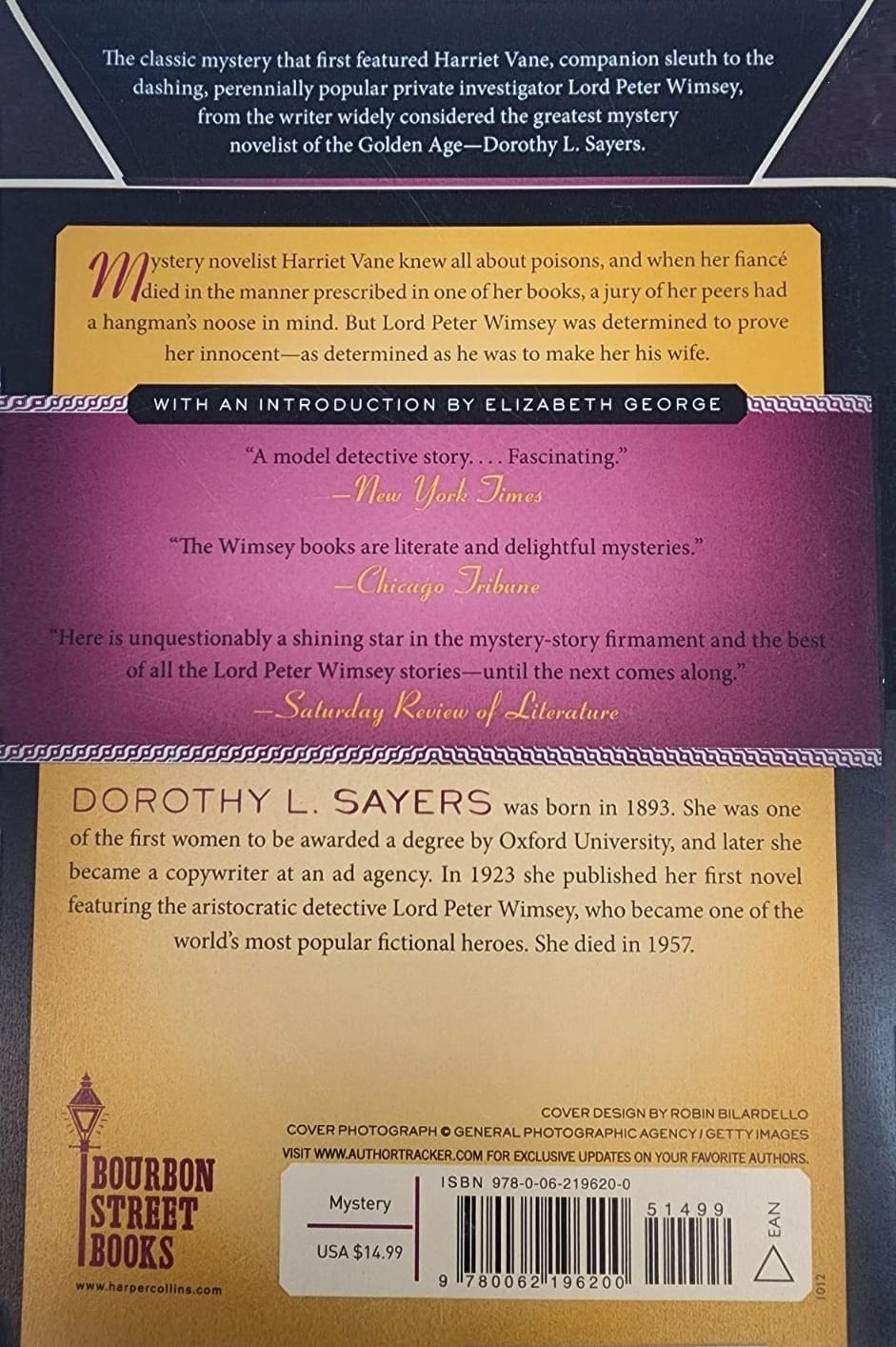 |
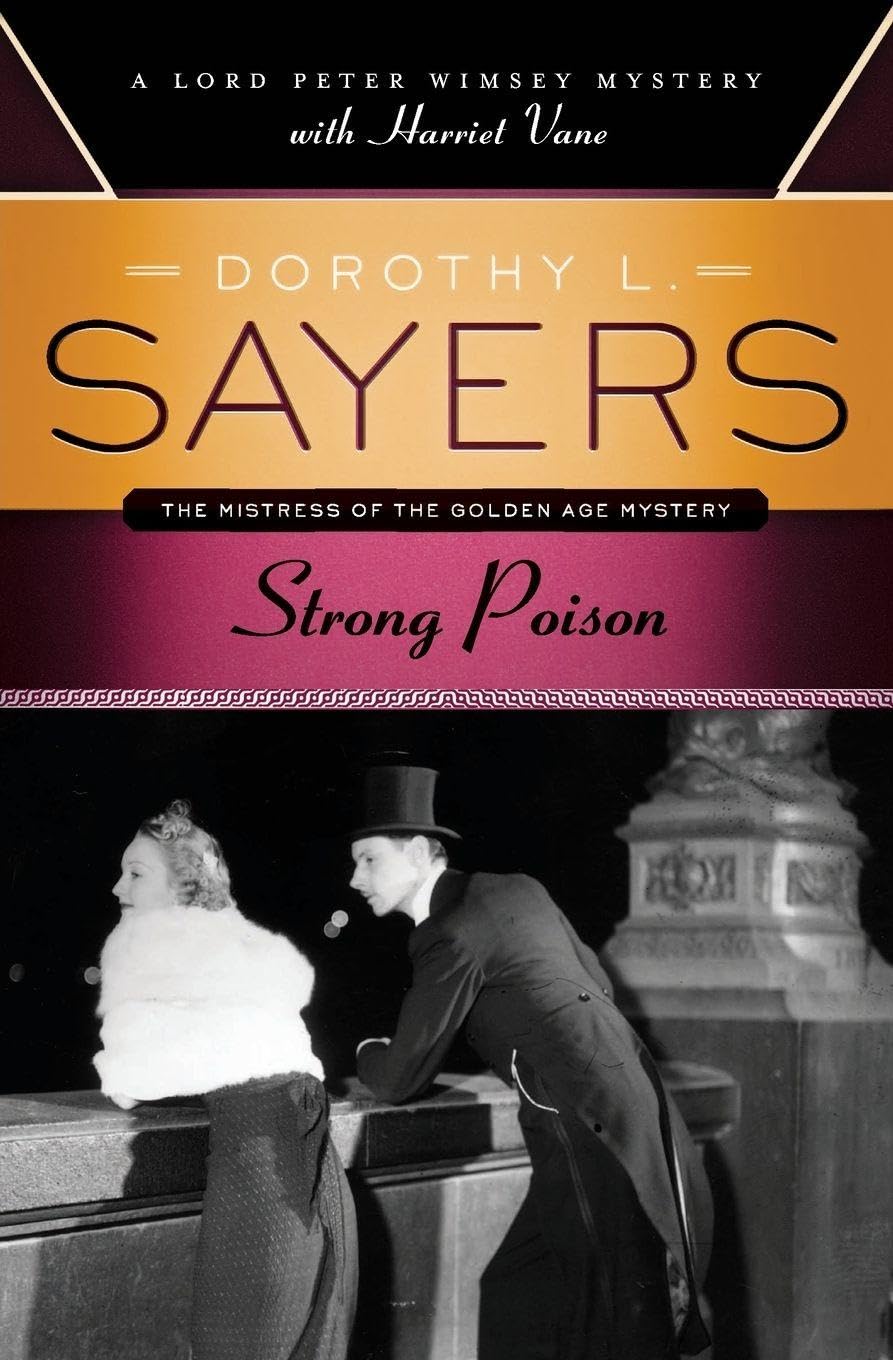
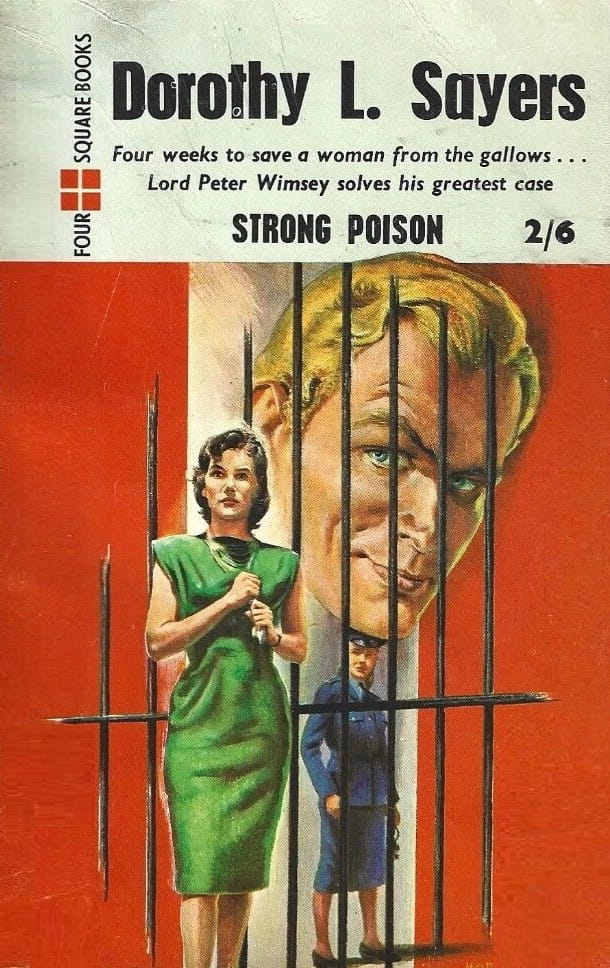
Strong Poison (Harper Paperbacks, 2012)
On one hand, I can’t regret the introduction of Harriet Vane into the series; she will play a significant role in some of the later novels, and even in this one her characterization is interesting.
On the other, while it’s in character for Wimsey to decide she’s innocent and take up investigating her case, it seems implausible for him to fall in love with her after having merely seen her in the witness box in a courtroom. I feel as if Sayers didn’t feel able to show the beginning of the attraction convincingly and fell back on making it a fait accompli.
And Wimsey’s declaration of his feelings during his first interview with Vane is awkward in a way that’s hard to believe of a man of such suavity. The events of Strong Poison are central to the series, but they make me wonder if the story Sayers was telling had gotten out of her control. So I can understand why some of her readers may have thought this particular storyline was ill-advised.
On the other hand, Sayers’s fusion of a murder mystery with a novel about courtship and social class certainly breaks the series out of any previously established formula, which is part of what makes it interesting.
“Forgive my asking, but — you were very fond of Philip Boyes?”
“I must have been, mustn’t I — under the circumstances?”
“Not necessarily,” said Wimsey, boldly, “you might have been sorry for him — or bewitched by him — or even badgered to death by him.”
“All those things.”
William H. Stoddard is a professional copy editor specializing in scholarly and scientific publications. As a secondary career, he has written more than two dozen books for Steve Jackson Games, starting in 2000 with GURPS Steampunk. He lives in Lawrence, Kansas with his wife, their cat (a ginger tabby), and a hundred shelf feet of books, including large amounts of science fiction, fantasy, and graphic novels.
The Wimsey novels have always been among my favorite mysteries (and comedies of manners), and I was pulled into them as a result of the television adaptations, which I note get a nod among the editions illustrated. As I recall, they did two series of them, the non-Vane and the ones including Vane, using two different sets of actors, so we got two different interpretations of Lord Peter. Great viewing, and great reading. Always nice to see one of the books delved into here.
Two series but separated by around 14 years. 1973 or so with Ian Carmichael as Wimsey although I think these ran as individual stories over three or four weeks with gaps between, then the run with Edward Petherbridge and Harriet Walter shown above in 1987.
My introduction to Sayers were the great Ian Carmichael TV shows from the 70’s. Besides her very entertaining mysteries she also translated The Song of Roland and The Divine Comedy for Penguin Classics. Her biographical blurb in ‘Roland’ describes her mystery novel The Nine Tailors as a fascinating novel about campanology.
Hard not to see the overlap between Harriet Vane and Ms. Sayers, especially when Harriet’s college (Shrewsbury, Oxford) is pretty much the same as Ms. Sayers’s (Somerville, Oxford), as seen in Gaudy Night.
And I have often wondered at a curious parallel, as Mr. Moorcock’s Elric is the “anti”-Conan, if Lord Peter is the “anti”-Sherlock. I recall one commentary that pointed out Lord Peter at a concert, swaying slowly in time to the music, which was contrasted with Holmes sitting marble-statue-still and tut-tutting at a nearby “noob” who was swaying to the melody.