My Top Thirty Films, Part 6
So here we are, the final wild bunch of my favorite films; films that I have returned to time and time again purely for their entertainment value and healing properties. I’m sure most of the thirty films on my list are favorites for you too, but I hope there are at least one or two titles spread upon this charcuterie board of nostalgia and cheese that you haven’t seen, and might have piqued your interest enough to seek them out. Thank you for your comments thus far — I have really enjoyed the mixture of enlightenment and fury in your replies. Onwards and upwards!
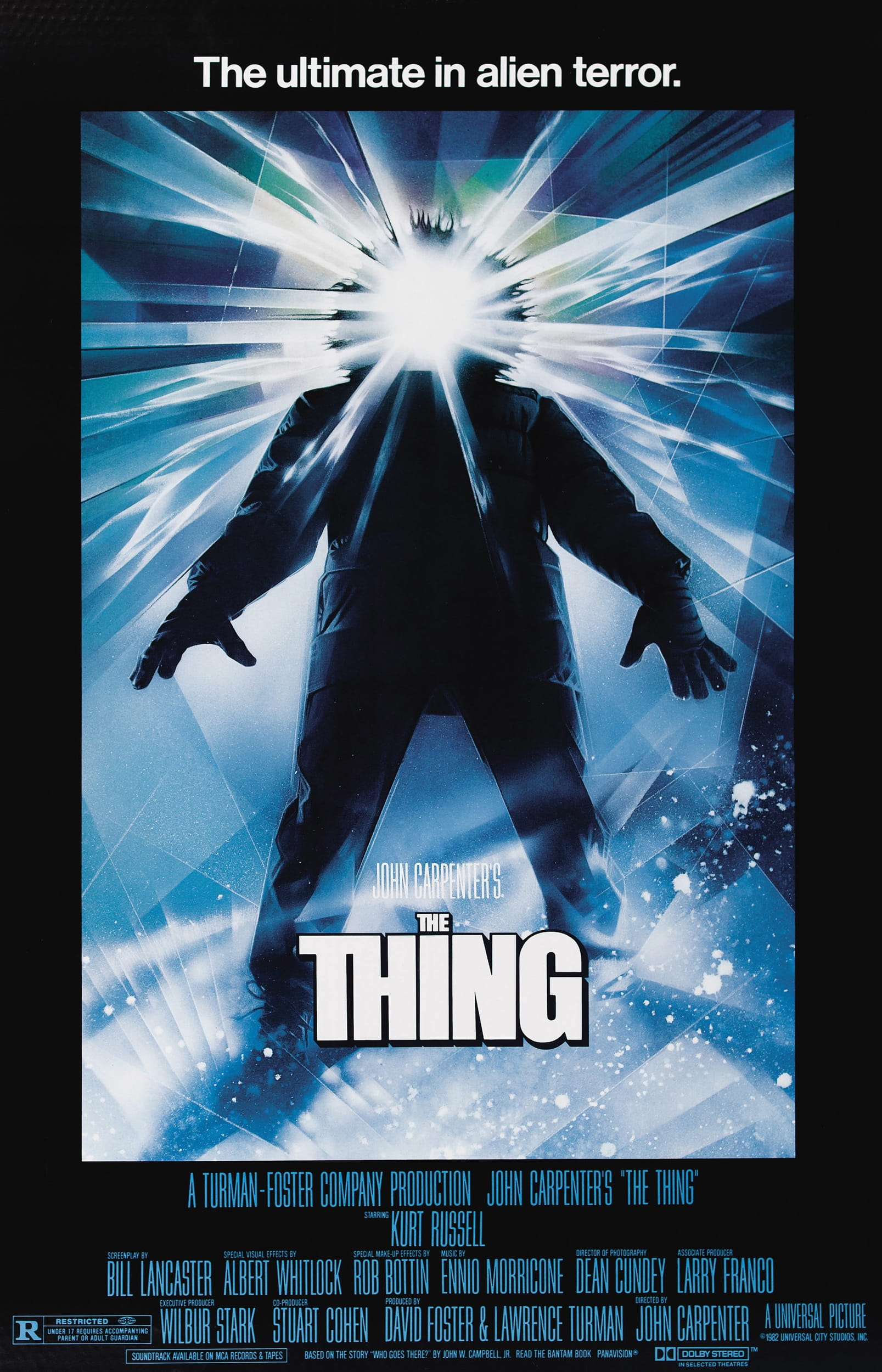
The Thing (1982)
Who’s in it?
Kurt Russell, Keith David, Donald Moffat, Richard Dysart
What’s it about?
A group of American researchers in a remote Antarctica facility find themselves on the edge of paranoia and despair after an alien shapeshifting parasite infects their group. The men must struggle to stay human, all the while trying to ascertain who among them has been infected by the thing.
Why do I love it?
I’ve watched this film in many different forms. Firstly, on a warped VHS (which seems strangely appropriate), then a glorious 70mm print at The Prince Charles cinema in London, then a bizarrely edited version complete with narration on late night TV, DVD versions, followed by Blu-ray versions, and latterly a cinema trip with my son for his first big screen horror outing. The Thing truly is the gift that keeps on giving, and still, over four decades later, we argue over small details and that ambiguous ending, such is the film’s power.
Four years after the film was released I was in art school, and eyeing a future in movie special effects. Rob Bottin’s extraordinary effects were a colossal influence on me while up to my armpits in latex and nose putty, and to this day, despite the occasional rubbery edge and overblown bladder, the transformations in The Thing still hold their own.
I’m also one of the few that didn’t hate the prequel. True, the effects were spoiled by an executive decision to layer CG over the rather splendid practical effects (and I have nothing against CG, but this was a mistake), but their faithful recreation of all the ghastliness that MacReady (Russell) and gang would later discover the aftermath of at the Norwegian camp is a lot of fun to watch played out.
Bonus points for The Thing being Stephen Colbert’s favourite film, and I like him, so there we go.
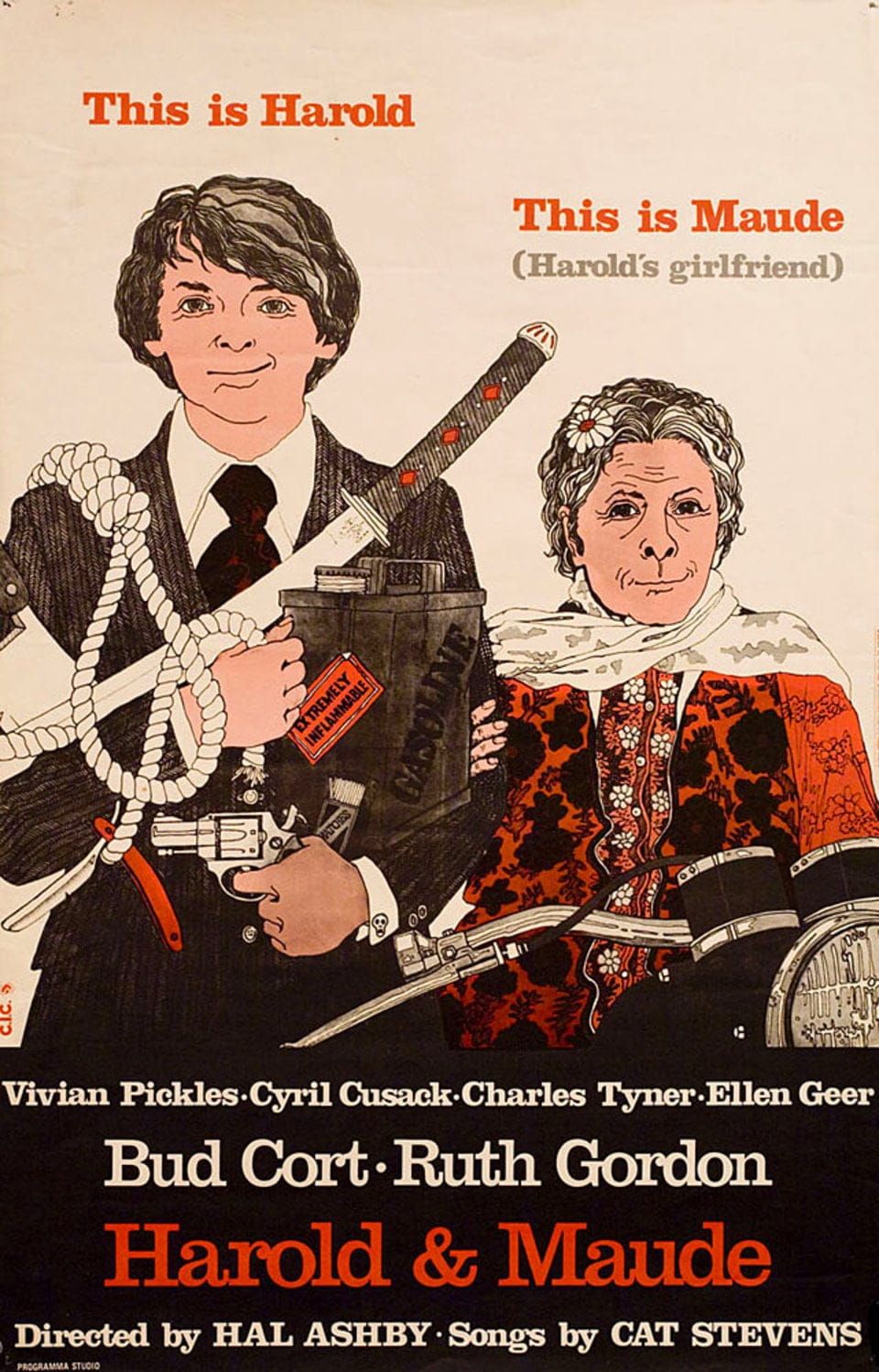
Harold and Maude (1971)
Who’s in it?
Bud Cort, Ruth Gordon, Vivian Pickles, Cyril Cusack
What’s it about?
A death-obsessed young man from a wealthy family just wants to be left alone, and scares away potential partners arranged by his mother by faking suicide. His thoughts grow darker, especially when faced with the prospect of being forced into military school, but then he meets an elderly woman with a profoundly infectious love of life, and the two of them begin an unlikely romance. As dark secrets are revealed we are invited to understand why life is worth living.
Why do I love it?
As I type these words I have just learned that Bud Cort has died (probably not related, but you never can tell). This made me sad, not because he was a favorite actor of mine, in fact I only knew him from Harold and Maude, and I had to have a little sit down to figure out why.
Ultimately, I think it is because I only see him in my mind’s eye as Harold, ghostly of pallor and impish of smirk, finally pulling off his final death with zero trickery. For a film so laden with death motifs, and a devastating denouement from Ruth Gordon’s Maude, the film is utterly drenched in joy, made all the more enjoyable by the reactions of the ‘sensible’ adults in the rooms.
Indeed, I will never tire of listening to Charles Tyner as Harold’s uncle, General Victor Ball, as he struggles to describe the concept of his nephew having sex with the elderly Maude. Also, I cannot possibly overlook his drawstring activated prosthetic arm, the first of two hilariously wielded false limbs in this final list.
The old chestnut “a rollercoaster of emotions” is often bandied about in regards to favorite films, and the afore-mentioned Silent Running meets the criteria, but this film truly does me in. I run the gamut of facial expressions, from grins, to slack-jawed laughter, to uncontrollable blubbing, every time I sit down to it, and when Cat Stevens’ end song kicks in, that’s it. Game over.
Time to watch it again.
Mystery Train (1989)
Who’s in it?
Youki Kudoh, Masatoshi Nagase, Screamin’ Jay Hawkins, Joe Strummer
What’s it about?
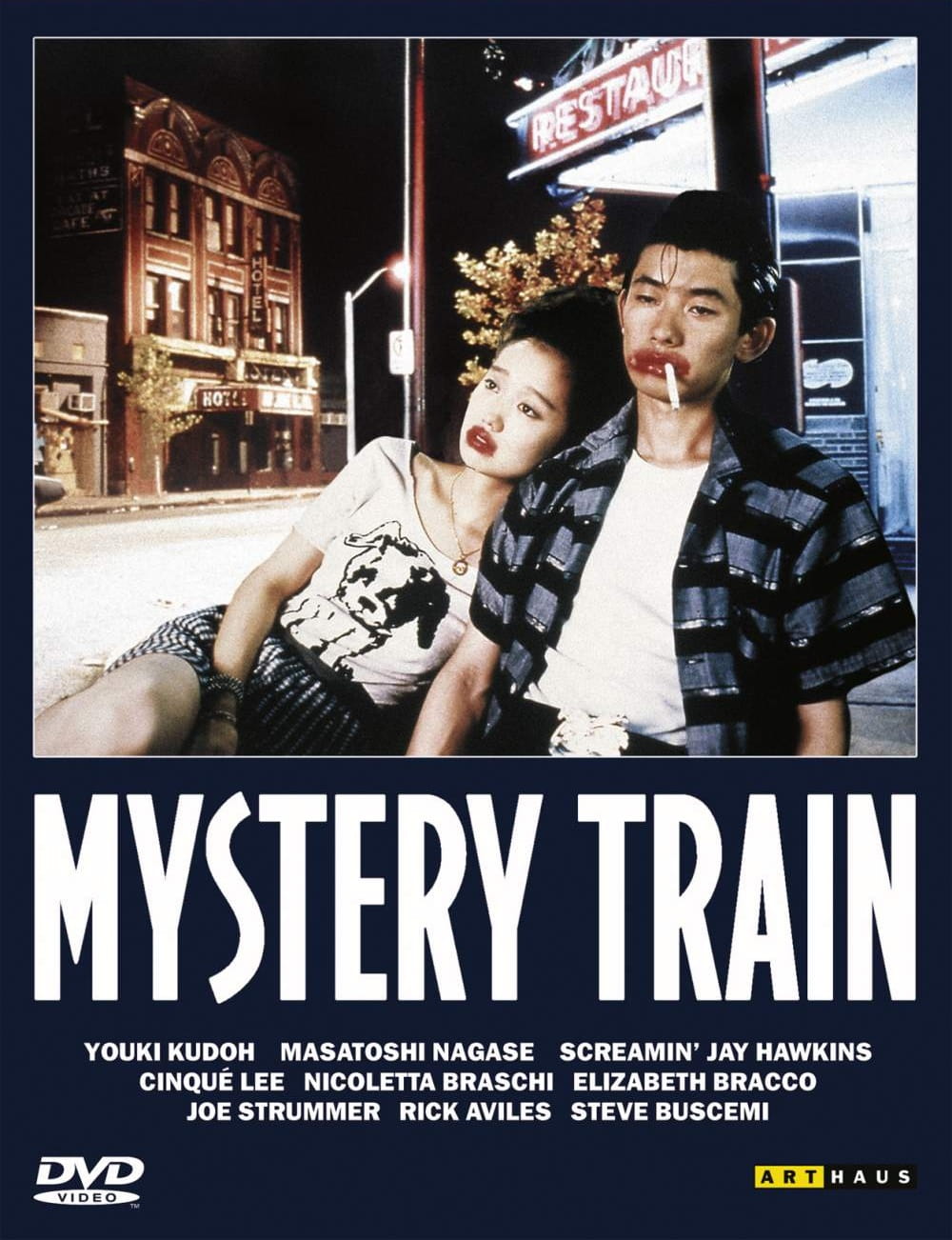
Three different stories take place on the same night, at the same time, all connected by a run-down hotel in Memphis. One story concerns a young couple from Yokohama on a pilgrimage to Elvis’ hometown, where they consider their spiritual connection to The King. The second story is about an Italian woman escorting her husband’s coffin home, but is stranded in Memphis overnight and has to share a room with an overly talkative stranger. The ghost of Elvis makes an appearance too. The final story follows the drunken exploits of a group of men who have just bungled a liquor store hold-up, and are now sheltering in the same hotel. Booze leads to words, which lead to a gunshot, a gunshot that echoes through all three stories.
Why do I love it?
I’m a sucker for an anthology film, especially Hammer and Amicus productions, their gruesome tales held together by an equally gruesome narrator, and I’ll admit that Jim Jarmush’s Mystery Train is more of a concurrent trio of tales rather than a traditional anthology, but I love it all the same.
The connective tissue in this body of work is slighter; a single gunshot, and the reactions of the hotel lobby staff, played by Cinqué Lee and the amazingly expressive Screamin’ Jay Hawkins. I can’t say I’m a particularly huge fan of Elvis Presley either, but his omniscience drives elements in all three tales, and he is another thread weaving the seemingly unconnected strangers together.
There is a dreamlike quality permeating the film, especially during the first story, ‘Far From Yokohama’, in which Mitsuki (Kudoh) seems overawed by Memphis spirits, giddily opening herself up to the presence of those who have made the pilgrimage before, while her cool as a cucumber boyfriend, Jun (Nagase) religiously attends to his greased quiff and lip-hung cigarettes. Their joy and bemusement is infectious, and only shattered by the sound of the gunshot.
The second story, ‘A Ghost’, is fun, but my least favorite, however, it cues up the final story perfectly, and ‘Lost in Space’ blasts off with Joe Strummer gifting us a glorious bit of British swearing, before the whole shebang goes full tilt into drunken chaos. This story explains the gunshot, and it would be remiss of me not to mention the fantastically funny reaction of Hawkins and Lee to the retort.
As of typing this, I am again saddened by the death of another favorite actor, Tom Noonan, who has a small role in this film, but as usual steals the scene with his giant frame and subtlety.
Blimey, I hope this list isn’t cursed…
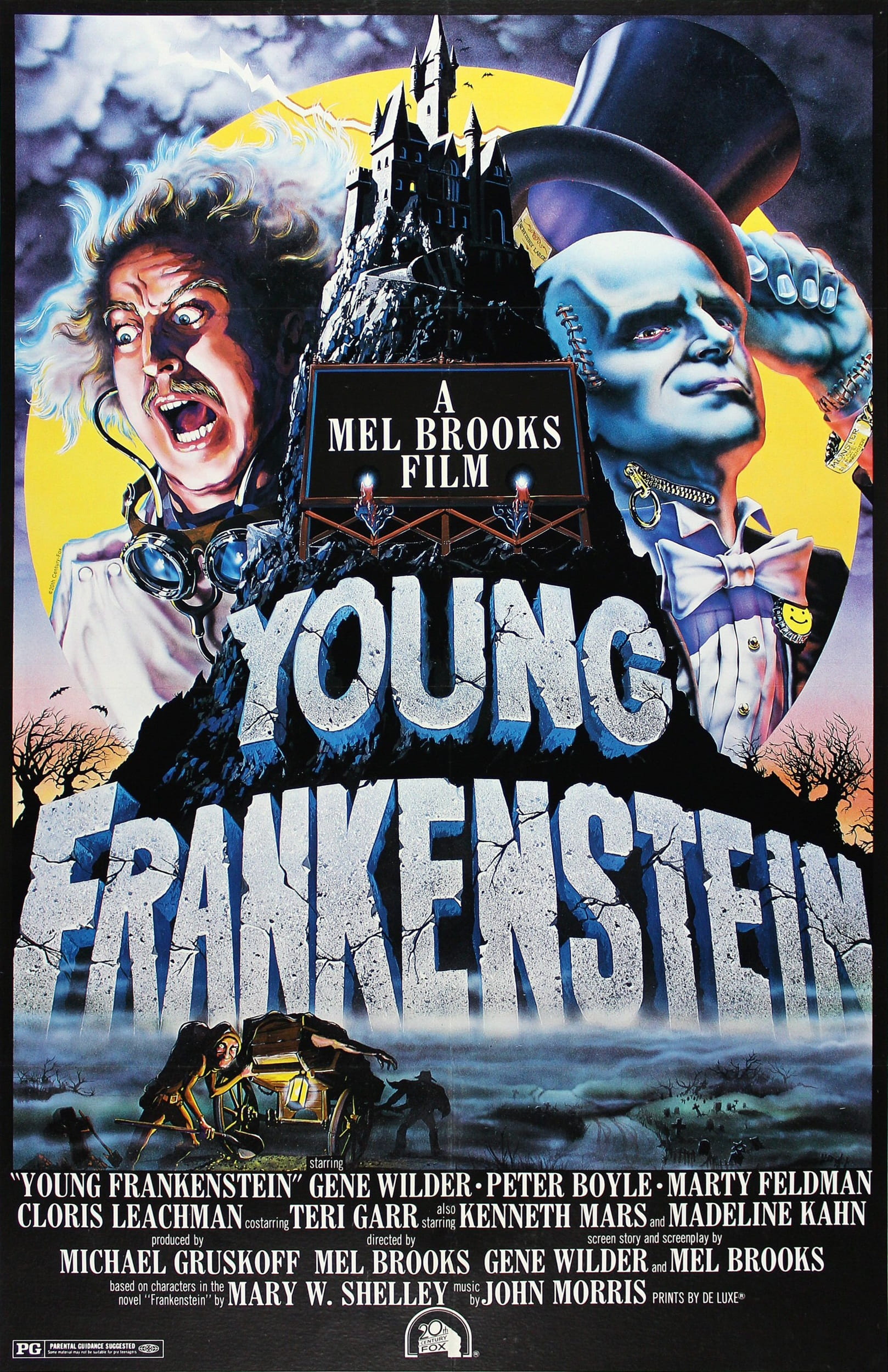
Young Frankenstein (1974)
Who’s in it?
Gene Wilder, Peter Boyle, Terri Garr, Marty Feldman
What’s it about?
When Frederick Frankenstein, great grandson of Victor, inherits the old family castle, he sets off on his own voyage of discovery and obsession, seemingly fated to make the same mistakes as his doomed ancestor. Against his better judgement he ends up creating a monster, but in this version of the classic story, both he and the creature get a happy ending.
Why do I love it?
Much like an earlier entry in this top thirty list, Woody Allen’s Sleeper, this film represents a trio of a beloved filmmaker’s early works that I feel are his best, being Young Frankenstein, Silent Movie (1976), and Blazing Saddles (1974), narrowly squeezing out The Producers (1967) and High Anxiety (1977). In fact, High Anxiety is the last Mel Brooks film I really enjoy, his later stuff does nothing for me.
Anyhoo, Spaceballs-diss controversy aside, Young Frankenstein for me is his most accomplished work, a pitchfork perfect pastiche of the Universal films he loves. It’s the funniest script, the best cast, and Brooks’ most solid direction. As quotable as Blazing Saddles might be, it’s Young Frankenstein I reference the most in everyday life; inflicting “walk this way”, “what knockers!”, and “there wolves” on friends and family an obscene number of times during a standard Earth year.
Gene Wilder cements his legacy as one of the most romantic actors to ever grace our screens, and I don’t mean in the lovey-dovey sense. His Frederick oozes passion, and I find Wilder’s performance nuanced and mesmerizing. On the flipside of this is Marty Feldman’s barely contained sack of insanity, and the faithfully reproduced equipment in the doctor’s lab isn’t the only thing crackling with raw energy when they are both in the room.
Throw in the eternally fabulous Terri Garr rolling in the hay, and Gene Hackman’s brilliant turn as the thumb-burning blind hermit, as well as Boyle, Khan, Leachman (NEIGH!), and Thomas Mars, and you have an ensemble firing on all cylinders, bouncing off each other with hilarious aplomb. Mars’ Inspector Kemp, the one-eyed, one-armed police inspector hot on the heels of Frederick, is the possessor of the second fake limb in this list, and he operates it with clinical German efficiency (even though we are in Transylvania) to the point that he steals every scene he is in.
Naturally I gravitate toward this film, such is my love for classic horror, and it is a perfect comfort flick for when I want to scratch an atmospheric comedy itch.
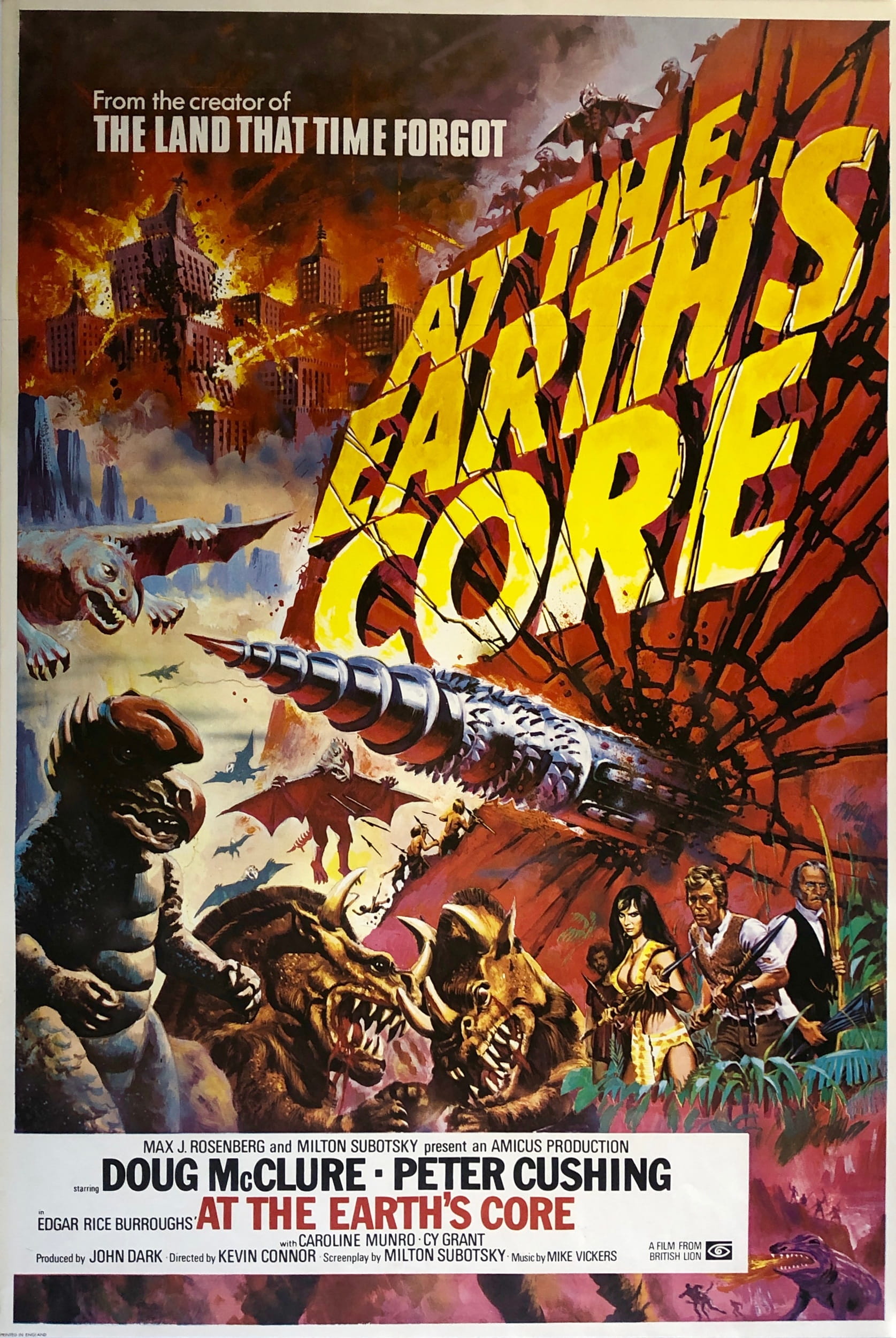
At the Earth’s Core (1976)
Who’s in it?
Doug McClure, Peter Cushing, Caroline Munro, Cy Grant
What’s it about?
Dr. Abner Perry and his financier, David Innes, board a ‘mechanical mole’ of Perry’s own design to drill through a Welsh mountain. However, things quickly go awry, and they end up boring down to the Earth’s core, where they discover a fantastical, prehistoric land, Pellucidar, ruled by evil, hypnotic flying reptiles, the Mahar, and populated by savage lackeys and primitive humans. In order to escape these lands, Perry and Innes must instigate a revolution against the Mahar and survive a menagerie of rubber, toothsome, beasties.
Why do I love it?
If you made it this far after six weeks of my ramblings, congratulations, although I should probably apologize for this concluding film.
But I won’t.
Yes, seen through the lens of the modern, cynical eye, At the Earth’s Core is patently rubbish. The daft, snorting monsters are big and rubbery, the jungle is luxuriously fake shrubbery, and some of the sets and acting are wobbly, but I adore it, by thunder. Having said that, as much as I love Peter Cushing in everything, I can’t stand his performance in this, and I really wish he’d been directed to be a bit more serious; too many ‘whoops-a-daisies’ and crossed-eyes for my tastes. However, McClure gives it all his usual side of beef persona, and it isn’t long before his shirt sleeves have been ripped off.
Then there is Caroline Munro. Here she is, in her third entry in my list (The Spy Who Loved Me (1977) and The Abominable Dr. Phibes (1971) aren’t far off), and I put this down to a very happy coincidence.
Anyhoo, back to the movie. Much like The Golden Voyage of Sinbad (1973), At the Earth’s Core is one of my healing films — it goes on whenever I’m sickly and need a bit of TLC. I dig the mechanical mole, warm to the fuchsia hues of the internal sky, wallow in the Moog-birthed soundscape of Mike Vickers’ score, and drift away dreamily when the Mahar start their blurry hypnosis. Oh, and a sweaty Munro certainly helps, as usual.
Permit me one last memory from around 45 years ago. I had recently seen At the Earth’s Core at my local cinema, and now I was laying prone on the sofa, my dad’s massive headphones swamping my head, and his copy of Pink Floyd’s Meddle doing its business in my earholes. During the middle section of “Echoes” I was drifting away, and when the strange, bird-like screeches kicked in I dreamt of the Mahar cracking their beaks and unfurling their leathery wings. A fantastic blurring of influences, and a memory I will treasure until I shuffle off.
Thanks for joining me on this ride — I can’t wait to read your comments 🙂
Previous Murky Movie surveys from Neil Baker include:
My Top Thirty Films, Part 1
My Top Thirty Films, Part 2
My Top Thirty Films, Part 3
My Top Thirty Films, Part 4
My Top Thirty Films, Part 5
The Star Warses
Just When You Thought It Was Safe
Tech Tok
The Weyland-Yutaniverse
Foreign Bodies
Mummy Issues
Ch-Ch-Ch-Ch-Changes
Monster Mayhem
It’s All Rather Hit-or-Mythos
You Can’t Handle the Tooth
Tubi Dive
What Possessed You?
See all of Neil Baker’s Black Gate film reviews here. Neil spends his days watching dodgy movies, most of them terrible, in the hope that you might be inspired to watch them too. He is often asked why he doesn’t watch ‘proper’ films, and he honestly doesn’t have a good answer. He is an author, illustrator, teacher, and sculptor of turtle exhibits.
Right there with you on Harold & Maude and Young Frankenstein.
I highly recommend getting your hands on the extended/enhanced/bonus/whatever version of Y.F. and watch the behind the scenes by Wilder!!
First, the whole movie was Gene Wilder’s concept and he brought it to Brooks. Great story all by itself.
Second, they didn’t ‘faithfully recreate’ the equipment from the first Frankenstein movie – they found the prop guys who had done that movie and asked for his help – he replied ‘I’ve still got all that stuff, you wanna use it?’ and THAT’S what you see in Y.F.
And a few stories about Cloris Leachman breaking everybody up every take. It’s sooooo good!
And dude, what I wouldn’t give for Harold’s Jag XKE!!
Man, I need to get that extended version. All I’ve ever seen are the various blooper reels on YT, mostly of Marty Feldman tormenting Madeline Khan, but those special features sound great. Thanks for correcting me on a couple of points – just goes to show I should probably do more research before spouting off, but hey! It’s the internet, do we still do research?
Also, heck yes, that Jaguar is divine!
Another fine entry and I should probably track down Mystery Train and Harold & Maude (although that one I may have seen at one point or another?).
Last night I watched a couple that would be in my own personal top 30: Crouching Tiger, Hidden Dragon, and Doug Liman’s Go.
To my shame I’ve never seen ‘Go’, but I do recall the exhilaration of watching ‘Crouching Tiger’ in the cinema. That and ‘House of Flying Daggers’ made for quite a double-bill!
I highly recommend checking out Go, although if you’re anything like me, these days when I watch it it makes me feel very, very old.
And yes, I remember seeing Crouching Tiger in the theater in its initial run and the audience applauding after the first fight scene; although at that point I don’t know if it was spontaneous, or if enough people had already heard about applause in other theaters that it just seemed like the thing to do.
“ both he and the creature get a happy ending.”…while they roll, roll, roll in ze hay.
I’m so bad.