Tor Doubles #37: Esther Friesner’s Yesterday We Saw Mermaids and Lawrence Watt-Evans’ The Final Folly of Captain Dancy
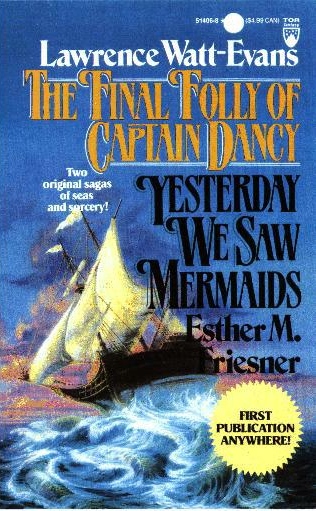
This volumes was originally scheduled for September 1991, but the series was cancelled before it would see print. Both stories were eventually published by Tor in different formats. Had this volume been printed, it would have been the first volume in the series to include two original stories. Although published separately, both were coincidentally first published in the same month.
Yesterday We Saw Mermaids was eventually published as a stand-alone novel by Tor Books in October, 1992. Set in 1492, Friesner tells the story of a magical ship that seems to be racing Christopher Columbus’ expedition to the new world. The ship is mostly crewed by a group of nuns from Porto in Spain, but there is also a monk, Brother Garcilaso, a woman named Rasha, and two unnamed women, one called La Zagala and one called the Jewess. The story is told from the point of view of a young nun, Sister Ana, who has been appointed the scribe for the voyage.
Although the nuns would appear to answer to Mother Catalina or Brother Garcilaso, the real power aboard the ship is Rasha and a demon she appears to have trapped who is called Zamiz the Unaccountably Repulsive, who may be married to Rasha. Zamiz also appears to have cast some sort of geas on Sister Ana, to make her continue to write up their chronicles, which he insists upon reading.
Although the novella opens with the sister seeing, and even being attacked by mermaids, or rather merfolk, Friesner quickly flashes back to the day of their departure from Spain, where they were attending an auto de fé and the burning execution of five Jews. The youngest Jew is rescued, hustled aboard the ship, and the motley crew finds themselves flying through the air away from Spain.
Sister Ana has her likes and dislikes and she is happy to share them in her chronicle, painting Brother Garcilaso in a bad light and noting her sympathy for the Jewess, who proves to be pregnant despite claims to virginity, La Zagala, and even has more of an affinity for Rasha than she seems to for the other nuns, especially Sister Angustiana. Ana is more than willing to question received wisdom.
While Columbus may be seeking the New World, or at least a trade route to the Far East, the sisters are also seeking their own way to the far east, specifically the court of Prester John, a Christian ruler who had been said to rule over a kingdom on the far side of the Muslim hordes since the twelfth century. Along the way, mermaids are the least of the mythical creatures they encounter and their eventual arrival at Prester John’s his court leads them to their own discovery of New Worlds, but not in the same way Columbus was to find.
Friesner has set up a world in which Columbus’ discovery means the dismissal of magic from the world. While Columbus’ voyage led him to the wonders of the Caribbean, Sister Ana’s sojourn with Prester John, allows her to see magic in its final grasp on the world and the banishment of the other nuns to a world in which magic cannot exist.
At the beginning of the Sister Ana seems to be naïve and unworldly, but as the story progresses, she is one of the few characters who can accept that the proscribed world that Brother Garcilaso would inflict upon her is limited and that Rasha, Zamiz, and eventually Prester John are offering her a much broader world that matches her abilities and potential better. She learns the meaning of empathy and mercy in a way that is foreign to Brother Garcilaso and those, including her father, who would conduct the auto de fé that opened the novella.
Sister Ana’s growth, even as she remains a nun, serves as an indictment of religiosity and closed-mindedness. She only really begins to achieve her potential when she is accepting of the three women who are not monks and when she comes under the tutelage of Prester John. The new world, whether it is the one discovered by Columbus or the one presented by Prester John, has a place for people like Sister Ana, while those who were more traditional find themselves lost to the wonders that are revealed.
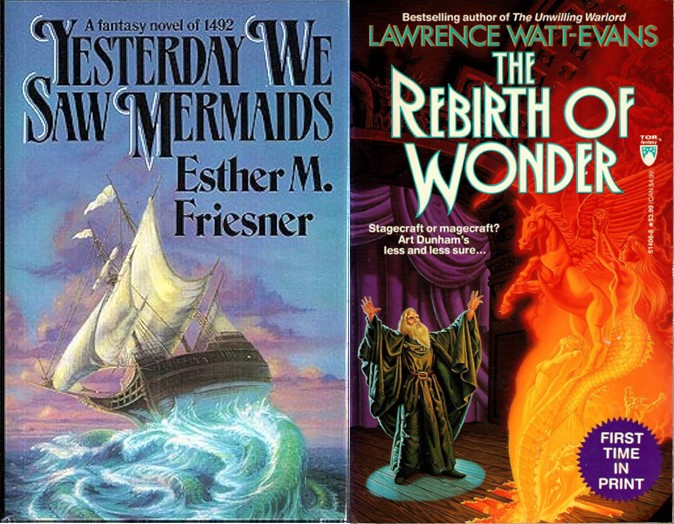
The Rebirth of Wonder, cover by Pat Morrissey
The Final Folly of Captain Dancy was eventually published in The Rebirth of Wonder published by Tor Books in October, 1992.
The story opens with Captain Dancy and one of his crewmen, Billy Jones, staggering out of Old Joe’s Tavern in the port city of Collyport, having just finished their role in a tavern brawl. When the drunken Dancy fell in an alleyway, he broke his neck, suffering an ignominious death for a flamboyant pirate captain. Exiting the alley, Jones finds another crewmember with a wagon that the Captain had instructed him to bring back to the ship. They use the wagon to get Dancy’s body back to the ship, where they hide the fact that he’s dead as best they can while discovering that he had made severa strange requests of different crew members.
It would be easy to ignore the odd requests until a letter arrives for Captain Dancy from Governot Lee, who rules over Collyport, indicating that Dancy had agreed to perform a task for him and if the task wasn’t completed by sunrise, the ship would be confiscated and the pardon under which the captain and his crew were allowed to operate would be rescinded.
The story moves into overdrive introducing new characters who have to be brought into the secret of the captain’s death, along with their attempts to figure out what task the captain agreed to perform for Governor Lee and how his various odd requests feed into his plan to accomplish that task, whatever it may be. Each of the crew member respected and liked the captain, aside from their desires to stay in the Governor’s good graces, and work to solve the riddle, bringing in additional people who might have more information, until eventually Jones is able to figure out enough of the plan to put it into action, even if they don’t have all the specifics.
As could be imagined, things don’t go smoothly, but Watt-Evans presents the crew’s activities as a sort of heist story, they are just attempting to plan and run the heist without fully understanding the rules of the situation or what the plan, or their roles in the plan, are. Watt-Evans does an excellent job keeping the plot moving and introducing strange detours, which almost all provide a payoff in the crew’s lopdided carrying out of Captain Dancy’s posthumous plot. Even the curveballs Watt-Evans lobs at the crew are entertaining and provide depth to their activities.
Despite spending the majority of the story dead, Captain Dancy’s presence is felt throughout the novella and the reader learns about his past, with references to previous adventures featuring the Pundit of Oul, the Dungeon Pits of the Black Sorcerer, the Caliburn Witch, and the Battle of Cushgar Couners. These references aren’t just included as a tease of previous adventures that Watt-Evans could choose to describe, but at least one of them becomes fairly important to the adventure the crew is participating in as Captain Dancy’s final folly.
A reasonably short piece, the crew of the Bonny Anne is made up of characters it is a pleasure to spend time with and Watt-Evans could easily have written other stories of Captain Dancy or stories set following the events of his death.
Tor Double #37, the first volume of the series which would be completely original, but the line was cancelled before publication. Eventually, Friesner’s story was published as a thin stand-alone and Watt-Evans’ story was used to flesh out the page count of his short novel, The Rebirth of Wonder, along with an excerpt from a collaboration Watt-Evans and Friesner wrote together, Split Heirs. One month after The Final Folly of Captain Dancy appeared in The Rebirth of Wonder, it was reprinted in Watt-Evans’ collection Crosstime Traffic, published by Del Rey Books
The cover which was used on Yesterday We Saw Mermaids and which was originally intended for the Tor Double, was by Pat Morressey. Depicted in a masted ship caught in a strange wave, it could have applied to either of the two stories which were earmarked for this volume.
 Steven H Silver is a twenty-one-time Hugo Award nominee and was the publisher of the Hugo-nominated fanzine Argentus as well as the editor and publisher of ISFiC Press for eight years. He has also edited books for DAW, NESFA Press, and ZNB. His most recent anthology is Alternate Peace and his novel After Hastings was published in 2020. Steven has chaired the first Midwest Construction, Windycon three times, and the SFWA Nebula Conference numerous times. He was programming chair for Chicon 2000 and Vice Chair of Chicon 7.
I don’t ever see anybody chatting about LWE’s Lords of Dus series, starring Garth the Overman.
I quite like it as something traditional but still different from the epic fantasy boom of the eighties.
And the Daryl K. Sweet covers were cool.
https://www.blackgate.com/2015/03/02/the-public-life-of-sherlock-holmes-the-lords-of-dus/
I read the Captain Dancy story a few years ago. Had no idea about its back story! In my opinion, anything Watt-Evans writes is pure gold, or at least pure fun!!!