Tor Doubles #34: Damon Knight’s Double Meaning and Rule Golden
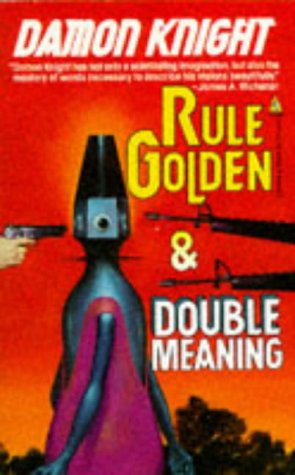
Originally published in May 1991, Tor Double #34 includes two stories by Damon Knight that had previously appeared together (along with three other stories) in Knight’s 1979 collection Rule Golden and Other Stories, published by Avon. Although listed as Tor Double #34 on the copyright page, this volume was published the month before Tor Double #33, which was discussed last week.
Double Meaning was originally published in Startling Stories in January 1953. It was reprinted as one half of an Ace Double in 1965, appearing with the Damon Knight collection Off Center. When reprinted as an Ace Double, it was retitled The Rithian Terror. Over the years, it has been reprinted using both titles.
Knight tells the story of Thorne Spangler, an investigator for the intergalactic human empire. Based on Earth in the mid-twenty-sixth century, he is given the task of finding an enemy Rithian who has managed to make it to the home planet. The Rithians are an alien race who can disguise themselves as humans. A group of either were known to have landed on Earth, seven of whom have been killed, but the final one has gone missing.
Double Meaning is a buddy story, of sorts. Spangler is paired up with Jawj Pembun, an investigator from one of the human colonies who has more experience dealing with the Rithians than anybody on Earth. Spangler views Pembun as a hick and an amateur who refuses to investigate following protocol, instead going off on tangents and jumping to conclusions. The fact that Pembun is quickly proven right in most cases, only makes it harder for Spangler to accept the man or his methods.
The importance of finding the final Rithian is laid out clearly. The Rithians appear to have hidden bombs on Earth and they need to find the missing one in order to discover where they are hidden. Pembun’s knowledge of the Rithians and their mentality offers insight into their psychology that Spangler just does have. Pembun’s own lack of willingness to follow the book is an asset that Spangler can’t admire.
Theoretically, Double Meaning is procedural and a thriller, but there is little tension built up in the novel. Knight introduces few red herrings and, while the amount of paperwork Spangler does may be realistic, is isn’t particularly engaging. He seems to spend more of his time dismissing the successful methods and results offered by Pembun than doing anything worthwhile. The result is that Double Meaning comes across as the petulant complaints of an unsympathetic protagonist.
The novel includes scenes from Spangler’s relationship with socialite Joanna Parker, although the main purpose of those scenes seems to be to further evaporate any sympathy they reader may have for Spangler. While their relationship is ongoing, every time Spangler thinks about it, he does so in terms of stalking and grooming. Playing mind games to get Parker to want to marry him. In one of the few extended scenes of the relationship, he becomes physically abusive to her. Unfortunately, her character appears to exist merely to take whatever mistreatment Spangler cares to dole out.
The crux of the story comes when Spangler orders Pembun to compose a report on what the Human Empire is doing wrong. Reading the note, Spangler sees treason in Pembun’s view of the stagnation affecting the massive bureaucracy that Spangler is part of, including some negative reflections on Spangler’s stoicism. Spangler, who has only a limited number of tools to use, as Pembun noted, decides it is important to interrogate Pembun to determine his loyalty to humanity, which proves more complicated than Spangler is able to understand.
Pembun offers insight into Knight’s world building for Double Meaning and this is a case where the world building is more interesting than the plot or characters of the story. It is too bad that both Spangler and Knight made the decision to get the information through interrogation, because the story would have been stronger and more interesting had Knight elected to show the Rithian psychology by allowing the Rithian spy to play a cat and mouse game with Spangler and Pembun, or even provided more interaction between the investigators and the Rithian.
Double Meaning is a story that hints at a better, more detailed story hiding inside it, almost as if it were serving as a first draft of a more detailed story that was to come. The fact that Knight elected to publish it as is, without fleshing it out, providing more details about the Rithian spy and an occasional red herring, means the story doesn’t fully satisfy.
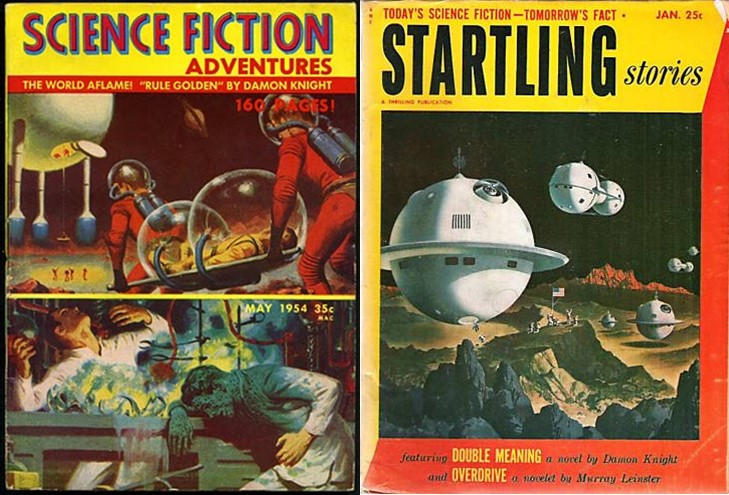
Startling Stories, January 1953 cover by Alex Schomburg
Rule Golden was an originally published in Science Fiction Adventures in May 1954. In 1979, it was the title story for a collection of five of Knight’s novellas, including Double Meaning.
Robert Dahl is the editor of the Herald-Star, a small town Midwest newspaper. A series of articles from around the Midwest catch his attention when he realizes that he hasn’t seen any news from his hometown of Chillicothe, Missouri, his home town. When he begins asking questions about Chillicothe, he is summoned to Washington D.C., where he is told to drop his inquiries,
Dahl’s commitment to getting the story results in him being placed in a military installation in Chillicothe, not as a prisoner, but as a reporter, although he has been informed that he won’t be allowed to report on the story, or leave the facility, until the government determines that sharing the story is no longer a threat to national security. What he finds there is an alien creature, named Aza-Kra, who landed on Earth. Aza-Kra has hidden his spaceship and the authorities are building a large dossier on him because they don’t tryst his explanations for his purpose on earth.
Following a talk with Aza-Kra, who claims he has come to Earth to help prepare humans for admission to a galactic federation by weaning them from their hostile ways, and an examination of the dossier, Dahl agrees to help Aza-Kra escape the prison. The rest of the novella focuses on Dahl and Aza-Kra being fugitives, traveling around the world to avoid capture and to allow Aza-Kra to further spread the catalyst which will help change the way humans view violence.
That catalyst is what gives the story its name. As Dahl realized from the strange news articles that spurred his investigations, through a mechanism never defined in the story, people who injure another person have the same injury mysteriously visited upon them, an inversion of the “Golden Rule.” For instance, a man who kicked his wife suffered from the same injuries he inflicted on her.
By focusing the story on Dahl and Aza-Kra, Knight is able to turn it into a more philosophical story about the alien’s view of the world and what it means to be a mature species and Dahl’s understanding of human nature and what the changes Aza-Kra is suggesting will mean. When Knight eventually begins to describe the actual changes that happen as a result of Aza-Kra’s interference, it isn’t always clear how the alien’s actions are causing the stated responses.
Rule Golden has some of the same issues as Double Meaning. Told from Dahl’s point of view as he and Aza-Kra are fugitives, he can describe the impact of the catalyst that Aza-Kra has released into the air, but he doesn’t really give details of what is happening. Similarly, as the world’s economic situation collapses, governments fall, and (brief) wars are launched, Knight only describes them at a distance, whch gives the feeling that Knight is telling the reader what is happening while refusing to actually show any of the action.
With the only real relationship the one between Dahl and Aza-Kra, there is little humanity for the reader to connect to, especially since their relationship is pretty one-sided and Aza-Kra must remain something of an enigma, even to Dahl, in order to maintain any tension concerning his purpose in coming to Earth, despite Aza-Kra telling Dahl, and previously his government captors, why he was on the planet.
One of the more interesting, if brief, conversations takes place late in the story, when Aza-Kra defends the collapse of nation states on earth because he claims that governments can’t do anything except wage war. Dahl defends governments, by pointing out various public works programs that can’t take place without government funding and organizations, to which Aza-Kra states that men do the work, completely missing the point of Dahl’s explanation.
Wayne Barlowe provided the cover. In addition to the stories, Damon Knight also provided an introduction, “Beauty, Stupidity, Injustice, and Science Fiction,” which had been published as an essay in Monad: Essays on Science Fiction #1 by Pulphouse Publishing in October 1990.
 Steven H Silver is a twenty-one-time Hugo Award nominee and was the publisher of the Hugo-nominated fanzine Argentus as well as the editor and publisher of ISFiC Press for eight years. He has also edited books for DAW, NESFA Press, and ZNB. His most recent anthology is Alternate Peace and his novel After Hastings was published in 2020. Steven has chaired the first Midwest Construction, Windycon three times, and the SFWA Nebula Conference numerous times. He was programming chair for Chicon 2000 and Vice Chair of Chicon 7.
I liked both these stories a good deal more than you did. I think Damon Knight was one of those many SF writers who did much of his best work at the novella length, and these two stories are among his best. (His best novella by far, though, is “The Earth Quarter”.)